Dōgo
Like many other onsen resorts, Dōgo (道後) has its strip shows and a deluge of hostess clubs and snack bars, as well as mundane tourist gift shops lining its arcade. However, Dōgo’s bathtime delights more than make up for this. Once you’ve sampled the onsen, there are also a couple of interesting museums to explore, along with the appealing Isaniwa-jinja shrine and over-the-top Ishite-ji temple.
Masaoka Shiki
Matsuyama heavily promotes its Japanese literary connections and one of the most prominent is with the poet Masaoka Shiki, a rather tragic figure who died at 35 from tuberculosis. He took his pen name, Shiki, from that of a bird, which according to legend coughs blood as it sings. His life story can be traced at the Shiki Kinen Museum in Dōgo and there are two houses connected with the poet preserved as tourist attractions in Matsuyama, including the villa he shared for a short period with Sōseki Natsume, one of Japan’s most famous authors, whose novel Botchan draws on his experiences as a young teacher working in Matsuyama in 1895.
Masaoka made his reputation by encouraging reforms to the then hidebound traditional poetic form haiku, which comprises just three lines of five, seven and five syllables and has a subject matter traditionally connected with the seasons. Famously criticizing the master of the genre, Bashō, Masaoka advocated that poets be allowed to use whatever words they wanted for haiku, on any subject matter, while striving to be more reflective of real life. Encapsulating his approach is one of his most famous poems: “Kaki kueba kane-ga narunari Hōryū-ji” (“I was eating a persimmon. Then, the bell of Hōryū-ji temple echoed far and wide”).
Masaoka is also one of the principal characters in Saka no Ue no Kumo (Clouds Over the Hill) by Shiba Ryotaro, a bestseller about Japan’s destruction of the Baltic fleet during the Russo-Japanese War. The novel and its heroes are celebrated at the modern Saka no Ue no Kumo Museum.
Matsuyama-jō
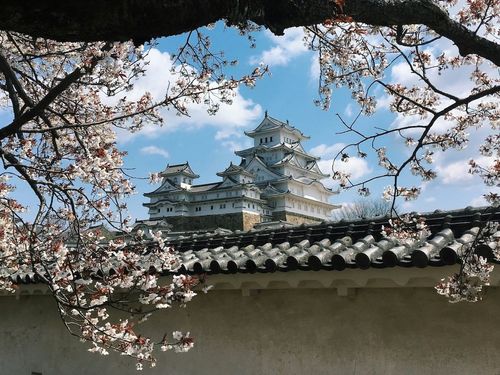
The 132m-high Katsu-yama dominates the centre of Matsuyama and on its summit stands the city’s prime attraction, Matsuyama-jō (松山城). Warlord Katō Yoshiakira began building his fortress in 1602, but by the time it was finished, 26 years later, he had moved to Aizu in Tōhoku. Like many Japanese castles hailed as “original”, this one has gone through several incarnations during its lifetime. The main five-storey donjon was destroyed by lightning on New Year’s Day in 1784 and rebuilt two storeys shorter in 1820 – the three lesser donjons are all modern-day reconstructions. Despite this, the castle is one of Japan’s more impressive fortresses and its location certainly provides commanding views of the city and Inland Sea.

 (1).jpg)