The best north Italy itinerary

Select Month

start planning

If you’re seeking an Italian vacation that delivers big on fine food, art, and stunning natural scenery, look no further than the Northern Italy itinerary presented below. Covering the beautiful lakes region—along with Verona, Florence, Turin, and the charming Cinque Terre—it invites immersion at every turn.

10 days in North Italy overview

This itinerary takes you from the foothills of the Alps to the Ligurian coast, with a mix of cities, lakes, and smaller towns. You’ll start in Bergamo, then head to Lake Garda and spend a couple of days in Verona. From there, you’ll continue south to Florence, then make your way to the coast for two nights in the Cinque Terre. The trip ends in Turin. Travel distances are reasonable, and the pace gives you time to explore without cramming too much in.

  • Day 1-2: Bergamo
  • Day 3: Lake Garda
  • Day 4-5: Verona
  • Day 6-7: Florence
  • Day 8-9: Cinque Terre
  • Day 10: Turin
Aerial view of Grotte di Catullo in Sirmione in Italy © Shutterstock

Aerial view of Grotte di Catullo in Sirmione in Italy © Shutterstock

Is 10 days enough in Northern Italy?

Ten days is a good amount of time to get a feel for northern Italy. You can cover a few major cities like Milan, Venice, and Bologna and still have time for smaller towns or lake regions like Como or Garda. If you’re into hiking or wine, you could also spend a few days in the Dolomites or Piedmont. Trains are reliable between cities, but a car makes sense if you're heading into the countryside. Just keep in mind that travel days eat into your time. What you see on an Italy trip depends on how long you stay; here's a breakdown:

ItineraryIdeal forMain highlightsPaceBest forFrom price*
5 days in ItalyShort breakPicking one area, like AmalfiFast-pacedFirst-timers on limited time$908 pp
7 days in ItalyAn extended city break with day tripsRome, Florence, VeniceFast-pacedFirst-timers and culture lovers$1,998 pp
10 days in ItalyClassic routeNaples, Pompeii, Amalfi Coast, Capri, or based in one area like TuscanyBalancedFoodies and couples$2,508 pp
14 days in ItalyExtended journeyMilan, Venice, Bologna, Florence, RomeRelaxedExplorers and art enthusiasts$2,875 pp

*Indicative price per person for a fully arranged tailor-made trip.

Day 1: Arrive in Bergamo

Day one of this richly rewarding Northern Italy itinerary begins in Bergamo—a beautiful city located 50 km northeast of Milan.

Things to do in Bergamo

Divided into the Città Alta (Upper Town) and Città Bassa (Lower Town), bella Bergamo is famous for its well-preserved Venetian walls (a UNESCO World Heritage Site, no less) and marvelous medieval streets, all set against a glorious backdrop of the Lombardy countryside. 

As such, its mix of splendid scenery and historic attractions sets a fitting tone for this entire Northern Italy itinerary.

After arriving and checking into your accommodation, head out to start exploring Bergamo’s historic heart.

To do this, take the funicular to the Città Alta and take a stroll around Piazza Vecchia—a beautiful square surrounded by architectural landmarks, among them Palazzo della Ragione and Palazzo Nuovo. 

After visiting the Basilica di Santa Maria Maggiore—a Romanesque masterpiece—and the adjacent Renaissance Cappella Colleoni, round off your first afternoon with a walk along the Venetian Walls ahead of enjoying dinner in a local trattoria.

Where to stay in Bergamo

To stay in scenic style, try a stay in Bergamo:

  • Città Alta (Upper Town): The historic heart of Bergamo, enclosed by Venetian walls. Expect cobbled streets, panoramic views, and plenty of charm. Ideal if you want atmosphere and don’t mind walking hills.
  • Città Bassa (Lower Town): The modern center, with shops, cafés, and excellent transport links. Great for easy access to the train station and connections to Milan or the airport.
  • Borgo Santa Caterina: A lively local neighborhood between the upper and lower towns. Known for its restaurants, bars, and authentic feel, it’s perfect if you want a taste of everyday Bergamo life.

Fancy staying in Milan before heading to Bergamo? Read up on where to stay in Milan.

bergamo-italy-shutterstock_389191504

This Northern Italy itinerary begins in Bergamo © Shutterstock

Day 2: Bergamo

Day 2 of this Northern Italy itinerary is devoted to doing a deeper dive into Bergamo. 

Things to do in Bergamo on your second day

Set out early to take the second funicular to San Vigilio Hill—the views of the city and surrounding valleys are truly breathtaking.

You’ll want to explore the ruins of Castello di San Vigilio, taking your time to truly take in the majestic setting.

Come late morning, return to Città Alta for lunch before heading to the Donizetti Museum—a magnificent museum dedicated to the celebrated opera composer Gaetano Donizetti, arguably Bergamo’s most famous son.

Come the afternoon, head up to the Città Bassa to see the city’s modern side. Via XX Settembre, for example, is a great place to shop and dine.

Panorama of the gorgeous Lake Garda surrounded by mountains in Riva del Garda, Italy © pointbreak/Shutterstock

Panorama of the gorgeous Lake Garda, Italy © pointbreak/Shutterstock

Day 3: Travel to Lake Garda

One of the most beautiful places in Italy awaits on day three, when you’ll transfer from Bergamo to Lake Garda, Italy's largest and (arguably) most picturesque lake, which is really saying something. 

Things to do in Lake Garda

Start your day early with a 1-2-hour drive to Lake Garda. Popular places to consider staying for the night include Sirmione, Desenzano del Garda, and Peschiera del Garda on the southern shores.

With just one night here, we suggest heading to Sirmione, which is known as the "Pearl of Lake Garda” for very good reason.

On arrival, we suggest spending the first part of your afternoon visiting the splendid Scaliger Castle (Rocca Scaligera).

Surrounded by water, this fine 13th-century fortress delivers stunning views of the lake. 

Next, head to the Grotte di Catullo—a ruined ancient Roman villa perched on an impossibly pretty peninsula—before spending your evening enjoying a sunset dinner by the waterfront.

Where to stay in Lake Garda

  • Sirmione (South): A picturesque peninsula known for its thermal baths, medieval castle, and lake views. Ideal for first-time visitors who want charm, history, and plenty of restaurants within walking distance.
  • Desenzano del Garda (Southwest): A lively lakeside town with great nightlife, shopping, and train connections. Perfect if you want a social atmosphere and easy access to Verona or Milan.
  • Malcesine (Northeast): A scenic base at the foot of Monte Baldo, popular with hikers and windsurfers. It’s quieter than the southern towns, with beautiful views and access to the cable car.
  • Riva del Garda (North): Surrounded by mountains, this area suits outdoor enthusiasts. Expect hiking, sailing, and cycling routes, plus a laid-back atmosphere.
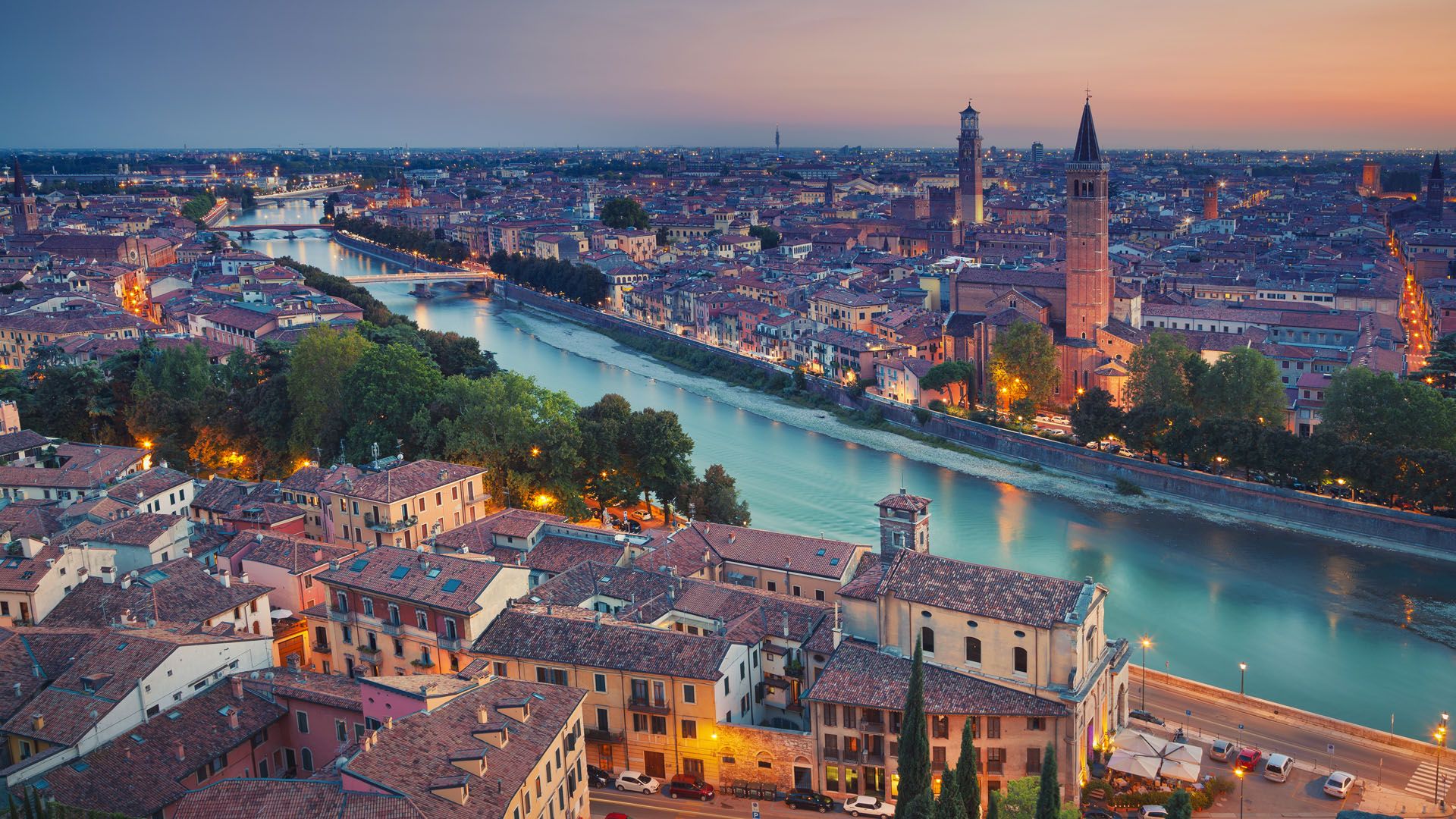
Verona image during summer sunset © Rudy Balasko/Shutterstock

Verona, Italy © Rudy Balasko/Shutterstock

Day 4: Travel to Verona 

Another gem of Northern Italy — and a hands-down highlight of this Northern Italy itinerary — awaits on day 3 when you’ll transfer to Verona .

The drive from Lake Garda to Verona takes just 30–45 minutes, with the A4/E70 (Autostrada) being the primary route for most travelers.

Connecting major cities in northern Italy, this toll highway is a smooth and scenic ride, offering views of rolling hills, vineyards, and cute villages.

Things to do in Verona

Famed for being the city of Romeo and Juliet, the entire city is a UNESCO World Heritage Site and every bit as rich in history as it is in romantic charm, with a well-preserved Roman amphitheater and picturesque piazzas framed by a ravishing riverside setting. It is a favorite for many Italy itineraries.

On arriving, after checking into your hotel or guesthouse, head to Piazza Bra — Verona’s main square — to tour the well-preserved Arena di Verona Roman amphitheater.

Next, we suggest strolling the shopping area of Via Mazzini, which will lead you to pretty Piazza delle Erbe — an historic marketplace festooned with frescoed buildings, and the towering Torre dei Lamberti. 

Where to stay in Verona

When it comes to accommodation in Verona, most visitors head to Centro Storico. Ideal if you’re short on time — you’ll be close to top attractions — it’s also the best option for first-time visitors.

  • Città Antica (Historic Center): The most atmospheric area, home to the Arena di Verona, Juliet’s House, and countless cafés and boutiques. Ideal if you want to walk everywhere and soak up the city’s charm.
  • San Zeno: A quieter, local neighborhood west of the center, known for its beautiful basilica and relaxed vibe. Great for travelers who want authentic Verona without the crowds.
  • Veronetta: Across the Adige River, this student-friendly area has a creative feel, with affordable stays, street art, and plenty of bars and restaurants. Perfect if you prefer a more laid-back, bohemian base.
Verona-italy-shutterstock_662035609

Juliet statue, Verona. Italy © Shutterstock

Day 5: Verona

You'll spend day five of this North Italy itinerary with another day in Verona.

Things to do in Verona

Day 5 of this Northern Italy itinerary begins with a visit to Juliet’s House (Casa di Giulietta) to see the iconic balcony and statue of Shakespeare’s heroine.

Next stop: the medieval fortress of Castelvecchio, which now houses a fabulous museum that’ll keep art aficionados well and truly sated.

Come the afternoon, head to Ponte Pietra. Spanning the Adige River, this Roman bridge offers wonderful views ahead of touring the Roman Theater and nearby Archaeological Museum.

After enjoying lunch at a riverside café, relax for a few hours before returning to Piazza delle Erbe for dinner. 

To end your stay in Verona in fine style, don’t pass up the chance to sample local Valpolicella wine while tucking into food at a typical trattoria.

Annalisa

Tips from Annalisa

Italy Travel Expert

quotes

Cards are fine in big cities, but in smaller towns or local spots, it’s smart to carry some cash. I’d keep 50 to 100 euros in small bills. Some places still charge extra for using a card under 10 euros, which technically isn’t allowed but happens all the time.

Want to make your trip stress-free? Our local travel experts create itineraries for your journey.

Piazza di Mercato Nuovo in Florence © Shutterstock

Piazza di Mercato Nuovo, Florence © Shutterstock

Day 6: Travel to Florence

Fabulous Florence awaits on day 6 of this Northern Italy — get ready to soak up Renaissance majesty, world-class art and very fine food.

The drive from Verona to Florence via the A1/E35 motorway takes 2.5-3 hours.

As parking in Florence’s historic center is limited, we suggest you use designated parking lots outside the ZTL (Restricted Traffic Zone).

Things to do in Florence

After checking into your accommodation, start your exploration of the city at Piazza del Duomo.

Home to the magnificent red-domed Florence Cathedral (Santa Maria del Fiore), it’s the city’s historic heart.

On your first afternoon, you could also stroll pretty Piazza della Signoria and the Palazzo Vecchio (Florence's town hall), before heading to nearby Ponte Vecchio — a charming medieval bridge lined with shops.

Where to stay in Florence

As revealed in our full guide to the best area to stay in Florence, the city has accommodation options to suit all tastes.

  • Duomo: The heart of Florence, close to major landmarks like the cathedral and Piazza della Repubblica. Ideal for first-time visitors who want to be in the center of everything.
  • Santa Croce: A lively neighborhood filled with artisan workshops, local restaurants, and bars. Great for travelers who want atmosphere and nightlife within walking distance of the main sights.
  • Oltrarno: Across the Arno River, this area feels more local and laid-back. It’s known for its craft studios, hidden courtyards, and great trattorias—perfect if you want a more authentic stay.
  • Santa Maria Novella: Near the train station, convenient for arrivals and day trips. A practical choice with a mix of mid-range and upscale hotels.
David of Michelangelo in Accademia Gallery of Florence, Galleria dell'Accademia, Italy © Shutterstock

 Michelangelo's David, Galleria dell'Accademia, Italy © Shutterstock

Day 7: Florence

Day 7 is devoted to visiting Florence’s best museums and galleries.

Things to do in Florence

Start out at one of the world’s greatest art museums—the Uffizi Gallery.

Be sure to book tickets in advance—this place is always packed with folks wanting to see masterpieces by Botticelli, Leonardo da Vinci and Michelangelo.

Next, head to the Accademia Gallery to soak up remarkable Renaissance art, including Michelangelo’s David sculpture.

Art devotees will also want to visit the Basilica of Santa Croce — the burial place of Michelangelo and Galileo.

Come the evening, go for a slap-up meal in the city’s historic heart to enjoy some must-try foods in Florence.

Riomaggiore, Cinque Terre, Italy © Shutterstock

Riomaggiore, Cinque Terre, Italy © Shutterstock

Day 8: Travel to Cinque Terre

Day 8 will see you leave Florence bound for the beautiful UNESCO-designated charms of the Cinque Terre

Comprising five towns on the awe-inspiring Italian Riviera—Monterosso, Vernazza, Corniglia, Manarola, and Riomaggiore — this enchanting area invites scenic hikes, boat trips, and long lunches by the shore.

It takes around 2 hours and 15 minutes to drive from Florence to La Spezia—the main gateway to the Cinque Terre. 

While you can drive directly to the villages from La Spezia, as parking is very limited around these parts, we recommend taking the train.

Where to stay in Cinque Terre

While all five Cinque Terre villages offer plenty of pretty places to stay—think candy-hued clifftop houses and cute guesthouses on medieval piazzas—they also have their own character.

  • Monterosso al Mare: The largest and flattest of the five villages, ideal if you want beaches, restaurants, and the widest range of accommodation. Great for families and anyone with luggage.
  • Vernazza: Known for its postcard-perfect harbor and pastel houses. It’s lively but small, perfect for travelers who want scenic views and easy access to the trails.
  • Corniglia: The quietest and most elevated village, reached by a long staircase from the train station. Best for those seeking peace and fewer crowds.
  • Manarola: Romantic and compact, with dramatic sea views and great swimming spots. A favorite for couples.
  • Riomaggiore: The most accessible by car, with colorful houses stacked above the harbor. It’s vibrant, practical, and a good all-round choice.
Colorful square with restaurant tables in the Cinque Terre village of Monterosso, Italy © Shutterstock

 Monterosso © Shutterstock

Day 9: Cinque Terre

Covering the main reasons folks flock to the Cinque Terre, day nine serves stacks of stunning scenery.

Things to do in Cinque Terre

Start your day with a morning hike from Riomaggiore. This is the southernmost village of the Cinque Terre and also the starting point for the area’s Sentiero Azzurro (Blue Trail)—an iconic coastal path that connects the villages.

While you could follow a 30-minute route to Manarola, we suggest continuing along the longer route from Corniglia to Vernazza—a moderate trek of around 1.5–2 hours that delivers dazzling views of terraced vineyards and the dramatic coastline.

Come the afternoon, explore Vernazza, which is often hailed the prettiest village of the Cinque Terre. Stop off for a seafood lunch before continuing to Monterosso al Mare. It’s a short train ride away if you don’t fancy another walk.

The largest of the five villages, the sandy beach here is ideal for a quick swim or sun-drenched afternoon drink.

Come the evening, take a boat tour from Monterosso al Mare to see all the villages from the water—the colorful cliffside villages look especially gorgeous at sunset—before dining at a waterfront restaurant in Monterosso.

piazza-san-carlo-turin-shutterstock_126583466

Piazza San Carlo, Turin © Shutterstock

Day 10: Transfer to Turin

The last day of this Northern Italy itinerary will take you to Turin—a city of rich, regal history and culinary pleasures. On that subject, you might want to find out why Turin should be your next foodie break.

Set out early to drive the A12 and A26 highways from Cinque Terre to Turin—it’ll take around 3–4 hours. 

Things to do in Turin

On arrival, check out Piazza Castello—the beating historic heart of Turin—for your first flavor of the city. 

Be sure to visit the stunning Baroque Palazzo Reale (Royal Palace)—a UNESCO World Heritage Site of ornate interiors, including those located in the grand Armeria Reale (Royal Armory).

Next, head to the Mole Antonelliana—an iconic landmark of Turin. For spectacular views of the city and the Alps, take the elevator to the top of the tower.

Come the late afternoon, take a stroll along the grand Via Roma shopping street before you end your day—and this Northern Italy itinerary—with dinner in a classic Turin restaurant.


Maria

Tips from Maria

Italy Travel Expert

quotes

Como, Bellagio, and Varenna are beautiful, but expensive. If you stay in Lecco, on the eastern side of the lake, you’ll spend a lot less and still get the same amazing views. It’s also easier to find good local food without the tourist prices.

Plan without limits using itineraries designed by our Italy travel experts.

dolomite-italy-shutterstock_164175596

Dolomites © Shutterstock

Italy itinerary FAQ

When is the best time to take a trip to North Italy?

The best time to visit Italy is spring or fall, especially April through June or September through October. You’ll avoid the worst of the crowds, the heat, and the steepest prices. Spring is perfect for outdoor sightseeing and city walks. Fall is wine and food season, with lots of small festivals happening throughout the country. Summer is busy and hot, especially in cities, though still fun if you're heading to the coast. Winter is quiet, with fewer tourists and cheaper rates, especially inland.

Is this itinerary suitable for a first-time visit to Italy?+

Should I include Milan in a North Italy itinerary?+

Should I include the Dolomites in this itinerary?+

Can I visit the Italian lakes on this route?+

Can I combine North Italy with Switzerland?+

Joanne Owen

written by
Joanne Owen

updated 11.11.2025

Joanne is a Pembrokeshire-born writer with a passion for the nature, cultures and histories of the Caribbean region, especially Dominica. Also passionate about inspiring a love of adventure in young people, she’s the author of several books for children and young adults, hosts international writing workshops, and has written articles on the Caribbean and inspirational community initiatives for Rough Guides. Follow her @JoanneOwen on Twitter and @joanneowenwrites on Instagram.