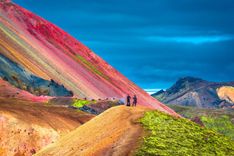
Hiking in western Snæfellsnes
Hellissandur makes a great base for the Wild West Iceland trip, especially for exploring the foot of Snæfellsjökull and the surrounding lava fields. One rewarding full day hike links Hellissandur with Eysteinsdalur valley, crossing Prestahraun lava field and continuing toward Rauðhóll, a red scoria crater with a visible rift in the lava nearby. The route can also include detours to Klukka and Klukkufoss waterfall, where the Móðulækur river cuts through a basalt column-lined canyon, and to Blágil ravine, where the Ljósulækir glacial river thunders through a narrow gorge. Route maps are typically available from the tourist office in Ólafsvík and local accommodation in Hellissandur.
Another recommended day hike (18km) leads first to the sandy bay of Skarðsvík, walled in by cliffs and crags on its northern and western edges. The lava above the cliffs is overgrown with moss and can be a good place to see rare plants. Excellent fishing can be had in the bay’s protected waters and it’s therefore a favourite spot for local boats. To get here, follow Route 574 west out of Hellissandur to its junction with the unnumbered road signed for Skarðsvík; it’s at this point that the main road swings inland, heading for the glacier and the turn for Eysteinsdalur valley. Just 2km west of Skarðsvík the road terminates at the peninsula’s westernmost point, Öndverðarnes, a dramatic and weatherbeaten spot marked only by a lonely lighthouse and a stone well which legend has it is linked to three springs: one of fresh water, one of sea water and one of wine. The promontory is a favourite destination for basking seals, which favour the pebbly beach here. South of the cape the Svörtuloft cliffs are worth a visit; swarming with seabirds in summer, the cliffs provided a major source of eggs and birds for the tables of local villagers until the 1950s, when living standards began to rise. The free-standing crag in the sea here, Skálasnagi, was once connected to the mainland by a natural stone bridge until it fell victim to the pounding of Atlantic breakers in 1973. From the cliffs, a path heads east, inland through the Neshraun lavafield to an area of small hillocks known as Neshólar before emerging at Skarðsvík.
Búðir
Nineteen kilometres east of Arnarstapi, Búðir is a romantic, windswept location, a former fishing village at the head of the sweeping expanse of white sand that backs the Búðavík bay, and a memorable pause on 16-day Iceland trips around Snæfellsnes. The settlement, like so many others in this part of the country, was abandoned in the early nineteenth century and today consists of nothing more than a hotel and a church, both situated just a stone’s throw from the ocean. Surrounded by the Búðahraun lavafield, rumoured to be home to countless elves, and enjoying unsurpassed views out over the Atlantic, the tiny pitch-black church with its three white-framed windows dates from 1703, and cuts an evocative image when viewed from the adjoining graveyard with the majestic Snæfellsnes mountain range as a backdrop. Look out too for the unusual wall, made of lava and topped with turf, that surrounds the churchyard.
Flatey
The largest of the Breiðafjörður islands, Flatey is a tranquil haven of two dozen or so restored wooden cottages set amid fields that are bright yellow with buttercups in summer. If you like the idea of having nothing to do all day but stroll through undisturbed meadows while taking in magnificent vistas of the West Fjord mountains and Snæfellsjökull, then dining by evening on succulent cod caught the same afternoon, this is the place to come. The weather is most dependable in August, but remember if you’re coming here out of season the island will be virtually deserted, since most of the houses are only occupied in summer by Reykjavík city slickers; just five people spend the winter on Flatey.
Although low-key in the extreme today, Flatey was once one of Iceland’s leading cultural centres, and in 1172 a monastery was founded on the island’s highest point, a little behind where the present-day church stands, though there’s nothing left of it today.
From the ferry jetty it’s a ten-minute walk down the rough track that passes as the island’s one and only road to the old village, a restored collection of painted houses nestling around a tiny harbour. It’s from here that Flatey’s sheep are painstakingly bundled into boats and taken to surrounding islands for summer grazing – quite a sight if you’re around to witness it.
Past the harbour the track bears right, turns into a well-trodden path and climbs a little to the diminutive Lundaberg cliffs where you’ll find plenty of black guillemot, kittiwakes, fulmars and puffins from April onwards; half of all the different species of bird that breed in Iceland are found on the islands of Breiðafjörður.
Flatey’s church, with its dramatic roof, is easily reached by a footpath from the village’s main street. Inside, you’ll see paintings of island life – and puffins – by the Catalan painter Baltasar Samper. Quite the entrepreneur, while visiting the island in the 1960s he suggested painting the church in return for free accommodation; his picture behind the altar shows Christ, unconventionally wearing a traditional Icelandic woolly sweater, standing alongside two local sheep farmers. After much hard work, the yellow building behind the church has been restored to its former glory and proudly claims the title of the oldest and smallest library in Iceland, established in 1864.
Beyond the Lundaberg cliffs, the footpath continues towards the eastern part of the island, which has been declared a nature reserve, marked by the odd sign or two and closed to the public during the breeding season (May 15 to July 20); the birds migrate south in late August or early September. Even during the breeding season, however, it’s possible to walk around the eastern part of the island following the marked wooden posts, to Flatey’s south coast, though the latter is also closed at this time – you can reach it but you cannot walk along it. Here you’ll be bombarded by arctic tern, which show no mercy for man or beast – even the island’s sheep are subject to regular divebombing raids. If you don’t mind this (keeping still seems to deter the birds a little), there are some secluded pebbly coves here, home to the odd wrecked fishing boat, with excellent views on a clear day across to Snæfellsjökull.
Flateyjarbók
Flatey was once home to the Flateyjarbók, a collection of illuminated medieval manuscripts written on 113 calfskins. Although the book was written at Víðidalstunga in northern Iceland around 1387, it somehow turned up on the island and remained in the possession of a local farmer’s family until they gave it to the Bishop of Skálholt, who in turn sent it by royal request to King Frederik III of Denmark in 1659. The Flateyjarbók finally returned to Iceland in 1971 and is today stored in Reykjavík.
Snæfellsjökull
Made world famous in the nineteenth century by Jules Verne’s Journey to the Centre of the Earth, Snæfellsjökull is a literary and natural icon and a defining stop on the South Coast and Snaefellsnes Iceland trip. Standing at the tip of the peninsula that bears its name, the glacier volcano is where Verne’s hero, Professor Lidenbrock, descends into a crater and begins his fantastical underground journey. The region has long been linked to mystery and folklore, and the glacier’s presence only deepens that atmosphere.
Snæfellsjökull rises to 1,446 meters in three peaks, sitting on a dormant volcano with a crater roughly 1 km wide and cliff walls about 200 meters high. For experienced hikers, several ascent routes exist, but conditions can be serious and typically require proper glacier equipment and up to date route and weather guidance from the national park office in Malarrif. Two main trailheads are commonly used, one accessed from Route F570 and another near the ice cap’s northwestern corner, with trails linking across the glacier’s apex, Jökulþúfur, on the crater rim.