Rough Guides combines destination expertise with tailor-made travel planned by vetted Greece local experts. You can use our city and regional guides as a starting point, then receive up to 3 personalized trip plans created from scratch around your preferred pace, experiences, and route through the country. The final itinerary is refined directly with the local travel agent instead of being selected from a fixed package.
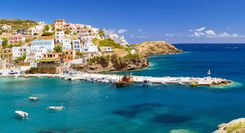
After Rhodes, Kos ranks second among the Dodecanese islands for both size and visitor numbers. Here too the harbour in Kos Town is guarded by an imposing castle of the Knights of St John, the streets are lined with Italian-built public buildings, and minarets and palm trees punctuate extensive Hellenistic and Roman remains. And while its hinterland mostly lacks the wild beauty of Rhodes’ interior, Kos is the most fertile island in the archipelago, blessed with rich soil and abundant ground water.
Mass tourism has largely displaced the old agrarian way of life on Kos. Large all-inclusive complexes dominate parts of the island, often contributing little to the local economy and putting pressure on smaller restaurants and modest hotels. Outside Kos Town and Mastihári, independent travellers are relatively scarce, and from mid-July to mid-September it is wise to reserve accommodation well in advance.
The tourist industry can sit strangely alongside more traditional rural scenes, from cows grazing near olive groves to military exercises in the volcanic landscapes around the airport. Like Tílos further south, Kos never depended heavily on the sea, so it has little maritime tradition and only a small contemporary fishing fleet.
Even with these contrasts, Kos is still worth a few days while island-hopping. Its mountain villages are appealing, the tourist infrastructure is excellent, and swimming opportunities are almost endless, with beaches of different sizes, colours, and textures fringing much of the island.
In 13-day Greece trips through the Dodecanese, Kos works best as a short, practical stop rather than the whole focus, giving you easy beaches, transport links, and a few inland villages before moving on to quieter islands or more historic harbour towns.
Trip ideas for Greece
Crafted with by local experts


9 days
view trip ⤍

8 days
view trip ⤍

9 days
view trip ⤍

4 days
view trip ⤍

9 days
view trip ⤍

13 days
view trip ⤍

10 days
view trip ⤍
10 days
view trip ⤍

7 days
view trip ⤍

8 days
view trip ⤍The east
The shoreline of the eastern half of Kos, in both directions from Kos Town, is fringed with good beaches, albeit interspersed with marshlands. The best, around Cape Psalídhi to the east and Lámbi, Tingáki and Marmári to the southwest, have attracted resort development, but with a bike especially (thanks to the coastal bike paths) it’s usually possible to find a stretch of sand to yourself. Inland, the rugged hills cradle some delightful villages, though many are now sadly empty.
Hippocrates
Hippocrates (c.460–370 BC) is generally regarded as the father of scientific medicine, even if the Hippocratic oath, much altered from its original form, may well have nothing to do with him. Hippocrates was certainly born on Kos, probably at Astypalia near present-day Kéfalos, but otherwise confirmed details of his life are few. A great physician who travelled throughout the Classical Greek world, he spent at least part of his career teaching and practising on his native island. Numerous medical writings have been attributed to Hippocrates; Airs, Waters and Places, a treatise on the importance of environment on health, is generally thought to be his, but others are reckoned to be a compilation found in a medical library in Alexandria during the second century BC. His emphasis on good air and water, and the holistic approach of ancient Greek medicine, now seem positively contemporary.