Deildartunguhver
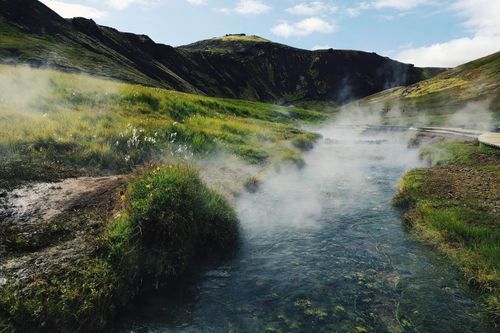
A stop at Deildartunguhver is a highlight of any North and West Iceland trip, especially if you’re already in the Reykholt area. Often described as the biggest hot spring in Europe, it sits near the hamlet of Kleppjárnsreykir, around 5 km west of Reykholt beside Route 50. Powered by the geothermal reserves of Reykholtsdalur valley, the spring releases about 180 litres of 97°C water every second, creating impressive clouds of steam that rise into the cool air. The hot water is piped to heat Borgarnes and Akranes, and it also supports local greenhouse farming, with small produce stalls sometimes appearing here in summer. From the car park, a short footpath leads directly to the spring.
Snorri Sturluson
Born at the farm of Hvammur near Búðardalur in 1179, Snorri Sturluson was descended from some of the greatest figures in early Icelandic history; on his father’s side were influential chieftains, on his mother’s, among others, the warrior poet Egill Skallagrímsson. At the age of 2 he was fostered and taken to one of Iceland’s leading cultural centres, Oddi (see Sæmundur and the seal), where, over the years, he became acquainted not only with historical writing but also the court of Norway – a relationship that would eventually lead to his death. In 1206, following his marriage to a wealthy heiress, he moved to Reykholt and consolidated his grip on power by becoming a chieftain, legislator and respected historian and writer; he also developed a distinct taste for promiscuity, fathering three children to women other than his long-suffering first wife, Herdís.
Snorri Sturluson is the most celebrated figure in Icelandic literature, producing first his Edda (an account of Norse mythology) then Egill’s Saga and Heimskringla (a history of the Norwegian kings up to 1177), which from its geographical detail shows that Snorri spent several years living in Norway. During this period he developed a close bond of allegiance to the Norwegian earl who reigned alongside the teenage king, Hákon. However, following a civil war in Norway, which resulted in the earl’s death, the Norwegian king declared Snorri a traitor and ordered one of his followers, Gissur Þorvaldsson, to bring the writer back to Norway – dead or alive. On the dark night of September 23, 1241, seventy armed men led by Gissur burst into Snorri’s farmhouse in Reykholt sending him fleeing from his bed unarmed and defenceless, down into the cellar. Five of the thugs pursued Snorri, and there they hacked Iceland’s most distinguished man of letters to death.
Tip from Rough Guides: also learn about the best ways to get to Iceland.
Top image: Deildartunguhver, a geothermal hotspring in Reykholtsdalur, Iceland © Felix Lipov/Shutterstock