Travel advice for Kenya
From travel safety to visa requirements, discover the best tips for visiting Kenya
If you're thinking about seeing wildlife in Kenya, you’re on the right track. It’s one of the easiest places to spot animals in their natural environment, thanks to its varied landscapes—open savannah in the Maasai Mara, forested highlands around Mount Kenya, and dry regions further north. That range means different species live in different areas, so each place feels a bit different. Here’s our guide to Kenya wildlife.
It doesn’t really matter if you’re into photography, conservation, or just curious about what a safari is like—being out in the bush is a unique experience. You spend your days tracking animals with a guide, learning how to read the landscape, and watching animals go about their business without much fuss. And because many trips are connected to local conservation projects, your visit can help support the protection of both wildlife and the people who live alongside it.
Kenya is one of those places where you can really slow down and just watch. If you’ve been wanting to see animals in the wild, this is a solid place to start. If it's your first time visiting this beautiful country, sometimes looking at a sample Kenya itinerary can help you get organized for your trip.

Zebra in Tsavo National Park - Kenya © ANTONIO JIMENO JIMENEZ/Shutterstock
You’ve probably heard of the “Big Five”—lions, elephants, leopards, buffalo, and rhinos—and you’ve got a good chance of seeing them here. But you’ll also come across plenty of other animals like giraffes, zebras, cheetahs, hyenas, and hippos. If you're around during the Great Migration, the herds of wildebeest and zebra crossing the Mara River are something to see—especially with predators nearby.
The undisputed kings of the African savannah, lions are among Kenya's most sought-after wildlife sightings. These magnificent big cats typically live in prides consisting of related females, their cubs, and a coalition of males. The Maasai Mara and Amboseli reserves are where you'll find exceptional opportunities to witness lions in their natural behaviors—from dramatic hunts at dawn to afternoon naps under acacia trees.
Males, immediately recognizable by their impressive manes, can weigh up to 550 pounds, while the slightly smaller females do most of the hunting. Kenya's lions face growing threats from habitat loss and human-wildlife conflict, making conservation efforts crucial. The best viewing times are early mornings and late afternoons when lions are most active. Witnessing a lion's powerful roar echoing across the savannah remains one of Africa's most spine-tingling wildlife experiences.

The undisputed kings of the African savannah © Shutterstock
African elephants, Earth's largest land mammals, roam Kenya's landscapes with a dignity that captivates every visitor. Amboseli National Park, set against the backdrop of Mount Kilimanjaro, hosts some of the largest-tusked elephants remaining in Africa. These intelligent giants live in matriarchal family groups led by experienced females who guide their herds to seasonal water sources through ancient migration routes they've memorized over generations.
An elephant's trunk—containing over 40,000 muscles—serves as a versatile tool for breathing, smelling, touching, grasping, and communicating. Tsavo National Park is famous for its "red elephants," who dust-bathe in the distinctive terra-cotta soil. Kenya's elephants face poaching threats despite international ivory bans, making the country's conservation work vital to their survival.
Elephants are of course a huge hit with kids. Watching a family of elephants interact with their complex social bonds and obvious affection gives profound insight into animal intelligence. For more tips, see our guide to Kenya with kids.
The most elusive of Kenya's big cats, leopards combine raw power with ghost-like stealth. These solitary predators are masters of camouflage, their rosette-patterned coats blending perfectly with dappled shadows in the trees where they often rest during daylight hours. Leopards are renowned for their extraordinary strength—capable of hoisting prey twice their weight into trees to protect it from scavengers.
The Maasai Mara and Samburu reserves are where you'll find Kenya's best leopard sightings, particularly at dawn and dusk when they're most active. Unlike other big cats, leopards adapt to diverse habitats, from dense forests to semi-deserts. Patient visitors might witness their graceful, calculated hunting technique or—with exceptional luck—spot cubs playing under their mother's watchful eye. Their secretive nature and declining populations make every leopard sighting a cherished safari memory and photography opportunity that wildlife enthusiasts dream about.

Leopards are one of the most elusive big cats © Shutterstock
Built for speed rather than power, cheetahs embody nature's perfect sprinting design. As the world's fastest land mammals, they can accelerate from 0 to 60 mph in just three seconds, reaching top speeds of 70 mph during their explosive hunting chases. The open grasslands of the Maasai Mara provide ideal habitat for witnessing these remarkable cats in action. Unlike other big cats, cheetahs hunt during daylight, using their exceptional eyesight to spot prey from great distances.
Their distinctive black "tear marks" running from eye to mouth serve a practical purpose—reducing glare like an athlete's eye black. Cheetahs face severe conservation challenges due to habitat fragmentation and cub mortality, making Kenya's protected areas crucial for their survival. The sight of a cheetah perched atop a termite mound surveying the plains or a mother teaching her cubs hunting skills ranks among Kenya's most photogenic and moving wildlife encounters.
Kenya's Savannah skyline wouldn't be complete without the elegant silhouette of giraffes browsing among acacia trees. As the world's tallest land mammals, reaching heights of 18 feet, these gentle giants make for a uniquely African wildlife experience. Kenya hosts several giraffe subspecies, including the reticulated giraffe with its geometric patterns and the Masai giraffe with more jagged markings.
Their extraordinary anatomy includes a heart weighing over 10 pounds to pump blood up their long necks and a special network of blood vessels to regulate pressure when they bend to drink. Giraffes communicate using low-frequency sounds and body language and possess distinctive spotted patterns as unique as human fingerprints. Conservation areas like Meru National Park and the Laikipia Plateau offer excellent viewing opportunities (and are some of the best places to visit in Kenya). The sight of a giraffe's graceful gait across the savannah or their delicate movements when drinking (their most vulnerable position) creates iconic safari memories for Kenya's visitors.

Massive animal with delicate movements © Shutterstock
Kenya is home to both black and white rhinos, with the latter being the second-largest land mammal. These prehistoric-looking creatures are best spotted in protected sanctuaries like Ol Pejeta Conservancy and Lewa Wildlife Conservancy. Witnessing a rhino in its natural habitat is increasingly rare—Kenya protects some of the world's last northern white rhinos.
Their massive bodies, distinctive horns, and surprisingly nimble movements make for an unforgettable safari highlight. Conservation efforts are intense, as poaching has pushed these magnificent animals to the brink of extinction. Many conservancies provide specialized rhino tracking experiences where visitors can approach these ancient beasts on foot with armed rangers, providing a heart-pounding wildlife encounter that directly supports crucial protection efforts.
Kenya's plains are home to two zebra species: the common Burchell's zebra and the larger, more narrowly striped Grevy's zebra. These iconic African animals gather in impressive herds across the Masai Mara and Amboseli, creating striking black-and-white patterns against golden grasslands. More than just photogenic, zebras play a crucial role in the ecosystem as grazing specialists that prepare grasslands for more selective feeders.
Each zebra's stripe pattern is as unique as a human fingerprint, and these markings serve as natural fly repellent and temperature regulation. During the Great Migration, thousands of zebras join wildebeest in the dramatic river crossings. Dawn and dusk game drives are the best opportunities to witness their social interactions and the enchanting sight of foals staying protectively close to their mothers.
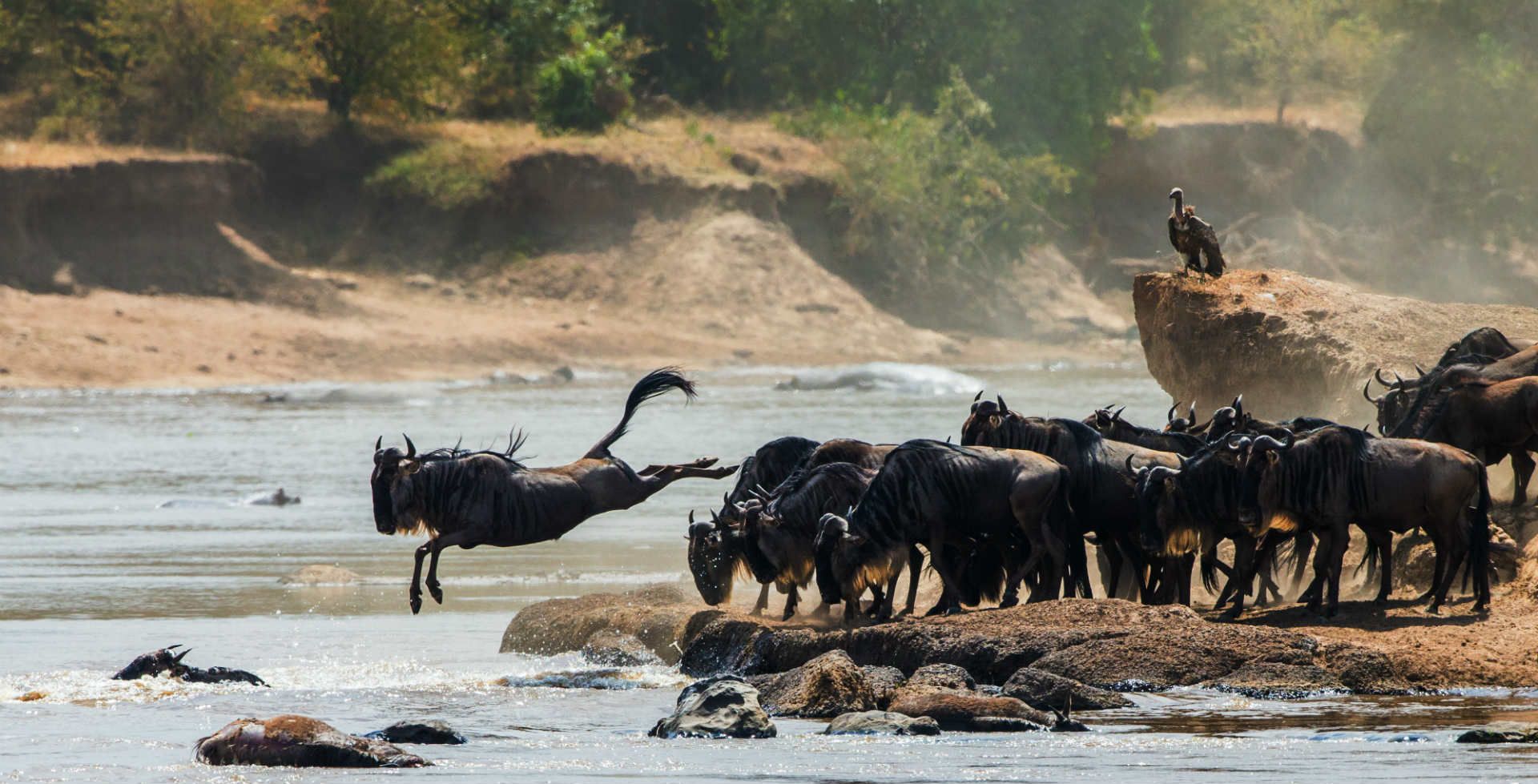
Wildebeest of Mara River, Masai Mara © Shutterstock
The wildebeest, or gnu, is the star of Kenya's greatest wildlife spectacle—the Great Migration. Each year, over 1.5 million of these unusual-looking antelope traverse the Masai Mara in search of fresh grazing, creating one of the planet's most impressive wildlife events.
Their distinctive appearance—featuring shaggy manes, curved horns, and bearded faces—belies their crucial ecological role as the migration's primary driving force. Witnessing the thundering herds cross the Mara River while dodging crocodiles provides the ultimate safari adrenaline rush. Despite their somewhat comical appearance, wildebeest display remarkable endurance and maternal devotion, with newborn calves able to run alongside the herd within minutes of birth—a necessary adaptation in predator-rich environments.
Kenya's rivers and lakes harbor one of Africa's most dangerous yet fascinating creatures—the hippopotamus. These aquatic giants, weighing up to three tons, spend daylight hours submerged in water bodies like Lake Naivasha and the Mara River. Despite their bulky appearance, hippos can charge at surprising speeds and are responsible for more human fatalities in Africa than any other large animal. Viewing their massive forms from a safe distance as they emerge at dusk to graze is an essential Kenya wildlife experience.
Their gaping yawns reveal impressive canines, while their unique adaptations—including the ability to close their nostrils underwater and secrete red oil that acts as natural sunscreen—make them evolutionary marvels. Boat safaris are the best (and safest) way to view hippos.

Hippo yawns to reveal canines © Shutterstock
The African cape buffalo, with its formidable horns and imposing presence, represents one of Kenya's "Big Five" game animals. These massive bovines travel in herds numbering from dozens to hundreds across grasslands in parks like Tsavo and the Masai Mara.
Known for their unpredictable temperament and willingness to confront predators, buffalo have earned the nickname "Black Death" among hunters and are one of the few animals that actively counter-attack lions. Witnessing a buffalo herd's defensive circle formation, with vulnerable calves protected in the center, gives insight into their complex social structure. Dawn game drives provide optimal viewing as these powerful creatures often gather near water sources, their breath creating misty halos in the early morning light.
Despite their unflattering reputation, spotted hyenas are among Kenya's most fascinating predators. Far from being mere scavengers, these highly intelligent social carnivores are skilled hunters with the strongest jaws in proportion to body size of any mammal. Amboseli and the Masai Mara offer excellent opportunities to observe their complex clan dynamics, led by dominant females that outrank all males. Their eerie "whooping" calls and distinctive silhouettes make dawn and dusk encounters particularly memorable.
Hyenas play a crucial ecological role as nature's cleanup crew, consuming almost every part of their prey, including bones. Their unusual reproductive biology and complex vocalizations continue to intrigue researchers, making a hyena sighting much more than just a checkmark on the safari list.

Buffalo accompanied by many flamingo © Shutterstock
Kenya is where you'll find one of the world's most spectacular avian displays when hundreds of thousands of flamingos gather at alkaline lakes in the Great Rift Valley. Lakes Nakuru, Bogoria, and Elementaita periodically transform into shimmering pink as lesser and greater flamingos wade through shallow waters, filtering algae with their specialized curved bills.
This breathtaking natural phenomenon is best viewed from elevated vantage points, where you can witness the mass of pink against blue water. The birds' synchronized movements and courtship displays add dynamic elements to an already mesmerizing scene. While flamingo populations fluctuate seasonally with algae blooms and water levels, Kenya remains one of the few places where visitors can witness such dense concentrations of these elegant birds—a highlight that extends beyond traditional Big Five safaris.
The ostrich, Africa's iconic flightless bird, roams Kenya's open grasslands with unmistakable grace. Standing up to 9 feet tall and weighing over 300 pounds, these magnificent creatures are the world's largest birds. Spot them in Amboseli or the Masai Mara, where they stride across plains on powerful legs capable of 45 mph sprints.
Males display striking black and white plumage, while females maintain a more camouflaged brownish-gray. Despite their inability to fly, ostriches have adapted brilliantly to Savannah life, using their excellent vision to spot predators from afar. They're particularly entertaining during mating season, when males perform elaborate courtship dances with wings outstretched. Dawn and dusk are when the best viewing opportunities occur as they forage among zebras and antelopes.

Nile crocodile grins for the camera © Shutterstock
Kenya's rivers and lakes harbor Nile crocodiles, ancient predators that have remained virtually unchanged for 200 million years. These formidable reptiles can grow up to 20 feet long and are most dramatically viewed during the Great Migration, when they ambush wildebeest crossing the Mara River.
Patient and calculating, they can remain motionless for hours before striking with explosive force. The Tana River and Lake Turkana host significant populations, where you might observe their fascinating parental behavior—mothers gently carrying hatchlings in their fearsome jaws to water. Despite their fearsome reputation, crocodiles play a crucial ecological role by controlling populations of fish and mammals. Early mornings are when to catch the best sightings as they emerge to bask in the sun, their armored bodies glistening on sandbanks.
Olive baboons thrive throughout Kenya's diverse landscapes, from savannahs to forests, showcasing remarkable adaptability and intelligence. These highly social primates live in troops of 40–150 individuals with complex hierarchies that fascinate observers. In places like Hell's Gate National Park, watch as they groom one another, reinforcing social bonds while juveniles play nearby, practicing skills they'll need as adults.
Baboons communicate through an impressive repertoire of vocalizations and facial expressions, making them among Kenya's most expressive wildlife. Their omnivorous diet and problem-solving abilities have allowed them to adapt to various habitats. Dawn visits to areas where forest meets grassland provide excellent viewing opportunities as troops emerge from sleeping sites in cliff faces or trees to begin their daily foraging, their distinctive dog-like profiles silhouetted against the morning light.

Baboons are a common Kenya wildlife © Shutterstock
The African Fish Eagle, with its distinctive white head and chestnut body, serves as Kenya's avian emblem. These majestic raptors are commonly spotted perched prominently in trees along Lake Naivasha and Lake Baringo, surveying waters for their next meal. Their piercing, melodic call—often described as "the voice of Africa"—echoes across Kenya's waterways at dawn.
Watch in awe as they dive with precision from heights of 60+ feet, snatching fish with powerful talons without fully submerging. Mated pairs perform spectacular aerial courtship displays, locking talons mid-flight and spiraling downward. They build massive nests they'll use for years, raising chicks that remain dependent for months. Photography enthusiasts particularly prize shots of these birds against Kenya's dramatic skies. Their striking appearance and fishing prowess make them unforgettable highlights of any Kenyan wildlife adventure.
These charismatic African pigs with distinctive upward-curving tusks and facial warts are frequent sights across Kenya's grasslands. Warthogs are easily recognized by their kneeling feeding posture and signature tail-up running style that locals call "radio antenna." Despite their intimidating appearance, warthogs are generally non-aggressive herbivores that primarily graze on grasses and roots.
They live in family groups led by a female and seek shelter in abandoned aardvark burrows. What makes warthogs particularly entertaining for visitors is their surprising agility—capable of sprinting up to 30 mph—and their comical behavior. Spotting a family of warthogs trotting across the savanna, tails held high, is a quintessential Kenya wildlife moment that perfectly captures the charm of these resilient survivors.

Gazelle looking off into the distance © Shutterstock
Graceful and swift, gazelles epitomize the elegance of Kenya's savanna. These medium-sized antelopes with distinctive ringed horns and tan coats serve as living barometers of ecosystem health. Thomson's and Grant's gazelles are the most common species, both recognizable by their striking black side stripes and white rumps that flash signals to others when danger approaches.
What makes gazelles fascinating for wildlife enthusiasts is their incredible adaptations—they can reach speeds of 60 mph and can survive without drinking water by extracting moisture from vegetation. Their constant vigilance and spectacular "stotting" behavior (bouncing high on all four legs) when threatened create captivating safari moments.
Kenya's diverse primate population makes for remarkable wildlife encounters. Vervet monkeys, with their distinctive black faces and silver-gray fur, inhabit savanna woodlands and are famous for their complex social structures and human-like expressions. Black-and-white colobus monkeys present a striking contrast with their dramatic flowing white manes against jet-black bodies. These remarkable forest dwellers are unique among primates, lacking thumbs and being exclusively leaf-eaters.
What makes monkey watching particularly rewarding is observing their intelligence in action—from tool use to sophisticated communication systems. Listen for vervets' distinct alarm calls that specifically identify different predators, or witness colobus monkeys' spectacular gliding jumps between trees. Encountering these charismatic creatures provides windows into evolutionary history and reminds visitors of our deep connections to the primate world.

Green Vervet Monkey on branch © Shutterstock
Among Kenya's most distinctive birds, the secretary bird commands attention with its eagle-like head, crane-like body, and peculiar name (derived from quill-like head feathers resembling 18th-century clerks with quills behind their ears). These remarkable raptors stand nearly 4 feet tall and patrol grasslands on stilt-like legs, hunting snakes and small animals. What makes secretary birds fascinating for wildlife enthusiasts is their unique hunting technique—they stomp prey to death with powerful, precise kicks that can crush a snake's spine.
Their specialized behavior represents a remarkable evolutionary adaptation found nowhere else in the bird world. Observing a secretary bird's deliberate stride through golden savanna grasses gives a glimpse of prehistoric elegance, as these birds closely resemble ancient avian dinosaurs and embody Africa's evolutionary marvel.

Wild Secretary Birds in Kenya © Shutterstock
Kenya has approximately 65 national parks and reserves, covering about 8% of the country's total land area. These protected areas are the backbone of Kenya's tourism industry, contributing significantly to the national GDP.
The Masai Mara is Kenya's crown jewel of wildlife viewing, famous for hosting the Great Migration, where over 1.5 million wildebeest and thousands of zebras cross from Tanzania's Serengeti. This spectacle, occurring between July and October, represents one of nature's most dramatic events.
The reserve's expansive savanna landscapes provide ideal habitats for the "Big Five" (lion, leopard, elephant, buffalo, and rhino), with one of Africa's highest concentrations of predators. Hot air balloon safaris are great for breathtaking aerial views of the plains teeming with wildlife. The Mara's cultural dimension is enhanced by the Maasai people, whose traditional villages (bomas) can be visited to learn about their unique way of life that has coexisted with wildlife for centuries.

Masai Mara Reserve in Kenya © Shutterstock
Amboseli is the iconic postcard view of Africa: elephants wandering against the backdrop of snow-capped Mount Kilimanjaro. Home to over 1,500 elephants, including some of the continent's largest tuskers, the park provides unparalleled opportunities to observe these intelligent giants in family groups.
The park's varied ecosystem includes swamps, woodlands, and dried lake beds, supporting over 400 bird species and abundant wildlife. What makes Amboseli special is its clear visibility—the relatively flat, open terrain means animals can be spotted from great distances. The Amboseli Elephant Research Project, one of the world's longest-running wildlife studies, has revolutionized our understanding of elephant social structure and intelligence, making your sightings here more meaningful in this scientific context.
Lake Nakuru, once renowned for its spectacular flocks of flamingos that turned shorelines pink, remains a birdwatcher's paradise despite fluctuating water levels affecting flamingo populations. The compact park is a diverse ecosystem with woodland, grassland, and euphorbia forests surrounding the alkaline lake.
It's one of Kenya's premier rhino sanctuaries, protecting both black and white rhino species within its electric-fenced boundaries. The park's Baboon Cliff viewpoint is where you'll find breathtaking panoramas of the entire lake basin. Unusual among Kenya's parks, Lake Nakuru houses the rare Rothschild's giraffe, introduced for conservation after their natural habitat diminished elsewhere. The park's accessibility from Nairobi (just 2-3 hours' drive) makes it perfect for visitors with limited time who still want authentic wildlife experiences.

Elephants are found in Kenya © Shutterstock
Together forming Kenya's largest protected area, the Tsavo parks cover a massive 4% of the country's total land area. Tsavo East's distinctive red soil and semi-arid plains create a dramatic backdrop for viewing elephants, often covered in the iconic red dust. Tsavo West features more varied topography with volcanic hills, crystal-clear springs, and lava flows that wildlife navigates around.
The parks gained historical notoriety from the "Man-Eaters of Tsavo," two infamous lions that halted railway construction in the 1890s by preying on workers. Visitors can still see the cave where they dragged their victims. The parks' sheer size means lower tourist density than the Mara, which means more exclusive game viewing experiences, particularly along the life-giving Galana River where wildlife congregates.
Samburu showcases Kenya's wild, rugged north, with landscapes dramatically different from the country's southern parks. The reserve's lifeline is the Ewaso Ng'iro River, attracting wildlife during the harsh dry seasons. Samburu's claim to fame is the "Special Five"—species found only in northern Kenya: Grevy's zebra, reticulated giraffe, Somali ostrich, gerenuk (the "giraffe-necked antelope" that stands on hind legs to feed), and Beisa oryx.
The reserve's semi-arid conditions create excellent visibility for predator sightings, including leopards that often drape themselves over the riverine trees. The indigenous Samburu people, cousins to the Maasai, serve as exceptional guides, sharing traditional wildlife knowledge passed through generations in this challenging landscape.

Group of camels early in the morning at sunrise in the dusty town of Maralal, Samburu District, Kenya © Shutterstock
Unlike Kenya's formal national parks, Lake Naivasha is a unique freshwater ecosystem where wildlife viewing happens from boats rather than vehicles. The lake supports over 400 bird species, including spectacular fish eagles that swoop down to catch prey. Hippos surface dramatically at dusk, revealing just their eyes and nostrils before submerging again.
Crescent Island, formed during the filming of "Out of Africa," provides the rare opportunity to walk among giraffes, zebras, and antelope without predators present. The lake's surroundings, influenced by colonial history, feature beautiful estates with expansive gardens. Boat trips to Crescent Island often encounter the curious "Jesus birds" (African jacanas) that appear to walk on water as they step delicately across lily pads.

White-tailed eagle on the lake Naivasha © kyslynskahal/Shutterstock
Kenya's wildlife viewing calendar revolves around seasonal migrations and animal behavior patterns. The best time to visit Kenya spans from June to October during the dry season, when vegetation thins and animals congregate around water sources, making them easier to spot. This period coincides with the spectacular wildebeest migration in the Maasai Mara. Wildlife enthusiasts particularly value this time for exceptional photographic opportunities and higher predator activity. Many safari operators consider July through September the prime viewing months, though premium pricing reflects this popularity.
The dry season (June-October) is when you're most likely to get consistent wildlife sightings with minimal rainfall, dustier conditions, and concentrated animal populations at water sources. Meanwhile, the green season (November-May) transforms landscapes with lush vegetation, birthing seasons for many species, and exceptional bird-watching opportunities.
While wildlife can be more dispersed during this period, visitors benefit from fewer crowds, lower rates, and stunning photography with dramatic skies and verdant backdrops. The short dry season in January-February provides an excellent compromise with good visibility and relatively green landscapes.

The Great Migration: wildbeest in Mara River, Masai Mara, Kenya © Shutterstock
Many travel to see these specific Kenya wildlife events:
Responsible wildlife viewing in Kenya requires specific practices that protect both animals and ecosystems. Stay at least 25 meters from most wildlife and 100 meters from predators with cubs or kills. Select operators certified by Ecotourism Kenya or those partnering with the Maasai Wilderness Conservation Trust.
Limit game drives to 3-4 hours and avoid wildlife at night when they actively hunt. Photograph using zoom lenses rather than approaching closer, and never use flash photography around nocturnal animals.
Support conservancies like Ol Pejeta or Lewa that fund anti-poaching K-9 units and community schools. Bring reusable water bottles and biodegradable soaps, and shop for crafts from certified community-based organizations like Kazuri Beads. Respect Maasai land by obtaining proper permissions and paying conservation fees directly to official park authorities.
Take a peek at the Rough Guide to Kenya, perfect for independent travelers planning a longer trip. With practical tips, hidden gems, suggestions, and more.
From travel safety to visa requirements, discover the best tips for visiting Kenya