Plan and book with vetted local experts
With 16 million foreigners flying into the country each year, Thailand is Asia’s primary travel destination and offers a host of places to visit. Travel to Thailand and you’ll find that despite this vast influx of visitors, it’s cultural integrity remains largely undamaged. Thailand is a country that cleverly avoided colonisation has been able to absorb Western influences while maintaining its own rich heritage.
Though the high-rises and neon lights occupy the foreground of the tourist picture, the typical Thai community is still the farming village, and you need not venture far to encounter a more traditional scene of fishing communities, rubber plantations and Buddhist temples.
Around 40% of Thais earn their living from the land, based around the staple rice, which forms the foundation of the country’s unique and famously sophisticated cuisine.
Tourism has been just one factor in the country’s development which, since the deep-seated uncertainties surrounding the Vietnam War faded, has been free, for the most part, to proceed at death-defying pace – for a time in the 1980s and early 1990s, Thailand boasted the fastest-expanding economy in the world.
Through all the changes of the last sixty years, the much-revered constitutional monarch, King Bhumibol has lent a measure of stability.
Furthermore, some 85 percent of the population are still practising Theravada Buddhists, a unifying faith that colours all aspects of daily life – from the tiered temple rooftops that dominate every skyline, to the omnipresent saffron-robed monks and the packed calendar of festivals.
Most budget travellers head for the Banglamphu district, where if you’re not careful you could end up watching DVDs all day long and selling your shoes when you run out of money. The district is far from having a monopoly on Bangkok accommodation, but it does have the advantage of being just a short walk from the major sights in the Ratanakosin area: the dazzling ostentation of the Grand Palace and Wat Phra Kaeo, lively and grandiose Wat Pho and National Museum.
Once those cultural essentials have been seen, you can choose from a whole bevy of lesser sights, including Wat Benjamabophit (the “Marble Temple”), especially at festival time, and Jim Thompson’s House, a small, personal museum of Thai design.
Self-improvement courses are a strong suit – from ascetic meditation to Thai cookery classes – while the overriding enticement of the surrounding region is the prospect of trekking through villages inhabited by a richly mixed population of tribal peoples.
Plenty of outdoor activities and courses, as well as hot springs and massages, can be enjoyed at Pai, a surprisingly cosmopolitan hill station for travellers, four hours northwest of Chiang Mai.
Many colourful festivals attract throngs of visitors here too: Chiang Mai is one of the most popular places in Thailand to see in the Thai New Year – Songkhran – in mid-April, and to celebrate Loy Krathong at the full moon in November, when thousands of candles are floated down the Ping River in lotus-leaf boats.
Beyond the city limits, a number of other day-trips can be made, such as to the ancient temples of Lamphun – and, of course, Chiang Mai is the main centre for hill-tribe trekking, as well as all sorts of other outdoor activities.
Ko Pha Ngan next door is still largely backpacker territory, where you have a stark choice between desolate coves and Hat Rin, Thailand’s party capital. The remotest island, rocky Ko Tao, is acquiring increasing sophistication as Southeast Asia’s largest dive-training centre.
Tucked away beneath the islands, Nakhon Si Thammarat, the cultural capital of the south, is well worth a short detour from the main routes through the centre of the peninsula – it’s a sophisticated city of grand old temples, delicious cuisine and distinctive handicrafts.
Even if you’re just passing through, you can’t miss the star attraction of Nakhon Pathom: the enormous stupa Phra Pathom Chedi dominates the skyline.
To get an idea of what shopping in Bangkok used to be like before all the canals were tarmacked over, many people take an early-morning trip to the floating market (talat khlong) at Damnoen Saduak. Sixty kilometres south of Nakhon Pathom and just over a hundred kilometres from Bangkok.
The largest Andaman coast island, Phuket, is one of Thailand’s top tourist destinations and graced with a dozen fine beaches, though several have been overdeveloped with a glut of high-rises and tacky nightlife.
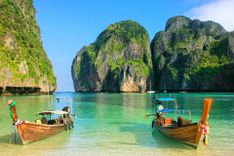
Beautiful little Ko Phi Phi is a major party hub, surrounded by the turquoise seas and dramatic limestone cliffs that characterize the coastline throughout Krabi province. Large, forested Ko Lanta is, for the moment at least, a calmer alternative for families, but for genuine jungle you’ll need to head inland, to the rainforests of Khao Sok National Park.
The greatest interest in the deep south is currently all over on the beautiful west coast, where sheer limestone outcrops, pristine sands and fish-laden coral stretch down to the Malaysian border.
Along Trang’s mainland coast, there’s a 30km stretch of attractive beaches, dotted with mangroves and impressive caves that can be explored by sea canoe, but the real draw down here is the offshore islands, which offer gorgeous panoramas and beaches, great snorkelling and at least a modicum of comfort in their small clusters of resorts.
Spanning five distinct forest types and rising to a height of 1,351m, the park sustains over 300 bird and twenty large land-mammal species – hence its UNESCO accreditation as a World Heritage Site.
Rangers discourage visitors from exploring the outer, non-waymarked reaches unguided, partly for environmental reasons, but also because of trigger-happy sandalwood poachers. Sandalwood trees are indigenous to Khao Yai, and though oil collection does not usually kill the tree, it does weaken it. Guides can point out trees that have been cut in this way along the trails.
It takes in archetypal agricultural villages and a fascinating array of religious sites, while the southern reaches of Isaan hold some of Thailand’s best-kept secrets – the magnificent stone temple complexes of Phimai, Phanom Rung and Khao Phra Viharn, all built by the Khmers of Cambodia almost ten centuries ago.
Some tourist developments have scarred much of the island, however, many of the beaches are still strikingly handsome, resort facilities are second to none, and the offshore snorkelling and diving are exceptional.
If you’re after a peaceful spot, aim for the 17km-long national park beach of Hat Mai Khao, its more developed neighbour Hat Nai Yang, or one of the smaller alternatives at Hat Nai Thon or Hat Kamala.
The island’s most appealing strand, Chaweng, has seen the heaviest, most crowded development and is now the most expensive place to stay, though it does offer by far the best amenities and nightlife. Its slightly smaller neighbour, Lamai, lags a little behind in terms of looks and top-end development, but retains large pockets of backpacker bungalow resorts.
The other favourite for backpackers is Maenam, which, though less attractive again, is markedly quiet, with plenty of room to breathe between the beach and the round-island road.
The rains usually builds momentum between June and August, hitting its peak in September and October. The cool season is when travelling in Thailand is most pleasant, though temperatures can still reach a sticky 30°C. In the hot season, you’re best of hitting the beach.
So, the best time to go to Thailand is the cool seasons: more manageable temperatures and less rain, it offers waterfalls in full spate and the best of the upland flowers in bloom. Bear in mind, however, that it’s also the busiest season.
Air fares to Thailand generally depend on the season, with the highest being approximately mid-November to mid-February, when the weather is best, and in July and August to coincide with school holidays. You will need to book several months in advance to get reasonably priced tickets during these peak periods.
The cheapest way of getting to most regional Thai airports is usually to buy a flight to Bangkok and then a separate domestic ticket. However, there are dozens of potentially useful, mostly seasonal, international routes into Phuket, including direct flights with several airlines from Australia.
Most international flights into Chiang Mai, Krabi, Ko Samui and Don Muang are from Malaysia, Singapore and China (including Hong Kong and Macau). Krabi also handles seasonal, mostly charter flights from Scandinavia, while Korean Airlines from Seoul is a popular route for North American visitors into Chiang Mai Airport, which has links with Myanmar and Laos too.
That said, the many transport options available makes getting around Thailand a whole lot easier than elsewhere in Southeast Asia. Buses are speedy, inexpensive and frequent, and can be quite luxurious.
Trains are slower, but safer and, there’s more chance to sleep during an overnight trip. It’s also worth nothing that if you’re travelling by day you’re more likely to follow a scenic route by rail than by road.
Songthaews (literally “two rows”) – open-ended vans with as many people squashed into the back as possible – supplement the bus network, especially in rural areas. Slightly more comfortable are share-taxis and air-conditioned mini-buses which connect many of the major towns and cities.
Discover more domestic transport options and how to get around Thailand.
You could spend a year in Thailand's capital and still not tick off all the boxes. There are a few absolute must-sees though. Start with Wat Pho, a lively and lavish temple, encompassing the awesome Reclining Buddha. Move onto the Grand Palace, which encompasses the country’s holiest and most beautiful temple, Wat Phra Kaeo. Then the markets…
Phuket, Thailand’s largest island, is the region’s major resort destination for families, package tourists and novice divers. Its dining, shopping and entertainment facilities are second to none. Phuket Town offers handsome Sino-Portuguese architecture and some of the most interesting sleeping, eating and drinking options on the island.
The furthest inhabited island of the Samui archipelago, Ko Tao, has taken off as a scuba-diving centre, but despite a growing nightlife and restaurant scene, still has the feel of a small, rugged and isolated outcrop. A boat-trip round Ko Tao Satisfying exploration and great snorkelling, especially off the unique causeway beaches of Ko Nang Yuan.
Southern Thailand’s gently undulating Gulf coast is famed above all for the Samui archipelago, three small, idyllic islands lying off the most prominent hump of the coastline. A lazy stay in a beachfront bungalow is so seductive a prospect that most people overlook the attractions of the mainland. Added to that you’ll find scenery dominated by forested mountains that rise abruptly behind the coastal strip, and a sprinkling of fascinating historic sights.
Old-town temples, the best of Thai crafts, cookery courses and fine restaurants – the north’s sophisticated capital is a great place to hang out. The capital and transport centre of the north, it's also a great place just to hang out or prepare for a journey into the hills. For many tourists, this means joining a trek to visit one or more of the hill tribes, who comprise one-tenth of the north’s population.
In the last few years Chiang Rai has acquired several genuine sights of interest, notably the Mae Fah Luang Art & Cultural Park, a beautiful storehouse of Lanna art. There’s now also a good choice of guesthouses and upmarket riverside hotels in which to lay your head, and from here you can set up a wide range of trekking, day-trips and other outdoor activities in the surrounding countryside.
In recent years, backpackers have tended to move over to Ko Samui’s fun-loving little sibling, which still has a comparatively simple atmosphere. The most popular activities on Ko Pha Ngan are round-island boat trips, from Hat Rin and Hat Yao, and trips to Ang Thong National Marine Park. Other activities include learning to cook Thai food, bicycle tours, yoga, meditation and kiteboarding.
The “island of long beaches”, Ko Lanta has an atmospheric old town, offers an appealing choice of places to stay. There’s good snorkelling and diving nearby, plus caves to explore, kayaking and other water sports. The island is especially popular with families, in part because of the local laws that have so far prevented jet-skis, beachfront parasols and girlie bars from turning it into another Phuket, though resort facilities are expanding fast.
Ko Samui is easily one of the most naturally beautiful Thai islands, with its long white-sand beaches and arching fringes of palm trees. Samui has over a dozen scuba-diving companies, offering trips for divers and snorkellers and courses throughout the year. Also on offer are plenty of spas, as well as meditation retreats, island tours, ziplines, kiteboarding and cooking classes.
The stunning jungle-clad karsts of Khao Sok National Park are well worth heading inland for. Located about halfway between the southern peninsula’s two coasts and easily accessible from Khao Lak, Phuket and Surat Thani, the park has become a popular stop on the travellers’ route, offering a number of easy trails, a bit of amateur spelunking and some scenic rafthouse accommodation on Cheow Lan Lake.
Protected from the ravages of the Andaman Sea by Phuket, Ao Phang Nga has a seascape both bizarre and beautiful. Covering some four hundred square kilometres of coast between Phuket and Krabi, the mangrove-edged bay is spiked with limestone karst formations up to 300m in height, jungle-clad and craggily profiled. This is Thailand’s own version of Vietnam’s world-famous Ha Long Bay, reminiscent too of Guilin’s scenery in China, and much of it is now preserved as national park.
Located in an idyllic spot in Phang Nga bay, almost equidistant from Phuket, Phang Nga and Krabi, the island of Ko Yao Noi enjoys magnificent maritime views from almost every angle and makes a refreshingly tranquil getaway. Measuring about 12km at its longest point, it’s home to some four thousand islanders, the vast majority of them Muslim, who earn their living from rubber and coconut plantations, fishing and shrimp-farming.
The fourth-largest island in Thailand, forested Ko Kood (also spelt Ko Kut and Ko Kud) is still a wild and largely uncommercialised island. Though it’s known for its sparkling white sand and exceptionally clear turquoise water, particularly along the west coast, Ko Kood is as much a nature-lover’s destination as a beach-bum’s. Swathes of its shoreline are fringed by scrub and mangrove rather than broad sandy beaches, and those parts of the island not still covered in virgin tropical rainforest are filled with palm groves and rubber plantations.
Blessed with the softest, squeakiest sand within weekending distance of Bangkok, the tiny Thai island of Ko Samet, which measures just 6km from top to toe, is a favourite escape for Thais, expats and tourists. Its fourteen small but dazzlingly white beaches are breathtakingly beautiful, lapped by pale blue water and in places still shaded by coconut palms and occasional white-flowered cajeput (samet) trees, which gave the island its name and which are used to build boats.
Ringed by high mountains, the small but prosperous provincial capital of Nan, 225km northeast of Lampang, rests on the grassy west bank of the river. Few Western visitors make it out this far, but it’s a likeable place with a thriving handicrafts tradition, a good museum and some superb temple murals at Wat Phumin, as well as at Wat Nong Bua out in the countryside. The town comes alive for the Lanna boat races, usually held in late October or early November.
So, whether you want to come closer to superlative nature, satisfy your appetite for Thailand’s varied and colourful cuisine, or keep things low-key on a paradise island, this lineup of Thailand travel guides will see you navigate this incredible country with ease.
Most of Thailand’s budget accommodation is in guesthouses and bungalows. These are small, traveller-friendly hotels whose services nearly always include an inexpensive restaurant, wi-fi and safe storage for valuables and left luggage, and often a tour desk.
Thailand travel sales reps and other people travelling for business rather than pleasure rarely use guest-houses, opting instead for budget hotels, which offer rooms for around B150–600. Usually run by Chinese-Thais, these functional three- or four-storey places are found in every sizeable town, often near the bus station or central market.
The rest of the accommodation picture is all about tourist hotels, which, like anywhere in the world, come in all sizes and qualities and are often best booked via online discount accommodation booking services such as local outfit sawadee.com. One way or another, it’s a good idea to reserve ahead in popular tourist areas during peak season.
As guesthouses have become increasingly hotel-like and commercial in their facilities and approach, many tourists looking for old-style local hospitality are choosing homestay accommodation instead. Homestays give an unparalleled insight into typical Thai (usually rural) life and can often be incorporated into a programme that includes experiencing village activities.
In fact, visit Thailand and you’ll find that you could eat more than adequately without ever entering a restaurant, as itinerant food vendors hawking hot and cold snacks materialise in even the most remote spots, as well as on trains and buses – and night markets often serve customers from dusk till dawn.
Hygiene is a consideration when eating anywhere in Thailand, but being too cautious means you’ll end up spending a lot of money and missing out on some real local treats. Wean your stomach gently by avoiding excessive amounts of chillies and too much fresh fruit in the first few days.
You can be pretty sure that any noodle stall or curry shop that’s permanently packed with customers is a safe bet. Furthermore, because most Thai dishes can be cooked in under five minutes, you’ll rarely have to contend with stuff that’s been left to smoulder and stew.
Most islands and beach resorts have at least one dive centre that organises trips. Thailand’s premier diving destinations are generally considered to be Ko Similan, Ko Surin, Richelieu Rock and Hin Muang and Hin Daeng – all of them off the Andaman coast.
For most visitors, however, these hardships are outweighed by the experience of encountering people of such different cultures, travelling through tropical countryside. Here’s our take on some of Thailand’s best trekking routes.
Thai massage (nuad boran) is based on the principle that many physical and emotional problems are caused by the blocking of vital energy channels within the body.
Spectacular archipelago in the Gulf of Thailand, generally visited on a day-trip from Ko Samui or Ko Pha Ngan.
Waterfalls, hill tribes, orchids, around four hundred bird species and the country’s highest peak.
An exceptionally pretty, seven-tiered waterfall that extends deep into the forest. Hugely popular as a day-trip from Kanchanaburi.
Coastal flats on the Gulf coast known for their rich birdlife plus an extensive stalactite-filled cave system.
Southern Thailand’s most visited park has rainforest trails and caves plus a flooded river system with eerie outcrops and raft-house accommodation.
Thailand’s most popular national park, three hours from Bangkok, features half a dozen upland trails plus organized treks and night safaris.
Remote group of Andaman Sea islands with famously fabulous reefs and fine above-water scenery. Mostly visited by dive boat but limited national park accommodation is provided.
National marine park archipelago of beautiful coastal waters in the Andaman Sea, though much of its coral became severely bleached in 2010. Good snorkelling and national park campsites.
Beautiful and wildly varied land- and seascapes on the main 26km-long island and fifty other smaller islands on its western side.
Dramatic and strange 1300m-high plateau, probably best avoided at weekends.
Buddhist celebrations usually revolve round the local temple, and while merit-making is a significant feature, a light-hearted atmosphere prevails, as the wat grounds are swamped with food and trinket vendors and makeshift stages are set up to show likay folk theatre, singing stars and beauty contests.
Many of the secular festivals (like the elephant roundups and the Bridge over the River Kwai spectacle) are outdoor local culture shows, geared specifically towards Thai and farang tourists. Here’s what you need to know on when to go.
From costs and climate to tipping to taxes, this Thailand travel guide has all the advice you’ll need to stay safe and happy.
Visa requirements for extended trips in Thailand are subject to frequent change, so you should always consult before departure a Thai embassy or consulate, a reliable travel agent, or the Thai Ministry of Foreign Affairs’ website at wmfa.go.th.
Top image: Thai khon dancers © saravutpics/Shutterstock
Though there are boxing venues all around the country, the very best fights are staged at Bangkok’s two biggest stadiums, Rajdamnoen and Lumphini, and are well worth attending as a cultural experience even if you have no interest in the sport itself (see The media & Thai boxing).