- Día de la Candelaria (Feb 2). The final day of a week-long fiesta, complete with dances, boat races and bulls let loose in the streets, in Tlacotalpan. Colourful fiesta in Jaltipán, near Acayucán, which includes the dance of La Malinche (Cortés’ Indian interpreter and mistress, who is said to have been born here).
- Carnaval (the week before Lent; variable Feb–March) is celebrated all over the region, most riotously in Veracruz.
- Congreso de Brujos (first Fri in March). Shamans, witches, wizards and healers from across Mexico attend purification rituals and celebrations in and around Catemaco, amid a festival that attracts plenty of visitors.
- Fiestas de San José (March 18–19). In Naranjos, between Tuxpán and Tampico, a fiesta with many traditional dances. In Espinal, a Totonac village on the Río Tecolutla, not far from El Tajín and Papantla, you can witness the spectacular voladores.
- Semana Santa (Holy Week, March/April). Re-creations of the Passion are widespread in this area. You can witness them in Papantla, where you’ll also see the voladores; in Coatzintla, a Totonac village nearby; in Cotaxtla, between Veracruz and Córdoba; and in Otatitlán. Naolinco, a beautiful village near Xalapa, stages a mock Crucifixion on Good Friday. Also celebrations in Catemaco and in the port of Alvarado – a ribald Fish Fiesta following the spirit of the Veracruz Carnaval.
- Feria del Cafe (first two weeks of May). Coatepec celebrates the local crop.
- Corpus Christi (variable; the Thurs after Trinity Sun). The start of a major four-day festival in Papantla with regular performances by the voladores.
- Día de San Juan (June 24). Celebrated with dancing in Santiago Tuxtla,and in Martinez de la Torre, near Tlapacoyan, where the voladores perform.
- Día de la Virgen del Carmen (July 15–16). A massive pilgrimage to Catemaco, accompanied by a fiesta which spills over into the following day. At the same time, Xico has a week-long celebration of Mary Magdalene.
- Día de Santiago (July 25). Celebrated with fiestas in Santiago Tuxtla and Coatzintla; each lasts several days. In Tlapacoyan you can see the bizarre Baile de los Negritos.
- Day of Assumption (Aug 15). Widely celebrated, particularly in Tlapacoyan, where you can see El Baile de los Negritos, and with a week-long festival in Tuxpán that includes dancing and the voladores.
- Independence Day (Sept 15–16). Celebrated everywhere.
- San Jeronimo (last week of Sept). Big celebrations in Coatepec.
- Fiesta de la Virgen del Rosario (Oct 7). In La Antigua the patroness of fishermen is honoured with processions of canoes on the river, while Alvarado, outside Veracruz, enjoys a fiesta filling the first two weeks of the month.
- Día de los Muertos (Day of the Dead; Nov 2). Observed everywhere.
- Dia del Niño Perdido (Dec 7). Huge candle-lit processions in Tuxpán.
- Día de la Virgen de Guadalupe (Dec 12). Widely observed, especially in Huatusco, Cotaxtla and Amatlán de los Reyes, near Córdoba.
- Christmas (Dec 25). Celebrated everywhere. There’s a very famous festival in Santiago Tuxtla that lasts until Twelfth Night (Jan 6).
Villa Rica de la Veracruz
VILLA RICA DE LA VERACRUZ was the first town founded by the Spanish in Mexico, a few days after Cortés’ arrival on Good Friday, 1519. Though today’s city occupies the area of coast where he first came ashore, made camp and encountered Aztec emissaries, the earliest development – little more than a wooden stockade – was in fact established some way to the north before being moved to La Antigua and finally arriving at its present site in 1589. The modern city is very much the heir of the original; still the largest port on the Gulf coast, its history reflects every major event from the Conquest onwards. “Veracruz,” states author Paul Theroux, “is known as the ‘heroic city’. It is a poignant description: in Mexico a hero is nearly always a corpse.”
Your first, and lasting, impression of Veracruz, however, will not be of its historical significance but of its present-day vitality. Its dynamic zócalo, pleasant waterfront location and relative absence of tourists make the city one of the most enjoyable places in the Republic in which to sit back and observe – or join – the daily round. This is especially true in the evenings, when the tables under the portales of the plaza fill up and the drinking and the marimba music begin, to go on late into the evening. Marimba – a distinctively Latin-Caribbean sound based around a giant wooden xylophone – is the local sound, but at peak times there are also mariachi and norteño bands and individual crooners all striving to be heard over each other. When the municipal band strikes up from the middle of the square, confusion is total. Veracruz’s riotous nine-day Carnaval celebrations (held in February) rival the best in the world, while the Festival Internacional Afrocaribeño, usually held in July or August, showcases dance, film, music and art from all over the Caribbean and Africa.
Brief history
Throughout the sixteenth and seventeenth centuries, Veracruz and the Spanish galleons that used the port were preyed on constantly by the English, Dutch and French. In the War of Independence the Spanish made their final stand here, holding the fortress of San Juan Ulúa for four years after the country had been lost. In 1838 the French occupied the city, in what was later dubbed “The Pastry War”, demanding compensation for French property and citizens who had suffered in the years following Independence; in 1847 US troops took Veracruz, and from here marched on to capture the capital. In January 1862 the French, supported by Spanish and English forces that soon withdrew, invaded on the pretext of forcing Mexico to pay her foreign debt, but ended up staying five years and setting up the unfortunate Maximilian as emperor. Finally, in 1914, US marines were back, occupying the city to protect American interests during the Revolution. These are the “Cuatro Veces Heroica” of the city’s official title, and form the bulk of the history displayed in the museums here.
The zócalo
The attractive zócalo is the heart of life in Veracruz in every sense – the place where everyone gathers, for morning coffee, lunch, afternoon strolls and at night. After dark, especially, it has an extraordinary energy, with tables set out under the portales, nonstop music and strolling crowds. The imposing Catedral de Nuestra Señora de Asunción, consecrated in 1721, dominates the square. Its most striking features are its solid, whitewashed exterior and tiled dome; inside, there’s little to see other than endless restoration works. On the plaza too is the elegant Palacio Municipal, one of the oldest in Mexico, originally built between 1609 and 1627, though it assumed its current form in the eighteenth century. The Fototeca de Veracruz, alongside, hosts beautifully presented photography exhibitions.
Comida y cerveza, a la Veracruzana
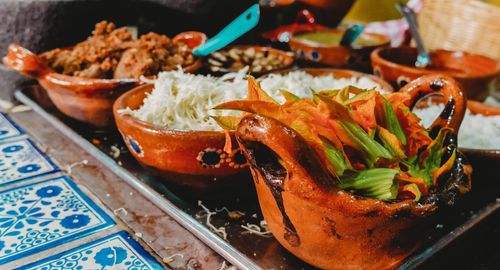
Veracruz offers up some fabulous food – the state’s coffee, fruit and vanilla are renowned, and the seafood is also superb. Huachinango a la Veracruzana (red snapper Veracruz-style) is served across the country, and is of course on every menu here; the Veracruzana sauce of tomato, chile, onions and olives can also spice up anything from steak to squid. Other local specialities include pulpos a la marinera (baby octopus), arroz a la tumbada (Veracruz-style rice, packed with seafood), empanadas de camaron (shrimp turnovers) and jaiba, a large local crab; look out too for anything made with chile chipotle, a hot, dark-brown chile with a very distinctive (and delicious) flavour – chilpachole de jaiba is a sort of crab chowder that combines the two. Sweet tamales, too, are a speciality, and to wash it all down, the brewery at Orizaba produces some of the best beers in the country. Stronger liquors include the mind-wiping toritos, made with fruits and blended with condensed milk and a tot of brandy.
Veracruz to Papantla
Immediately north of Veracruz lie the oldest Spanish settlements in Mexico, and the sites of the indigenous towns which became Cortes’ first allies. A short stretch of toll highway takes you as far as Cardel, a busy little town and handy place to change buses or visit the bank, at the junction of the coastal highway and the road up to Xalapa. La Antigua lies 2km off this road. Beyond Cardel there’s very little to stop for in the long coastal stretch (about 4hr on the bus) to Papantla. At Nautla, 153km from Veracruz, you pass the largest town en route to Papantla, surrounded by coconut groves, at the heart of the so-called “Costa Esmeralda”. There are hotels, some of them pretty fancy, trailer parks and campsites all the way up here, but most are just metres from the highway, which runs close to the shore. The grey sand is frequently desolate and windswept, and it’s not really a place you’d want to stay.
La Antigua
For all its antiquity, there’s not a great deal to see in LA ANTIGUA, site of the second Spanish settlement in Mexico (it’s often incorrectly described as the first – Villa Rica is further north), but it can be a pleasant short excursion on 8-day Mexico trips. It is, however, a beautiful, cobbled tropical village, just 20km north of Veracruz on the banks of the Río La Antigua (or Río Huitzilapan). At weekends it makes a popular excursion for Veracruzanos, who picnic by the river and swim or take boat rides.
In the semi-ruined centre of the village stand some of the oldest surviving Spanish buildings in the country: on the plaza are the Edificio del Cabildo, built in 1523, which housed the first ayuntamiento (local government) established in Mexico, and the Casa de Cortés, a fairly crude stone construction, which, despite the name, was probably never lived in by Cortés and is now a ruin, undergoing restoration. Nearby is the tranquil Ermita del Rosario, the first Christian church built in New Spain, which also dates from the early sixteenth century, though it’s been altered and restored since.
On the riverbank stands a grand old tree – the Ceiba de la Noche Feliz – to which it is claimed that Cortés moored his ships. A pedestrian suspension bridge crosses the river near the tree, and on this stretch of the bank are lanchas offering river trips and a little row of restaurants with waterside terraces, the pick of which is Las Maravillas.
Cempoala
The first native city visited by the conquistadors, CEMPOALA (or Zempoala) quickly became their ally against the Aztecs. When Cortés arrived, the city, under the leadership of Chicomacatl (dubbed the “Fat Chief” by conquistador Bernal Díaz del Castillo), had been under Aztec control for little over fifty years. Its people, who numbered some 25,000 to 30,000, had already rebelled more than once and were only too happy to stop paying their tribute once they believed that the Spaniards could protect them. This they did, although the inhabitants must have begun to have second thoughts when Cortés ordered the idols of their deities to be smashed and replaced with crosses and Christian altars.
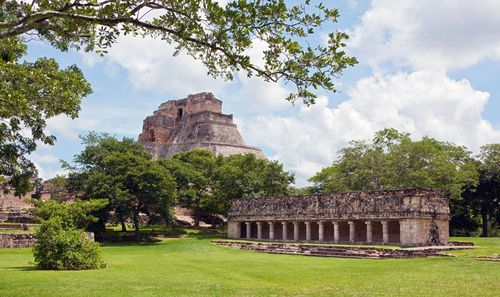
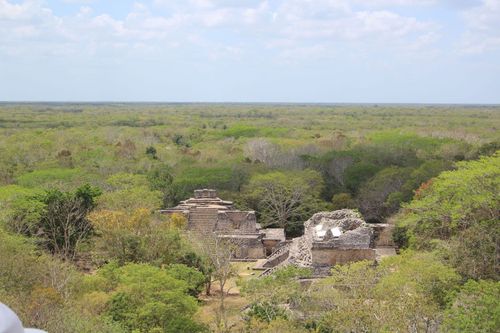
The ruins, though nowhere near as dramatic as El Tajín further north, make for an absorbing detour and take no more than an hour to explore. They date mostly from the Aztec period, and although the buildings have lost their decorative facings and thatched sanctuaries, they constitute one of the most complete surviving examples of an Aztec ceremonial centre – albeit in an atypical tropical setting and on a very small scale. The double-stairway pyramids, grouped around a central plaza, must have resembled miniature versions of those at Tenochtitlán. Apart from the main, cleared site, consisting of the Templo Mayor, the Gran Pirámide and the Templo de las Chimeneas, there are lesser ruins scattered throughout, and around, the modern village. Look out in particular for the circular Templo de Ehecatl (Temple of the Wind God) on the opposite side of the main road through the village.
Villa Rica
Around 15km north of Cardel, the sleepy village of Villa Rica was the first permanent Spanish settlement in New Spain. Established by Cortés in 1519, it was abandoned in 1524 for La Antigua, and only foundations remain today, close to the normally deserted beach. Just beyond, an exceptionally scenic area of steep, green hills is home to Mexico’s only nuclear plant, on the coast at Laguna Verde.’s only nuclear plant, on the coast at Laguna Verde.
Papantla and around
PAPANTLA, 227km from Veracruz, is the most attractive town on the route north, straggling over an outcrop of low, jungly hills. Even so, if it weren’t for the proximity of El Tajín, few people would consider staying here. In addition to being one of the most important centres of the Mexican vanilla industry – the sweet, sticky odour frequently hangs over the place, and vanilla products are on sale everywhere – Papantla is also one of the last surviving strongholds of Totonac culture. You’ll see Totonacs, barefoot and in loose white robes in the markets, and can regularly witness the amazing dance-spectacle of the Voladores de Papantla.
On the edge of the zócalo, the huge Mural Cultural Totonaca depicts the clash between modern and traditional life, with sculpted images of Totonac gods, myths and the pyramids of El Tajín alongside oil rigs and farm machinery (the tourist office has a leaflet describing this in detail). It’s best appreciated in the evening, when floodlights pick out the relief and the zócalo itself is wildly animated; especially at weekends, when there’s often live music and dancing. On the terrace above the mural stands the solid Catedral de la Asunción, beyond which you can climb to the Volador monument, a giant statue affording tremendous views of the town.
The Voladores de Papantla
Although the full significance of the dance of the voladores has been lost over time, it has survived much as the earliest chroniclers reported it, largely because the Spanish thought of it as a sport rather than a pagan rite. It involves five men: a leader who provides acoustics on flute and drum, and four performers. They represent the five earthly directions – the four cardinal points and straight up, from earth to heaven. After a few preliminaries, the five climb to a small platform atop a pole, where the leader resumes playing and directs prayers for the fertility of the land in every direction. Meanwhile, the dancers tie ropes, coiled tightly around the top of the pole, to their waists and at a signal fling themselves head-first into space. As they spiral down in increasing circles the leader continues to play, and to spin, on his platform, until the four hit the ground (hopefully landing on their feet, having righted themselves at the last minute). In all, they make thirteen revolutions each, symbolizing the 52-year cycle of the Aztec calendar.
At Papantla (performances in front of the cathedral Fri, Sat & Sun 10.30am–7pm) and El Tajín (regular performances outside the entrance to the ruins starting at 11am), the ritual has become primarily a tourist spectacle, as the permanent metal poles attest. In local villages there is still more ceremony attached, particularly in the selection of a sufficiently tall tree to act as the pole, and its temporary erection in the place where the dance is to be performed. Note that performances are nominally free, though if you catch one of the regular shows in Papantla or El Tajín you’ll be expected to make a donation.
El Tajín
With numerous substantial structures spread over an extensive site, EL TAJÍN is by far the most important and impressive archeological site on the Gulf coast. It divides broadly into two areas: Tajín Viejo, which centres on the amazing Pirámide de los Nichos, and Tajín Chico, a group of official residential buildings belonging to the city’s ruling class built on an artificial terrace. The site museum, by the entrance, has a model of the site worth examining before you venture in, along with a collection of the more delicate stonework salvaged from the ruins, notably murals and columns, bits of pottery and statues – displays are primarily labelled in Spanish, but there are a few English explanations.
Brief history
The principal architecture at El Tajín dates from the Classic period (300–900 AD); the city declined in the early Post-Classic (900–1100 AD), and by the time of the Conquest it had been forgotten. Our knowledge comes entirely from archeological enquiries made since the accidental discovery of the site in 1785 – El Tajín remains one of the most enigmatic of all of Mexico’s ancient cities. No one even knows who built it: some claim it was the Huastecs, others the Totonacs. Most archeologists prefer not to speculate too wildly, instead calling the civilization Classic Veracruz. You’ll notice many of its hallmarks at El Tajín, including niches in temple walls and complex ornamental motifs known as “scrolls”. Classic Veracruz influence was widespread, and is strongly felt at Teotihuacán,to the extent that some believe that city may have been built by Veracruzanos.
Tajín Viejo
From the site entrance, a track leads through a small group of buildings to the Plaza del Arroyo, the city marketplace, and into the heart of Tajín Viejo. Around the plaza are several ball-courts, the most prominent of which is the South Court, or Juego de Pelota Sur; it looks like a wide avenue between two small pyramids. Seventeen such courts are known here, and more possibly lie unexcavated; it’s thought that the game took on a greater importance here than at any other known site. The superb bas-relief sculptures that cover the walls of the South Court include portrayals of a decapitated player, and another about to be stabbed with a ritual knife by fellow players, with Death waiting to his left. Such bas-reliefs are a constant feature of the site, adorning many of the ball-courts and buildings, with more stacked in the museum.
The unique Pirámide de los Nichos, one of the last to be built here, is the most famous building at El Tajín, and indeed one of the most remarkable of all Mexican ruins. It rises to a height of about 20m in six receding tiers, each face punctuated with regularly spaced niches; up the front a steep stairway climbs to a platform on which the temple originally stood. If you tally up the niches, including those hidden by the stairs and those, partly destroyed, around the base of the temple, there are 365 in all. Their exact purpose is unknown, but clearly they were more than mere decoration: theories include each holding some offering or sacrifice, one for each day of the year, or that they symbolized caves to the underworld – the dwellings of the earth god. Originally they were painted black, with the pyramid in red, to enhance the impression of depth. Niches are also present on other buildings at the site, some bearing the attributes of Quetzalcoatl, the plumed serpent, El Tajín’s most depicted god.
Around the plaza in front of the pyramid stand all the other important buildings of Tajín Viejo. Opposite is Monumento 3, a similar pyramid without niches, and behind it Monumento 23, a strange steep-sided bulk, one of the last structures to be built here. To the right of the Pirámide de los Nichos, Monumento 2, a low temple, squats at the base of Monumento 5, a beautiful truncated pyramid with a high decorative pediment broken by a broad staircase; on the left, Monumento 4 is one of the oldest at El Tajín, and only partly restored.
Tajín Chico
From the back of Monumento 4 the path continues past the Juego de Pelota Norte, with its worn relief sculptures, onto the levelled terrace of Tajín Chico, home of the city’s elite. From here, you get a great overview of Tajín Viejo. Only parts of the buildings survive, making a rather confusing whole. Edificio C and the adjoining Edificio B are the most impressive remains: Edificio C has stone friezes running around its three storeys, giving the illusion of niches. In this case, they were purely decorative, an effect that would have been heightened by a brightly coloured stucco finish. It also has the remains of a concrete roof – originally a huge single slab of poured cement, unique in ancient Mexico. Edificio A had a covered interior, and you can still see the entrance covered by a false arch of the type common in Maya buildings.
Estructura I (aka Edificio de las Pinturas) is distinguished by a palapa roof protecting its elaborate decoration, including relief carvings and delicately painted murals. Such luxurious decor suggests that this was probably the residence of some major political or religious figure. On the hill above Tajín Chico stood the Edificio de las Columnas, which must have dominated the entire city. El Tajín’s most famous ruler, 13 Rabbit, lived here; bas-reliefs on columns recorded his exploits, and some of these are now on show in the museum.
Gran Greca
From the terrace of Tajín Chico you can walk down the stone path to the Gran Greca complex, also known as Xicalcoliuhqui, whose spiral walls contain two ball-courts and more pyramids. It has been only partially cleared of jungle, but you can stroll along the walled edges to get a sense of its vast size. Built towards the end of the city’s life, it is regarded as a sign of growing crisis, Tajín’s rulers becoming increasingly obsessed with monumental projects in order to maintain control over a disenchanted populace.
El Baile de los Negritos
Popular at festivals across the state of Veracruz, the frenetic Baile de los Negritos is a Totonac dance dating back to colonial times, when African slaves were imported to work on local plantations, often living and labouring alongside indígenas. Stories abound as to the origin of the dance: the most popular version has it that a female slave and her child escaped from a plantation near Papantla and lived in the dense jungle with local indigenous groups. After her child was poisoned by a snake bite, the mother, using African folk medicine, danced herself into a trance. The Totonacs around her found the spectacle highly amusing and, it is said, began to copy her in a spirit of mockery.
Good opportunities to see the dance are Corpus Christi (late May–June) in Papantla, or in Tlapacoyan at the Feast of Santiago (July 25) or the Day of the Assumption (Aug 15); it’s frequently performed on a smaller scale at other village festivals in the area.
Rough Guides tip: Find tons of ideas for your Mexican adventure in our guide to the best vacation spots in Mexico.