Royal deities
A word about the confusing matter of royal deities: Gorakhnath, a mythologized Indian guru, was revered as a kind of guardian angel by all the Shah kings, and Taleju Bhawani, to whom many temples and bells are dedicated in the Kathmandu, Patan and Bhaktapur Durbar squares, played a similar role for the Malla kings. The kings of both dynasties worshipped the Kumari, but mainly as a public gesture to secure her tika, which lent credibility to their divine right to rule.
The old city
The Kathmandu most travellers come to see is the old city, a tangle of narrow alleys and temples immediately north and south of the central Durbar Square. Its dense lanes, courtyard architecture and easy access to major heritage sights make it a natural focus for 9-day Nepal trips, giving you enough time to explore the city properly before heading on to the mountains or lowlands.
It’s a bustling quarter, where tall extended-family dwellings block out the sun, open-fronted shops crowd the lanes and vegetable sellers clog the intersections. The fundamental building block of the old city is the bahal (or baha) – a set of buildings joined at right angles around a central courtyard. Kathmandu is honeycombed with bahal, many of which were originally Buddhist monasteries, but have since reverted to residential use.
Though the city goes to bed early, there’s always something happening from before dawn to around 10pm, including early morning religious rites (puja) and after-dinner devotional hymn-singing (bhajan) in the neighbourhoods of Indrachowk, Asan or Chhetrapati.
Durbar Square
Teeming, touristy Durbar Square is the natural place to begin sightseeing. The fascinating old royal palace (durbar), running along the eastern edge of the square, takes up more space than all the other monuments combined. Kumari Chowk, home of Kathmandu’s “living goddess”, overlooks from the south. The square itself is squeezed by the palace into two parts: at the southwestern end is the Kasthamandap, the ancient building that probably gave Kathmandu its name, while the northern part is taken up by a varied procession of statues and temples.
Indra Jaatra: eight days of pomp and partying
According to Kathmandu Valley legend, Indra, the Vedic King of Heaven, wanted to buy flowers for his mother. Unable to find any in heaven, he descended to the valley and stole some, but was caught and imprisoned. When Indra’s mother came looking for him, the people realized their mistake and to appease him, started an annual festival in his honour.
Usually held in late August or early September, Indra Jaatra is an occasion to give thanks to the god for bringing the monsoon rains that make the vital summer rice crop possible. Yet Indra’s humiliation is a parallel theme, as straw effigies of the god are placed in jails. Another local legend claims an invading king, calling himself Indra, was defeated by the valley’s indigenous people, and some anthropologists believe such an event may have provided the historical impetus for the festival.
Indra Jaatra features eight days of almost nonstop spectacle. It begins with the ceremonial raising of a 15m-tall pole in front of the Kala Bhairab statue by members of the Manandhar (oil-presser) caste. In Indrachowk, the famous blue mask of Akash Bhairab, a god sometimes identified with Indra, is displayed, as are lesser Bhairab images in other neighbourhoods. Locals do puja (an act of worship) to them by day, and light lamps by night in memory of deceased relatives. Masked dancers perform around the old city, and one group stages a tableau of the das avatar (the ten incarnations of Vishnu) at the base of the Trailokya Mohan.
Indra Jaatra is the fusion of two festivals, and the second, Kumari Jaatra, begins on the afternoon of the third day. From noon, Durbar Square steadily fills up with spectators and, in the balcony of the Gaddi Baithak, with politicians and foreign dignitaries dressed in formal attire. (Tourists are herded into an area around the Shiva Parbati Mandir, where it’s hard to get a decent view unless you’re right behind the police cordon; however, women can sit on the elevated steps of the Maju Dewal.) Masked dancers entertain the crowd: the one in the red mask and shaggy hair is the popular Lakhe, a demon said to keep other spirits at bay if properly appeased. The procession formerly began when the king and queen arrived, but now senior politicians have taken over their roles. The Kumari and two attendants, representing Ganesh and Bhairab, are pulled in wooden chariots around the square past the Gaddi Baithak. They then make a circuit of the southern old city, as far as Jaisi Dewal and Lagan, before returning to the square after dark.
When they depart, the formal ceremony gives way to all-out partying. Dance troupes from around the valley perform near the entrance to the old royal palace, and a pantomime elephant – Indra’s mount – careers through the streets. Young men gravitate toward Sweta Bhairab where, after lengthy ritual preliminaries, rice beer flows from a pipe sticking out of the idol’s mouth.
Without the VIPs and ceremonial pomp, the chariots are again pulled the next afternoon, past Nardevi and Asan. On the final day, after a few days of relative calm, the chariots are pulled for a third time to Kilagal. According to legend, this last procession was added by King Jaya Prakash Malla to allow his concubine, who lived in Kilagal, to see the Kumari. In the days of the monarchy, when the chariots returned to Durbar Square later that evening, the king would come before the Kumari to receive the royal tika that assured his right to rule for another year. Finally, the ceremonial pole is pulled down, and people take pieces of it as amulets against ghosts and spirits.
Thamel
In the Thamel tourist zone north of Thahiti, old buildings are scarce, though Kwa Bahal, a traditional courtyard tucked away just off the touristy main drag, is one of several bahal in Kathmandu and Patan that have their own Kumaris. Bhagwan Bahal, which lends its name to an area north of Thamel Chowk, is home to a little-used pagoda whose most notable feature is a collection of kitchen pans and utensils nailed to the front wall as offerings to the deity. (“Bikrama Sila Mahabihar”, the name on the sign in front, refers to a moribund monastery contained within the complex.) During the spring festival of Holi, a portrait of the bahal’s eleventh-century founder is displayed to celebrate his slaying of demons on his return from a trade delegation to Lhasa.
The Bagmati ghats
The old city south of Durbar Square is home mainly to working-class castes and, increasingly, immigrant squatters from other parts of Nepal. With fewer traders, it’s less touristy than the quarters north of the square, although New Road, which bristles and throbs with consumerism, is as lively a street as any in Kathmandu.
A path from the open-air shrine of Pachali Bhairab leads to the Bagmati River ghats, stretching as far as the eye can see in either direction. Statues, temples and all manner of artefacts are jumbled along these stone-paved embankments – especially to the west, where the Bishnumati joins the Bagmati – and you could easily spend several hours here. The area has been the subject of a proposed restoration project for many years – several link roads that aim to reduce the city’s chronic congestions are also being built – so perhaps it will some day enjoy a much-deserved renaissance. For the time being, though, it’s in a pretty sorry state of neglect.
Pachali Ghat
The path forks before reaching the river, but both ways lead to Pachali Ghat and its remarkable collection of Hindu and Buddhist statuary. If you take the right fork, you’ll enter an area that serves as a neat introduction to the Newari pantheon of gods. Statues in niches along the right-hand wall depict (from right to left) Hanuman, Saraswati, the green and white Taras, Bhairab, Ganesh, a linga/yoni, a standing Vishnu, the Buddha, Ram, Shiva as sadhu, and a flute-playing Krishna. On the left are many more, concluding with depictions of the ten incarnations (das avatar) of Vishnu: fish, tortoise, the boar Baraha, the man-lion Narasingh, the dwarf Vaman, the Brahman Parasuram, the mythical heroes Ram and Krishna, the Buddha, and finally Kalki, the saviour yet to come.
Off to the right is the three-tiered Lakshmishwar Mahadev Mandir which occupies a crumbling bahal that’s been taken over by a school. The temple’s construction was sponsored by the late eighteenth-century queen Rajendra Laskhmi Devi Shah.
Pancha Nadi Ghat
Continuing downstream (westwards), you pass under an old footbridge and a modern motorable one, both leading to Patan’s northern suburb of Sanepa. Beyond is Pancha Nadi Ghat which used to be one of Kathmandu’s most important sites for ritual bathing, but no longer is, as the Bagmati has receded from the embankment: the river is literally shrinking as its water is siphoned off for ever-growing industrial and domestic needs. The several pilgrims’ shelters (sattal) and rest-houses (dharmsala) along here have been taken over by squatters.
A small sleeping Vishnu in this area recalls, in miniature, the great statue at Budhanilkantha. Cremations are infrequently held at the nearby burning ghats and butchers slaughter animals down by the river in the early morning.
Teku Dobhan
The embankment ends just short of Teku Dobhan, the confluence (dobhan) of Kathmandu’s two main rivers, the Bagmati and the Bishnumati. The spot is also known as Chintamani Tirtha – a tirtha is a sacred place associated with nag (snake spirits).
The confluence area is ancient, though none of the temples or buildings is more than a century old. The most prominent is the Radha Krishna Mandir, a brick shikra built in the 1930s; flute-playing Krishna is the middle of three figures inside. The rest-house behind the temple, Manandhar Sattal, is named after a wealthy nineteenth-century trader who was forced to retire here after his property was confiscated by the prime minister. The next-door building is an unused electric crematorium built in the 1970s. The riverbank from here downstream to the Ring Road has been used as a landfill: this dumping site, like an earlier one further upstream near the Pashupatinath temple complex, will leak toxins into the river for decades to come.
Tin Dewal
Heading upstream (eastwards) from Pachali Ghat, you reach the atmospheric Tin Dewal (“Three Temples”) by an entrance from the riverside. The temple’s popular name refers to its three brick shikra sharing a common base and ground floor – an unusual combination of Indian and Nepali styles, with some fine brick detailing.
A sign identifies the site by its official name, which is transliterated into English as Bomveer Vikalashora Shibalaya. The complex was erected in 1850 by Bom Bahadur Kunwar, brother of Jang Bahadur Rana, who’d seized power in a bloody coup four years earlier. A shivalaya (a shrine containing a linga) can be seen behind each of the temple’s three lattice doors.
Further east there’s a 300m break in the embankment, as a path makes its way through a semi-permanent shantytown. Its residents – landless rubbish-pickers, day labourers and street vendors – have moved in as the river has receded, and take their chances each monsoon.
West of the Bishnumati
Most of Kathmandu west of the Bishnumati River was settled relatively recently, with much of the development focused on the ugly Kalimati–Kalanki corridor and the suburbs either side. The only real antiquities are the famous Swayambhu stupa and a few shrines and temples that can be visited en route, plus the exhibits preserved in the National Museum. All of these sights are within fairly easy walking distance of central Kathmandu or Thamel, but to make a circuit of all of them it’s more pleasant to hire a bike or taxi for the day (taxis wait at Swayambhu, but are hard to find near the museum).
Swayambhu
Swayambhu (or Swayambhunath), magnificently set atop a conical hill 2km west of Thamel, is a great place to get your bearings, geographically and culturally, in your first few days in Nepal: the hill commands a sweeping view of the Kathmandu Valley, and the temple complex is overrun with pilgrims and monkeys.
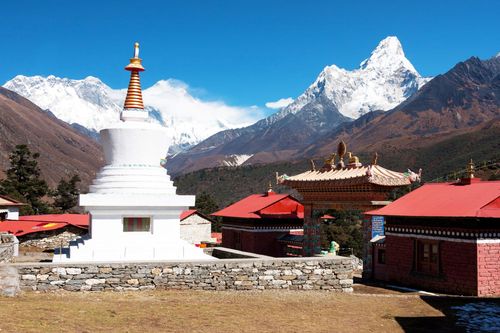
The ancient stupa – which has benefited from a recent renovation – is the most profound expression of Buddhist symbolism in Nepal (many bahal in the valley contain a replica of it), and the source of the valley’s creation myth. Inscriptions date the stupa to the fifth century, and there’s reason to believe the hill was used for animist rites even before Buddhism arrived in the valley two thousand years ago. Tantric Buddhists consider it the chief “power point” of the Kathmandu Valley; one chronicle states that an act of worship here carries thirteen billion times more merit than anywhere else. To call it the “Monkey Temple” (its tourist nickname) is to trivialize it.
The apparently simple structure belies an immensely complex physical representation of Buddhist cosmology, and the purpose of walking round it is to meditate on this. The solid, whitewashed dome (garbha) symbolizes the womb or creation. Set in niches at the cardinal points, statues of dhyani (meditating) Buddhas correspond to the four elements (earth, air, fire and water) and a fifth, placed at an angle, to the sky or space. Each represents a different aspect of Buddhahood: the hand positions, colours and “vehicles” (the animal statues below) of each are significant. The dhyani Buddhas are the same characters who appear on virtually every chaitya around the Kathmandu Valley. At each of the sub-cardinal points sit female counterparts, who in tantric Buddhism represent the wisdom aspect that must be united – figuratively speaking – with the compassionate male force to achieve enlightenment.
The gilded cube (harmika) surmounting the stupa surrounds a thick wooden pillar, which may be considered the phallic complement to the female dome. The eyes painted on it are those of the all-seeing Adi-Buddha (primordial Buddha), staring in all four directions. Between the eyes is a curl of hair (urna), one of the identifying features of a Buddha; the thing that looks like a nose is a miraculous light emanating from the urna (it can also be interpreted as the Nepali figure “one”, conveying the unity of all things). A spire of gold disks stacked above the pillar represents the thirteen steps to enlightenment, while the torana, or gold plaques above the painted eyes, also show the five dhyani Buddhas, known collectively as the panchabuddha. Finally, the umbrella at the top symbolizes the attainment of enlightenment: some say it contains a bowl filled with precious gems.
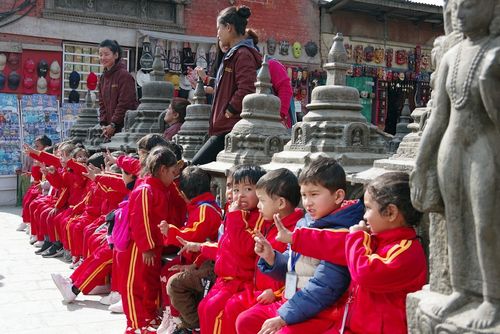
Since the Chinese invasion of Tibet in 1959, the surrounding area has become home to many exiled Tibetans. You’ll see them and many other Buddhist pilgrims making a full circumambulation (kora) of the hill, queuing up to spin the gigantic fixed prayer wheels and the six thousand smaller ones that encircle the perimeter, and frequently twirling their own hand-held ones. The place is so steeped in lore and pregnant with detail you’ll never absorb it all in a single visit. Try going early in the morning at puja time, or at night when the red-robed monks pad softly around the dome, murmuring mantras.
A paved road circles the base of the hill. Although there are several other ways up, the steep main path from the eastern entrance, with its three-hundred-odd centuries-smoothed steps, is the most dramatic. The Buddha statues near the bottom are from the seventeenth century, while a second group further up was donated in the early part of the twentieth century. The chiselled slates sold by entrepreneurs along the path are mani stones, inscribed, in Tibetan script, with the ubiquitous Buddhist mantra Om mani padme hum – “Hail to the jewel in the lotus”. Swayambhu stupa is surrounded by an incredible array of shrines and votive items, most of which have been donated over the past four centuries by merit-seeking kings and nobles.
The legend of Manjushri
According to Buddhist scriptures, the Kathmandu Valley was once a snake-infested lake – and geologists agree about the lake (see History). Ninety-one aeons ago, a perfect, radiant lotus flower appeared on the surface of the lake, which the gods proclaimed to be Swayambhu (“self-created”), the abstract essence of Buddhahood. Manjushri, the bodhisattva of knowledge, drew his sword and cut a gorge at Chobar, south of Kathmandu, to drain the lake and allow humans to worship Swayambhu. As the water receded, the lotus settled on top of a hill and Manjushri established a shrine to it, before turning his attention to ridding the valley of snakes and establishing its first civilization. Another legend tells how, when Manjushri cut his hair at Swayambhu, the strands that fell on the ground grew into trees, and the lice turned into monkeys.
Where are the mountains?
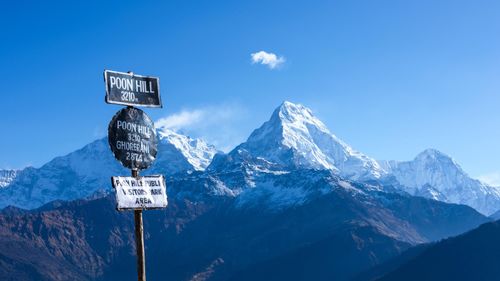
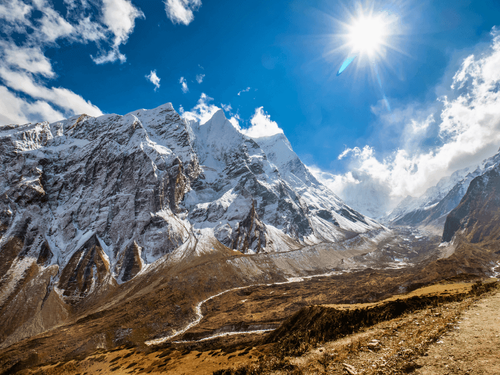
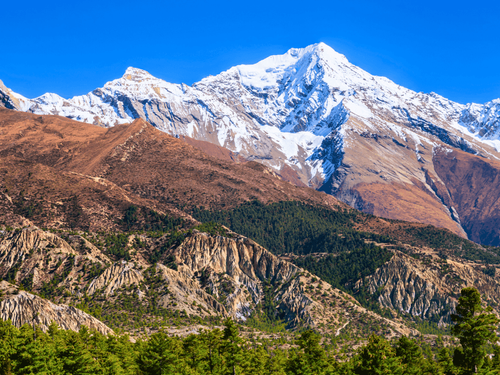
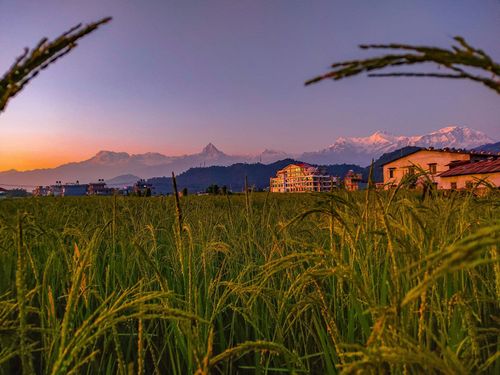
They’re there – behind the smog. In the 1990s, peaks such as Ganesh I, Langtang Lirung and Dorje Lakpa could be seen most mornings from Kathmandu. Now they’re rarely visible from the metropolitan area except on clear mornings after a soaking rain, or on bandh (general strike) days when all traffic is banned.
Kathmandu is among the world’s most polluted cities, and the traffic and fumes are appalling. The ever-increasing number of cars, motorbikes, buses and lorries, fuel adulteration, lax emissions tests, poorly surfaced roads, rapid urbanization, rubbish dumping and high levels of general pollution, mean that air quality frequently reaches “unhealthy” levels, according to official measurements. This toxic brew irritates lungs and eyes, weakens immune systems and increases the long-term risk of various health problems. If you can help it, don’t stay more than a couple of days in Kathmandu at the start of your trip to Nepal. If you do, you’re likely to come down with a chest or sinus infection that will dog you for days and may be hard to shake if you go trekking.