Kinabalu National Park Travel Guide
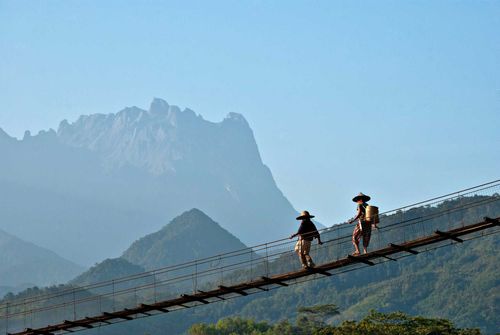
Sabah holds no more impressive sight than Gunung Kinabalu (Mount Kinabalu), 85km northeast of KK and plainly visible from the west coast. Revered as “aki nabalu” (home of the spirits of the dead) by the Kadazan/Dusun, it’s 4095m high and dominates the 750 square kilometres of KINABALU NATIONAL PARK, a World Heritage Site renowned for its ecology, flora and geology. Although there are other hikes within the park, the prospect of reaching the summit fires the imagination of Malaysian and foreign tourists alike.
Gunung Kinabulu: the climb
Conquering Gunung Kinabalu today is far easier than it was in 1858, when Spenser St John, British consul-general to the native states of Borneo, found his progress blocked by Kadazan “shaking their spears and giving us other hostile signs”. Hugh Low, then British colonial secretary on Pulau Labuan, had made the first recorded ascent of the mountain seven years earlier, though he baulked at climbing its highest peak, considering it “inaccessible to any but winged animals”. The peak – subsequently named after Low – was finally conquered in 1888 by John Whitehead.
Here we detail the Timpohon trail to the top as it is by far the most popular, although a longer and quieter route up, the Mesilau trail, starts 17km east of the park HQ, and offers a greater chance of spotting wildlife.
The first day
The summit route begins with an optional but time-saving minibus ride (25min; RM16.50/vehicle) to the start of the Timpohon trail. The day’s climb to the mountain huts at Laban Rata takes between five and seven hours, depending on your fitness and trail conditions. Roots and stones along the trail serve as steps, with wooden “ladders” laid up the muddier stretches. There are regular rest shelters with toilets along the path.
To Layang Layang
The air gets progressively cooler as you climb, but the walk is still hard and sweaty, and you’ll be glad of the water tanks and rest point at Layang Layang (2621m), three hours into the climb. Around this point, if the weather is kind, incredible views of the hills, sea and clouds start to unfold below you.
To Laban Rata
At just above 3000m, a detour to the left brings hikers to Pondok Paka, a large overhanging rock that was the site of overnight camps on early expeditions. It’s a further 6km to Laban Rata, which lies at 3272m. The final 2km, dominated by large boulders and steep slippery rock surfaces, are demanding even for the fittest, particularly considering the lower oxygen levels. The rewards are the view of the mighty granite slopes of the Panar Laban rock face, plus the promise of reaching your accommodation.
The second day
Most climbers get up at 2.30am for the final ascent, although those who are particularly fit might leave slightly later to avoid getting to the summit too long before sunrise.
To the summit
The trail crosses the sheer Panar Laban rock face, past the Sayat Sayat hut and onwards to the summit at Low’s Peak. Although ropes, handrails and wooden steps help in places, it’s a stiff climb at the very least. You’ll also be doing it in pitch darkness so headlamps are an advantage and a powerful torch a must. Climbers should also be aware of the symptoms of altitude sickness.
After the final push, the beautiful spectacle of sunrise at Low’s Peak will rob you of any remaining breath. Remember that it’ll be bitingly cold, so bring very warm clothing for that brief photo stop at the summit.
Descending from the mountain
After all that toil, it’s back to Laban Rata for a hearty breakfast – prepare to be shocked when you see the sharp drops along the trail, which were not visible in the dark. Then it’s time to head back down to park HQ, which usually takes three to five hours. As your leg muscles ache from the relentless downhill trudge – which is likely to get worse the next day – take a moment to reflect on the fact that the record time for the annual Kinabalu Climbathon is just over two and a half hours. That’s up and down.
Preparing to climb Gunung Kinabulu
Climbing the mountain has become a must-do in Borneo itineraries. For the thousands of people who come here annually to haul themselves up, the process is made easier by a well-defined, 8.5-kilometre-long path that weaves up through jungle on the southern side to the bare granite of the summit.
Despite its popularity, it’s a very tough trek and not to be undertaken lightly. Even given perfect weather conditions, there’s a remorseless, freezing, final pre-dawn ascent to contend with and it’s quite possible to suffer from altitude sickness and not get to the top. Bad weather can also scupper an ascent, or at least make it a pretty miserable experience.
Don’t undertake the challenge unless you are fully prepared with suitable clothing and in good general health. If you suffer from vertigo then you shouldn’t have a problem on the route up to Laban Rata (where there’s foliage to hide any drops), or even for the summit ascent (since it’s in the dark), but the way down from the summit may cause you problems.
Booking ahead
If you want to do the climb in just one day – an option only available from tour operators based in KK – then you can substantially cut costs. This does, however, mean an exceptionally long and tiring day on the mountain, while the view from the top will almost certainly be obscured by clouds by the time you get there. Getting a permit for a day-trip can also be difficult. All in all, it isn’t really worth it.
For the vast majority of visitors, therefore, ascending and descending Gunung Kinabalu takes two days. The standard route begins at the park HQ, two hours from KK and 1588m up. It’s possible to arrive on the morning of the climb, but spending the previous night in the area is a good idea; it gives time to acclimatize and means you can make an earlier start in the morning. Climbers then have to spend a night two-thirds of the way up the mountain in huts at Laban Rata, allowing for a final dawn ascent.
The accommodation on the mountain is often booked up long in advance, although tour operators in KK may be able to offer a package at short notice for an additional fee; you can also call direct in the hope of a cancellation. Avoid booking packages with overseas tour operators, which can work out a lot more expensive.
What to bring
Essential items to carry with you include a torch (preferably a headlamp), headache tablets, suntan lotion, energy boosters (such as nuts, fruit and muesli bars), and a water bottle (there’s unfiltered but drinkable water along the trail). Wear waterproof shoes or hiking boots with a good tread, and bring a few layers of warm clothing for the summit; the Laban Rata resthouse has a few jackets for rent, but you need to call ahead to reserve one. Most guides do not carry first-aid kits, so it’s best to bring your own.
The morning of the climb
Get to the park HQ as early as possible: the last group usually sets off by 11am, but ideally you should be here by 9am, in order to reach Laban Rata before the hot water runs out in the showers. Call in at the Sutera Sanctuary Lodges reception to confirm your place at Laban Rata, then go next door to the Sabah Parks office to pay the various fees.
Besides the climbing permit, conservation fee and insurance, you must pay for a guide. All those charges are mandatory; some climbers also opt to pay for a porter (maximum load 10kg). If you’re alone, ask whether you can join another group for company and to save on the guide fee. Lockers and a safe room are available at the HQ to deposit valuables or even your pack.
Kinabalu flora and fauna
If you dash headlong up and down Gunung Kinabalu and then depart, as many visitors do, you’ll miss out on many of the national park’s riches. Its diverse terrains have spawned an incredible variety of plants and animals, and you are far more likely to appreciate them by walking some of the lower trails (see Around the park headquarters) at a leisurely pace.
Plants
Around a third of the park’s area is covered by lowland dipterocarp forest, characterized by massive, buttressed trees and allowing only sparse growth at ground level. The world’s largest flower, the parasitic – and elusive – Rafflesia, occasionally blooms in the lowland forest. Between 900m and 1800m, you’ll come across the oaks, chestnuts, ferns and mosses (including the Dawsonia – the world’s tallest moss) of the montane forest.
Higher up (1800–2600m), the cloudforest supports a huge range of flowering plants: around a thousand orchids and 26 varieties of rhododendron have been identified, including Low’s rhododendron with its enormous yellow flowers. The hanging lichen that drapes across branches of stunted trees lends a magical feel to the landscape at this height. It’s at this altitude, too, that you’re most likely to see the park’s most famous plants – its nine species of insectivorous pitcher plants (Nepenthes) whose cups secrete a nectar that first attracts insects and then drowns them, as they are unable to escape up the slippery sides of the pitcher.
Higher still, above 2600m, only the most tenacious plantlife can survive – like the agonizingly gnarled sayat-sayat tree, and the heath rhododendron found only on Mount Kinabalu – while beyond 3300m, soil gives way to granite. Here, grasses, sedges and the elegant blooms of Low’s buttercup are all that flourish.
Animals
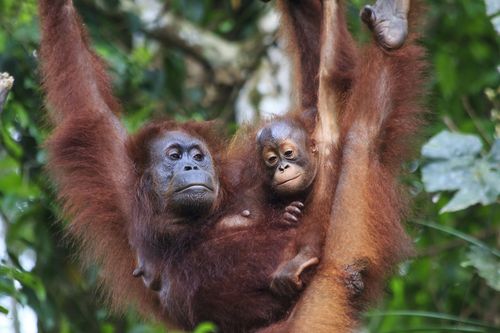
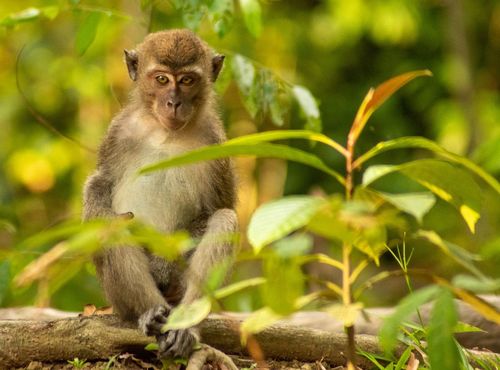
Although orang-utans, Bornean gibbons and tarsiers are among mammals that dwell in the park, you’re unlikely to see anything more exotic than squirrels, rats and tree shrews, or conceivably a mouse deer or a bearded pig if you’re lucky. The higher reaches of Gunung Kinabalu boast two types of birds seen nowhere else in the world – the Kinabalu friendly warbler and Kinabalu mountain blackbird. Lower down, look out for hornbills and eagles, as well as the Malaysian tree pie, identifiable by its foot-long tail. You’re bound to see plenty of insects: butterflies and moths flit through the trees, while the forest floor is home to creatures like the trilobite beetle, whose orange-and-black armour-plating lends it a fearsome aspect.
Mountain Torq
If merely walking up to the summit isn’t enough of a challenge, then Asia’s first via ferrata – pathways of rungs, ropes, rails and planks running along sheer cliffsides – may provide the adrenaline rush you are looking for. It’s exhilarating stuff with some incredible views, yet it’s safe because you’re always clipped onto something. Of the two routes, one is suitable for anyone over ten years old, the other has a minimum age of seventeen.
Located close to Laban Rata, the Mountain Torq centre also runs climbing and abseiling courses. Participants can arrange to stay at the Pendant Hut instead of at Laban Rata.
Kundasang
Ten kilometres along the road from Poring to Ranau, KUNDASANG is little more than a junction where simple stalls sell fruit and vegetables. It is, however, worth a stop for those interested in the World War II history of Borneo.
Kundasang War Memorial
The Kundasang war memorial commemorates the victims of the Sandakan Death Marches of 1945, when Japanese troops force-marched POWs from Sandakan to Ranau. No soldiers are buried here.
The site has been extensively renovated, and now includes an information centre that shows an Australian documentary about the death marches, plus three peaceful and well-tended memorial gardens (Australian, British and Bornean).
From Lahad Datu to the Maliau Basin
Sabah’s main trunk road continues southeast from Sandakan and the Sungai Kinabatangan to Lahad Datu. This unenthralling town offers access to two excellent rainforest areas: Danum Valley Conservation Area and Tabin Wildlife Reserve. Further south, Semporna draws scuba divers headed for the world-renowned Pulau Sipadan. It’s possible to stay in town or in an island resort; the latter range from backpacker shacks to luxurious retreats.
The main road around Sabah stops at the busy, noisy town of Tawau, from which ferries depart for Indonesian Kalimantan. Also from Tawau, 4WDs head daily for Keningau along rough routes that complete a ring road of sorts. This is also the way to the Maliau Basin, a magnet for trekkers although only accessible within expensive tour packages.
Danum Valley Conservation Area
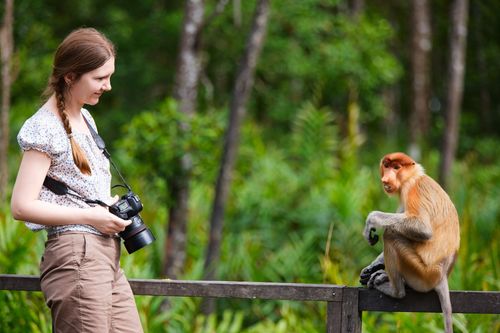
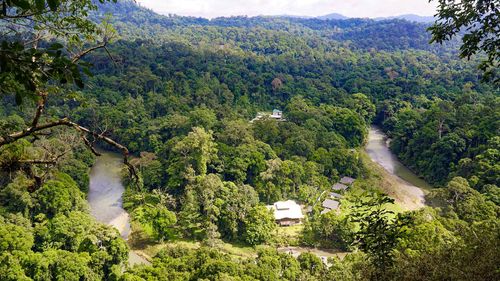
Spanning 438 square kilometres, over ninety percent of its primary dipterocarp rainforest, the Danum Valley Conservation Area (DVCA) is contained within a sprawling logging concession. Wildlife includes bearded pigs, orang-utans, proboscis monkeys, clouded leopards and elephants, as well as reptiles, fish, insects and more than 320 bird species. Short hiking trails are limited to the eastern side, where the tourist accommodation is located. The remainder is pristine forest, out of bounds to all but researchers.
Semporna
Travellers usually only visit the chaotic, traffic-clogged town of SEMPORNA because they plan to scuba dive and snorkel off nearby islands such as Sipadan, Mabul and Kapalai. While some divers base themselves on the islands, particularly Mabul, a backpacker scene has developed in Semporna since staying inexpensively can release funds for an extra dive or two. It also gives access to the more northerly islands, not usually visited from Mabul.
Semporna broadly consists of three sections: downtown, the commercial centre where buses and minivans stop; Semporna Seafront, home to dive operators (there are yet more out in the resorts themselves) and most tourist accommodation (plus an ATM in front of the Giant supermarket); and the jetty-lined Jalan Kastam, which holds more dive kiosks, a few cafés and the business-oriented Seafest Hotel.
The sea gypsies
Generations of Muslim Bajau and Suluk peoples have farmed the Celebes and Sulu seas for fish, sea cucumbers, shells and other marine products. Often dubbed sea gypsies, these people were originally nomads who lived aboard intricately carved wooden boats called lepa-lepa. Most are now settled in Semporna or on the islands around it, but their love of (and dependence upon) the sea remains strong, and the traditional red and yellow sails of the Bajau boats can sometimes still be seen billowing in the breeze. Every April, the Regatta Lepa Semporna (wetawau.com/Semporna/LEPA/LEPA.htm) sees the boats converge on the town for two days. Amid traditional singing and dancing, as well as sea sports and competitions, awards are given for the best lepa-lepa.
Islands around Semporna
Visitors come to Semporna not to hang out in town, but to explore the magnificent islands offshore. The prime destination for divers is Pulau Sipadan, but nearby Pulau Mabul and Pulau Kapalai are also renowned for marine life, and the latter in particular offers great snorkelling.
These well-known islands are, however, just the beginning. Sibuan, for example, on the edge of the chain and just over 45 minutes by boat from Semporna, has a breathtaking beach and shallow coral reefs. On Mantubuan there’s amazing pristine coral and very good visibility – a popular dive is to a section of very rare black coral (actually white), where you swim through a forest of what resemble underwater Christmas trees.
Pulau Sipadan
Acclaimed by Jacques Cousteau as “an untouched piece of art”, Sipadan is a cornucopia of marine life, its waters teeming with turtles, moray eels, sharks, barracuda, vast schools of colourful tropical fish, and a diversity of coral comparable to that at Australia’s Great Barrier Reef.
There is no accommodation on the island and thanks to Sipadan’s popularity, a permit system limits the number of divers each day. As a result, dive shops and resorts will typically require you to dive with them at other islands for three or four days before you get a day at Sipadan; you should also book well in advance. Dive shops regularly take less experienced divers, but you are likely to enjoy your time here more if you have some experience and preferably Advanced Open Water certification – there can be fairly strong drifts and some of the best dives go below 20m. At the very least you should be sure that you have enough buoyancy control to avoid damaging the coral.
You can also use the same permit to snorkel in Sipadan, but it’s hard to justify the huge premium over snorkelling trips to the other islands.
Most of the dozen-plus commonly visited dive sites around Sipadan offer the chance to see abundant turtles and white-tip sharks. The most popular, Barracuda Point, is a drift dive where divers hold onto rocks while shoals of barracuda pass by. Another great site is the Drop-off, close to the jetty, where you often find large schools of barracuda, bump-head parrot fish and Napoleon wrasse. Close to here is the entrance to Turtle Cave, a watery grave for the skeletal remains of turtles that have strayed in and become lost; fatal accidents have occurred when divers have gone in without proper guidance.
Pulau Mabul
Mabul, the chain’s largest island, holds the lion’s share of accommodation. It’s evenly split between posh resorts and affordable guesthouses; many of the latter are on the western side of the island, also home to a lively stilt-village inhabited by Bajau fisherfolk. Although there’s a beach on the eastern side, development means that this is not a very picturesque island and non-divers are not likely to find much to do (other than, perhaps, laze around the more upmarket resorts). Litter is also a major problem on the western side.
Visibility in the water can be 20m or more but it’s much less reliable than at Sipadan, particularly from July to September. Actually, though, the muck diving – seeking out creatures in the sediment – is famous here. Divemasters tend to prefer Mabul to Sipadan: while the latter has the big-ticket attractions like sharks and turtles, Mabul rewards patience. Among the marine life close to the island are seahorses – including the rare pygmy seahorse – frog fish, cuttlefish, mimic octopus, lion fish, stone fish, ribbon eels, mandarin fish and crocodile fish.
Pulau Kapalai
Little more than a sand bar, tiny Kapalai is exquisite and other-wordly. It has room only for one resort and an expensive one at that, although its reef is enjoyed by many visitors who are staying on Mabul. Again, the main attractions are the macro life: divers go looking for pygmy seahorses, harlequin ghost pipefish, frog fish and mandarin fish.
Pulau Pom Pom
The diving at Pom Pom Island itself is not the best in the area, but the island is lovely and a real desert-island escape which even has a relatively affordable resort. You also have access to plenty of other islands if diving is your passion.
Pulau Mataking
This great little island had only a single resort at the time of research, though another was under construction. Dive boats come here sometimes, as Mataking is renowned for turtles and magnificent rays, as well as interesting hammerhead nudibranchs.
Tabin Wildlife Reserve
Tabin Wildlife Reserve, a government-owned tract of land twice the size of Singapore, holds a single resort managed by a private company. It’s around 44km northeast of Lahad Datu airport, where the reserve office is based, of which the last 25km is unsurfaced. Although just eleven percent primary dipterocarp forest, Tabin offers excellent opportunities to see wildlife. Indeed, charismatic manager Fernando argues that Tabin’s strength as a habitat is in its combination of primary forest, secondary forest and plantation (which is rich in fruit for animals to eat).
Both hiking and night drives offer opportunities to come across pygmy elephants, macaques or wild boar as they cross the tracks from the forest to the plantations in search of food; orang-utans can also be spotted, and even the rare clouded leopard. Birdwatchers can look out for such endemic species as the Bornean bristlehead, blue-headed pitta and all eight local species of hornbills.
A visit to Tabin will typically include a walk to a mud volcano, used by animals as a mineral lick; a nearby tower allows guests to observe the scene and you can even sleep there by arrangement. Serious trekkers can explore the virgin forest of the Core Area, although this is not part of the normal schedule.
Maliau Basin
Sabah’s last true wilderness, and one of the world’s oldest rainforests, the MALIAU BASIN CONSERVATION AREA (wborneoforestheritage.org.my) remains barely explored; most visitors are scientists or researchers. Featuring various types of forest including lower montane, heath and dipterocarp, the basin is home to an impressive range of large mammals, notably the Borneo pygmy elephant, clouded leopard, Malayan sun bear and banteng (wild cattle), while birds include rare species found otherwise only at Gunung Kinabalu and Gunung Trus Madi.
To visit you must be on a tour, for which Borneo Nature Tours (wborneonaturetours.com) are the sole providers. The standard five-day itinerary starts at Tawau, a five-hour drive from the park, and includes long and strenuous hikes suitable only for the fit. You’ll need a doctor’s certificate to prove this, plus insurance that covers helicopter evacuation. The itinerary follows a circular route, spending the first and last night in dorms at the spartan Agathis Camp close to the park entrance, and the rest at the similarly basic Nepenthes (aka Camel Trophy) Camp, six hours’ walk deeper. Also included are night drives and a side-trip to the Maliau Falls.
 (1).jpg)