Bolungarvík
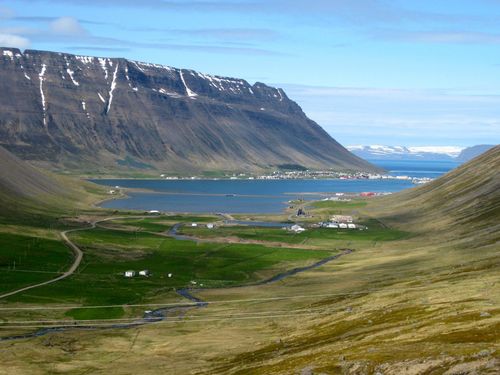
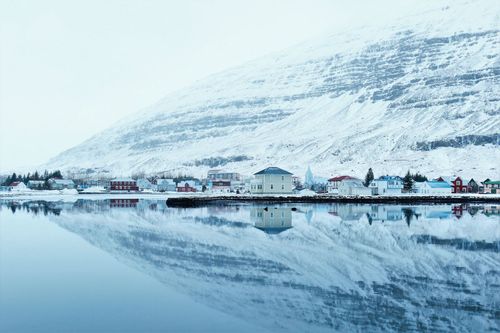
Fifteen kilometres northwest of Ísafjörður along Route 61, the fishing village of Bolungarvík, at the mouth of Ísafjarðardjúp, suffers from one of the most exposed locations in the country, a fact that becomes part of the raw appeal of 16-day Iceland trips through the Westfjords. Not only does it receive some of the foulest weather in Iceland, but its position at the foot of three mountains, two of which are close to 700m high, means it’s also susceptible to avalanches and landslides. Consequently, the road now passes through a new tunnel which ensures that Bolungarvík is no longer cut off when the winter weather takes a turn for the worse.
Although it’s one of the larger settlements in the West Fjords, with a population of around 950, Bolungarvík is a workaday place with little to entertain visitors, though it does boast a couple of good museums.
Ósvör Maritime Museum
At the entrance to town, just before the bridge, the open-air Ósvör Maritime Museum is well worth the twenty-minute trip from Ísafjörður. The tiny, turf-roofed huts here, with their thick stone lower walls, are reconstructions of structures that were once used to house fishing-boat crews, a salting house and a rack for drying fish, and give a good idea of how cramped conditions were in the early twentieth century. The museum also has a six-oared rowing boat from the 1940s, built to a traditional local design, on display. The landing stage, beyond the huts, was used when the weather conditions were too severe for boats to land in more exposed Bolungarvík itself.
Natural History Museum
A ten-minute walk from the Maritime Museum at Vitastígur 3, the town’s only other attraction is the Natural History Museum down by the harbour; to get here, follow the main road into town, Þuríðarbraut, across the Hólsá river, and head straight on into the main street, Aðalstræti, then right into Vitastígur. Inside there’s an excellent collection of stuffed seals, arctic fox and various birds – everything from a wigeon to a pink flamingo, which oddly turned up out of the blue in eastern Iceland – you name it, they’ve got it stuffed. The prize exhibit, though. is the 3-year-old male polar bear (minus penis, which was claimed by the Phallological Museum in Reykjavík) found floating on spring pack ice off Hornstrandir a few years ago. The bear was snared by local fishermen who spotted him drifting, exhausted, on the ice, and the fact that its death was most likely caused by dragging the animal to shore, half-hanging over the side of a fishing boat, came in for much public criticism.
Around Ísafjarðardjúp
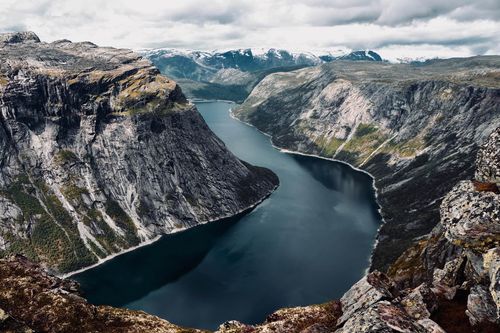
The largest and most breathtaking of all the West Fjords, the 75km-long Ísafjarðardjúp stretches all the way from the mountains around Bolungarvík at its mouth to the shores of Ísafjörður fjord, the most easterly of the nine smaller fjords that make up the southern coastline of this extended arm of the Denmark Strait. Approaching from the southeast, descending from the Steingrímsfjarðarheiði plateau on Route 61, the views of Ísafjarðardjúp are spectacular: remote, uninhabited, forbidding fjordlands as far as the eye can see. In fact, from the head of Ísafjörður fjord to the regional capital there’s just one village along a very lonely road stretching around 200km. Look across the waters of the bay and, on the northern shoreline, you’ll see the sheer, snowcapped mountains of Langadalsströnd and Snæfjallaströnd, themselves divided by the glacial lagoon Kaldalón, which is fed by meltwater from the only glacier in the West Fjords, Drangajökull. Until just a couple of decades ago these coasts were dotted with isolated farms making an uncertain living from sheep farming and the odd crop; today, most have been deserted, reminders of how difficult life is up here. In addition to working the land, many farmers also eked out an existence as fishermen on Ísafjarðardjúp, where whitefish was once abundant. Nowadays, the bay is better known for the rich shrimping grounds found at its mouth, as the whitefish have moved further out to sea.
Tip from Rough Guides: also learn about the best ways to get to Iceland.
Drangajökull
From the parking area by the low hills at the head of the lagoon it’s possible to walk up to the snout of the Drangajökull glacier along a trail, marked by cairns, in roughly ninety minutes; from the car park head east, following the low hills, to the track leading along the eastern side of the valley up to the glacier. Keep to the eastern side of the cairns and you’ll find the going easier, although there are still boulders, stones and streams to negotiate. Note that you shouldn’t underestimate the time it’ll take to walk to the glacier – the clear air makes the ice appear much closer than it actually is. If you spot the unmarked path leading up the western edge of the snout, past Drangajökull’s highest point, Jökulbunga (925m), before descending into Furufjörður on the eastern shore of Hornstrandir, don’t be tempted to follow it – it’s strictly for experienced mountaineers only.
The Súðavík avalanche
Spend any time in Súðavík and you’ll soon spot that its houses are grouped into two distinct areas. The majority are located in the south of the village, but a handful remain in the northern half, closest to Ísafjörður. In January 1995, this tight-knit community was hit by tragedy when an avalanche engulfed the northern part of the village, roaring down from the precipitous slopes of Súðavíkurhlíð, the steep mountain that rears up behind Súðavík, and leaving fourteen people dead. Since then, all new buildings are constructed in the southern part of the village, away from the avalanche risk, while those in the northern half are uninhabited during the winter months. Beside the main road, close to the entrance to the village from Ísafjörður, a stone monument has been raised in memory of those who lost their lives.
The west coast: along Route 60
Passing through some of the most dramatic scenery the West Fjords have to offer, Route 60 is the access route for the southern and western sections of this region. It’s predominantly a mountain road, winding through narrow passes and deep-green valleys as often as it rounds the heads of fjords, past the handful of tiny villages which mark the way down the west coast south of Ísafjörður. It arrives on the south coast at the insubstantial outpost of Brjánslækur, where you have the option of continuing south or east and out of the region, or heading down to the West Fjord’s southwestern tip at Látrabjarg.
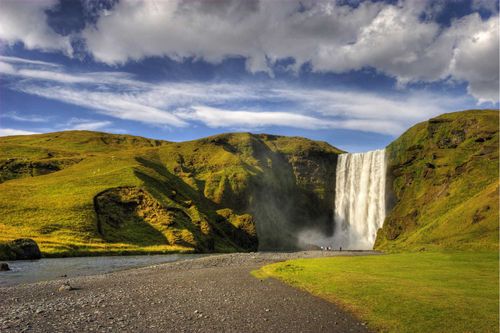
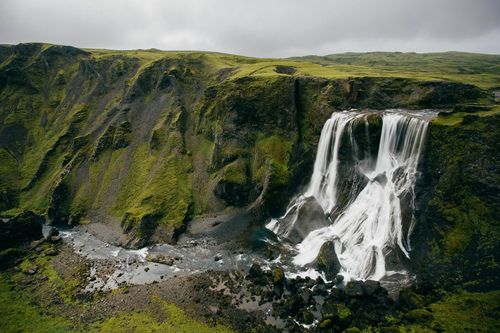
Despite Route 60 being one of the West Fjords’ main roads, once you’re south of the small sleepy fishing villages of Flateyri and Þingeyri, it’s little more than an unsurfaced and badly potholed dirt track, where driving requires slow speeds, much gear changing and even more patience. Things improve after the spectacular climb and descent into minute Hrafnseyri, the birthplace of Jón Sigurðsson, the man who led Iceland’s nineteenth-century independence movement. Beyond here, look out for triangular Dynjandi waterfall, at the head of the eponymously named fjord, and a favourite rest break for buses. One of the main entrance points into the West Fjords lies due south of here, the ferry terminal at Brjánslækur for connections to the island of Flatey and on to Stykkishólmur on the Snæfellsnes peninsula.
Flateyri’s avalanches
Flateyri is known across the country for its avalanche problems: the colossal earth dams separated by 15m walls on the lower slopes of the omnipresent mountains here are man-made barriers against the snowfalls which occur every year. A memorial stone next to the church, at the entrance to the village, bears the names of the twenty people who died in the most recent devastating avalanche, in October 1995. The tragedy was a painful loss for this closely knit community where the total population is barely over three hundred, not least because the frozen ground and heavy snow prevented the bodies from being buried in the village cemetery; instead, they had to be kept in the morgue in Ísafjörður until the ground thawed and they could be buried in Reykjavík. Extensive rebuilding was necessary after the avalanche, including the erection of the defences which now effectively channel all snow-slides into the sea. From the filling station at the entrance to the village, a short path (10min) leads up to a viewpoint on the mountainside giving a superb panorama, not only of Flateyri and Önundarfjörður, but down into the lifesaving earth dams.
Activities in Þingeyri
Þingeyri makes a marvellous place to get out in the great outdoors. Belgian-Danish couple, Wouter and Janne, who run the Simbahöllin café at Fjarðargata 5, rent out top-quality mountain bikes as well as running horseriding tours into neighbouring Sandadalur. If you’re stuck for transport to Þingeyri, they can usually arrange to pick you up from Ísafjörður.
Brjánslækur
Barely 7km west of Flókalundur on Route 62, Brjánslækur is essentially just the departure point for ferries to Stykkishólmur via Flatey, though there is a snack-bar-cum-ticket-office in the small wooden building on the main road by the jetty.
Jón Sigurðsson
To Icelanders, Jón Sigurðsson (1811–69) is what Winston Churchill is to the British and George Washington to the Americans. This is the man who, through his tremendous skills of diplomacy, achieved independence from the Danes, who had almost bankrupted Iceland during the time of the Trade Monopoly. Born in Hrafnseyri in 1811, Sigurðsson spent the first 22 years of his life in his native West Fjords, and after completing the entry examination for university study, he left for Copenhagen where he chose history and political science among his subjects. Although a committed student, he never graduated from the university, opting instead to dedicate his life to the Árni Magnússon Institute, then a powerful symbol of the struggle for recognition against the Danes; this institute fought a long battle to have many of Iceland’s most treasured medieval manuscripts, kept in Copenhagen by the Danish authorities, returned home. However, it wasn’t until 1841 that Sigurðsson began his political activities, publishing a magazine in which he put forward historical arguments for Iceland’s right to independence. A prolific writer about Icelandic history, politics and economics, he was later elected to the Icelandic parliament, which regained its powers as a consultative body in 1843 thanks to his agitation. Further reforms followed as a direct consequence of his influence, including the right to free trade in 1854, and eventually, twenty years later, a constitution making Iceland self-governing in home affairs. Sadly, Sigurðsson didn’t live to see Iceland become a sovereign state under the Danish crown on December 1, 1918, nor Iceland gain full independence from Denmark on June 17, 1944, the anniversary of his birth – he died in Copenhagen in 1879, and his body was returned to Reykjavík for a state funeral.
The Southwestern Peninsula
From its mountain-top junction with Route 60 by Lónfell, Route 63 descends towards Trostansfjörður, one of the four baby fjords which make up the Suðurfirðir, the southern fjords, forming the southwestern corner of Arnarfjörður. This section of the road is in very poor condition and features some alarmingly large potholes and ruts. Unusually for the West Fjords, three fishing villages are found within close proximity to one another here – barely 30km separates the uneventful port of Bíldudalur from its neighbours, identical Tálknafjörður, and the larger Patreksfjörður, a commercial centre for the surrounding farms and smaller villages. However, it’s the Látrabjarg cliffs, 60km beyond Patreksfjörður to the west, that draw most visitors to this last peninsula of rugged land. Here, in summer, thousands upon thousands of seabirds – including guillemots, kittiwakes and puffins – nest in the cliff’s nooks and crannies making for one of the most spectacular sights anywhere in the region; and what’s more, the cliffs are easily accessible from nearby Breiðavík, an idyllic bay of aquamarine water backed by white sand and dusky mountains.
The Fossheiði trail
What Bíldudalur lacks in attractions it more than makes up for with stunning scenery, and there are some lovely hikes in the area, such as the excellent 15km Fossheiði trail (4–5hr) up the Fossdalur valley to the tiny settlement of Tungumúli on the Barðaströnd coast (Route 62). It begins at Foss farm, 6km south of the airport at the head of Fossfjörður, following the route taken by local postmen in the late 1800s. From the western side of the farm, the track leads up through Fossdalur towards the small lake, Mjósund, beyond which the route forks. Keep right and take the path over the Fossheiði plateau, which has fantastic views over the surrounding rocky countryside, until it descends through Arnbylisdalur valley on the western edge of Tungumúlafjall mountain, to the coast and Route 62 at Tungumúli. The route is shown on the Vestfirðir & Dalir maps available from regional tourist offices. From Kross and Tungumúli, it’s possible to link up with the three weekly summer buses to Látrabjarg or Brjánslækur – check the schedules first at Ísafjorður’s information office or online at bsi.is.
Breiðavík
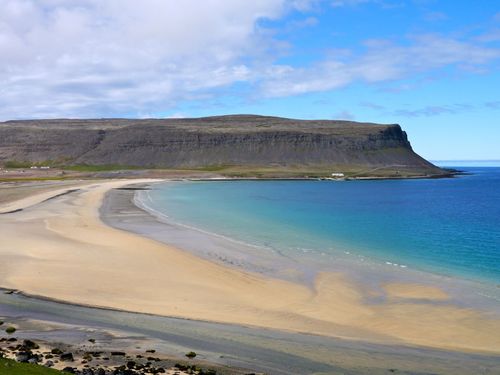
Beyond Hnjótur, Route 612 will bring you, after 10km or so, to a church and handful of buildings comprising the settlement at idyllic Breiðavík bay, with open views westwards over white sand to the aquamarine waters of the Atlantic. This exquisite beach, without a doubt one of Iceland’s finest, is irresistible, and when the sun shines the sands are seen to their best advantage: kilometres of empty, unsullied white strands, punctuated solely by trickling mountain streams finally reaching the ocean, flocks of squawking seabirds and the odd piece of whitewashed driftwood, which can provide welcome shelter from the wind if you’re intent on catching the rays.
Látrabjarg
Beyond Breiðavík, Route 612 climbs up and over a plateau (there’s an extremely rough 12km gravel road off here to Keflavík) and then steeply down to the coast again before expiring a few kilometres further on, below the lighthouse at Bjargtangar, the westernmost point in Europe. The Ísafjörður–Brjánslækur–Patreksfjörður bus spends about two-and-a-half hours here before heading back – don’t miss it unless you can afford to wait for the next one; there is nothing there.
The lighthouse also marks the start of Látrabjarg cliffs, which rise up to 441m above the churning sea as they run 14km east from here to the small inlet of Keflavík. A footpath leads along the clifftops, with excellent views of the thousands of seabirds that come here to nest on the countless ledges below. For centuries, locals would abseil down the cliffs to collect their eggs and trap the birds for food – it’s estimated that around 35,000 birds were caught here every year until the late 1950s – and, occasionally, they still do
Látrabjarg’s birds
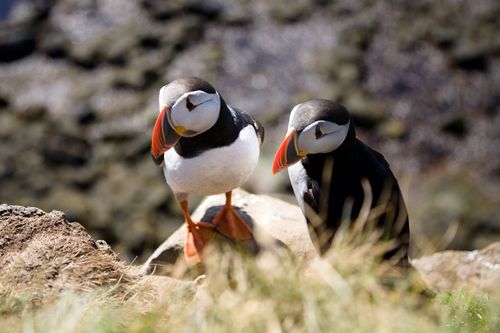
Although the guillemot is the most common bird at Látrabjarg, it’s the thousands of puffins that most people come here to see. The high ground of the clifftops is riddled with their burrows, often up to 2m in length, since they nest in locations well away from the pounding surf, ideally surrounded by lush grass and thick soil. They return to the same burrows they occupied the year before, almost always during the third week of April, where they remain until August or September. The cliffs are also home to the largest colony of razorbills in the world, as well as to thousands of other screeching breeds of seabird including cormorants, fulmars and kittiwakes; the din here can be quite overpowering, as can the stench from the piles of guano on the cliff face.
The Látrabjarg rescue
One of Iceland’s most daring sea-rescue operations occurred at Látrabjarg in December 1947, when farmers from Hvallátur set out to rescue the crew of a British trawler, the Dhoon, which had been wrecked off the rocky shoreline during a severe snowstorm. After sliding down the ice-covered cliffs by rope, the Icelanders pulled the sailors to safety using a rescue line they fired across to the stricken vessel – although it took two separate attempts to hoist all the men up the treacherous cliff face, from where they were taken by horseback to nearby farms to recover. A year later, a film crew arrived in Hvallátur to make a documentary about the accident, in which several locals were to re-enact the rescue – however, while they were filming, another British trawler, Sargon, became stranded in nearby Patreksfjörður, giving the film makers a chance to catch a drama on film for real.
Patreksfjörður
Located on the shores of the southernmost of all the West Fjords, Patreksfjörður (known locally as Patró) is named after Saint Patrick, who acted as spiritual adviser to one of the region’s first settlers, Örlygur Hrappson. With a population of 770, the village is now large enough to exist independently of Ísafjörður, 172km away, and is the only place in the West Fjords outside the regional capital to boast more than the odd shop and restaurant. Over the years, this tiny place has won a reputation for pioneering excellence: trawler fishing in Iceland began here; a particular style of saltfish now popular in Mediterranean markets was developed here; and, somewhat less notably, the village also dispatched the only Icelandic vessel ever to hunt seal in the Arctic.
Built on two sand spits, Geirseyri and Vatnseyri, Patreksfjörður comprises a main road in and out of the town, Strandgata, which runs along the shoreside to the harbour. Several side streets branch off Strandgata’s western end, including Eyrargata, while the main shopping street, Aðalstræti, runs parallel to it. There’s little to do in town other than amble up and down the parallel streets peering in windows, or take a swim in the open-air pool.
Patreksfjörður’s one real attraction is its spectacularly located open-air swimming pool, perched high above the fjord at the western edge of the tiny town centre. As you swim here, you’re treated to uninterrupted views across the fjord to the mountain of Vatnsdalsfjall, which rises on Patrekfjörður’s sandy southern shore; soaking in the hot pots, drinking in the views, is equally as pleasurable. Though the pool should have been built a little longer (the neighbouring graveyard is in the way), a swim here is one of the most restorative and relaxing activities in the whole of the West Fjords region.