The best restaurants in Central Vietnam
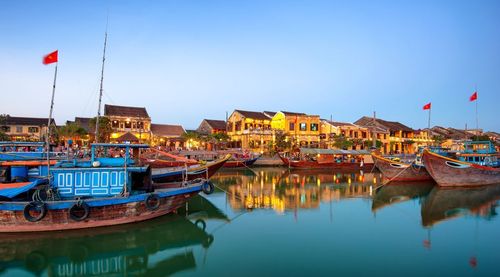
Hoi An
Probably Hoi An’s most popular restaurant, this place can accommodate lots of customers on two floors, but it’s still often packed, and for good reason – everything is delicious, beautifully presented and served with a smile. Try the roast duck with banana flower salad; it’s a masterful blend of tastes and textures. Owner Ms Vy runs several other restaurants in town, plus the popular Taste Vietnam cookery class.
Hidden away down an alley off Le Loi (turn at no. 60), this restaurant is a gem. Dine on high-quality, thoughtfully prepared Vietnamese cuisine in a romantic candlelit garden, with live traditional music every night and excellent service.
Da Nang
This two-storey restaurant and bar is probably Da Nang’s most popular choice for expat diners, and the upstairs balcony seats with views of the promenade and Dragon Bridge are always first to be occupied. Sharply attired staff float around upstairs delivering burgers, seafood baskets and steaks. The downstairs bar is also a good place to drink.
The shady garden of this Spanish-Italian restaurant is a popular retreat for travellers’ and expats alike. The kitchen produces home-made pasta, tosta and burgers with a fusion of local and imported ingredients, while the bar does a roaring trade in cocktails and craft beer.
Hue
Located 2km west of the citadel, this atmospheric compound consists of five ancient wooden houses, three of which function as restaurants, one as an art gallery and one as a garden house. They serve both royal cuisine and Western fusion dishes, and this is the place to go for the full “Imperial Hue” feeling. There are frequent performances of traditional music and martial arts, and cooking classes are also offered.
The DMZ
Charming café serving a range of coffees, juices, smoothies and ice cream, plus tasty main dishes. Owner Tam is your one-stop Mr Fixit for all things DMZ and as the café is a few kilometres north along the river, most people eat here pre- or post- a DMZ tour.
Da Nang
The largest city in Central Vietnam, Da Nang is primarily used by travellers as a jumping-off point for Hoi An, a city that has no airport or train station of its own. However, stick around a while and you’ll find an unexpectedly amiable place, whose burgeoning middle class are seeing their cosmopolitan desires sated with a slew of trendy bars and cafés. The old French presence is also apparent in the leafy boulevards and colonial edifices along the riverfront promenade.
The elongated oval of Da Nang occupies a small headland protruding into the southern curve of Da Nang Bay. The city faces east, fronting onto Bach Dang and the Han River, across which the narrow Son Tra Peninsula shelters it from the South China Sea. The city itself harbours few specific sights of its own, beyond the wonderful Cham Museum with its unparallelled collection of sculpture from the period. However, there are a number of interesting sights in the area – just across the Son Tra Peninsula is China Beach, an increasingly developed stretch of sand from which you can see Monkey Mountain to the north and the Marble Mountains to the south.
Brief history of Da Nang
During the sixteenth and seventeenth centuries, trading vessels waiting to unload at Fai Fo (Hoi An) often sheltered in nearby Da Nang Bay, until Hoi An’s harbour began silting up and Da Nang developed into a major port in its own right. After 1802, when Hué became capital of Vietnam, Da Nang naturally served as the principal point of arrival for foreign delegations to the royal court. However, the real spur to the city’s growth came in the American War when the neighbouring air base spawned the greatest concentration of US military personnel in South Vietnam.
China Beach
The seaward side of the Son Tra Peninsula provides Da Nang with its nearest unpolluted beach – My Khe, the original China Beach, though its rival to the south, Non Nuoc Beach, also claims the same sobriquet. My Khe is a long, if not exactly glorious, stretch of sand less than 3km southeast of central Da Nang. This was where US servicemen were helicoptered in for R&R during the American War, though these days it’s far more popular with seafood-craving locals. A xe om ride here should cost 30,000đ (slightly more at night) for the ride from Da Nang.
Da Nang during the war
The city of Da Nang mushroomed after the arrival of the first American combat troops on March 8, 1965. An advance guard of two battalions of Marines waded ashore at Red Beach in Da Nang Bay, providing the press with a photo opportunity that included amphibious landing craft, helicopters and young Vietnamese women handing out garlands – not quite as the generals had envisaged. The Marines had come to defend Da Nang’s massive US Air Force base; as the troops flew in so the base sprawled. Eventually Da Nang became "a small American city", as journalist John Pilger remembers it, "with its own generators, water purification plants, hospitals, cinemas, bowling alleys, ball parks, tennis courts, jogging tracks, supermarkets and bars, lots of bars". For most US troops the approach to Da Nang airfield formed their first impression of Vietnam, and it was here they came to take a break from the war at the famous China Beach.
At the same time the city swelled with thousands of refugees, mostly villagers cleared from "free-fire zones" but also people in search of work – labourers, cooks, laundry staff, pimps, prostitutes and drug pushers, all inhabiting a shantytown called Dogpatch on the base perimeter. Da Nang’s population rose inexorably: twenty thousand in the 1940s, fifty thousand in 1955 and, some estimate, a peak of one million during the American years. North Vietnamese mortar shells periodically fell in and around the base, but the city’s most violent scenes occurred when two South Vietnamese generals engaged in a little power struggle. In March 1966 Vice Air Marshal Ky, then prime minister of South Vietnam, ousted a popular Hué overlord, General Thi, following his open support of Buddhist dissidents. Demonstrations spread from Hué to Da Nang where troops loyal to Thi seized the airfield in what amounted to a mini civil war. After much posturing Ky crushed the revolt two months later, killing hundreds of rebel troops and many civilians. In the preceding chaos, the beleaguered rebels held forty Western journalists hostage for a brief period in Da Nang’s largest pagoda, Chua Tinh Hoi, while streets around filled with Buddhist protesters.
When the North Vietnamese Army finally arrived to liberate Da Nang on March 29, 1975, they had less of a struggle. Communist units had already cut the road south, and panic-stricken South Vietnamese soldiers battled for space on any plane or boat leaving the city, firing on unarmed civilians. Many drowned in the struggle to reach fishing boats, while planes and tanks were abandoned to the enemy. Da Nang had been all but deserted by South Vietnamese forces, leaving the mighty base to, according to Pilger, be "taken by a dozen NLF cadres waving white handkerchiefs from the back of a truck".
Pass of the Ocean Clouds
Thirty kilometres north of Da Nang, the first and most dramatic of three mountain spurs off the Truong Son range cuts across Vietnam’s pinched central waist, all the way to the sea. This thousand-metre-high barrier forms a climatic frontier blocking the southward penetration of cold, damp winter airstreams, which often bury the tops under thick cloud banks and earn it the title Hai Van, or "Pass of the Ocean Clouds". These mountains once formed a national frontier between Dai Viet and Champa, and Hai Van’s continuing strategic importance is marked by a succession of forts, pillboxes and ridge-line defensive walls erected by Nguyen-dynasty Vietnamese, French, Japanese and American forces.
Da Nang to Hue
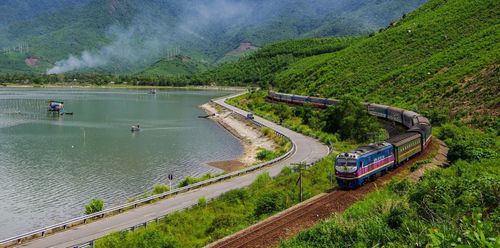
Up the coast from Da Nang, Highway 1 zigzags over the Hai Van Pass, a wonderfully scenic ride by road or (especially) rail. These days, most buses cut out the pass via the Hai Van Tunnel, leaving a more peaceful journey for those that choose to take on the pass. From the top of the pass there are superb views, weather permitting, over the sweeping curve of Da Nang Bay, with glimpses of the rail lines looping and tunnelling along the cliff. The two routes converge again where the tunnel emerges, at the small beach town of Lang Co, whose beach boasts brilliant white sands – and is still, as yet, markedly undeveloped. To the west is Bach Ma National Park, a gorgeous place where the remains of another French-era hill station are swamped by some of the lushest vegetation in Vietnam.
Hue
Still packed with the accoutrements of its dynastic past, Hué is one of Vietnam’s most engaging cities. It boasts an unparalleled opportunity for historic and culinary exploration, thanks in no small part to its status as national capital from 1802–1945. Though the Nguyen dynasty is no more, Hué still exudes something of a regal, dignified air – its populace, indeed, are considered somewhat highbrow by the rest of the country. It’s still a breeding ground for poets, artists, scholars and intellectuals, and you’ll notice far more youngsters here than in other cities – largely because, unlike elsewhere in Vietnam, female students still wear the traditional ao dai.
Hué repays exploration at a leisurely pace, and contains enough in the way of historical interest to swallow up a few days with no trouble at all. The city divides into three clearly defined urban areas, each with its own distinct character. The nineteenth century walled citadel, on the north bank of the Perfume River, contains the once magnificent Imperial City as well as an extensive grid of attractive residential streets and prolific gardens. Across Dong Ba Canal to the east lies Phu Cat, the original merchants’ quarter of Hué where ships once pulled in, now a crowded district of shophouses, Chinese Assembly Halls and pagodas. What used to be called the European city, a triangle of land caught between the Perfume River’s south bank and the Phu Cam Canal, is now Hué’s modern administrative centre, where you’ll also find most hotels and tourist services.
Pine-covered hills form the city’s southern bounds; this is where the Nguyen emperors built their palatial Royal Mausoleums. And through it all meanders the Perfume River, named somewhat fancifully from the tree resin and blossoms it carries, passing on its way the celebrated, seven-storey tower of Thien Mu Pagoda. If you can afford the time, cycling out to Thuan An Beach makes an enjoyable excursion. Hué is also the main jumping-off point for day-tours of the DMZ.
With all this to offer, Hué is inevitably one of Vietnam’s pre-eminent tourist destinations. The choice and standard of accommodation are generally above average, as are its restaurants serving the city’s justly famous speciality foods. Nevertheless, the majority of people pass through Hué fairly quickly, partly because high entrance fees make visiting more than a couple of the major sights beyond many budgets, and partly because of its troublesome weather. Hué suffers from the highest rainfall in the country, mostly falling over just three months from October to December when the city regularly floods for a few days, causing damage to the historic architecture, though heavy downpours are possible at any time of year.
Brief history of Hue
The land on which Hué now stands belonged to the Kingdom of Champa until 1306, when territory north of Da Nang was exchanged for the hand of a Vietnamese princess under the terms of a peace treaty. The first Vietnamese to settle in the region established their administrative centre near present-day Hué at a place called Hoa Chan, and then in 1558 Lord Nguyen Hoang arrived from Hanoi as governor of the district, at the same time establishing the rule of the Nguyen lords over southern Vietnam which was to last for the next two hundred years. In the late seventeenth century the lords moved the citadel to its present location where it developed into a major town and cultural centre – Phu Xuan, which briefly became the capital under the Tay Son emperor Quang Trung (1788–1801).
The Nguyen dynasty
However, it was the next ruler of Vietnam who literally put Hué on the map – Emperor Gia Long, founder of the Nguyen Dynasty. From 1802, he sought to unify the country by moving the capital, lock, stock and dynastic altars, from Thang Long (Hanoi) to the renamed city of Hué. Gia Long owed his throne to French military support but his Imperial City was very much a Chinese concept, centred on a Forbidden City reserved for the sovereign, with separate administrative and civilian quarters.
The Nguyen emperors were Confucian, conservative rulers, generally suspicious of all Westerners yet unable to withstand the power of France. In 1884 the French were granted land northwest of Hué citadel, and they then seized the city entirely in 1885, leaving the emperors as nominal rulers. Under the Nguyen, Hué became a famous centre of the arts, scholarship and Buddhist learning, but their extravagant building projects and luxurious lifestyle demanded crippling taxes.
Hué ceased to be the capital of Vietnam when Emperor Bao Dai abdicated in 1945; two years later a huge fire destroyed many of the city’s wooden temples and palaces. From the early twentieth century the city had been engulfed in social and political unrest led by an anti-colonial educated elite, which simmered away until the 1960s. Tensions finally boiled over in May 1963 when troops fired on thousands of Buddhist nationalists demonstrating against the strongly Catholic regime of President Ngo Dinh Diem. The protests escalated into a wave of self-immolations by monks and nuns until government forces moved against the pagodas at the end of the year, rounding up the Buddhist clergy and supposed activists in the face of massive public demonstrations.
Wartime
During the 1968 Tet Offensive Hué was torn apart again when the North Vietnamese Army (NVA) held the city for 25 days. Communist forces entered Hué in the early hours of January 31, hoisted their flag above the citadel and found themselves in control of the whole city bar two small military compounds. Armed with lists of names, they began searching out government personnel, sympathizers of the Southern regime, intellectuals, priests, Americans and foreign aid workers. Nearly three thousand bodies were later discovered in mass graves around the city – the victims were mostly civilians who had been shot, beaten to death or buried alive. But the killing hadn’t finished: during the ensuing counter-assault as many as five thousand North Vietnamese and Viet Cong, 384 Southern troops and 142 American soldiers died, plus at least another thousand civilians. Hué was all but levelled in the massive fire power unleashed on NVA forces holed up in the citadel but it took a further ten days of agonizing, house-to-house combat to drive the Communists out, in what Stanley Karnow described as “the most bitter battle” of the entire war. Seven years later, on March 26, 1975, the NVA were back to liberate Hué in its pivotal position as the first major town south of the Seventeenth Parallel.
The mammoth task of rebuilding Hué has been going on now for more than twenty years but received a boost in 1993 when UNESCO listed the city as a World Heritage Site, which served to mobilize international funding for a whole range of projects, from renovating palaces to the revival of traditional arts and technical skills.
Hue speciality foods
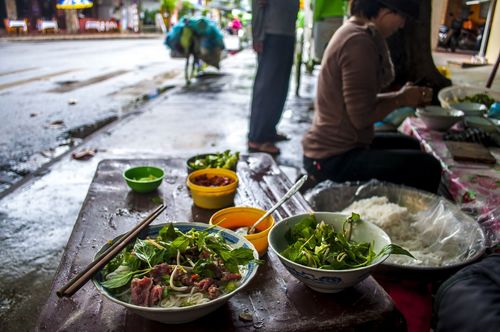
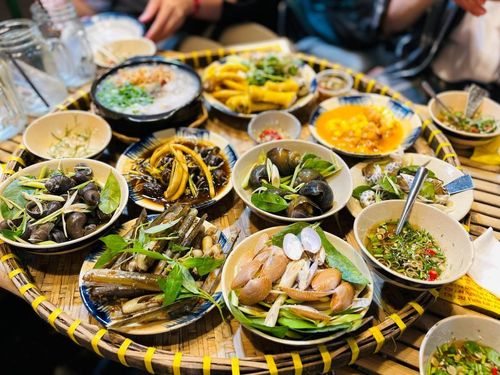
One good argument for staying in Hue an extra couple of days is its many speciality foods, best sampled at local stalls and street kitchens.
Bahn Beo
Order this afternoon dish and you get a whole trayful of individual plates, each containing a small amount of steamed rice-flour dough topped with spices, shrimp flakes and a morsel of pork crackling; add a little sweetened nuoc mam sauce to each dish and tuck in with a teaspoon. Banh nam, or banh lam, is a similar idea but spread thinly in an oblong, steamed in a banana leaf and eaten with rich nuoc mam sauce. Manioc flour is used instead of rice for banh loc, making a translucent parcel of whole shrimps, sliced pork and spices steamed in a banana leaf, but this time the nuoc mam is pepped up with a dash of chilli. Finally, ram it consists of two small dollops of sticky rice-flour dough, one fried and one steamed, to dip in a spicy sauce. You’ll find good places in which to sample these dishes all over the city.
Banh Khoai
Probably the most famous Hue dish, a small, crispy yellow pancake made of egg and rice flour, fried up with shrimp, pork and bean sprouts and eaten with a special peanut and sesame sauce (nuoc leo), plus a vegetable accompaniment of star fruit, green banana, lettuce and mint. Amazingly, it’s even more delicious than it sounds.
Bun Bo
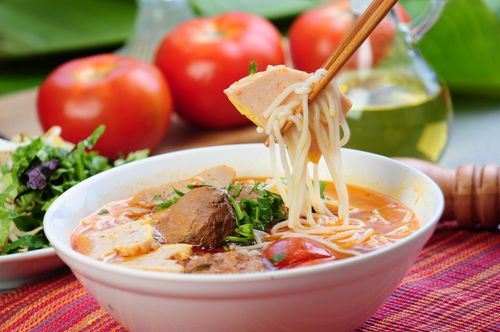
Spicy rice-noodle beef soup flavoured with citronella, shrimp and basil; also called bun ga with chicken, or bun bo gio heo with beef and pork.
Che
A refreshing drink made from green bean and coconut (che xanh dua), fruit (chetrai cay) or, if you’re lucky, lotus seed (che hat sen).
The Imperial City
A second moat and defensive wall inside the citadel guard the Imperial City, which follows the same symmetrical layout as Beijing’s Forbidden City – though oriented northwest-southeast, rather than north-south. The Vietnamese version, popularly known as Dai Noi ("the Great Enclosure"), has four gates – one in each wall – though by far the most impressive is south-facing Ngo Mon, the Imperial City’s principal entrance. In its heyday the complex must have been truly awe-inspiring, a place of glazed yellow and green roof tiles, pavilions of rich red and gilded lacquer and lotus-filled ponds – all surveyed by the emperor with his entourage of haughty mandarins. However, many of its buildings were badly neglected even before the battle for Hué raged through the Imperial City during Tet 1968, and by 1975 a mere twenty out of the original 148 were left standing among the vegetable plots. Some are in the midst of extensive restorations, and those which have been completed are stunning – notably Thai Hoa Palace, The Mieu complex and Dien Tho. The rest of the Imperial City, especially its northern sector, is a grassed-over expanse full of birds and butterflies where you can still make out foundations and find bullet pockmarks in the plasterwork of ruined walls.
Ngo Mon Gate
In 1833 Emperor Minh Mang replaced an earlier, much less formidable gate with the present dramatic entrance way to the Imperial City, Ngo Mon, considered a masterpiece of Nguyen architecture. Ngo Mon (the "Noon" or "Southwest" Gate) has five entrances: the emperor alone used the central entrance paved with stone; two smaller doorways on either side were for the civil and military mandarins, who only rated brick paving, while another pair of giant openings in the wings allowed access to the royal elephants.
Five Phoenix Watchtower
The bulk of Ngo Mon is constructed of massive stone slabs, but perched on top is an elegant pavilion called the Five Phoenix Watchtower as its nine roofs are said to resemble five birds in flight when viewed from above. Note that the central roof, under which the emperor passed, is covered with yellow-glazed tiles, a feature of nearly all Hué’s royal roofs. Emperors used the watchtower for two major ceremonies each year: the declaration of the lunar New Year; and the announcement of the civil service exam results, depicted here in a lacquer painting. It was also in this pavilion that the last Nguyen emperor, Bao Dai, abdicated in 1945 when he handed over to the new government his symbols of power – a solid gold seal weighing ten kilos and a sheathed sword encrusted with jade.
Thai Hoa Palace
Walking north from Ngo Mon along the city’s symmetrical axis, you pass between two square lakes and a pair of kylin, mythical dew-drinking animals that are harbingers of peace, to reach Thai Hoa Palace ("the Palace of Supreme Harmony"). Not only is this the most spectacular of Hué’s palaces, its interior glowing with sumptuous red and gold lacquers, but it’s also the most important since this was the throne palace, where major ceremonies such as coronations or royal birthdays took place and foreign ambassadors were received (see Ceremonies at the Thai Hoa Palace).
The palace was first constructed in 1805, though the present building dates from 1833 when the French floor tiles and glass door panels were added, and was the only major building in the Imperial City to escape bomb damage. Nevertheless, the throne room’s eighty ironwood pillars, swirling with dragons and clouds, had been eaten away by termites and humidity and were on the point of collapse when rescue work began in 1991. During the restoration every column, weighing two tonnes apiece, had to be replaced manually and then painted with twelve coats of lacquer, each coat taking one month to dry. Behind the throne room a souvenir shop now sells books and tapes of Hué folk songs where once the emperor prepared for his grand entrance. It also contains two large dioramas depicting the Imperial City and flag tower in their heyday.
The Forbidden Purple City
From Thai Hoa Palace the emperor would have walked north through the Great Golden Gate into the third and last enclosure, the Forbidden Purple City. This area, enclosed by a low wall, was reserved for residential palaces, living quarters of the state physician and nine ranks of royal concubines, plus kitchens and pleasure pavilions. Many of these buildings were destroyed in the 1947 fire, leaving most of the Forbidden Purple City as open ground, a "mood piece", haunted by fragments of wall and overgrown terraces.
The Left House and Right House
However, a handful of buildings remain, including the restored Left House and Right House facing each other across a courtyard immediately behind Thai Hoa Palace. Civil and military mandarins would spruce themselves up here before proceeding to an audience with the monarch. Of the two, the Right House (actually to your left – the names refer to the emperor’s viewpoint) is the more complete with its ornate murals and gargantuan mirror in a gilded frame, a gift from the French to Emperor Dong Khanh.
Thai Binh Reading Pavilion
Walking northeast from here you pass behind the Royal Theatre, built in 1826 and now belonging to the University of Fine Arts, to find the Thai Binh Reading Pavilion, an appealing, two-tier structure surrounded by bonsai gardens. The pavilion was built by Thieu Tri and then restored by Khai Dinh, who added the kitsch mosaics. This was where the emperor came to listen to music and commune with nature, but at the time of writing it was in a state of disrepair.
The Ancestral Altars
The other main cluster of sights lies a short walk away in the southwest corner of the Imperial City. Aligned on a south–north axis, the procession kicks off with Hien Lam Cac ("Pavilion of Everlasting Clarity"), a graceful, three-storey structure with some notable woodwork, followed by the Nine Dynastic Urns. Considered the epitome of Hué craftsmanship, the bronze urns were cast during the reign of Minh Mang and are ornamented with scenes of mountains, rivers, rain clouds and wildlife, plus one or two stray bullet marks. Each urn is dedicated to an emperor: the middle urn, which is also the largest at 2600kg, honours Gia Long. They stand across the courtyard from the long, low building of The Mieu, the Nguyens’ dynastic temple erected in 1822 by Minh Mang to worship his father. Since then, altars have been added for each emperor in turn, except Duc Duc and Hiep Hoa, who reigned only briefly, and Bao Dai who died in exile in 1997; the three anti-French sovereigns – Ham Nghi, Thanh Thai and Duy Tan – had to wait until after Independence in 1954 for theirs. Take a look inside to see the line of altar tables, most sporting a portrait or photo of the monarch. Behind each is a bed equipped with a sleeping mat, pillows and other accoutrements and, finally, a shrine holding funeral tablets for the emperor and his wife or wives. Anniversaries of the emperors’ deaths are still commemorated at The Mieu, attended by members of the royal family in all their finery.
Hung Mieu
Exit The Mieu by its west door, beside a 170-year-old pine tree trained in the shape of a flying dragon, and follow the path north into the next compound to find Hung Mieu. This temple is dedicated to the Nguyen ancestors and specifically to the parents of Gia Long, and is distinguished by its fine carving.
Dien Tho
North again, Dien Tho, the queen mother’s residence, is worth a look. Built in a mix of Vietnamese and French architectural styles, the palace later served as Bao Dai’s private residence, and the downstairs reception rooms are now set out with period furniture, echoing the photos of the palace in use in the 1930s.
Traditional entertainment
Under the Nguyen emperors, Hué was the cultural and artistic as well as political capital of Vietnam. A rich tradition of dance and music evolved from popular culture, from the complex rituals of the court and from religious ceremonies. Though much of this legacy has been lost, considerable effort has gone into reviving Hué folk songs, Ca Hué, which you can now sample, drifting down the Perfume River on a balmy Hué evening.
Historically the Perfume River was a place of pleasure where prostitutes cruised in their sampans and artists entertained the gentry with poetry and music. While the former officially no longer exist, today’s folk-song performances are based on the old traditions, eulogizing the city’s beautiful scenery or the ten charms of a Hué woman – including long hair, dreamy eyes, flowing ao dai and a conical hat – while she waits for her lover beside the river. This sounds great, but be warned that the experience can feel somewhat cheap – the fees given to performers are far too low to recruit those with genuine talent, and in 2009 the state of affairs was fiercely lambasted by local authorities.
The city authorities have also instigated a biennial arts festival (held in June) featuring not only folk songs, kite-flying, water-puppetry and other local traditions, but also international groups
Ceremonies at the Thai Hoa Palace
On these occasions the emperor sat on the raised dais, wearing a golden tunic and a crown decorated with nine dragons, under a spectacular gilded canopy. He faced south across the Esplanade of Great Salutations, a stone-paved courtyard where the mandarins stood, civil mandarins to the left and military on the right, lined up in their appointed places beside eighteen stelae denoting the nine subdivided ranks. A French traveller in the 1920s witnessed the colourful spectacle, with "perfume-bearers in royal-blue, fan-bearers in sky-blue waving enormous yellow feather fans, musicians and guardsmen and ranks of mandarins in their curious hats and gorgeous, purple-embroidered dragons, kow-towing down, down on their noses amidst clouds of incense – and all in a setting of blood-red lacquer scrawled with gold.
Around Hue
For the most part the Nguyen emperors lived their lives within Hué’s citadel walls, but on certain occasions they emerged to participate in important rituals at symbolic locations around the city. Today these places are of interest more for their history than anything much to see on the ground, though the mouldering Royal Arena still hints at past spectacles. A visit to at least a couple of the Royal Mausoleums, however, is not to be missed – it’s in these eclectic architectural confections in the hills to the south of Hué that the spirit of the Nguyen emperors lives on. Taking a boat along the Perfume River to get to the best mausoleums also offers the chance to stop off at the Thien Mu Pagoda and Hon Chen Temple on the way.
Thuan An Beach is a bike-ride away, if you have the time and energy, making for an attractive journey across the estuary with views of fish farms to either side, though the beach itself is nothing spectacular. Further afield, one of the most popular excursions from Hué is a whirlwind day-trip round the DMZ. Bach Ma National Park is also within striking distance.
Boat trips on the Perfume River
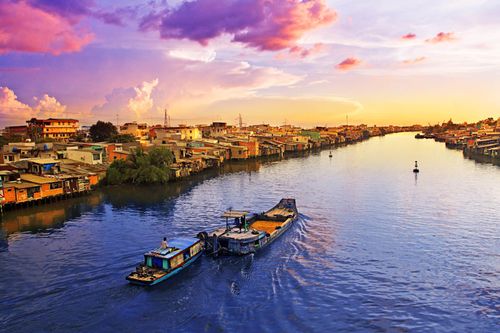
Many people still live on boats along the Perfume River and Hué’s waterways, including the Dong Ba and Phu Cam canals, creating a timeless river life that feels especially enchanting on a romantic Vietnam trip. Drifting past the citadel on a misty morning, you can watch daily routines unfold at an unhurried pace. A boat journey along the Perfume River offers a gentle way to absorb Hué’s atmosphere, with visits to Thien Mu Pagoda, Hon Chen Temple, and the most striking royal mausoleums such as Tu Duc, Khai Dinh, and Minh Mang. For those wishing to linger longer, private charters allow a more flexible and intimate experience.
The Royal Mausoleums
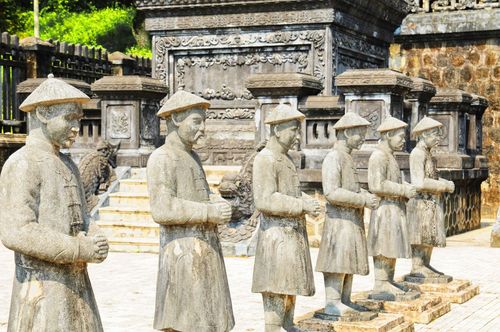
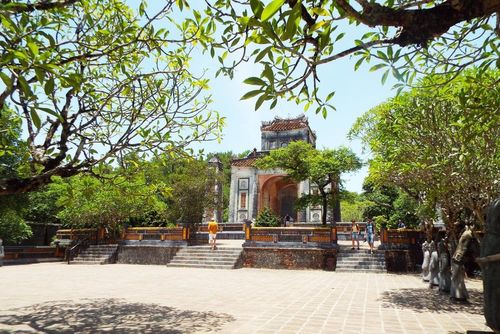
Unlike previous Vietnamese dynasties, which buried their kings in ancestral villages, the Nguyen built themselves magnificent Royal Mausoleums in the valley of the Perfume River among low, forested hills to the south of Hue. For historical reasons only seven mausoleums were built, but each one is a unique expression of the monarch’s personality, usually planned in detail during his lifetime to serve as his palace in death. More than anywhere else in Hue, it’s here that the Nguyen emperors excelled in achieving a harmony between the works of man and his natural surroundings. Along with the Imperial City, these constitute Hue’s most rewarding sights.
The mausoleums are intoxicating places, occasionally grandiose but more often achieving an elegant simplicity, where it’s easy to lose yourself wandering in the quiet gardens. However, given the entry fee for each – except on public holidays, when entry is free – you’ll want to pick the ones you visit carefully. Of the seven, the contrasting mausoleums of Tu Duc, Khai Dinh and Minh Mang are the most attractive and best preserved, as well as being easily accessible. These are also the three covered by the boat trips, so they can get crowded (especially at weekends); don’t let this put you off – but if you do want something more off the beaten track then those of Gia Long, Dong Khanh and Thieu Tri are worth calling in on. Finally, Duc Duc’s temple and mausoleum are very modest but they are the closest to Hue and still tended by members of the royal family.
Mausoleum design
It often took years to find a site with the right aesthetic requirements that would also satisfy the court cosmologists charged with interpreting the underlying supernatural forces. Artificial lakes, waterfalls and hills were added to improve the geomantic qualities of the location, at the same time creating picturesque, almost romantic, garden settings for the mausoleums, of which the finest examples are those of Tu Duc and Minh Mang.
Though details vary, all the mausoleums consist of three elements: a temple dedicated to the worship of the deceased emperor and his queen; a large, stone stele recording his biographical details and a history of his reign, usually written by his successor; and the royal tomb itself at the highest spot, enclosed within a wall and a heavy, securely fastened door. Traditionally the burial place was kept secret as a measure against grave-robbers and enemies of the state, and in extreme cases all those who had been involved in the burial were killed immediately afterwards.
The Hon Chen Temple Festivals
Festivals at Hon Chen were banned between Independence and 1986 but have now resumed, taking place twice yearly in the middle of the third and seventh lunar month. The celebrations, harking back to ancient rituals, include trance-dances performed by mediums, usually females dressed in brightly coloured costumes, who are transported by a pulsating musical accompaniment. These events have proven popular with the few foreign tourists lucky enough to be here at the right time, and to hear that they’re actually happening.

 (1).jpg)