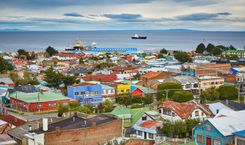
A brief history of Valparaíso
The bay was chosen as the site of the new colony’s port as early as 1542, when Pedro de Valdivia decided it would “serve the trade of these lands and of Santiago”. Growth was slow, however, owing to trading restrictions, but when Latin American trade was liberalized in the 1820s, after independence, Valparaíso started to come into its own. On the shipping route from Europe to America’s Pacific Coast, it became the main port of call and resupply centre for ships after they crossed the Straits of Magellan. As Chile’s own foreign trade expanded with the silver and copper booms of the 1830s, the port became ever more active, but it was the government’s innovative creation of public warehouses where merchants could store goods at low prices that really launched Valparaíso into its economic ascent.
Progress and setbacks
Foreign businessmen, particularly British ones, flocked to the city where they ran trading empires built on copper, silver and nitrate. By the late nineteenth century they had turned Valparaíso into Chile’s foremost financial and commercial centre. Even as it prospered, however, Valparaíso continued to be dogged by the kind of violent setbacks that had always punctuated its history, from looting pirates and buccaneers to earthquakes and fires. On March 31, 1866, following Chile’s entanglement in a dispute between Spain and Peru, the Spanish admiralty bombarded Valparaíso, wreaking devastation. It took a long time to rebuild the city, but worse was to come. On August 16, 1906, a colossal earthquake practically razed the city to the ground, killing over two thousand people. The disaster took a heavy toll on Valparaíso’s fortunes, which never really recovered. Eight years later, the opening of the Panama Canal signalled the city’s inexorable decline.
Modern Valpo
Today, Valparaíso wears a rundown, moth-eaten air. Crime and poverty are worse than elsewhere in Chile, the sex trade is still rampant, and at night parts of the town are dangerous. That said, it’s still a vital working port, moving thousands of containers annually, and has been the seat of Congress since the return to democracy in 1990. The port underwent a mini-economic boom in the early years of the new millennium, though the city’s inhabitants, known as Porteños, do not seem to have benefited enormously. As the capital of Region V, it also has its share of galleries and museums, but the city’s chief attractions lie in its crumbling, romantic atmosphere and stunning setting.
Valparaíso’s antiquated lifts
Most of Valparaíso’s fifteen ascensores, or funicular “lifts”, were built between 1883 and 1916 to provide a link between the lower town and the new residential quarters spreading up the hillsides. Today only a handful of them are still operating, and appearances would suggest that they’ve scarcely been modernized. However, despite their rickety frames and alarming noises, they’ve so far proved safe and reliable. What’s more, nearly all drop off passengers at a panoramic viewpoint. The ascensores generally operate every few minutes from 7am to 11pm, and cost around CH$300 one-way. Here are a few of the best, from east to west:
Ascensor Polanco
The most picturesque ascensor, and the only one that’s totally vertical, Polanco is on Calle Simpson, off Avenida Argentina (opposite Independencia). It’s approached through a cavernous, underground tunnel and rises 80m through a yellow wooden tower to a balcony that gives some of the best views in the city. A narrow bridge connects the tower to Cerro Polanco, with its flaking, pastel houses in varying states of repair.
Ascensor Concepción (also known as Ascensor Turri)
Hidden in a small passage opposite the Turri clock tower, at the corner of Prat and Almirante Carreño, this was the first ascensor to be built, in 1883, and was originally powered by steam. It takes you up to the beautiful residential area of Cerro Concepción, well worth a visit.
Ascensor El Peral
Next door to the Tribunales de Justicio, just off Plaza Sotomayor, this ascensor leads to one of the most romantic corners of the city: Paseo Yugoslavo, a little esplanade looking west onto some of Valparaíso’s most beautiful houses, and backed by a flamboyant mansion housing the Museo de Bellas Artes. It’s worth walking from here to Ascensor Concepción.
Ascensor Artillería
Always busy with tourists, but highly recommended for the stunning vistas at the top, from the Paseo 21 de Mayo. It was built in 1893 to transport cadets to and from the naval school at the top of the hill, now the site of the Museo Naval y Marítimo.
South of Valparaíso
The resorts south of Valparaíso are among the busiest and most developed in the region. Most – including Algarrobo, El Tabo and Cartagena – sit on overcrowded beaches, are overrun with ugly apartment blocks and are jam-packed with noisy vacationers. However, a few places in the area are well worth a visit: peaceful Quintay, the vineyards of the Casablanca Valley, and – most notably – the village of Isla Negra, site of Pablo Neruda’s extraordinary house and now a museum.
Casa Museo Isla Negra
From 1939, poet Pablo Neruda spent forty years of his life, on and off, in the village of Isla Negra, enlarging his house and filling it with the strange and beautiful objects he ceaselessly gathered from far-flung corners of the world. The Fundación Neruda, acting on the wishes of the poet’s widow, Matilde Urrutia, transferred Neruda’s and Matilde’s graves to its garden and operates the house as the Casa Museo Isla Negra. Inside this museum, the winding passages and odd-shaped rooms are crammed full of fascinating exotic objects like ships’ figureheads, Hindu carvings, African and Japanese masks, ships in bottles, seashells, butterflies, coloured bottles, Victorian postcards and a good deal more.
There’s little else to Isla Negra save a small, pretty beach, which makes a great picnic spot.
Casablanca Valley wine route
The Casablanca Valley, famed for its excellent white wines, is accessed via Ruta 68, which connects Valparaíso and Viña with Santiago. Ruta del Vino Valle de Casablanca, Portales 90, in Casablanca, organizes tours of the wineries. You can also visit the vineyards independently; having your own car makes things a lot easier, but it is possible to visit some using the frequent Valparaíso/Viña–Santiago buses.
Central Coast Chile
Of Chile’s 4000km-plus coastline, the brief central strip between Rocas de Santo Domingo and Los Vilos is the most visited and developed. Known as the Litoral Central, this 250km stretch boasts bay after bay lined with gorgeous, white-sand beaches, and a string of coastal resort towns. Valparaíso (“Valpo” for short) and Viña del Mar (or “Viña”) sit next to each other near the middle of the strip. They are geographical neighbours, but poles apart in appearance and atmosphere.
Viña is Chile’s largest beach resort and one of its ritziest. With its high-rises, casino, and seafront restaurants, as well as the beaches and clubs in nearby Reñaca, Viña typifies modern hedonism. Valparaíso, on the other hand, has far more personality, with ramshackle, colourful houses spilling chaotically down the hills to the sea (but no decent beaches). For stretches of sand, you’ll need to head south or north.
Closest to Santiago, via the “Autopista del Sol” (Ruta 78), are the resorts south of Valparaíso, which are busier and more developed. Further south, there’s an almost uninterrupted string of cabañas, villas and small, unappealing resorts. Even so, it’s still possible to find places with charm and soul, especially where Pablo Neruda found them, at Isla Negra – though it, too, is fast being swallowed up by development.
Heading north of Viña you leave most of the concrete behind at Concón, and from Horcón up, the coast begins to look more rugged and feels distinctly wild and windswept by the time you reach Maitencillo, where sandstone cliffs tower above a huge, white beach. The stretch from here to Papudo is easily the most beautiful of the region. Not even the new villas and second-home complexes that have sprung up along here have managed to spoil Zapallar, the most architecturally graceful of the resorts, or Papudo, a small town dramatically hemmed in by steep, green hills. Two more resorts lie further north: Los Vilos and Pichidangui.