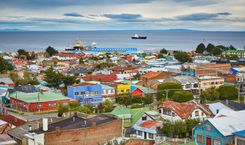
Lago Blanco
Twenty-one kilometres from Camerón lies Lago Blanco itself, majestic and brooding, surrounded by steeply forested hills and snow-covered mountains, where you’ll find plenty of wilderness in which to trek, fish and camp.
From Lago Blanco the road continues further south, past Lago Deseado, currently ending just beyond the majestic Lago Fagnano, part of Parque Nacional Tierra del Fuego. The Chilean government has big plans for Tierra del Fuego, which include building a completely new settlement on the shores of the lake, thus providing easier access to the natural attractions on the Argentinian side.
Isla Navarino
Apart from compact Puerto Williams and the even tinier fishing village of Puerto Toro, Isla Navarino, the largish island to the south of Isla Grande, is an uninhabited wilderness studded with barren peaks and isolated valleys. Navarino is dominated by a dramatic range of peaks, the Cordón Dientes del Navarino through which weaves a 70km hiking trail called the Los Dientes Circuit. What has spoiled some of the landscape, especially the woodland, however, is the devastation brought about by feral beavers, imported from Canada for fur-farming in the 1940s by the Argentine military – a project that misfired most spectacularly and to which there is still no solution.
Puerto Williams
Puerto Williams nestles in a small bay on the north shore of Isla Navarino, 82km due east and slightly south of Ushuaia along the Beagle Channel. Although Ushuaia loudly proclaims its “end of the world” status, it suffers from geographical envy when it comes to tiny Puerto Williams, home to just over two thousand people. Originally founded as a military outpost, it’s officially the capital of Chilean Antarctica. The compact, windblown settlement has a somewhat desolate quality to it even in the height of the brief summer, but the people are exceptionally warm and welcoming and you get a real sense of a close-knit community, brought together by isolation from the rest of Chile. Most businesses are concentrated in the Centro Comercial, by the Plaza O’Higgins.
The seafront Avenida Costanera, leads you past a rusted hulk of a half-sunken barge loaded with centolla traps towards the indigenous community of Villa Ukika. From the bright-red x-shaped pier that juts into the channel’s cold blue waters, you get a wonderful view of the town against a backdrop of the forest-covered jagged peaks of Los Dientes beyond.
Los Dientes de Navarino circuit
Many travellers come to Puerto Williams to complete the Los Dientes de Navarino Circuit challenge, a strenuous four- to seven-day hike in the Isla Navarino wilderness, where there is no infrastructure whatsoever, and you are faced with unpredictable weather as well as the rigours of the trail. This is for experienced hikers only and not to be attempted alone.
The trail
Follow Vía Uno west out of town; the trail starts behind the statue of the Virgin Mary in a grassy clearing. The road leads uphill to a waterfall and reservoir, from where a marked trail climbs steadily through the coigüe and ñire forest. It is a two-hour ascent to Cerro Bandera, a miradór with a wonderful view of the town, the Beagle Channel and the nearby mountains; this climb is definitely worthwhile, even if you’re not doing the circuit. The rest of the trail is not well marked; there are 38 trail markers (rock piles) spread out over the 53km route, which entails crossing four significant passes and negotiating beaver dams in between.
Once past the starkly beautiful Laguna El Salto, you can either cross a fairly steep pass and make a detour to the south, to the remote expanse of Lago Windward, or head west to Laguna de los Dientes. Continue west past Lagunas Escondido, Hermosa and Matrillo before reaching the particularly steep and treacherous descent of Arroyo Virginia; beware of loose rocks. The trail markers end before Bahía Virginia, and you have to make your own way over pastures and through scrubland to the main road. The trail officially finishes 12km out of town, behind a former estancia owned by the MacLean family, which has been developed into a centolla- and shellfish-processing factory. From here you can follow the main road back to Puerto Williams or hitch a lift.
Maps and essentials
The best map is the Tierra del Fuego & Isla Navarino satellite map by Zagier & Urruty Publications, available in Ushuaia in conjunction with GPS. Make sure you have plentiful food and water supplies (water on the island is not drinkable owing to the giardia carried by the beavers), sunscreen and warm and waterproof outdoor gear, and inform people in town of your plans before leaving.
The Yámana, the Selk’nam and the Kawéskar
The harsh lands of Tierra del Fuego and Isla Navarino were originally home to three tribes, the Yámana (Yaghan), the Selk’nam (Ona) and the Kawéscar (Alacalúf). The latter inhabited the Magellan Strait and the western fjords, and the former two resided on and around Isla Navarino. The Yámana and the Kawéskar were both “Canoe Indians”, who relied on their catch of fish, shellfish and marine animals, while the Selk’nam were hunter-gatherers who subsisted almost entirely on a diet of guanaco meat.
Though dismissed by European explorers as savages (Charles Darwin famously commented that the “Canoe Indians” were “among the most abject and miserable creatures I ever saw”), and now largely culturally extinct, the tribes had complex rituals. The Selk’nam, for example, performed a sophisticated male initiation ceremony, the Hain, during which the young male initiates, or kloketens, confronted and unmasked malevolent spirits that they had been taught to fear since their youth, emerging as maars (adults). Father Martín Gusinde was present at the last Hain ceremony in 1923, and managed to capture the event in a series of remarkable photographs, copies of which circulate as postcards today.
Ushuaia
Its name means “westward-looking bay” in the indigenous Yámana language; Ushuaia lies hemmed in between the Sierra Venciguerra range and the deep blue of the icy Beagle Channel – the most dramatic location of any Argentine city, with colourful houses tumbling down the hillside to the wide, encircling arm of land that protects its bay from the southwesterly winds. Though across the border in Argentina, it can also feature in longer southern itineraries and selected 6-day Chile trips that combine Patagonia with Tierra del Fuego. San Martín is the city’s main thoroughfare, and most visitors without their own transport stick to the compact grid of streets in Ushuaia’s centre.
Around Ushuaia, the nature trails of Parque Nacional Tierra del Fuego, the spectacular Beagle Channel, the historic Estancia Harberton and the snow-covered slopes of Cerro Castor offer plenty of activities for travellers throughout the year.
Round the Horn by sea and air
Directly south of Isla Navarino lies a cluster of islands, part of the Cabo de Hornos biosphere reserve – a staggering five million hectares of native forest, tundra, glaciers, fjords and tall black cliffs. This pristine marine habitat is set aside for strict conservation only; overnight stays are not permitted
For centuries the treacherous icy waters surrounding the islands of Cape Horn captured the imagination of sailors and adventurers, not least because they constitute the biggest ship graveyard in the Americas: on old nautical maps, the waters around the islands are littered with tiny pictures of sunken ships. Today, Cape Horn still presents a sizeable challenge for experienced sailors and travellers alike, many of whom, having come this far south, can’t resist going all the way round.
SIM and Victory Adventure Expeditions in Puerto Williams are good places to enquire about sailing trips. Weather permitting, you disembark on a shingle beach, climb a rickety ladder and visit the tiny Chilean naval base, lighthouse and chapel; a statue of an albatross overlooks the stormy waters beyond. Aerovías DAP and the local flying clubs run fairly expensive (around CH$500,000 per small chartered plane) half-hour flights from both Punta Arenas and Puerto Williams that do a loop and return without landing. These air excursions treat you to incredible views of Isla Navarino and the Darwin peaks. As always, weather is a vital factor.
Winter sports around Ushuaia
To ski at the end of the world, come sometime between June and early September (though not in July if you wish to avoid the holidaying crowds) and head for Cerro Castór, the only alpine ski resort in the area, 26km from Ushuaia along the RN-3 and boasting powder snow as well as 24km of ski runs. The fifteen slopes feature a good mix of runs, and you can rent equipment at the resort. Ask at the tourist office about transport to and from Ushuaia. If cross-country skiing is your passion, you won’t want to miss the annual Marcha Blanca ski marathon.
Around 20km northeast of Ushuaia is the Valle de Lobos. This husky breeding centre offers dog-sledding, snowmobile rides and off-road safaris, depending on the season.