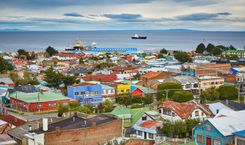
Hanga Roa
The laidback town of Hanga Roa has been the island’s only residential sector since the 1860s, when Catholic missionaries relocated the islanders here to facilitate their conversion. Its long, sprawling streets are lined with single-storey houses and fragrant eucalyptus trees, giving the place the feel of a recently settled frontier town.
Atamu Tekena is the main road, lined with souvenir shops, restaurants, and tour agencies. Most of the action is centred around the Caleta Hanga Roa harbour, overlooked by Ahu Tautira, the only moai in the town proper. Restaurants stretch from here along oceanside Policarpo Toro, parallel to Atamu Tekena. East-west Te Pito O Te Henua connects the two, ending at the church, where islanders still congregate every Sunday morning. Just south of the pier lies tiny Playa Pea, where a rock pool safe for swimming is cordoned off from the stretch of ocean popular with surfers and bodyboarders — the kind of easy, central stop that works well on compact 5-day Chile trips focused on Easter Island.
The southeastern circuit
Ahu Vinapu
From Hanga Roa, follow Avenida Hotu Matu’a down to the southern coast road then turn right, just after the white oil containers, and you’ll reach Ahu Vinapu, the site of two large ahus, with moai lying in fragments behind the platforms. Anyone who’s seen Machu Picchu or other Inca ruins will be amazed by the similarity of the masonry of Vinapu’s main ahu, made of huge, mortarless blocks of stone “fitted carefully to one another without a crack or a hole”. Close to this platform, known as Vinapu I, is another ahu, Vinapu II, whose stonework is vastly inferior to its neighbour.
Thor Heyerdahl’s expedition was the first to excavate the site and, with radiocarbon dating, concluded that the precisely carved Vinapu I was among the earliest built
on the island, and that Vinapu II was a much later construction, suggesting that the island’s first settlers imported the highly specialized stone-carving techniques of Peru, and that later platforms were built by “far less capable architects, who were no longer masters of the complicated Inca technique”. Modern archaeologists, however, believe that this impressive masonry is simply a perfected example of a style developed locally on Easter Island, and more recent radiocarbon tests have given Vinapu I a new date of 1516 AD, and Vinapu II a date of 857 AD – the reverse of Heyerdahl’s sequence.
Sites along the southern coast
East from Vinapu on the coast road, the first site you pass is Ahu Vaihu, where eight tall statues lie face-down on the ground, their red stone topknots strewn along the coast. Three kilometres further along, Ahu Akahanga presents an equally mournful picture of a row of fallen moai; according to some oral traditions, it’s also the burial place of Hotu Matu’a. Further up the coast, Ahu Hanga Tetenga is the site of the tallest moai (9.94m) ever transported to a platform.
Just beyond Ahu Hanga Tetenga, the road forks. The left-hand branch (Camino de los Moai) leads to the quarry of Rano Raraku. It’s thought to have been the main roadway along which the statues were transported from the quarry. The right-hand branch continues up the coast to the magnificent Ahu Tongariki.
Ahu Tongariki
The fifteen colossal moai lined up on Ahu Tongariki make a sensational sight. This was the largest number of moai ever erected on a single ahu, which, at 200m long, was the largest built on the island. It was destroyed in 1960 when a massive tsunami, triggered by an earthquake in Chile, swept across this corner of the island, dragging the platform blocks and the statues 90m inland – a remarkable distance, given that the statues weigh up to 30 tonnes each.
In November 1988, Sergio Rapu, a former Governor of Easter Island, stated during an interview for a Japanese TV show that if they had a crane they could save the moai; a Japanese man watching the show decided to act and a committee was established. The restoration of the ahu involved Chilean archaeologists Claudio Cristino and Patricia Vargas, a group of forty islanders, specialists from the Nara Institute of Japan and recognized international experts in stone conservation. The five-year project was completed in 1995.
Rano Raraku
North of Tongariki, Rano Raraku rises from the land in a hulking mass of volcanic stone. This crag is where almost all of the island’s statues were produced, carved directly from the “tuff” (compacted volcanic ash) of the crater’s outer slopes. The first surprise, on approaching the crater from the car park, are the dozens of giant heads sprouting from the ground. They are, in fact, finished moai brought down from the quarry, which were probably placed in shallow pits (that gradually built up) until they could be transported to their ahu. One of them bears an image on its chest of a three-masted sailing ship, suggesting that they were carved after European contact.
Among this mass of shapes, still attached to the rock face, is El Gigante, the biggest moai ever carved, stretching over 20m from top to bottom. Experts believe that it would have been impossible to transport, let alone erect.
The east end of the trail culminates in the kneeling, round-headed Moai Tukuturi, the only one of its kind, discovered by Thor Heyerdahl’s expedition in 1955. To the west, the trail winds its way up between wild guava trees into the crater itself, with several dirt paths running through knee-high shrubbery alongside the large reed-strewn, freshwater lake. If you follow the trails all the way up to the crater’s eastern rim (avoid treading on the toppled moai at the top) you are rewarded with unparalleled views of the bay and Ahu Tongariki in the distance.
The myth of the "Long Ears" and the "Short Ears".
An oft-repeated oral tradition has it that the island’s population, in the time just before the toppling of the statues, was divided into two principal groups, the “Short Ears” and the “Long Ears”. In fact, the whole myth is based on a mistranslation. It seems the two clans were really the Hanau eepe (“short and stocky”) and the Hanau momoko (“tall and slim”); the strange mix-up came from mistranslating eepe – short and stocky – as “ear” (“epe” in Rapa Nui).
The Long Ears, who saw themselves as more aristocratic, were extremely domineering, and the Short Ears resented them intensely. The Short Ears rebelled when forced to clear rocks off the land, forcing the Long Ears to retreat to the Poike Peninsula. Here they dug deep ditches, and filled them with branches and grass, intending to force their enemies inside and set them alight. However, a Short Ears woman who was married to one of the Long Ears alerted her people, and allowed them to surround their enemies while they were sleeping. When they attacked, the Long Ears ran straight into their own ditch, which was set alight. Most of the Long Ears burned to death, but three escaped. Two of them were caught and executed, but one, Ororoina, was allowed to live, and went on to father many children – whose descendants, to this day, are proud of their Hanau momoko heritage.
The Moai of Easter Island
Easter Island’s enduring symbol is the moai. A Neolithic statue cult on this scale would impress in any location, but the fact it developed in total isolation on a tiny island in the middle of the Pacific almost defies belief. There are some four hundred finished statues scattered around the island, and almost as many in the quarry, in varying stages of completion. The moai range in height from 2m to about 20m, and though styles evolved over time, all are carved in a highly stylized manner. Their bellies are gently rounded, and their arms are held tightly by their sides, with their strange, long-fingered hands placed across their abdomens. Their heads are long and rectangular, with pointed chins, prominent, angular noses and thin, tight lips.
Function and form
According to the islanders’ assertions, which are consistent with widespread Polynesian tradition, these figures represented important ancestors, and were erected on the ancestral land of their kin-groups, which they would watch over and protect with their mana (almost all the moai face inland). Archaeologists have proposed tentative dates of around 1000 AD for the carving of the early statues, and around the fifteenth century for the bulk of the statues, when production peaked. Rano Raraku’s unfinished statues demonstrate how their forms were chiselled out of the rock face until they were attached to it by just a thin keel running down their spine. When all was completed but their eye sockets, they were freed from their keel and slid down the quarry’s slope, then temporarily erected in a pit until they were transported to their ahus.
Transportation
The island’s oral histories offer no clues as to how the 20- to 25-tonne statues were moved, claiming the statues’ mana enabled them to walk short distances each day until they reached their platforms. Modern theories have included horizontal and vertical swivelling, but since it was established in the 1980s that the island was once densely covered by trees, it’s been assumed that they were dragged on wooden sledges or on top of rollers.
Raising the Moai
How the statues were erected onto their platforms in the absence of any type of machinery is another enigma, though in 1955, Thor Heyerdahl challenged the island’s mayor to raise a fallen, 25-tonne statue at Anakena Beach and, under the mayor’s supervision, twelve islanders raised the statue in eighteen days, using two levers and slipping layer after layer of stones underneath the horizontal statue. Little by little, it was raised on the bed of stones until it was level with its platform; at this point, the layers of pebbles were placed only under its head, until the statue was nearly vertical and could be slipped into place. Archaeologists agree this method is highly likely to have been used to raise the statues. In contrast, no one has been able to demonstrate how the large, heavy “topknots” were placed on the raised statues’ heads – a monumental feat, achieved only with a crane in modern times.
The statue-carvers
Easter Island society was based around independent clans, or kin-groups, each with its own high-ranking members. The statue-carvers were highly revered members of a privileged class who were exempt from food production and were supported by farmers and fishermen. Such a system must have involved a great deal of economic cooperation, which appears to have been successfully maintained for centuries.
The beginning of the end
Then, in the later stages of the island’s prehistory, the system collapsed, and the island became engulfed by warfare. Archaeological records reveal a sudden, dramatic proliferation of obsidian weapons during the eighteenth century, as well as the remains of violently beaten skulls, and evidence of the widespread use of caves as refuges. Archaeologists have also found possible evidence of cannibalism – which featured prominently in the island’s oral traditions. The most dramatic testimony of this period, however, is provided by the hundreds of fallen statues littering the island, deliberately toppled as enemy groups set out to desecrate each other’s sacred sites.
So what went wrong?
It seems likely the seeds of social collapse lay in the extremes the statue cult was taken to by the islanders. As the impulse to produce moai required more and more hands, the delicate balance between food distribution and statue-carving was destroyed. This situation was profoundly aggravated by the growing scarcity of food brought about by overpopulation, and deforestation, following centuries of logging for boat-building, fuel consumption and statue-transportation. This must have had a catastrophic effect on the islanders’ ability to feed themselves: deep-sea fishing became increasingly difficult, and eventually impossible, owing to the lack of wood available for new canoes, and even land cultivation was affected, as the deforestation caused soil erosion. In this climate of encroaching deprivation, the Easter Island civilization descended into anarchy, dragging its majestic monuments with it.
The northern circuit
Although the triangle formed by Vinapu, Tongariki and Anakena contains the densest concentration of sites, the western and northern parts of the island are also well worth exploring. Attractions include the impressive moai of Tahai and Ahu Akivi, plus a network of underground caves.
Tahai
If you walk north from the caleta past the cemetery, taking the road that hugs the coast, after about ten minutes you’ll reach the ceremonial centre of TAHAI, composed of three ahus, a favourite spot for viewing colourful sunsets. The first, Ahu Vai Uri, supports four broad, squat moai, two of which have badly damaged heads, and the stump of a fifth statue. In front of the ahu is the outline of a flattened esplanade, presumed to have been used as a ceremonial site.
Archeological remains suggest some individuals – possibly chiefs and priests – used to live near these ceremonial sites, in several locations on the island, in stone, oval houses called hare paenga that looked like an upturned canoe. You can see the foundations of one of these houses near Ahu Vai Uri. The second platform is Ahu Tahai itself, topped by a lone, weathered moai. Finally, Ahu Ko Te Riku is the site of a well-preserved moai fitted with white, glinting eyes and a red topknot.
Ana Kakenga
On the coastal road, around 3km north of the Museo Antropológico, you reach the point where you’re opposite two little islands. A stone cairn by the left-hand side of the road signals a track down towards the cliffs; it’s not easy to spot. At the end of the track, a tiny opening in the ground is the entrance to a pitch-black passage (take a torch), which continues 50m underground to the adjoining Ana Kakenga (Dos Ventanas Caves). Both caves are flooded with light streaming in from the “windows”, or gaping holes, that open out of the cliff wall. Prepare for a rush of adrenaline as you approach the edges, as both drop vertically down to a bed of sharp rocks and pounding waves many metres below.
Ahu Te Peu
About 1km further up the coast from the Dos Ventanas Caves is Ahu Te Peu. The moai that once stood on the ahu still lie flat on the ground, left as they were during the period of warfare. Scattered around are the remains of many boat-shaped hare paenga, including one that’s 60m long. It’s thought this was the site of the village of the Miru clan, the direct descendants of Hotu Matu’a.
At Ahu Te Peu, most people join up with the inland road and head back to Hanga Roa via Ahu Akivi. You can, however, continue north, either heading up the gentle volcanic cone of Terevaka, where you’ll be rewarded with fine views across the island from its 510m summit, the highest point of the island (no path; 1hr up), or else follow the coastline round to Playa Anakena (4–5hr on foot; sunscreen is absolutely essential and you must take plenty of water). On the way, you’ll pass many fallen moai, none of them restored, as well as the ruins of stone houses and chicken pens.
Inland to Puna Pau
From Hanga Roa, heading up the inland road to Ahu Akivi (first left from the paved road to Anakena) you’ll pass a signed track branching left to Puna Pau, a low volcanic crater made of rusty-coloured rock, known as scoria, where the islanders carved the pukao – the cylindrical “topknots” worn by up to seventy of the moai standing on ahu. No one knows for sure what these cylinders represented, though suggestions include topknots (of hair) and feather headdresses. Up in the quarry, and along the track to the top, you can see thirty or so finished pukao lying on the ground.
Ahu Akivi
On the inland road north of Puna Pau, the seven moai at Ahu Akivi are the only ones
to have been erected inland, and the only ones that look towards the sea. It’s been discovered that they are oriented directly towards the rising summer solstice, along with several other ahu, suggesting that solar positions were of significance to the islanders. The Ahu Akivi moai were raised in 1960 by William Mulloy and Gonzalo Figueroa, two archeologists recruited by Heyerdahl in 1955, both of whom devoted their careers to Easter Island.
Ana Te Pahu
From Ahu Akivi, the road turns towards the coast, where it meets Ahu Te Peu. On the way, a second path branches left from the main road, leading towards the Ana Te Pahu caves. If you clamber down, you’ll see some tall bamboo trees growing in a magical underground garden, along with sweet potatoes, taro, avocados, lemons and sugarcane. This cave is connected to another huge cave (once used as a dwelling) by a long lava tube.