Brief history of Amman
The first known settlement near Amman, a Neolithic farming town near the Ain Ghazal spring in the hills to the northeast of the modern city, dates from over nine thousand years ago. This was one of the largest such towns discovered in the region, three times bigger than contemporary Jericho. Artisans from among its two thousand inhabitants produced strikingly beautiful human busts and figurines in limestone and plaster, some of the earliest statuettes ever discovered – now on display in the Jordan Museum.
Amman during the Old Testament
Around 1800 BC, during the Bronze Age, the hill now known as Jabal Al Qal’a, which overlooks the central valley of Amman, was fortified for the first time. According to Genesis, the area was inhabited by giants before the thirteenth-century-BC arrival of the Ammonites, named as descendants (along with the Moabites) of the drunken seduction of Lot by his own two daughters. By 1200 BC, the citadel on Jabal Al Qal’a had been renamed Rabbath Ammon (Great City of the Ammonites) and was capital of an amply defended area which extended from the Zarqa to the Mujib rivers.
Rabbath – or Rabbah – is mentioned many times in the Old Testament; the earliest reference, in Deuteronomy, reports that, following a victory in battle, the city had seized as booty the great iron bed of King Og, last of the giants. Later, the book of Samuel relates that, around 1000 BC, the Israelite King David sent messengers to Rabbah with condolences for the death of the Ammonite king. Unfortunately, the Ammonites suspected the messengers were spies: they shaved off half their beards, shredded their garments and sent them home in ignominy. In response to such a profound insult, David sent his entire army against Rabbah, although he himself stayed behind in Jerusalem to develop his ongoing friendship with Bathsheba, who soon became pregnant. On David’s orders, her husband Uriah was placed in the front line of battle against Rabbah and killed. David then travelled to Rabbah to aid the conquest, threw the surviving Ammonites into slavery and returned home to marry the handily widowed Bathsheba. Their first child died, but their second, Solomon, lived to become king of Israel.
The feud between neighbours simmered for centuries, with Israel and Judea coveting the wealth gathered from lucrative trade routes by Ammon and its southern neighbours, Moab and Edom. In the absence of military or economic might, Israel resorted to the power of prophecy. “The days are coming,” warned Jeremiah in the sixth century BC, “that a trumpet blast of war will be heard against Rabbah of Ammon.” The city was to become “a desolate heap” with fire “destroying the palaces”. In a spitting rage at the Ammonites’ celebration of the Babylonian conquest of Jerusalem in 587 BC, Ezekiel went one better, prophesying that Rabbah was to be occupied by bedouin and to become “a stable for camels”.
From Alexander the Great to modern times
After Alexander the Great conquered the region in 332 BC, his successor Ptolemy II Philadelphus rebuilt Rabbah and named it Philadelphia, the “city of brotherly love”. Turmoil reigned following the Seleucid takeover in 218 BC until the Romans restored order by creating the province of Syria in 63 BC. Philadelphia was at its zenith as the southernmost of the great Decapolis cities, and benefited greatly from improved trade and communications along the Via Nova Traiana, completed in 114 AD by Emperor Trajan to link Bosra, the provincial capital, with the Red Sea. The Romans completely replanned Philadelphia and constructed grand public buildings, among them two theatres, a nymphaeum, a temple to Hercules and a huge forum, all of which survive.
In Byzantine times, Philadelphia was the seat of a bishopric and was still a regional centre when the Arabs conquered it in 635; the city’s name reverted to Amman under the Damascus-based Umayyad dynasty. Amman became a regional capital and, around 720, its Umayyad governor expanded the Roman buildings surviving on Jabal Al Qal’a into an elaborate palatial complex, which promptly collapsed in the great earthquake of 749. Following the Abbasid takeover shortly afterwards, power shifted east to Baghdad and Amman’s influence began to wane, although it continued to serve as a stop for pilgrims on the way south to Mecca.
Over the next centuries, travellers mention an increasingly desolate town; by the time Circassian refugees were settled here by the Ottomans in the 1870s, Amman’s hills served only as pastureland for the local bedouin – Ezekiel’s furious prophecy come true. The Circassians, however, revived the city’s fortunes, and when the Emirate of Transjordan was established in 1921, Emir Abdullah chose Amman to be its capital.
Twentieth-century Amman
Up to 1948, Amman comprised only a village of closely huddled houses in the valleys below Jabal Al Qal’a, with a handful of buildings on the lower slopes of the surrounding hills. But in that year Palestinians, escaping or ejected from the newly established State of Israel, doubled the city’s population in just two weeks. Makeshift camps to house the refugees were set up on the outskirts, and, following another huge influx of Palestinian refugees from the West Bank, occupied by Israel in 1967, creeping development began to merge the camps with the city’s sprawling new suburbs.
A fundamental shift in Amman’s fortunes came with the outbreak of the Lebanese civil war in 1975. Beirut had been the financial, cultural and intellectual capital of the Middle East, but when hostilities broke out, many financial institutions relocated their regional headquarters to the security of Amman. Most subsequently departed to the less parochial Gulf, but they nonetheless brought with them money, and with the money came Western influence: today there are parts of West Amman indistinguishable from upmarket neighbourhoods of American or European cities, with broad leafy avenues lined with mansions, and fast multilane freeways swishing past strip malls and glass office buildings. A third influx of Palestinians – this time expelled from Kuwait following the 1991 Gulf War – again bulged the city at its seams, squeezing ever more urban sprawl along the roads out to the northwest and southwest.
Into the 21st century
When King Hussein signed a peace treaty with Israel in 1994, ending a state of war that had persisted since 1948, many Ammanis hoped for the opening of a new chapter in the city’s life; Amman’s intimate links with Palestinian markets and its generally Western-oriented business culture led many to believe wealth and commerce – not to mention Western aid – would start to flow. Building development burgeoned across the city, but for several years many of the new hotels and office buildings were white elephants, with Amman seeing little economic comeback from political rapprochement with Israel.
Since the early years of this century, that situation has changed. Substantial quantities of US aid are starting to have an effect. Jordan’s political and economic institutions are strengthening. With the government’s increasing liberalization of the economy, confidence in Amman as a city on the up is growing. Private sector investment has rocketed, much of it coming from Arab countries. Refugees have continued to arrive – notably Iraqis, following the 2003 Gulf War, and Syrians, following the 2011 uprising and subsequent war – adding to the social mix but putting extra strain on the city’s infrastructure. Horrendous traffic, resulting from the failure to implement a coherent transport strategy, is damaging both business performance and quality of life.
Yet with its carefully nurtured international image as the moderate and hospitable face of the modern Arab world – an image that rings true for visitors – Amman today can be said to enjoy a greater influence in the region and the world than at any time since the Romans.
Amman Orientation
If you're using a map while trip planning to Jordan, don’t be fooled by Amman’s seemingly short distances. The city is built on hills, and what looks like a quick walk can turn into a steep climb. Streets wind through valleys or cling to hillsides, meaning getting anywhere above Downtown often involves zigzagging up sharp gradients — whether by car, taxi, or sheer determination.
Downtown and Jabal Al Qal’a
The area known in English as Downtown, and in Arabic as il-balad, literally “the city”, is the historical core of Amman. Roman Philadelphia lies beneath its streets, and as late as the 1940s, this small area comprised virtually the whole of the city.
Downtown forms a slender T shape nestling in the valleys between six hills. At the joint of the T, and the heart of the city, is the imposing Husseini Mosque, which faces along King Faisal Street, the commercial centre of Downtown and home to most of its budget hotels.
The other main thoroughfare of Downtown, Hashmi Street and King Talal Street, together forming the cross piece of the T, runs in front of the mosque. It passes to the west of most of Amman’s street markets, and to the east, the huge Roman Theatre.
Towering over Downtown are several hills, including Jabal Al Qal’a, or Citadel Hill, the site of a partly restored Umayyad Palace and a rewarding stop on a Jordan private tour.
Jabal Amman
Amman’s wealth is concentrated in upmarket West Amman; other districts to the north, south and east are poorer and more populous. The various neighbourhoods of Jabal Amman form the heart of the city’s rich western quarter. Running along the crest of the ridge is Zahran Street, the main east–west traffic artery, punctuated by numbered intersections known as circles (not all of them are roundabouts, and most feature overpasses and/or multilevel, crisscrossing tunnels that keep the traffic moving). Closest to Downtown, 1st Circle marks a quiet district with some elegant old stone buildings, focused on the cafés and galleries of cobblestoned Rainbow Street. The area around 2nd Circle has back streets comprising close-knit neighbourhoods with rows of shops and diners. Offices, upmarket residential districts and big hotels cluster around busy 3rd Circle. The slopes around 4th and 5th Circles are where the Prime Ministry and many embassies are located (as well as more big hotels). Overlooked by the Jordan Gate twin towers, 6th Circle lies near the cafés and boutiques of Sweifiyyeh and Umm Uthayna. The start of the Airport Road/Desert Highway (heading south) is marked by 7th Circle, which features supermarkets, petrol stations and drive-through fast-food outlets. Busy 8th Circle hosts hard-working neighbourhoods at the western limits of the city proper.
In the western part of the city also lies Al Hussein Public Parks, a favorite green arena of locals where you can find the Royal Automobile Museum and the Children's Museum.
Jabal Al Lweibdeh, Abdali and Shmeisani
The next hill north of Jabal Amman is Jabal Al Lweibdeh, a historic residential neighbourhood that’s home to the National Gallery and several other art galleries. Lweibdeh abuts the unromantic commercial area of Abdali, where a large chunk of land is being transformed into a new business district centred on a cluster of skyscrapers. Above Abdali lies Shmeisani, a lively financial district sprinkled with restaurants and pavement cafés. Beyond here, the northwestern suburbs dribble on for miles out to Jordan University.
Sweifiyyeh, Abdoun and beyond
South of Shmeisani, Sweifiyyeh, the city’s most upmarket shopping district, lies below 6th Circle, alongside the lavish mansions of Abdoun, residence of most of Jordan’s millionaires and reachable from 4th and 5th Circles.
Within spitting distance of Abdoun’s villas, the Wadi Abdoun valley marks a division between rich West Amman and poor East Amman – a contrast worth noticing in Amman even on tightly planned 5-day Jordan trips, especially around Muhajireen and Ras Al Ain, the areas closest to Downtown, the latter hosting the Jordan Museum.
Cooking Classes at Beit Sitti
One of the most innovative developments in Amman’s dining scene in recent years is Beit Sitti, a project set up by Maria Haddad and her sisters Dina and Tania in which visitors cook their own meal under supervision. In a spotless modern kitchen installed in a charming historic townhouse, you get to spend a couple of hours handling ingredients, learning techniques and hearing stories of culinary endeavour from chefs – generally wives and mothers with a lifetime of cooking behind them – as you prepare a three-course Arabic meal. Then, of course, you scoff your handiwork together, often on the shaded front terrace, with a gorgeous view over the Downtown rooftops. Wine is also available. It’s a wonderful, insightful experience – cultural as much as culinary – that has rapidly become a hit among locals as well as visitors.
Reservations – which are essential, at least one day ahead – are very flexible: they can accommodate bookings for breakfast, lunch or dinner, at times to suit you. If you’re booking as an individual or couple, they will try to slot you in with the next available group – or you can pay extra for a private session of your own.
Jabal Al Qal’a (Citadel Hill)
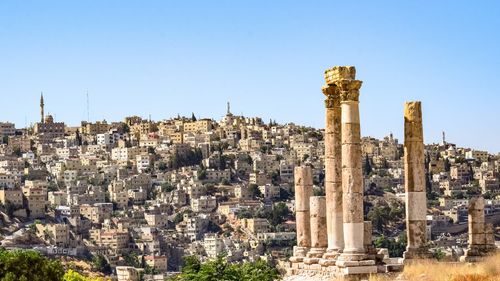
Jabal Al Qal’a (Citadel Hill) has been a focus for human settlement since the Paleolithic Age, more than eighteen thousand years ago. Unfortunately, when the Romans moved in to occupy the area, they cleared away whatever they found, including the remains of the Ammonite city of Rabbath Ammon, and chucked it over the side of the hill: Bronze Age, Iron Age and Hellenistic pottery shards have been found mixed up with Roman remains on the slopes below. Of the remains surviving today, the most impressive is the huge Umayyad palace complex on the upper terrace of the Citadel, dating from the first half of the eighth century. On the middle terrace below and to the south lies the Roman Temple of Hercules, its massive columns dramatically silhouetted against the sky. East of the temple, Roman fortifications protect the grassy lower terrace, which has no visible antiquities.
The easiest way to reach the summit is by taxi; the ascent on foot (20min from Downtown) is extremely steep. About 150m along Shabsough Street as you head east, and just past the second turning on the left, a side street has a wide flight of steps leading left up the hillside. Turn right at the top, and head up any way you can from here: there are crumbling steps most of the way, often leading through private backyards, though note you’ll still have to circle around to enter the site at the ticket office.
Temple of Hercules
The Temple of Hercules, its towering columns visible from Downtown, dates, like the Roman Theatre, from the 2nd century AD. The temple stands on a platform at the head of the monumental staircase which formerly led up from the lower city: the blocks on the cliff edge mark the position of the staircase, and afford a tremendous panoramic view over the city centre that is particularly striking at sunset, when – in addition to the visual dramatics – the dozens of mosques in the city all around start broadcasting the call to prayer almost simultaneously.
The temple’s columns, which were re-erected in 1993, formed part of a colonnaded entrance to the cella, or inner sanctum. Within the cella a patch of bare rock is exposed, which, it’s thought, may have been the sacred rock that formed the centrepiece of the ninth-century BC Ammonite Temple of Milcom on this spot. The Roman dedication to Hercules is not entirely certain but, given the quantity of coins bearing his likeness found in the city below, pretty likely. Look out for the giant marble hand displayed nearby, part of an immense statue also thought to be of Hercules.
Up, up and away
For an alternative flavour of life on Citadel Hill, consult well in advance with the urban communities project Hamzet Wasel (w hamzetwasel.com). They work frequently with the low-income families living on the Jabal Al Qal’a slopes. As part of an “exchange tourism” outlook, they can bring you along to meet with a group of kids who can take an hour or two to teach you how to build – and fly – a kite, employing the materials and techniques they use every day. It’s a great way to break down the tourist/local barrier and feed a bit of money into these often-sidelined communities – and gives a unique experience of Amman life. Check Hamzet Wasel’s website for details of this and other schemes running in untouristed neighbourhoods of the city.
“Souk Jara” street market
In the summer months, don’t miss Souk Jara, a popular, easy-going flea market of antiques, crafts, T-shirts and other streetwear, art and food, established by JARA (the Jabal Amman Residents’ Association). It is held on Fawzi Malouf Street, off the lower end of Rainbow Street, and often includes impromptu concerts, film screenings and other activities.
Top image © Victor Jiang/Shutterstock