Fiestas
January
22: Saint’s day fiesta at San Vicente de la Barquera.
February–April
Start of Lent: Carnaval Week-long festivities in Avilés, Gijón, Oviedo, Mieres, Santoña – fireworks, fancy dress and live music.
Good Friday Re-enactment of the Passion at Castro Urdiales.
Easter Sunday and Monday: Bollo Cake festival at Avilés.
First weekend after Easter: La Folia Torch-lit procession at San Vicente de la Barquera; a statue of the Virgin Mary is carried through town on a fishing boat.
June/July
29: La Amuravela Cudillero enacts an ironic review of the year – and then proceeds to obliterate memories.
Throughout July Weekly fiestas in Llanes, with Asturian dancers balancing pine trees on their shoulders and swerving through the streets. Also, tightrope walking and live bands down at the harbour.
First Friday: Coso Blanco Nocturnal parade at Castro Urdiales.
Mid-July: Festival de Folk Cultural fiesta at San Vicente de la Barquera.
15: Traditional festival at Comillas, with greased-pole climbs, goose chases and other such events.
25: Festival of St James Cangas de Onis.
August
Throughout August: Festival Internacional Music and cultural festival at Santander. This being one of the wealthiest cities of the north, you can usually depend on the festival featuring some prestigious acts.
First or second weekend: Descenso Internacional del Sella Mass canoe races from Arriondas to Ribadesella down the Río Sella, with fairs and festivities in both towns.
First Sunday: Asturias Day Celebrated above all at Gijón.
12: Fiesta at Llanes.
15: El Rosario The fishermen’s fiesta at Luarca, when the Virgin is taken to the sea.
Last Friday: Battle of the Flowers At Laredo.
Last week: San Timoteo Fairly riotous festivities at Luarca: best on the final weekend of the month, with fireworks over the sea, people being thrown into the river and a Sunday romería.
September
7–9: Running of the bulls at Ampuero (Santander).
19: Americas Day In Asturias, celebrating the thousands of local emigrants in Latin America; at Oviedo, there are floats, bands and groups representing every Latin American country. The exact date for this can vary.
21: Fiesta de San Mateo At Oviedo, usually a continuation of the above festival.
Last Sunday: Campoo Day Held at Reinosa, and featuring a parade in traditional dress.
29: Romería de San Miguel At Puente Viesgo.
November
First or second weekend: Orujo Local-liquor festival in Potes.
30: San Andrés Saint’s day fiesta, celebrated with a small regatta at Castro Urdiales. The tradition is to sample sea bream and snails.
If you're planning a trip to Spain, don't miss our Spain itineraries and information on how to get there.
Asturian food and drink
Asturian food is not for the faint-hearted, and it’s certainly not for vegetarians. The signature dish is fabada, a dense haricot-bean stew floating with pungent chunks of meat: black pudding, chorizo and ham. It’s served in a round terracotta dish, and you mop up the juice with the ubiquitous hunk of solid bread. Seafood is another feature, from sea urchins – particularly popular in Gijón – to sea bream and squid. The region produces a huge variety of handmade cheeses, most notably the veined and slightly spicy cabrales, which, in its purest form, is made with cow-, sheep- and goat-milk combined. Another variety is a small cone-shaped cheese, known as afuega’l pitu, which sometimes has a wrinkled exterior owing to its having been hung in cloth.
One sight you won’t miss is waiters and punters pouring sidra (cider) – which you can only order by the bottle – from above their heads into wide-rimmed glasses. The idea is that you knock back the frothing brew in one go. Since it’s a point of honour for the waiters to stare straight ahead rather than look at the glasses, and any residue that you don’t drink within a minute or two is summarily discarded on the floor, it’s hardly surprising the region seems to reek of stale cider.
East to Castro Urdiales
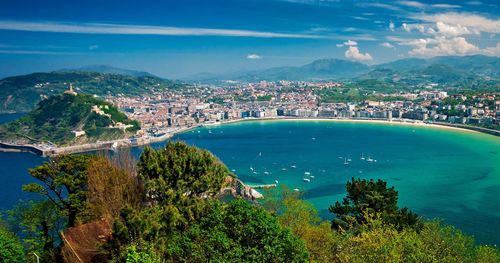
Easily accessible by car but still appealingly rural, the coast east of Santander is becoming ever more developed for tourism. The best-known resort is Laredo, with its enormous beach, but lower-key alternatives include the fishing ports of Santoña and the congenial, handsome resort of Castro Urdiales, 20km east of Laredo and only a short drive west from the huge conglomeration of Bilbao.
Castro Urdiales retains a considerable fishing fleet, gathered around a beautiful natural harbour. Above this looms a massively buttressed Gothic church, Santa María, and a lighthouse, built within the shell of a Knights Templar castle. These are linked to the remains of an old hermitage by a dramatic reconstructed bridge, medieval in age, but known locally as the Puente Romano, under which the sea roars at high tide. The old quarter, the Mediavilla, is relatively well preserved, with arcaded streets and tall, glass-balconied houses.
Heading to Spain anytime soon? Don't miss our important planning tips.
Santillana del Mar and around
The outrageously picturesque village of SANTILLANA DEL MAR is the first major tourist destination west along the Cantabrian coast from Santander. No less an authority than Jean-Paul Sartre, in Nausea, hailed Santillana as “le plus joli village d’Espagne”. The crowds that flock here in summer have unquestionably diminished its appeal, but on a quiet day it remains as beautiful as ever. Its cobbled lanes abound in gorgeous sandstone churches and mansions with flowery overhanging balconies, while the farms and fields that climb the adjacent hillsides give it a lovely rural atmosphere. Strolling is a delight, even if most of its ochre-coloured buildings now hold restaurants, hotels or souvenir shops.
Despite consisting of little more than two pedestrianized streets and a couple of plazas, Santillana feels more like a sizeable medieval town that never grew beyond its original core than a village. Its unusual name derives from a bastardization of “Santa Juliana”, whose remains were brought here 1200 years ago after she was put to death by her husband for refusing to renounce her virginity. Referring to its literal translation, the locals jokily call it the “town of the three lies” – as it’s neither very holy (santi) nor particularly flat (llana), and despite the del Mar actually stands a few kilometres back from the sea.
Many of the fifteenth- to eighteenth-century mansions clustered close to the Plaza Mayor still belong to the original families, but their noble owners have rarely visited in the last couple of centuries. Among the finest is the Casa de los Hombrones, on c/Cantón, named after the two moustached figures that flank its grandly sculpted escutcheon.
The Caves of Altamira
The Caves of Altamira, which burrow into the hillside 2km west of Santillana, consist of an extraordinary series of caverns, adorned by prehistoric human inhabitants around fourteen thousand years ago with paintings of bulls, bison, boars and other animals. Etched in red and black with confident and impressionistic strokes, and sealed by a roof collapse a thousand years later, the murals were in near-perfect condition when rediscovered in the 1870s, their colours striking and vigorous; as Picasso put it, “After Altamira, everything is decadence”. During the 1950s and 1960s, however, they seriously deteriorated due to the moisture released in the breath of visitors, and the caves are now closed to prevent further damage.
Alongside the site, the fascinating Museo de Altamira centres on a “Neocave”, a large and very convincing replica of a portion of the caverns that gives a spine-tingling sense of how the paintings look in situ. Comprehensive displays in the adjoining galleries trace human history all the way back to Africa, with three-dimensional replicas and authentic finds from Altamira and other Spanish sites, and plentiful captions in English. No one knows exactly why the Paleolithic art at Altamira was created, but according to archeologists it was not primarily related to hunting, in that the specific animals depicted were not eaten any more than other species
Puente Viesgo
Genuine prehistoric caves can still be visited just outside the attractive village of Puente Viesgo, set in a river gorge amid magnificent forested escarpments on the N623 to Burgos, 15km southeast of Santillana or 24km southwest of Santander. Guided tours (in Spanish only) depart from an informative visitor centre located 1.5km up a winding mountain road from the village bus stop (served by SA Continental buses from the main station in Santander). Two of the four caves, 700 metres apart, are open to the public, Las Monedas and the slightly better El Castillo, but places are limited, and in summer it’s best to book at least 24 hours in advance. The caves are magnificent, with weirdly shaped stalactites and stalagmites, and bizarre organ-like lithophones, natural features used by Paleolithic peoples to produce primitive music, while the astonishing paintings, depicting animals from mammoths to dogs, are clear precursors to the later developments at Altamira. Should you be unable to find a place on a tour, the visitor centre has an excellent digital exhibit enabling 360-degree views and interactive “tours”.