Explore Porto and the Rio Douro
As with Lisbon, it’s hard not to like PORTO. A large city, maybe, but it’s also a beguiling one, with a lengthy history – it was known in Roman times as Portus Cale (the “sheltered port”). However, there the comparison with the capital ends: as the saying goes: “Coimbra studies, Braga prays, Lisbon shows off and Porto works”. Rather than a prettified tourist destination, it’s a busy commercial city whose fascination lies more in its riverside setting and day-to-day life.
The prosperous business core is tempered by a kernel of cramped streets, ancient alleys and antiquated shops. But since 2001, when Porto was declared European City of Culture, many of the city’s streets and squares have been reconstructed and historic buildings restored, particularly in the riverside bairro of Ribeira – now a UNESCO World Heritage Site – where the waterfront cafés and restaurants are an obvious attraction. This apart, there is only a handful of true tourist sights in the city centre, including the Baroque Clérigos tower, the cathedral, and a couple of good museums. The one must-see attraction, the contemporary art gallery and park at the Fundação de Serralves, is a short way out of the centre, and most visitors also choose to take the antique tram out to the local beach at Foz do Douro, at the mouth of the Rio Douro. Getting out on the Douro itself is a must too, and the various river cruises are the best way to see the city’s famous bridges – there are five more besides the landmark Ponte Dom Luís I, notably the Ponte do Infante, whose central 280-metre reinforced concrete arch is the world’s longest, and further east upriver, Gustave Eiffel’s iron railway bridge, Ponte Dona Maria Pia. For many, though, it is the port wine trade that defines the city, with its centre of operations at Vila Nova de Gaia (just Gaia to locals), on the south bank of the river, the home of the famous port wine lodges.
Read More-
Fundação Serralves
Fundação Serralves
If there’s a must-see cultural attraction in Porto it’s the contemporary art museum and park at the Fundação Serralves. The Museu de Arte Contemporânea is the work of Porto architect Álvaro Siza Vieira, and is a minimalist triumph of white facades and terraces strikingly set in an overwhelmingly green park. There’s no permanent collection, but instead several changing exhibitions a year draw on the works of Portuguese and international artists, mainly from the 1960s to the present day. Other exhibitions are held in the separate, pink Art Deco Casa de Serralves in the grounds.
You can get an idea of the main building from the outside, and from the terrace café, more formal restaurant and museum shop, which means if the exhibitions aren’t to your taste, you miss nothing by just visiting the park. Indeed, many people prefer this to the museum itself and it’s easy to spend a lazy afternoon here, winding along swept gravel paths and clipped lawns before descending wooded tracks to the herb gardens and farmland beyond, grazed by goats and cattle. There are art installations dotted around and a tea house in a glade with a vine colonnade. July and August see a sequence of “Jazz no Parque” (jazz in the park) concerts held in the gardens.
-
Foz do Douro
Foz do Douro
Foz do Douro, formerly a fishermen’s quarter but a distinctly more upmarket beach suburb these days, is around 5km from the city centre. The confluence of river and ocean is dominated by the squat Castelo de São João, beyond which stretch several kilometres of coves and beaches, backed by the cafés and bars of Avenida do Brasil, which becomes the hub of Porto’s summer nightlife. At the northern end stands the Castelo do Queijo (Cheese Castle), so-named because it was built upon boulders that apparently looked like cheese.
-
Vila Nova de Gaia and the port wine lodges
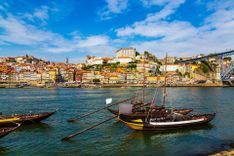
Cross to the south side of the Douro River, over the Ponte Dom Luís I, and you leave the city of Porto for the separate town of Vila Nova de Gaia (or just Gaia), though the distinction is irrelevant to visitors. The riverfront here – facing Porto’s Ribeira – also has a long line of cafés, bars and restaurants; cruise boats dock along the esplanade, while the wooden craft with sails are known as barcos rabelos, the traditional boats once used to transport wine casks downriver from the Douro port estates. The views are, if anything, better from Gaia than from the Porto side, looking back across to a largely eighteenth-century cityscape, with few modern buildings intruding in the panoramic sweep from Palácio de Cristal gardens to cathedral towers.
Gaia, of course, is completely dominated by the port wine trade, whose company lodges and warehouses spell out their names in huge letters across the roofs. Although most have long since been bought by multinationals they still try hard to push a cosy, family-owned image, bolstered by tastings and tours, conducted in English, with a view to enticing you to buy. Most lodges are open daily between May and October; some close at weekends in winter, or are only open then by appointment; where there’s an entrance fee, usually just a couple of euros, the amount is deducted from anything you buy. Tours of the smaller, lesser-known companies tend to be more personal than those of larger producers, but they are all pretty informative and you’ll soon know the difference between a tawny and a ruby, and which vintages are best. The best single place for information about opening hours is the Vila Nova de Gaia turismo.
Cálem wwww.calem.pt. One of the best visitor centres, especially informative about the wine’s history and the port-production process.
Graham’s wwww.grahams-port.com. A lodge originally founded by a Scottish family, and with a splendid tasting terrace overlooking the river.
Ramos Pinto wwww.ramospinto.pt. The famous advertising posters of this Portuguese company did much to popularize port in the 1900s – there’s a really good museum housed in the 1930s period offices.
Sandeman wwww.sandeman.eu. The black-hat-and-cape cut-out provides the most recognizable of company logos and the lengthy tour includes an explanatory film and a good museum.
Taylor, Fladgate & Yeatman wwww.taylor.pt. Founded in 1692, and still an independent family firm, Taylor’s has panoramic views from its salon, terrace and restaurant.
-
Festa de São João
Festa de São João
The city is at its earthiest for the riotous celebration that is the Festa de São João, St John’s Eve (the night of June 23–24), in honour of John the Baptist, patron saint of the city. Be warned – for one night only, seemingly the entire population takes to the streets hitting each other over the head with leeks, squeaky plastic hammers, or anything else to hand, whilst paper balloons illuminated by candles drift off into the night sky. There are free concerts throughout the night and a massive firework display at midnight over the river at Praça da Ribeira. The bash forms only part of the wider city festival, the Festas da Cidade, that runs throughout June and promotes the start of the summer with concerts, dances, vintage car rallies, regattas, sardine grills and other wholesome entertainments. A local speciality is the cascata competitions (displays of dolls depicting Santo António, São João and São Pedro, complete with miniature houses, trains and cars).
-
Porto’s festival calendar
You can check exact festival and event dates on Porto’s tourism website wwww.portoturismo.pt. The following are the annual highlights.
February
Fantasporto (wfantasporto.com), the respected international fantasy, sci-fi and thriller film festival, is held during the last two weeks of the month.
March–April
Festival Intercéltico do Porto – Celtic sounds from Portugal, Galicia, Brittany, Wales, Ireland and Scotland.
Fazer a Festa (wwww.teatroartimagem.org) – international theatre festival held in a “theatre village” in the gardens of the Palácio de Cristal.
June
For the city’s biggest popular festival, São João (June 23–24). June 29 is São Pedro, with more street decorations, music and dancing. The month also marks the start of the respected PortoCartoon World Festival (until Sept), one of the biggest festivals of caricature in the world.
July
International Folklore Festival held during the last week. The annual Festa da Cerveja (beer fest) begins in Foz do Douro and runs through to August. Also the annual GLBT Porto Pride march and celebration.
August
São Bartolomeu (Sun after Aug 24) – a procession in Foz do Douro culminating in a cleansing bathe (banho santo) in the sea. On the last weekend there’s the Noites Ritual, an exclusively Portuguese music festival at the Palácio de Cristal.
September
The Porto Jazz Festival is held during the month, and the Concurso Internacional de Música (international music competition) begins. The Festival Internacional de Marionetas do Porto (FIMP) is a ten-day festival of dance, circus, puppetry and theatre.
-
Rio Douro river cruises
You can book all sorts of tours and cruises at the Porto Tours office (w www.portotours.com) in the Torre Medieval, close to the Sé; trips can also be booked at the main city turismo and São Bento train station. Porto’s stock-in-trade is the river cruise along the Douro. Services are daily and frequent in the summer, much reduced between November and February. The basic cruise is the fifty-minute bridges cruise, though there are also evening and dinner cruises, and full-day or weekend cruises.The longer cruises all operate via the port wine town of Peso da Régua, halfway along the Douro, where – depending on your choice – you’re shuttled around a port wine lodge or take a trip on a steam train.
-
Accommodation
Accommodation
Porto has a wide range of accommodation, though many of the older pensions are dog-eared, noisy or dodgy, or all three. Nearly all the cheapest accommodation is in the city centre, rather than in the medieval streets nearer the river – there are concentrations along Rua de Cedofeita, Rua do Alamada, around Avenida dos Aliados, and near Praça da Batalha. There’s a fair bit of boutique accommodation in and around the city centre, while the upmarket suburbs of Boavista and Serralves, west of the centre, contain most of the city’s four- and five-star hotels, but the suburban location is a drawback. Only a few hotels have their own parking, but a handful have negotiated deals with nearby car parks.
-
Cafés and restaurants
There are hundreds of places to eat in Porto, from old-town tascas and Art Nouveau cafés to riverfront designer restaurants. However, on any lengthy stay you might struggle for variation, as menus are broadly similar, with grilled fish, seafood and bacalhau as staples. The local speciality is tripas (tripe) – the story goes that the inhabitants selflessly gave away all their meat for Infante Dom Henrique’s expeditions to North Africa, leaving themselves only the tripe, and it’s been on the menu ever since, cooked à moda do Porto (stewed with chouriço and white beans). Courtesy of returning emigrants, meanwhile, is the francesinha (“little French thing”) – a mighty doorstep of steak, sausage and ham between toasted bread, covered with melted cheese and a peppery tomato-and-beer sauce.
Both sides of the Douro have become the default places to spend the evening. Along Porto’s Cais da Ribeira a dozen largely touristy fish restaurants are installed under the arches, with more simple places hidden along the backstreets. Over the bridge in Vila Nova de Gaia there’s a mix of traditional fish places and international restaurants and bars. For cheaper meals look in the city centre, around the university (facing the Jardim da Cordoaria), up Rua do Bonjardim, south of the Clérigos church (on streets such as Rua dos Caldeireiros) and near Praça da Batalha. In the main market, the Mercado do Bolhão, you can also eat a very cheap lunch at a couple of little cafés amid the flower stalls. For the best local fish restaurants, you need to take the metro out to Matosinhos, a half-hour ride from the centre.
-
Bars, clubs and live music
Porto’s ever-changing bar scene is spread over three distinct areas: down and around Ribeira, across the river in Gaia, and – unsurprisingly – around the university (near Praça Parada Leitão and on “Bar Street”, Rua Galeria de Paris). There are more bars out to the west in Massarelos (particularly the floating pontoon bars of Rua do Ouro) and in beachside Foz do Douro, but most of the city’s best clubs are fairly central (though the hard house and techno clubs tend to be further out, in Ramalde). For port wine tasting in refined surroundings there are two main bars, the official Solar do Vinho do Porto (city centre) and the Vinologia wine bar (Ribeira), both excellent in their own way.
Most bars don’t open until 10pm and stay open until 2am, later at weekends (often until 4am). Clubs open (or really only get going) at midnight, and most stay open until 4 or 5am or later, with a standard €5–15 admission fee, more for special events and top guest DJs. The entrance ticket acts as a voucher for free drinks, not that it’ll last long as prices are pretty high.
-
Arts and culture
Arts and culture
There will be something worth catching in Porto almost any night of the year. The Casa da Música concert hall has a wide musical remit, but it’s also home of the Orquestra Nacional do Porto, one of the country’s leading symphony orchestras. Otherwise, concerts of all kinds are held at a variety of venues, while in summer there’s usually a series of outdoor concerts in the Jardim do Palácio de Cristal and at Serralves. Local theatre is almost always in Portuguese, though there’s a strong tradition of contemporary dance and other visual and experimental genres. On the whole, though, visitors are more likely to go to the cinema, as films in Portugal are shown in their original language. There are multiplexes in the suburban shopping malls, such as NorteShopping (Senhora da Hora metro).
-
Shopping
Shopping
One of Porto’s abiding pleasures is its surviving traditional shops, often in beautiful Art Nouveau or Art Deco premises, in which you’ll find anything from bacalhau and dusty bottles of vintage port to filigree gold jewellery. Even right in the city centre, people still do much of their day-to-day shopping at small, independent shops – in the line of shops below the Clérigos tower, for example, you could, if you so wished, buy an apple, a pair of shoes, a pig’s tongue or a bucket. The main market, Mercado do Bolhão, still sees brisk business too, though most of the other neighbourhood markets have been eclipsed by the city’s modern shopping centres – the biggest is NorteShopping, in the northwest at Senhora da Hora (on the metro).
Porto’s two main shopping streets are Rua de Cedofeita and the more upmarket Rua de Santa Catarina – these are where you’ll find high-street fashion chains, designer boutiques, jewellers, shoe shops, and electrical and phone stores. Rua de Santa Catarina also has its own mall, Via Caterina, halfway up, as well as a few stalls selling beads, cheap jewellery and accessories, and some secondhand and “vintage” shops towards the top end. Rua de Miguel Bombarda (off Rua de Cedofeita) is at the heart of Porto’s “gallery and arts” district and is the place for designers, delis, and urban arts and crafts.