Explore Tuscany
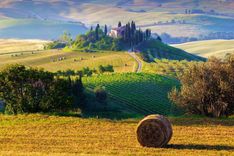
The inland hills of southern Tuscany display the region at its best, an infinite gradation of trees and vineyards that encompasses the depopulated crete before climbing into the hills around Monte Amiata. Southwest of Siena towards the sea, the memorable but little-visited hill-town of Massa Marittima presides over a marshy coastal plain. Magnificent monastic architecture survives in the tranquil settings of San Galgano and, further east, Monte Oliveto Maggiore, which also boasts some marvellous frescoes. The finest of the hill-towns to the south of Siena is Montepulciano, with its superb wines and an ensemble of Renaissance architecture that rivals neighbouring Pienza.
Further south, the tourist crush is noticeably eased in smaller towns and villages that are often overlooked by visitors gorged on Florentine art and Sienese countryside. Wild Monte Amiata offers scenic mountain walks, while the isolated, dramatic medieval town of Pitigliano nurtures the amazing story – and scant remains – of what was once Tuscany’s strongest Jewish community.
Read More-
Massa Marittima
Massa Marittima
The road south from Volterra over the mountains to MASSA MARITTIMA is scenically magnificent yet little explored: classic Tuscan countryside which is given an added surreal quality around Larderello by the presence of soffioni (hot steam geysers), huge silver pipes snaking across the fields, and sulphurous smoke rising from chimneys amid the foliage.
The outskirts of Massa have been marred by modern development, but the medieval town itself at the top of the hill, divided between two very distinct levels, remains a splendid ensemble. While visitor numbers are much lower than, say, San Gimignano, Massa is the closest hill-town to several coastal resorts, and on summer evenings it fills up with beach-based day-trippers.
Brief history
Like Volterra, Massa has been a wealthy mining town since Etruscan times. In 1225, it passed Europe’s first-ever charter for the protection of miners; in the century afterwards, before Siena took over in 1335, its exquisite Duomo went up and the population doubled. The trend was reversed in the sixteenth century, and by 1737, after bouts of plague and malaria, it was a virtual ghost town. Massa gained its “Marittima” suffix in the Middle Ages when it became the leading hill-town of this coastal region, even though the sea is 20km distant across a silty plain. Its recovery began with the draining of coastal marshes in the 1830s. Today, it’s a quiet but well-off town, where the effects of mining are less evident than agriculture and low-profile tourism.
-
Montepulciano
Montepulciano
Highest of all the major Tuscan hill-towns, at more than 600m, the ravishing, self-contained community of MONTEPULCIANO stretches atop a long, narrow ridge 65km southeast of Siena. Its main street, the Corso, coils its way between scores of crumbling Renaissance palazzi and churches, here clustered around perfect little squares, there towering over tiny alleyways. Wherever stairways or mysterious passages drop down the hillside, you get sudden, stunning glimpses of the quintessential wine-growing countryside rolling off to the horizon; occasionally terraced gardens allow you to contemplate the whole stunning prospect at leisure.
Henry James, who compared Montepulciano to a ship, spent most of his time here drinking – a sound policy, in view of the much-celebrated Vino Nobile, production of which dates back well over a thousand years. More recent visitors have been enticed by the drinking of blood rather than wine; Montepulciano’s ancient squares made an ideal location for the 2009 teen vampire movie New Moon.
Brief history
Montepulciano’s rise to eminence began in 1511, when the town finally threw in its lot with Florence rather than Siena. The Florentines thereupon sent Antonio Sangallo the Elder to rebuild the town’s gates and walls, which he did so impressively that the council took him on to work on the town hall and a series of churches. The local nobles meanwhile hired Sangallo, his nephew Antonio Sangallo the Younger, and later the Modena-born Vignola, a founding figure of Baroque, to work on their own palazzi. Totally assured in conception and execution, this trio’s work makes a fascinating comparison with Rossellino’s Pienza.
-
Pienza
Pienza
The tiny, perfectly preserved village of PIENZA, 11km west of Montepulciano, is as complete a Renaissance creation as any in Italy, established as a Utopian “New Town”, in an act of considerable vanity, by Pope Pius II. A scion of the leading family of what was formerly Cortignano, he set about transforming his birthplace in 1459, under the architect Bernardo Rossellino. The cost was astronomical, but the cathedral, papal and bishop’s palaces, and the core of a town (renamed in Pius’s honour), were completed in just three years. Pius lived just two more years, and of his successors only his nephew paid Pienza any regard: intended to spread across the hill, the planned city remained village-sized. Today, despite the large number of visitors, it still has an air of emptiness and folly: a natural stage-set, where Zeffirelli filmed Romeo and Juliet.
-
Pitigliano
Pitigliano
Tuscany’s deep south, on the Lazio border, is its least visited corner. PITIGLIANO, the area’s largest town, is best approached along the road from Manciano, 15km west. As you draw close, the town soars above you on a spectacular outcrop of tufa, its quarters linked by the arches of an immense aqueduct. Etruscan tombs honeycomb the cliffs, but the town was known for centuries for its flourishing Jewish community. Today it has a slightly grim grandeur, owing to its mighty fortress and the tall and largely unaltered alleys of the old Jewish ghetto.
-
Abbazia di San Galgano
The Abbazia di San Galgano, surrounded by majestic fields of sunflowers in a peaceful rural setting 26km northeast of Massa Marittima, is perhaps the most evocative Gothic building in all Italy – roofless, with grass for a floor in the nave, nebulous patches of fresco amid the vegetation, and panoramas of the sky, clouds and hills through a rose window.
During the twelfth and thirteenth centuries, local Cistercian monks were the leading power in Tuscany. The abbots exercised powers of arbitration in city disputes, while the monks in Siena served as the city’s accountants. Through them, the ideas of Gothic building were imported to Italy. The order began a hilltop church and monastic buildings here in 1218, but their project to build a grand abbey on the fertile land below was doomed to failure. Building work took seventy years up to 1288, but then famine struck in 1329, the Black Death in 1348, and mercenaries ran amok in subsequent decades. By 1500, all the monks had moved to the security of Siena. The buildings mouldered until 1786, when the belltower was struck by lightning and collapsed. Three years later, the church was deconsecrated, and the complex was abandoned for good.
These days, the main appeal of the abbey is its general state of ruin, although the basic structure has been stabilized. In summer, it makes a wonderful open-air venue for opera performances, staged on various evenings between late June and the end of July; see w sangalgano.org for schedules.
-
Abbazia di Monte Oliveto Maggiore
Tuscany’s grandest monastery – the Abbazia di Monte Oliveto Maggiore, renowned for its absorbing Renaissance frescoes – stands 26km southeast of Siena, or roughly 50km east of San Galgano, in a secluded but exceptionally beautiful tract of countryside.When Pius II visited in 1463, it was the overall scene that impressed him: the architecture, in honey-coloured Sienese brick, merging into the woods and gardens that the Olivetan or White Benedictine monks had created from the eroded hills of the crete. The pope recognized the order within six years, and over the following two centuries this, their principal house, was transformed into one of the most powerful monasteries in the land. Only in 1810, when the monastery was suppressed by Napoleon, did it fall from influence. Today it’s maintained by a small group of Olivetan monks, who supplement their state income with a high-tech centre for the restoration of ancient books.
The abbey complex
From the gatehouse, an avenue of cypresses leads to the abbey. Signs at the bottom of the slope direct you along a walk to Blessed Bernardo’s grotto – a chapel built on the site where the founder lived as a hermit.
The abbey is a huge complex, though much of it remains off-limits to visitors. The entrance leads to the Chiostro Grande, where the cloister walls are covered by frescoes that depict the Life of St Benedict, the founder of Christian monasticism. The fresco cycle, which begins on the east wall, immediately to the left of worshippers emerging from the church itself, was started in 1497 by Luca Signorelli, who painted nine panels in the middle of the series that start with the depiction of a collapsing house. The colourful Antonio Bazzi, known as Il Sodoma, painted the remaining 27 scenes between 1505 and 1508. He was by all accounts a lively presence, bringing with him part of his menagerie of pets, which included badgers, depicted at his feet in a self-portrait in the third panel. There’s a sensuality in many of the secular figures, especially the young men – as befits the artist’s nickname – but also the “evil women” (originally nudes, until the abbot protested).
The church was given a Baroque remodelling in the eighteenth century and some superb stained-glass in the twentieth. Its main treasure is the choir stalls, inlaid by Giovanni di Verona and others with architectural, landscape and domestic scenes (including a nod to Sodoma’s pets with a cat in a window). Stairs lead from the cloister up to the library, again with carving by Giovanni; sadly, it has had to be viewed from the door since the theft of sixteen of its twenty codices in 1975.
-
Taking the waters at Bagno Vignoni
The extraordinary ancient site of Bagno Vignoni is tucked away 6km southeast of San Quirico. Its central square is entirely taken up by an arcaded Roman piscina, or open pool; the springs still bubble up at a steamy 51°C, with a backdrop of the Tuscan hills and Renaissance loggia – built by the Medici, who, like St Catherine of Siena, took the sulphur cure here. Bathing in the piscina itself is forbidden, but you can still take the waters at the sulphur springs below the village (30°C), or wallow in the mineral-rich waters of one of the nearby spas (advance booking necessary).