Explore Tuscany
Since the early nineteenth century FLORENCE has been celebrated by many as the most beautiful city in Italy. Stendhal staggered around its streets in a perpetual stupor of delight; the Brownings sighed over its charms; and E.M. Forster’s Room with a View portrayed it as the great southern antidote to the sterility of Anglo-Saxon life. The pinnacle of Brunelleschi’s stupendous cathedral dome dominates the cityscape, and the close-up view is even more breathtaking, with the multicoloured Duomo rising beside the marble-clad Baptistry. Wander from here down towards the River Arno and the attraction still holds: beyond the broad Piazza della Signoria – site of the towering Palazzo Vecchio – the river is spanned by the medieval, shop-lined Ponte Vecchio, with the gorgeous church of San Miniato al Monte glistening on the hill behind it.
For art lovers, Florence has no equal in Europe. The development of the Renaissance can be plotted in the vast picture collection of the Uffizi and in the sculpture of the Bargello and the Museo dell’Opera del Duomo. Equally revelatory are the fabulously decorated chapels of Santa Croce and Santa Maria Novella, forerunners of such astonishing creations as Masaccio’s superb frescoes in the Cappella Brancacci. The Renaissance emphasis on harmony and rational design is expressed with unrivalled eloquence in Brunelleschi’s architecture, specifically in the churches of San Lorenzo, Santo Spirito and the Cappella dei Pazzi. While the full genius of Michelangelo, the dominant creative figure of sixteenth-century Italy, is on display in San Lorenzo’s Biblioteca Laurenziana and the marble statuary of the Cappelle Medicee and the Accademia, every quarter of Florence can boast a church worth an extended call, and the enormous Palazzo Pitti south of the river constitutes a museum district on its own. If you’re on a whistle-stop tour, note that it’s not possible to simply stroll into the Cappella Brancacci, and that spontaneous visits to the Accademia and Uffizi are often difficult.
The greater Florence area has a number of towns and attractions to entice you on a day-trip from the city or even act as a base for exploring the region. City buses run northeast to the hill-village of Fiesole, while inter-town services run south into the hills of Chianti, Italy’s premier wine region.
Brief history
The Roman colony of Florentia was established in 59 BC and expansion was rapid, based on trade along the Arno. In the sixth century AD the city fell to the barbarian hordes of Totila, then the Lombards and then Charlemagne’s Franks. In 1078 Countess Mathilda of Tuscia supervised the construction of new fortifications, and in the year of her death – 1115 – granted Florence the status of an independent city. Around 1200, the first Arti (Guilds) were formed to promote the interests of traders and bankers in the face of conflict between the pro-imperial Ghibelline faction and the pro-papal Guelphs. The exclusion of the nobility from government in 1293 was the most dramatic measure in a programme of political reform that invested power in the Signoria, a council drawn from the major guilds. The mighty Palazzo della Signoria – now the Palazzo Vecchio – was raised as a visible demonstration of authority over a huge city: at this time, Florence had a population around 100,000, a thriving mercantile sector and a highly developed banking system (the florin was common currency across Europe). Strife within the Guelph camp marked the start of the fourteenth century, and then in the 1340s the two largest banks collapsed and the Black Death struck, destroying up to half the city’s population.
The Medici
The rise of Cosimo de’ Medici, later dubbed Cosimo il Vecchio (“the Old”), was to some extent due to his family’s sympathies with the smaller guilds. The Medici fortune had been made by the banking prowess of Cosimo’s father, Giovanni Bicci de’ Medici, and Cosimo used the power conferred by wealth to great effect. Partly through his patronage of such figures as Brunelleschi and Donatello, Florence became the centre of artistic activity in Italy.
The ascendancy continued under Cosimo’s grandson Lorenzo il Magnifico, who in effect ruled the city at the height of its artistic prowess. Before Lorenzo’s death in 1492, the Medici bank failed, and in 1494 Lorenzo’s son Piero was obliged to flee. Florentine hearts and minds were seized by the charismatic Dominican monk, Girolamo Savonarola, who preached against the decadence and corruption of the city. Artists departed in droves as Savonarola and his cohorts, in a symbolic demonstration of the new order, gathered books, paintings, tapestries, fancy furniture and other frivolities, and piled them high in Piazza della Signoria in a Bonfire of the Vanities. Within a year, however, Savonarola had been found guilty of heresy and treason, and was burned alive on the same spot.
After Savonarola, the city functioned peaceably under a republican constitution headed by Piero Soderini, whose chief adviser was Niccolò Machiavelli. In 1512 the Medici returned, and in 1516, Giovanni de’ Medici became Pope Leo X, granting Michelangelo and Leonardo da Vinci major commissions. After the assassination of Alessandro de’ Medici in 1537, power was handed to a new Cosimo, who seized the Republic of Siena and, in 1569, took the title Cosimo I, Grand Duke of Tuscany.
Florence’s subsequent decline was slow and painful. Each of the later Medicis was more ridiculous than the last: Francesco spent most of his thirteen-year reign indoors, obsessed by alchemy; Ferdinando II sat back as harvests failed, plagues ran riot and banking and textiles slumped to nothing; the virulently anti-Semitic Cosimo III spent 53 years in power cracking down on dissidents; and Gian Gastone spent virtually all his time drunk in bed. When Gastone died, in 1737, the Medici line died with him.
Florence after the Medici
Under the terms of a treaty signed by Gian Gastone’s sister, Anna Maria Ludovica, Florence – and the whole Grand Duchy of Tuscany – passed to Francesco of Lorraine, the future Francis I of Austria. Austrian rule lasted until the coming of the French in 1799; after a fifteen-year interval of French control, the Lorraine dynasty was brought back, remaining in residence until being overthrown in the Risorgimento upheavals of 1859. Absorbed into the united Italian state in the following year, Florence became the capital of the Kingdom of Italy in 1865, a position it held until 1870.
At the end of the nineteenth century, large areas of the medieval city were demolished by government officials and developers; buildings that had stood in the area of what is now Piazza della Repubblica since the early Middle Ages were pulled down to make way for undistinguished office blocks, and old quarters around Santa Croce and Santa Maria Novella were razed. In 1944, the retreating German army blew up all the city’s bridges except the Ponte Vecchio and destroyed acres of medieval architecture. A disastrous flood in November 1966 drowned several people and wrecked buildings and works of art, and restoration of the damage is still going on. Indeed, monuments and paintings are the basis of Florence’s survival, a state of affairs that gives rise to considerable disquiet. The development of new industrial parks on the northern outskirts is the latest and most ambitious attempt to break Florence’s ever-increasing dependence on its tourists.
Read More-
The Duomo (Santa Maria del Fiore)
Traffic and people gravitate towards the square at the heart of Florence, Piazza del Duomo, beckoned by the pinnacle of Brunelleschi’s extraordinary dome, which dominates the cityscape in a way unmatched by any architectural creation in any other Italian city. Yet even though the magnitude of the Duomo is apparent from a distance, the first full sight of the church and the adjacent Baptistry still comes as a jolt, the colours of their patterned exteriors making a startling contrast with the dun-coloured buildings around them.
It was sometime in the seventh century when the seat of the Bishop of Florence was transferred from San Lorenzo to the ancient church that stood on the site of the Duomo. In the thirteenth century, it was decided that a new cathedral was required, to better reflect the wealth of the city and to put the Pisans and Sienese in their place. In 1294 Arnolfo di Cambio designed a vast basilica focused on a domed tribune; by 1418 this project was complete except for its crowning feature. The conception was magnificent: the dome was to span a distance of nearly 42m and rise from a base some 54m above the floor of the nave. It was to be the largest dome ever constructed – but nobody had yet worked out how to build it.
A committee of the masons’ guild was set up to ponder the problem, and it was to them that Filippo Brunelleschi presented himself. Some seventeen years before, in 1401, Brunelleschi had been defeated by Ghiberti in the competition to design the Baptistry doors, and had spent the intervening time studying classical architecture and developing new theories of engineering. He won the commission on condition that he worked jointly with Ghiberti – a partnership that did not last long. The key to the dome’s success was the construction of two shells: a light outer shell about one metre thick, and an inner shell four times thicker. On March 25, 1436 – Annunciation Day, and the Florentine New Year – the completion of the dome was marked by the papal consecration of the cathedral.
The exterior
The Duomo’s overblown main facade is a nineteenth-century imitation of a Gothic front, its marble cladding quarried from the same sources as the first builders used – white stone from Carrara, red from the Maremma, green from Prato. The south side is the oldest part, but the most attractive adornment is the Porta della Mandorla, on the north side. This takes its name from the almond-shaped frame that contains the relief The Assumption of the Virgin, sculpted by Nanni di Banco around 1420.
The interior
The Duomo’s interior is a vast enclosure of bare masonry that makes a stark contrast to the fussy exterior. Initially, the most conspicuous pieces of decoration are two memorials to condottieri (mercenary commanders) in the north aisle – Uccello’s monument to Sir John Hawkwood, painted in 1436, and Castagno’s monument to Niccolò da Tolentino, created twenty years later. Just beyond, Domenico do Michelino’s Dante Explaining the Divine Comedy makes the dome only marginally less prominent than the mountain of Purgatory. Judged by mere size, the major work of art in the Duomo is the fresco of The Last Judgement inside the dome; painted by Vasari and Zuccari, it merely defaces Brunelleschi’s masterpiece. Below the fresco are seven stained-glass roundels designed by Uccello, Ghiberti, Castagno and Donatello; they are best inspected from the gallery immediately below them, which forms part of the route up inside the dome – the entrance is outside, on the north side (Mon–Fri 8.30am–7pm, Sat 8.30am–5.40pm; €8). The gallery is the queasiest part of the climb, most of which winds between the brick walls of the outer and inner shells of the dome, up to the very summit with its stunning views over the city.
In the 1960s remnants of the Duomo’s predecessor, Santa Reparata, were uncovered beneath the west end of the nave (€3). A detailed model helps make sense of the jigsaw of Roman, early Christian and Romanesque remains, areas of mosaic and patches of fourteenth-century frescoes. Also down here is the tomb of Brunelleschi, one of the few Florentines honoured with burial inside the Duomo.
-
The Uffizi
The Uffizi
The Galleria degli Uffizi, the finest picture gallery in Italy, is housed in what were once government offices (uffizi) built by Vasari for Cosimo I in 1560. After Vasari’s death, work on the building was continued by Buontalenti, who was asked by Francesco I to glaze the upper storey so that it could house his art collection. Each of the succeeding Medici added to the family’s trove of art treasures, which was preserved for public inspection by the last member of the family, Anna Maria Lodovica, whose will specified that it should be left to the people of Florence and never be allowed to leave the city. In the nineteenth century a large proportion of the statuary was transferred to the Bargello, while most of the antiquities went to the Museo Archeologico, leaving the Uffizi as essentially a gallery of paintings supplemented with some classical sculptures. The gallery is in the process of expansion, doubling the number of rooms open to the public in order to show some eight hundred pictures that have been kept in storage; accordingly, some paintings – especially those in the later sections – may not be on show precisely where they appear in the following account.
Pre-Renaissance
You can take a lift up to the galleries, but if you take the staircase instead, you’ll pass the entrance to the Uffizi’s prints and drawings section. The bulk of this vast collection is reserved for scholarly scrutiny but samples are often on public show.
The beginnings of the stylistic evolution of that period can be traced in the three altarpieces of the Maestà (Madonna Enthroned) that dominate Room 2: the Madonna Rucellai, Maestà di Santa Trinità and Madonna d’Ognissanti, by Duccio, Cimabue and Giotto respectively. These great works, which dwarf everything around them, show the softening of the hieratic Byzantine style into a more tactile form of representation.
Painters from fourteenth-century Siena fill Room 3, with several pieces by Ambrogio and Pietro Lorenzetti and Simone Martini’s glorious Annunciation. In Room 5, devoted to the last flowering of Gothic art, Lorenzo Monaco is represented by an Adoration of the Magi and his greatest masterpiece, The Coronation of the Virgin. Equally arresting is another Adoration of the Magi by Gentile da Fabriano, a picture spangled with gold and crammed with incidental detail. Opposite is the Thebaid, a beguiling little narrative that depicts monastic life in the Egyptian desert as a sort of holy fairy-tale; though labelled as being by the young Fra’ Angelico, it’s also been attributed to the now-obscure Gherardo di Jacopo Starnina.
Early Renaissance
Room 7 reveals the sheer diversity of early Renaissance painting. Fra’ Angelico’s gorgeous Coronation of the Virgin takes place against a Gothic-like field of gold, but there’s a very un-Gothic sensibility at work in its individualized depiction of the attendant throng. Paolo Uccello’s The Battle of San Romano once hung in Lorenzo il Magnifico’s bedchamber, in company with its two companion pieces now in the Louvre and London’s National Gallery. The Madonna and Child with Sts Francis, John the Baptist, Zenobius and Lucy is one of only twelve extant paintings by Domenico Veneziano, whose greatest pupil, Piero della Francesca, is represented in Room 8 by the paired portraits of Federico da Montefeltro and Battista Sforza, the duke and duchess of Urbino. Much of this room is given over to Fra’ Filippo Lippi, whose Madonna and Child with Two Angels is one of the gallery’s most popular faces: the model was Lucrezia Buti, a convent novice who became the object of one of his more enduring sexual obsessions. Lucrezia puts in another appearance in Lippi’s crowded Coronation of the Virgin, where she’s the young woman gazing out in the right foreground; Filippo himself, hand on chin, makes eye contact on the left side of the picture. Their liaison produced a son, the aptly named Filippino “Little Philip” Lippi, whose Otto Altarpiece – one of several works by him here – is typical of the more melancholic cast of the younger Lippi’s art.
The Pollaiuolo brothers and Botticelli
Lippi’s great pupil, Botticelli, steals some of the thunder in Room 9 – Fortitude, one of the series of cardinal and theological virtues, is a very early work by him. The rest of the series is by Piero del Pollaiuolo, whose brother Antonio (primarily a sculptor) assisted him in the creation of Sts Vincent, James and Eustace, their finest collaboration.
It’s in the merged rooms 10–14 that the finest of Botticelli’s productions are gathered. The identities of the characters in the Primavera are clear enough: on the right Zephyrus, god of the west wind, chases the nymph Cloris, who is then transfigured into Flora, the pregnant goddess of spring; Venus stands in the centre, to the side of the three Graces, who are targeted by Cupid; on the left Mercury wards off the clouds of winter. What this all means, however, has occupied scholars for decades, but the consensus seems to be that it shows the triumph of Venus, with the Graces as the physical embodiment of her beauty and Flora the symbol of her fruitfulness.
The Birth of Venus is less obscure: it takes as its source the myth that the goddess emerged from the sea after it had been impregnated by the castration of Uranus, an allegory for the creation of beauty through the mingling of the spirit (Uranus) and the physical world.
Botticelli’s devotional paintings are equally stunning. The Adoration of the Magi is traditionally thought to contain a gallery of Medici portraits: Cosimo il Vecchio as the first king, his sons Giovanni and Piero as the other two kings, Lorenzo the Magnificent on the far left, and his brother Giuliano as the black-haired young man in profile on the right. Only the identification of Cosimo is reasonably certain, along with that of Botticelli himself, on the right in the yellow robe. In later life, influenced by Savonarola’s teaching, Botticelli confined himself to religious subjects and moral fables, and his style became increasingly severe. The transformation is clear when comparing the easy grace of the Madonna of the Magnificat with the angularity and agitation of the Calumny of Apelles.
Not quite every masterpiece in this room is by Botticelli. Set away from the walls is the Adoration of the Shepherds by his Flemish contemporary Hugo van der Goes. Brought to Florence in 1483 by Tommaso Portinari, the Medici agent in Bruges, it provided the city’s artists with their first large-scale demonstration of the realism of Northern European oil painting, and had a great influence on the way the medium was exploited here.
Leonardo to Mantegna
Works in Room 15 trace the formative years of Leonardo da Vinci, whose distinctive touch appears first in the Baptism of Christ by his master Verrocchio: the wistful angel in profile is by the 18-year-old apprentice, as is the misty landscape in the background, and Leonardo also worked heavily on the figure of Christ. A similar terrain of soft-focus mountains and water occupies the far distance in Leonardo’s slightly later Annunciation, in which a diffused light falls on a scene where everything is observed with a scientist’s precision. In contrast to the poise of the Annunciation, the sketch of The Adoration of the Magi – abandoned when Leonardo left Florence for Milan in early 1482 – presents the infant Christ as the eye of a vortex of figures, all drawn into his presence by a force as irresistible as a whirlpool. Most of the rest of the room is given over to Raphael’s teacher, Perugino.
Room 18, the octagonal Tribuna, houses the most important of the Medici’s collection of classical sculpture – in particular, the Medici Venus – but also some fascinating portraits by Bronzino, painted like figures of porcelain, and Andrea del Sarto’s flirtatious Portrait of a Young Woman.
The last section of this wing throws together Renaissance paintings from outside Florence. Signorelli, Perugino and Piero di Cosimo are the principal artists in Room 19, and after them comes a room devoted to Cranach, Dürer and other German artists. A taste of the Uffizi’s remarkable collection of Venetian painting follows, with an impenetrable Sacred Allegory by Giovanni Bellini, and three works attributed to Giorgione. In Room 22, a clutch of Northern European paintings includes some superb portraits by Holbein (notably Sir Richard Southwell and a self-portrait) and Hans Memling. The following room has a trio of Correggio pictures and a clutch of exquisite paintings by Mantegna, including the Madonna delle Cave, which takes its name from the minuscule quarry (cave) in the background.
Michelangelo, Mannerism and Titian
Beyond the stockpile of statues in the short corridor overlooking the Arno, the main attraction in Room 25 is Michelangelo’s Doni Tondo, the only easel painting he came close to completing. The adjoining room contains Andrea del Sarto’s sultry Madonna of the Harpies and a number of compositions by Raphael, including his self-portrait, the lovely Madonna of the Goldfinch and Pope Leo X with Cardinals Giulio de’ Medici and Luigi de’ Rossi. The Michelangelo tondo’s contorted gestures and virulent colours were greatly influential on the Mannerist painters of the sixteenth century, as can be gauged from Moses Defending the Daughters of Jethro by Rosso Fiorentino, one of the seminal figures of the movement, whose works hang in Room 27, along with major works by Bronzino and his adoptive father, Pontormo.
Room 28 is dominated by another of the titanic figures of sixteenth-century art, Titian, with ten of his paintings on show. His Flora and A Knight of Malta are stunning, but most eyes tend to swivel towards the Urbino Venus, the most provocative of all Renaissance nudes, described by Mark Twain as “the foulest, the vilest, the obscenest picture the world possesses”. A brief diversion through the painters of the sixteenth-century Emilian school follows, centred on Parmigianino, whose Madonna of the Long Neck is one of the pivotal Mannerist creations. Rooms 31 to 34 feature a miscellany of sixteenth-century artists (look out for the El Greco) and some masterpieces from Venice and the Veneto, including work by Moroni, Tintoretto, Paolo Veronese and Lorenzo Lotto.
The seventeenth and eighteenth centuries
The Uffizi’s collection of seventeenth-century art is in rooms 41–45. Room 41 features strong work from Van Dyck and Rubens, whose Portrait of Isabella Brandt is perhaps his finest painting here. The most overwhelming, however, are the huge Henry IV at the Battle of Ivry and The Triumphal Entry of Henry IV into Paris – Henry’s marriage to Marie de’ Medici is the connection with Florence. This pair are displayed in the majestic Neoclassical Niobe Room. In this section of the gallery you should also see some superb works by Rembrandt, Goya, Guercino, Canaletto, Tiepolo and Chardin, but the plan is to move the non-Italian artists to new rooms downstairs some time soon.
At the moment these new galleries are used for temporary exhibitions and as a showcase for Italian art of the seventeenth century. Dramatic images from Salvator Rosa, Luca Giordano and Artemisia Gentileschi make quite an impression, but the presiding genius is Caravaggio, with his bravura Medusa (painted on a shield), the smug little Bacchus, and the throat-grabbing Sacrifice of Isaac.
-
Chianti
Chianti
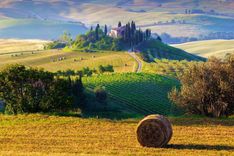
Ask a sample of middle-class Northern Europeans to define their idea of paradise and the odds are that a hefty percentage will come up with something that sounds a lot like Chianti, the territory of vineyards and hill-towns that stretches between Florence and Siena. Life in Chianti seems in perfect balance: the landscape is a softly varied terrain of hills and valleys; the climate for most of the year is sunny; and on top of all this there’s the wine, the one Italian vintage that’s familiar to just about everyone. Visitors from Britain and other similarly ill-favoured climes were long ago alerted to Chianti’s charms, and the rate of immigration has been so rapid since the 1960s that the region is now wryly dubbed Chiantishire. Yet it would be an exaggeration to say that Chianti has completely lost its character: the tone of certain parts has been altered, but concessions to tourism have been more or less successfully absorbed into the rhythm of local life.
Hotels in Chianti are rarely inexpensive, but this is prime agriturismo territory, with scores of farms offering rooms or apartments (or even self-contained mini-villas), generally for a minimum period of one week, which for an extended stay can provide a good-value alternative to hotel accommodation.
- Florence addresses
- Picnic supplies
- Top 5 places for outdoor drinking
- Florence’s festivals
- Fashion factory outlets
- Getting around
-
Accommodation
Accommodation
Hotels are plentiful in Florence but demand is almost limitless, which means that prices are high and the tourist inundation has few slack spots: “low season” is defined by most hotels as meaning mid-July to the end of August (the weeks during which nearly all Italians head for the beaches or the mountains), and from mid-November to mid-March, except for the Christmas and New Year period; between March and October, booking ahead is strongly advised. In recent years, boutique hotels and B&Bs have sprung up all over the city, operating under several different labels: places calling themselves a relais or a residenza d’epoca are generally smart B&Bs, often located in historic palazzi. The Via Cavour tourist office has a full accommodation list, or see w firenzeturismo.it.
-
Eating and drinking
Eating and drinking
As you’d expect in a major tourist city, Florence has plenty of restaurants, but – unsurprisingly – a large number of them are aimed squarely at the outsiders, so standards are often patchy. But the situation is nowhere near as bad as some would have it – in fact it’s been improving in recent years, with the appearance of several stylish and good-value restaurants. Bear in mind also that simple meals are served in many Florentine bars and cafés if you fancy a quick bite to eat rather than a full-blown restaurant meal.
-
Nightlife and entertainment
Florence is quite a sedate city, but like every university town it has some decent clubs and live music venues, and events such as the Maggio Musicale maintain Florence’s standing as the hub of cultural life in Tuscany. The best clubs and music venues are listed below, but for a full picture of the Florence after-dark scene, check the “Bars” listings too – many of Florence’s bars try to keep punters on the premises all night, by serving free snacks with the aperitivi (usually from about 7–9/10pm) before the music kicks in, either live or (more often) courtesy of the in-house DJ. For information about concerts and shows, get hold of the Firenze Spettacolo monthly listings magazine or drop in at the Box Office ticket agency, which is at Via delle Vecchie Carceri 1, near the Mercato di Sant’Ambrogio (boxol.it). Online, a great info source is w nottefiorentina.it.
-
Shopping
Shopping
Florence is known as a producer of luxury items, notably gold jewellery and top-quality leather goods. The whole Ponte Vecchio is crammed with goldsmiths, but the city’s premier shopping thoroughfare is Via de’ Tornabuoni, where you’ll find not only an array of expensive jewellery and shoe shops but also the showrooms of Italy’s top fashion designers. For cheap and cheerful stuff there’s the plethora of street stalls around the San Lorenzo market, while if you want everything under one roof, there’s also a handful of department stores. Marbled paper is another Florentine speciality, and, as you’d expect in this arty city, Florence is also one of the best places in the country to pick up books on Italian art, architecture and culture.