Explore Emilia-Romagna
Emilia-Romagna doesn’t attract nearly the same volume of tourists as its neighbouring provinces of Lombardy, the Veneto and Tuscany, which is strange because it offers just as fine a distillation of the region’s charms: glorious countryside, plenty of historic architecture and local cuisine renowned across the rest of Italy. It’s also pretty easy to get around, with most of its main sites located along the Via Emilia (or more prosaically the A1 and A14 roads), the dead-straight road first laid down by the Romans in 187 BC that splits the province in two along its east–west axis, dividing the Apennine mountains in the south from the flat fields of the northern plain, the Pianura Padana.
Dotted along this road are some proud, historic towns, filled with restored medieval and Renaissance palazzi, the legacy of a handful of feuding families – the Este in Ferrara and Modena, the Farnese in Parma, and lesser dynasties in Ravenna and Rimini – who used to control the area before the papacy took charge. The largest urban centre, and the main tourist draw, is Bologna, the site of Europe’s first university – and today best known as the gastronomic capital of Italy. It’s generally regarded as one of the country’s most beautiful cities with a mazy network of porticoed, medieval streets housing a collection of restaurants that easily live up to the town’s reputation.
To the west are the wealthy, provincial towns of Modena, Parma and Reggio Emilia, easily reached by train, and each with their own charming historic centres and gastronomic delights, while to the east lies Ravenna, once the capital of the Western Roman Empire and today home to the finest set of Byzantine mosaics in the world. The Adriatic coast south is an overdeveloped ribbon of settlements, although Rimini, at its southern end, provides a spark of interest, with its wild seaside nightlife and surprisingly historic town centre.
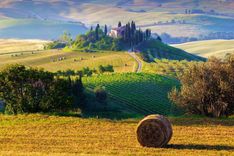
Away from the central artery, Emilia-Romagna’s countryside comes in two topographical varieties: flat or hilly. To the north lies one of the largest areas of flat land in Italy, a primarily agricultural region where much of the produce for the region’s famed kitchens is grown. It also boasts a good deal of wildlife, particularly around the Po Delta on the Adriatic (a soggy expanse of marshland and lagoons that has become a prime destination for birdwatchers) and in Ferrara, just thirty minutes north of Bologna, one of the most important Renaissance centres in Italy. To the south are the Apennines, an area best explored using your own transport, sampling local cuisine and joining in the festivals; although it’s still possible to get a taste of this beautiful region, far removed from the functional plain to the north, by bus. If you’re a keen hiker, you might be tempted by the Grande Escursione Appenninica, a 25-day-long trek following the backbone of the range from refuge to refuge, which can be accessed from the foothills south of Reggio Emilia.
Read More-
Regional food and wine
Emilia-Romagna has a just reputation for producing the richest, most lavish food in Italy, with its famous specialities of parmesan cheese (parmigiano-reggiano), egg pasta, Parma ham (generically known as prosciutto di Parma) and balsamic vinegar. Despite its current foodie connotations, balsamic vinegar started off as a cottage industry, with many Emilian families distilling and then redistilling local wine to form a dark liquor that is then matured in wooden barrels for at least twelve years. Bologna is regarded as the gastronomic capital of Italy, and Emilia is the only true home of pasta in the North: often lovingly handmade, the dough is formed into lasagne, tortellini stuffed with ricotta cheese and spinach, pumpkin or pork, and other fresh pastas served with ragù (meat sauce), cream sauces or simply with butter and parmesan – alla parmigiana usually denotes something cooked with parmesan. Modena and Parma specialize in bollito misto – boiled meats, such as flank of beef, trotters, tongue and spicy sausage – while another Modenese dish is zampone – stuffed pig’s trotter. The region is second only to Sicily for the amount of fish caught in its waters.
Regional wines are, like the landscapes and people, quite distinct. Emilia is synonymous with Lambrusco, but don’t despair: buy only DOC Lambrusco and be amazed by the dark, often blackberry-coloured wine that foams into the glass and cuts through the fattiness of the typically meaty Emilian meal. There are four DOC zones for Lambrusco and you get a glimpse of three of them, all around Modena, from the Via Emilia, each supporting neat rows of high-trellised vines. The fourth zone extends across the plains and foothills of the Apennines, in the province of Reggio Emilia. Other wines to try, both whites, are Trebbianino Val Trebbia and Monterosso Val D’Arda, while the lively Malvasia (also white) from the Colli di Parma goes well with the celebrated local ham.
Heading east towards the Adriatic coast, you come to the Romagna, a flatter, drier province where the wines have less exuberance but more body and are dominated by Albana and Sangiovese. The sweeter versions of Albana are often more successful at bringing out the peachy, toasted-almond flavours of this white. The robust red of Sangiovese, from the hills around Imola and Rimini, comes in various “weights” – all around the heavy mark. Much lighter is Cagnina di Romagna, which is best drunk young (within six months of harvest).