The Beara Peninsula
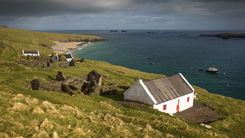
The largest and most remote of Cork’s peninsulas, the Beara (w www.bearatourism.com) careers southwestwards for 50km between Bantry Bay and the Kenmare River. Patterns in the landscape are hard to distinguish here, and contrasts frequent. Indeed, the peninsula’s most popular tourist spot, Glengarriff, has built an industry on the stunning contrast between its lush subtropical setting and the irregular, barren rocks of the Caha Mountains behind. The mountainous spine is often augmented by ribs, and particularly in the awesome Slieve Miskish Mountains at the Beara’s tip, the coast road is forced to climb through whatever passes can be found. Round on the north coast, half of which belongs to County Kerry, the only settlements occupy occasional cups of green farmland beneath the stony ridges. This diverse scenery is linked together by two routes: the Beara Way, a 200-kilometre waymarked walk (9–11 days), following mostly tracks and minor roads from Glengarriff west (via Adrigole, Castletownbere and a ferry to Bere Island, which can easily be missed out) to Dursey Island, then along the north coast of the peninsula (via Allihies, Eyeries, Ardgroom and Lauragh) to Kenmare and back to Glengarriff; and the 138-kilometre Beara Way Cycle Route, which mostly follows the quiet main road around the peninsula. Route guides are available locally, and the Ordnance Survey 1:50,000 Discovery map 84 covers nearly the whole peninsula.
Glengarriff
The founders of GLENGARRIFF were perhaps having an off-day when they named it An Gleann Garbh, the “rugged glen” – or, to be charitable, maybe the climate has changed since then. It’s true that above and behind stands the magnificent backdrop of the wild, bare Caha Mountains, but the village itself sits in a sheltered oasis of balmy greenery. This picturesque juxtaposition, warmed by the Atlantic Gulf Stream, has attracted tourists since the eighteenth century, when the Eccles Hotel was built. The landscape – and the gift shops – still pull in the coach parties, but the village’s popularity also means there’s a decent range of places to stay, making it a good base for exploring some of Cork’s most beautiful countryside or for just hopping over to see the horticultural delights of Garinish Island. To the west, in the dramatic shadow of Hungry Hill, watersports and a pleasant hostel are on offer at Adrigole.
Garinish Island (Ilnacullin)
In 1910, the MP Annan Bryce bought Garinish (aka Ilnacullin) from the British War Office and, after shipping in all the topsoil, gradually turned the rocky inshore island into an exotic garden oasis. Having passed into public ownership in 1953, the island is now a delightful and accessible escape from the mainland, especially in summer, when colourful plants from around the world set the island alight against a backdrop of the sparse, jagged mountains just across the water. The island’s centrepiece is a formal Italianate garden, surrounded by a walled garden and wilder areas, a Grecian temple with magnificent views of the Caha Mountains and a Martello tower. There’s a coffee shop and a self-guided trail around the gardens, and serious horticulturalists should pick up the Heritage Service’s guidebook, which includes detailed plant lists. The ten-minute boat trip to the island takes you past the lush islets of Glengarriff Harbour, where you may see basking seals.
Allihies
Looping round an especially harsh and rocky part of the peninsula on the R575, you’ll come upon ALLIHIES, its brightly coloured houses dramatically huddled together against the leathery creases of Slieve Miskish’s western flank and blessed with superb sunset views. In 1812, the Industrial Revolution descended on this most remote corner of Ireland with a vengeance, bringing state-of-the-art engineering and Cornish mining techniques to work the copper ore in the mountains above the village. At any one time, up to 1500 people, including women and children, worked for the mines here in desperate conditions, until their closure in the 1880s, when many of the miners emigrated to the huge copper lode in Butte, Montana. The story is now engagingly told at the excellent Allihies Copper Mine Museum, set up by a group of dedicated local enthusiasts, in a renovated Methodist church that was built for the immigrant Cornish miners. Highlights of the thoughtful displays include video recollections of local men who worked in the mines when they briefly reopened in the 1950s, bits of ore that you can handle and a small-scale reconstruction of a steam pump. In addition, a network of signposted trails has been laid out in the surrounding countryside, allowing you to take in ruined mine buildings and spectac- ular views. One of the trails leads down to Ballydonegan Strand (beware the currents when swimming), 1km to the southwest – this sandy beach is actually composed of crushed quartz produced in the copper extraction process.
Ballymaloe
Around 10km southeast of Midleton, off the R629 Cloyne–Ballycotton road, lies Ireland’s most famous restaurant Ballymaloe House, serving exceptional modern Irish cuisine using local ingredients, with some nice traditional touches – you’ll be asked if you want second helpings and you choose your dessert from a groaning trolley. There’s much more to this grand enterprise than just a restaurant: accommodation in the vine-covered, originally fifteenth-century manor house and adjacent courtyard mixes country-house style with contemporary art, and there’s a summertime heated outdoor pool, five-hole golf course and a tennis court, plus bicycles for guests’ use and walks around the extensive grounds and farm. Attached to the house is a shop selling crafts and, of course, kitchenware, with an excellent daytime café; there’s also a seventeenth-century grainstore that’s been converted into a concert venue. The nearby cookery school runs prestigious twelve-week certificate courses as well as a host of short courses, and you can visit the school’s restored nineteenth-century gardens, featuring the largest formal herb garden in Ireland and a Celtic maze.
Cobh
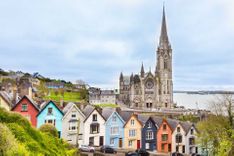
On the southern coast of Great Island, with extensive views of Cork Harbour, COBH (pronounced “cove”) makes a great escape from the city on a fine day. This historic and unpretentious resort, clinging onto a steep, south-facing slope, sports a stony beach, a promenade with a bandstand and gaily painted rows of Victorian hotels and houses. Much of the tourist traffic comes now from the dozens of huge cruise-liners that dock here every year, continuing a long tradition for this fine, natural harbour: Cobh was a port of call for the Sirius, the first steamship to cross the Atlantic, in 1838, and for the Titanic on her disastrous maiden voyage in 1912. The port was also a major supply-depot during the American and Napoleonic wars, and became Ireland’s main point of emigration after the Great Famine. This long and often tragic seafaring history is vividly detailed at the Queenstown Story, a heritage centre in the former Victorian train station on the seafront (the town was renamed Queenstown after a visit by Queen Victoria in 1849, but its old name was restored after Independence). If your appetite for salty tales and memorabilia still hasn’t been sated, get along to the Cobh Museum, housed in a nineteenth-century Presbyterian church on the west side of the town centre.
Cork city
The Republic’s second city, CORK (Corcaigh, “marshy place”) is strongly characterized by its geography. The centre sits tight on a kilometre-wide island, much of which was reclaimed from marshes, in the middle of the River Lee, while the enclosing hills seem to turn this traditionally self-sufficient city in on itself. Given this layout and its history, it comes as no surprise that Corkonians have a reputation in Ireland for independence of spirit, not to say chippiness. Indeed, in many ways, Cork sees itself not in second place but as a rival to Dublin. It produces its own national newspaper, The Irish Examiner, brews Murphy’s and Beamish, its own versions of the national drink, stout, and supports a vigorous artistic, intellectual and cultural life of its own. Even its social divisions match Dublin’s: here too the south side of the river is generally more affluent, while the north side has more public housing and a stronger working-class identification.
In colonial times, Cork also maintained its own strong links with London, through its role as a major port, proof of which can still be seen all around town. The main drag, curving St Patrick’s Street, was originally a waterway lined with quays, while you can still spot eighteenth-century moorings on Grand Parade. Though contemporary Cork doesn’t make the most of its long riverfront, much of which is now lined by major roads, the channels of the Lee, spanned by more than twenty bridges, break up the cityscape and pleasantly disorientate. The harbour area has Ireland’s largest concentration of chemical factories, fortunately downstream of the centre, while the city’s other main modern industry, computers, is linked to the prestigious university, to the west of the centre. All of this has spawned a widespread commuter belt, but the compact island is still the place for the many excellent restaurants, lively pubs and artistic venues.
The best of the city’s sightseeing options are the Crawford Art Gallery, with its fine collection of eighteenth- to twentieth-century art, Cork City Gaol, which vividly evokes life in a nineteenth-century prison, and the hi-tech cosmological displays of Blackrock Castle Observatory. In truth, however, none of Cork’s sights are absolute must-sees, though it’s a pleasant place to stroll around on a fine day. The city centre is essentially the eastern part of the island, with its quaysides, bridges, old warehouses and the narrow alleys of the medieval heart, plus a segment to the north of the River Lee that has MacCurtain Street as its central thoroughfare.