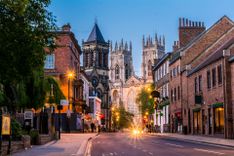
Ripon and around
The attractive market town of RIPON, eleven miles north of Harrogate, is centred upon its small cathedral, which can trace its ancestry back to its foundation by St Wilfrid in 672; the original crypt below the central tower can still be reached down a stone passage. The town’s other focus is its Market Place, linked by narrow Kirkgate to the cathedral (market day is Thursday, with a farmers’ market on the third Sunday of the month). Meanwhile, three restored buildings – prison, courthouse and workhouse – show a different side of the local heritage, under the banner of the Yorkshire Law and Order Museums. Just four miles away lies Fountains Abbey, the one Yorkshire monastic ruin you must see.
Fountains Abbey and Studley Royal
It’s tantalizing to imagine how the English landscape might have appeared had Henry VIII not dissolved the monasteries:
Fountains Abbey
gives a good idea of what might have been. The abbey was founded in 1133 by thirteen dissident Benedictine monks and formally adopted by the Cistercian order two years later. Within a hundred years, Fountains had become the wealthiest Cistercian foundation in England, supporting a magnificent
abbey church
. The
Perpendicular Tower
, almost 180ft high, looms over the whole ensemble, while equally grandiose in scale is the undercroft of the
Lay Brothers’ Dormitory
off the cloister, a stunningly vaulted space over 300ft long that was used to store the monastery’s annual harvest of fleeces. Its sheer size gives some idea of the abbey’s entrepreneurial scope; some thirteen tons of wool a year were turned over, most of it sold to Venetian and Florentine merchants who toured the monasteries.
A riverside walk, marked from the visitor centre car park, takes you through Fountains Abbey to a series of ponds and ornamental gardens, harbingers of Studley Royal (same times as the abbey), which can also be entered via the village of Studley Roger, where there’s a separate car park. This lush medley of lawns, lake, woodland and Deer Park was laid out in 1720 to form a setting for the abbey, and there are some scintillating views from the gardens, though it’s the cascades and water gardens that command most attention.
Sheffield and around
Yorkshire’s second city, SHEFFIELD remains linked with its steel industry, in particular the production of high-quality cutlery. As early as the fourteenth century the carefully fashioned, hard-wearing knives of hardworking Sheffield enjoyed national repute, while technological advances later turned the city into one of the country’s foremost centres of heavy and specialist engineering. Unsurprisingly, it was bombed heavily during World War II, and by the 1980s the steel industry’s subsequent downturn had tipped parts of Sheffield into dispiriting decline. The subsequent revival has been rapid, however, with the centre utterly transformed by flagship architectural projects. Steel, of course, still underpins much of what Sheffield is about: museum collections tend to focus on the region’s industrial heritage, complemented by the startling science-and-adventure exhibits at Magna, built in a disused steel works at Rotherham, the former coal and iron town a few miles northeast of the city.
Sheffield orientation
Sheffield’s city centre is very compact and easily explored on foot. Southeast of the Winter Garden/Peace Gardens hub, clubs and galleries exist alongside arts and media businesses in the Cultural Industries Quarter. North of the stations, near the River Don, Castlegate has a traditional indoor market (closed Sun) while spruced-up warehouses and cobbled towpaths line the neighbouring canal basin, Victoria Quays. South of here, down Fargate and across Peace Gardens, the pedestrianized Moor Quarter draws in shoppers, though it’s the Devonshire Quarter, east of the gardens and centred on Division Street, that is the trendiest shopping area. A little further out, to the northeast of the city centre and easily accessible by bus or tram, lies the huge Meadowhall Shopping Complex, built on the site of one of Sheffield’s most famous steelworks.
York and around
YORK is the North’s most compelling city, a place whose history, said George VI, “is the history of England”. This is perhaps overstating things a little, but it reflects the significance of a metropolis that stood at the heart of the country’s religious and political life for centuries, and until the Industrial Revolution was second only to London in population and importance. These days a more provincial air hangs over the city, except in summer when it comes to feel like a heritage site for the benefit of tourists. That said, no trip to this part of the country is complete without a visit to York, and the city is also well placed for any number of day-trips, the most essential being to Castle Howard, the gem amongst English stately homes.
The Minster is the obvious place to start, and you won’t want to miss a walk around the walls. The medieval city is at its most evocative around the streets known as Stonegate and the Shambles, while the earlier Viking city is entertainingly presented at Jorvik, perhaps the city’s favourite family attraction. Standout historic buildings include the Minster’s Treasurer’s House, Georgian Fairfax House, the Merchant Adventurers’ Hall, and the stark remnants of York’s Castle. The two major museum collections are the incomparable Castle Museum and the National Railway Museum (where the appeal goes way beyond railway memorabilia), while the evocative ruins and gardens of St Mary’s Abbey house the family-friendly Yorkshire Museum. Just fifteen miles away from town, and accessible by bus, Castle Howard is one of the nation’s finest stately homes.
Brief history
An early Roman fortress of 71 AD in time became a city – Eboracum, capital of the empire’s northern European territories and the base for Hadrian’s northern campaigns. Later, the city became the fulcrum of Christianity in northern England: on Easter Day in 627, Bishop Paulinus, on a mission to establish the Roman Church, baptized King Edwin of Northumbria in a small timber chapel. Six years later the church became the first minster and Paulinus the first archbishop of York. In 867 the city fell to the Danes, who renamed it Jorvik, and later made it the capital of eastern England (Danelaw). Later Viking raids culminated in the decisive Battle of Stamford Bridge (1066) six miles east of the city, where English King Harold defeated Norse King Harald – a pyrrhic victory in the event, for his weakened army was defeated by the Normans just a few days later at the Battle of Hastings, with well-known consequences for all concerned.
The Normans devastated much of York’s hinterland in their infamous “Harrying of the North”. Stone walls were thrown up during the thirteenth century, when the city became a favoured Plantagenet retreat and commercial capital of the north, its importance reflected in the new title of Duke of York, bestowed ever since on the monarch’s second son. Although Henry VIII’s Dissolution of the Monasteries took its toll on a city crammed with religious houses, York remained wedded to the Cathoic cause, and the most famous of the Gunpowder Plot conspirators, Guy Fawkes, was born here. During the Civil War Charles I established his court in the city, which was strongly pro-Royalist, inviting a Parliamentarian siege. Royalist troops, however, were routed by Cromwell and Sir Thomas Fairfax at the Battle of Marston Moor in 1644, another seminal battle in England’s history, which took place six miles west of York.
The city’s eighteenth-century history was marked by its emergence as a social centre for Yorkshire’s landed elite. Whilst the Industrial Revolution largely passed it by, the arrival of the railways brought renewed prosperity, thanks to the enterprise of pioneering “Railway King” George Hudson, lord mayor during the 1830s and 1840s. The railway is gradually losing its role as a major employer, as is the traditional but declining confectionery industry, and incomes are now generated by new service and bioscience industries – not forgetting, of course, the four million annual tourists.
Dig!
Where Jorvik shows what was unearthed at Coppergate, the associated attraction that is
Dig!
illustrates the science involved. Housed five minutes’ walk away from the museum, in the medieval church of St Saviour, on St Savioursgate, a simulated dig allows you to take part in a range of excavations in the company of archeologists, using authentic tools and methods. Tours to visit
Dig Hungate
, York’s latest major archeological excavation, start from here.
Jorvik
The city’s blockbuster historic exhibit is
Jorvik
, located by the Coppergate shopping centre. Propelling visitors in “time capsules” on a ride through the tenth-century city of York, the museum presents not only the sights but also the sounds and even the smells of a riverside Viking city. Excavations of Coppergate in 1976 uncovered a real Viking settlement, now largely buried beneath the shopping centre outside. But at Jorvik you can see how the unearthed artefacts were used, and watch live-action domestic scenes on actual Viking-age streets, with constipated villagers, axe-fighting and other singular attractions.
The Yorkshire Dales
The Yorkshire Dales – “dales” from the Viking word dalr (valley) – form a varied upland area of limestone hills and pastoral valleys at the heart of the Pennines. Protected as a National Park, (or, in the case of Nidderdale, as an Area of Outstanding Natural Beauty), there are more than twenty main dales covering 680 square miles, crammed with opportunities for outdoor activities. Most approaches are from the south, via the superbly engineered Settle to Carlisle Railway, or along the main A65 road from towns such as Skipton, Settle and Ingleton. Southern dales like Wharfedale are the most visited, while neighbouring Malhamdale is also immensely popular due to the fascinating scenery squeezed into its narrow confines around Malham village. Ribblesdale is more sombre, its villages popular with hikers intent on tackling the famous Three Peaks – the mountains of Pen-y-ghent, Ingleborough and Whernside. To the northwest lies the more remote Dentdale, one of the least known but most beautiful of the valleys, and further north still Wensleydale and Swaledale, the latter of which rivals Dentdale as the most rewarding overall target. Both flow east, with Swaledale’s lower stretches encompassing the appealing historic town of Richmond.
Here for the beer
If you’re a beer fan, the handsome Wensleydale market town of Masham (pronounced Mass’m) is an essential point of pilgrimage. At Theakston brewery (tours daily 11am–3pm; reservations advised; w theakstons.co.uk), sited here since 1827, you can learn the arcane intricacies of the brewer’s art and become familiar with the legendary Old Peculier ale. The Black Sheep Brewery, set up in the early 1990s by one of the Theakston family brewing team, also offers tours (daily 11am–4pm, but call for availability; w blacksheepbrewery.com). Both are just a few minutes’ signposted walk out of the centre.
Malhamdale
A few miles west of Wharfedale lies Malhamdale, one of the National Park’s most heavily visited regions, thanks to its three outstanding natural features of Malham Cove, Malham Tarn and Gordale Scar. All three attractions are within easy hiking distance of Malham village.
Malham
MALHAM village is home to barely a couple of hundred people who inhabit the huddled stone houses on either side of a bubbling river. Appearing in spectacular fashion a mile to the north, the white-walled limestone amphitheatre of Malham Cove rises 300ft above its surroundings. After a breath-sapping haul to the top, you are rewarded with fine views and the famous limestone pavement, an expanse of clints (slabs) and grykes (clefts) created by water seeping through weaker lines in the limestone rock. A simple walk (or summer shuttle bus ride) over the moors abruptly brings Malham Tarn into sight, its waterfowl protected by a nature reserve on the west bank. Meanwhile, at Gordale Scar (also easily approached direct from Malham village), the cliffs are if anything more spectacular than at Malham Cove. The classic circuit takes in cove, tarn and scar in a clockwise walk from Malham (8 miles; 3hr 30min), but you can also do it on horseback – the Yorkshire Dales Trekking Centre at Holme Farm in the village centre is the place to enquire about saddling up.
The Settle to Carlisle Railway
The 72-mile Settle to Carlisle line is a feat of Victorian engineering that has few equals in Britain. In particular, between Horton and Ribblehead, “England’s most scenic railway” climbs 200ft in five miles, before crossing the famous 24-arched Ribblehead viaduct and disappearing into the 2629 yards of the Blea Tunnel. Meanwhile, the station at Dent Head is the highest, and bleakest, mainline station in England. The journey from Settle to Carlisle takes 1hr 40min, so it’s easy to do the full return trip in one day. If your time is short, ride the most dramatic section between Settle and Garsdale. There are connections to Settle from Skipton and Leeds.
Richmond
RICHMOND is the Dales’ single most tempting destination, thanks mainly to its magnificent castle, whose extensive walls and colossal keep cling to a precipice above the River Swale. Indeed, the entire town is an absolute gem, centred on a huge cobbled market square backed by Georgian buildings, hidden alleys and gardens. Market day is Saturday, augmented by a farmers’ market on the third Saturday of the month.
Top image: Aerial view of Robin Hood’s Bay, North Yorkshire, England © Andrei Petrus/Shutterstock