Arundel and around
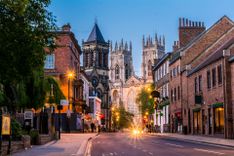
The hilltop town of ARUNDEL, eighteen miles west of Brighton, has for seven centuries been the seat of the dukes of Norfolk, whose fine castle looks over the valley of the River Arun. The medieval town’s well-preserved appearance and picturesque setting draws in the crowds on summer weekends, but at any other time a visit reveals one of West Sussex’s least spoilt old towns. The two main attractions are the castle and the towering Gothic cathedral, but the rest of Arundel is pleasant to wander round – especially the antique-shop-lined Maltravers and Arun streets. North of Arundel lie a couple more attractions: Bignor Roman Villa, with some outstanding Roman mosaics; and the grand, seventeenth-century Petworth House, which has a notable art collection.
In the last week in August, Arundel’s festival features everything from open-air theatre to salsa bands.
Bignor Roman Villa
The excavated second-century ruins of the
Bignor Roman Villa
, just six miles north of town, have some of the best Roman mosaics in the country – the one showing Ganymede being carried by an eagle from Mount Ida is the most outstanding. The site is superbly situated at the base of the South Downs and features the longest extant section of mosaic in England, as well as the remains of a hypocaust, the underfloor heating system developed by the Romans.
Petworth House
Petworth House
, adjoining the pretty little village of
PETWORTH
, is one of the southeast’s most impressive stately homes. Built in the late seventeenth century, the house contains an outstanding art collection, with paintings by Van Dyck, Titian, Gainsborough, Bosch, Reynolds, Blake and Turner – the last a frequent guest here. The extensive
Servants’ Quarters
, connected by a tunnel to the main house, contain an impressive series of kitchens bearing the latest technological kitchenware of the 1870s, while the 700-acre grounds were landscaped by Capability Brown and are considered one of his finest achievements.
Brighton
Recorded as the tiny fishing village of Brithelmeston in the Domesday Book, Brighton seems to have slipped unnoticed through history until the mid-eighteenth century, when the new trend for sea-bathing established it as a resort. The fad received royal approval in the 1780s, after the decadent Prince of Wales, the future George IV, began patronizing the town in the company of his mistress, thus setting a precedent for the “dirty weekend”. Trying to shake off this blowsy reputation, Brighton, which was granted city status in 2000, now highlights its Georgian charm, its upmarket shops and classy restaurants, and its thriving conference industry. Despite these efforts, however, the essence of Brighton’s appeal remains its faintly bohemian vitality, a buzz that comes from a mix of English holiday-makers, foreign-language students, a thriving gay community, and an energetic local student population from the art college and two universities. On 12-day England trips that combine London with the south coast, Brighton works best as a lively seaside counterpoint, adding royal history, beach energy and nightlife without feeling like a simple day at the sea.
Any trip to Brighton inevitably begins with a visit to its two most famous landmarks – the exuberant Royal Pavilion and the wonderfully tacky Brighton Pier, a few minutes away – followed by a stroll along the seafront promenade or the pebbly beach. Just as interesting, though, is an exploration of Brighton’s car-free Lanes – the maze of narrow alleys marking the old town – or a meander through the quaint, but more bohemian streets of North Laine. One of the most useful England travel tips for visiting Brighton? Don’t rush it — leave time to wander, browse, and soak up the city’s offbeat energy.
The Royal Pavilion
In any survey to find England’s most loved building, there’s always a bucketful of votes for Brighton’s exotic extravaganza, the
Royal Pavilion flaunts itself in the middle of the main thoroughfare of Old Steine. The building was a conventional farmhouse until 1787, when the fun-loving Prince of Wales converted it into something more regal, and for a couple of decades the prince’s south-coast pied-à-terre was a Palladian villa, with mildly Oriental embellishments. Upon becoming Prince Regent, however, George commissioned John Nash, architect of London’s Regent Street, to build an extraordinary confection of slender minarets, twirling domes, pagodas, balconies and miscellaneous motifs imported from India and China. Supported on an innovative cast-iron frame, the result defined a genre of its own – Oriental Gothic.
Approached via the restrained Long Gallery, the Banqueting Room erupts with ornate splendour and is dominated by a one-ton chandelier hung from the jaws of a massive dragon cowering in a plantain tree. Next door, the huge, high-ceilinged kitchen, fitted with the most modern appliances of its time, has iron columns disguised as palm trees. The stunning Music Room, the first sight of which reduced George to tears of joy, has a huge dome lined with more than 26,000 individually gilded scales and hung with exquisite umbrella-like glass lamps. After climbing the famous cast-iron staircase with its bamboo-look banisters, you can go into Victoria’s sober and seldom-used bedroom and the North Gallery where the king’s portrait hangs, along with a selection of satirical cartoons. More notable, though, is the South Gallery, decorated in sky-blue with trompe l’oeil bamboo trellises and a carpet that appears to be strewn with flowers.
Canterbury
One of England’s most venerable cities, CANTERBURY offers a rich slice through two thousand years of history, with Roman and early Christian ruins, a Norman castle and a famous cathedral that dominates a medieval warren of time-skewed Tudor dwellings. Its compact centre, partly ringed by ancient walls, is virtually car-free, but this doesn’t stop the High Street seizing up all too frequently with the milling crowds.
Brief history
The city that began as a Belgic settlement was known as Durovernum to the Romans, who established a garrison and supply base here, and renamed Cantwarabyrig by the Saxons. In 597 the Saxon King Ethelbert welcomed Augustine, despatched by the pope to convert the British Isles to Christianity; one of the two Benedictine monasteries founded by Augustine – Christ Church, raised on the site of the Roman basilica – was to become England’s first cathedral.
At the turn of the first millennium Canterbury suffered repeated sackings by the Danes, and Christ Church was eventually destroyed by fire a year before the Norman invasion. A struggle for power later developed between the archbishops, the abbots from the nearby Benedictine abbey and King Henry II, culminating in the assassination of Archbishop Thomas à Becket in 1170, a martyrdom that established this as one of Christendom’s greatest shrines. Geoffrey Chaucer’s Canterbury Tales, written towards the end of the fourteenth century, portrays the unexpectedly festive nature of pilgrimages to Becket’s tomb, which was later plundered and destroyed on the orders of Henry VIII.
In 1830 a pioneering passenger railway service linked Canterbury to the sea and prosperity grew until the city suffered extensive German bombing on June 1, 1942, in one of the notorious Baedeker Raids – the Nazi plan to destroy Britain’s most treasured historic sites as described in the eponymous German travel guides.
The cathedral
Mother Church of the Church of England and seat of the Primate of All England – the Archbishop of Canterbury –
Canterbury Cathedral
fills the northeast quadrant of the city with a sense of authority, even if architecturally it’s not the country’s most impressive. A cathedral has stood here since 602, but in 1070 the first Norman archbishop, Lanfranc, levelled the original Saxon structure to build a new cathedral. Over successive centuries the masterpiece was heavily modified, and with the puritanical lines of the Perpendicular style gaining ascendancy in late medieval times, the cathedral now derives its distinctiveness from the thrust of the 235ft-high Bell Harry Tower, completed in 1505.
The precincts
The precincts are entered through the superbly ornate early sixteenth-century Christ Church Gate, where Burgate and St Margaret’s Street meet. This junction, the city’s medieval core, is known as the Butter Market, where religious relics were once sold to pilgrims hoping to prevent an eternity in damnation. Once through the gatehouse, you can enjoy one of the best views of the cathedral, foreshortened and crowned with soaring towers and pinnacles.
The interior
In the magnificent interior, look for the tomb of Henry IV and his wife, Joan of Navarre, and for the gilded effigy of Edward III’s son, the Black Prince, all of them in the Trinity Chapel behind the main altar. Also here, until demolished in 1538, was the shrine of Thomas à Becket; the actual spot where he died, known as “The Martyrdom”, is marked in the northwest transept by the Altar of the Sword’s Point, where a jagged sculpture of the assassins’ weapons is suspended on the wall. Steps from here descend to the low, Romanesque arches of the crypt, one of the few remaining relics of the Norman cathedral and considered the finest such structure in the country, with some amazingly well-preserved carvings on the capitals of the columns. Back upstairs, look out for the vivid medieval stained glass, notably in the Trinity Chapel, where the life and miraculous works of Thomas à Becket are depicted. Look out too for an animal-skin-clad Adam delving in the west window and Jonah and the whale in the Corona (the eastern end of the cathedral, beyond the Trinity Chapel). The thirteenth-century white marble St Augustine’s Chair, on which all archbishops of Canterbury are enthroned, is located in the choir at the top of the steps beyond the high altar.
On the cathedral’s north flank are the fan-vaulted colonnades of the Great Cloister, from where you enter the Chapter House, with its intricate web of fourteenth-century tracery supporting the roof and a wall of stained glass.
Chichester and around
The handsome market town of CHICHESTER has plenty to recommend it: a splendid twelfth-century cathedral, a thriving cultural scene and one of the finest collections of modern British art in the country on show at the Pallant House Gallery. The town began life as a Roman settlement, and its Roman cruciform street plan is still evident in the four-quadrant symmetry of the town centre. The main streets lead off from the Gothic Market Cross, a bulky octagonal rotunda topped by ornate finials and a crown lantern spire, built in 1501 to provide shelter for the market traders. The big attraction outside Chichester is Fishbourne Roman Palace, the largest excavated Roman site in Britain.