Vis
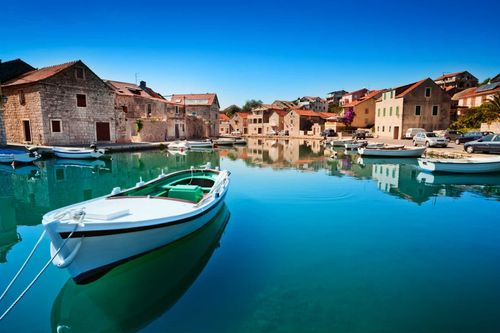
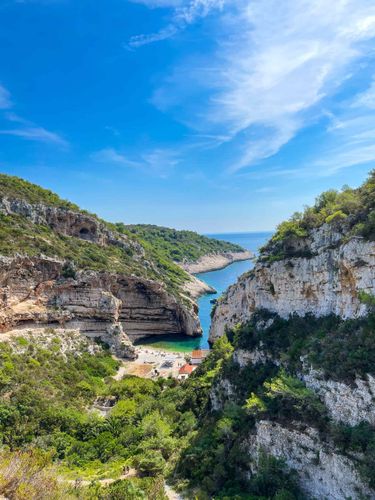
A compact hump rearing dramatically out of the sea, Vis is situated farther offshore than any of Croatia’s other inhabited Adriatic islands. Closed to foreigners for military reasons until 1989, it has never been overrun by tourists, and with only two or three package-oriented hotels on the whole island, this is definitely one place in Croatia where the independent traveller rules the roost. They have fallen in love with the place over the last two decades, drawn by its breathtaking bays, fantastic food and wine and two great-looking small towns – Vis Town and Komiža. The latter is the obvious base for trips to the islet of Biševo, site of one of Croatia’s most famous natural wonders, the Blue Cave.
Brief history of Vis
The Greeks settled on Vis in the fourth century BC, treating the island as a stepping stone between the eastern and western shores of the Adriatic, and founding Issa on the site of present-day Vis Town. Hvar took over as the major mid-Adriatic port in the late Middle Ages, and Vis became a rural retreat for Hvar nobles. When the fall of Venice in 1797 opened up the Adriatic to Europe’s other maritime powers, Vis fell to the British, who fortified the harbour and fought off Napoleon’s navy in 1811. The Austrians took over in 1815, famously brushing aside Italian maritime ambitions in another big sea battle here in 1866. During World War II, Vis briefly served as the nerve centre of Tito’s Partisan movement. After the war, the island was heavily garrisoned, a situation which, along with the decline of traditional industries like fishing and fish canning, encouraged successive waves of emigration. The island had ten thousand inhabitants before World War II; it now has fewer than three thousand. According to local estimates, there are ten times more Komiža families living in San Pedro, California, than in the town itself.
Vis in World War II
The collapse of Italy in the autumn of 1943 led to a power vacuum in the Adriatic, with both the Germans and Tito’s Partisans racing each other to take control of the region’s major ports and islands. Eager to support the Partisan effort, the British occupied Vis in early 1944, and in June of that year the island was chosen as the temporary headquarters of the Partisan high command, headed by Tito himself. Having narrowly escaped a German attack on Drvar in western Bosnia, Tito was taken to Vis on board the HMS Blackmore on June 7, entertaining the officers’ mess, it is said, with a near-perfect recital of The Owl and the Pussycat.
Tito took up residence in a cave on the southern flanks of Mount Hum, while his staff meetings took place in another cave next door. British officers entertained all kinds of wild ideas about who this shadowy guerilla leader really was. Novelist Evelyn Waugh (then a British liaison officer) was obsessed with the idea that Tito was a lesbian in disguise, and continued to spread this rumour for reasons of personal amusement even after meeting the Partisan supremo in person – it’s said that Tito upbraided Waugh about this during a trip to the beach, the Marshal’s skimpy trunks leaving no room for further doubt about his gender.
Vis soon became a vast armed camp, hosting 10,000 Partisans and 700 British and American commandos. The island was an excellent base from which to harry German positions on nearby islands, although commando raids on rugged Brač (where the Scottish Highlanders indulged in a Guns of Navarone-style attempt to capture Vidova Gora) led to heavy casualties. The daily existence of those stationed on Vis was made bearable by the endless opportunities for swimming, sunbathing and drinking the local wine, though for the local population things were not quite so jolly: all men between the ages of 15 and 50 were called up by the Partisans, while women, children and the elderly were evacuated to the British-controlled El Shatt camp in the Egyptian desert, where many died in the stifling heat.
Vis saw the first meeting between Tito and the head of the royalist Yugoslav government in exile, Ivan Šubašić, who arrived there on June 16, 1944. After agreeing on paper that Tito would protect democracy after the war, the signatories went on a trip to the Blue Cave on Biševo, where they indulged in skinny dipping, followed by a lunch of lobster and wine. Fitzroy Maclean, Winston Churchill’s envoy at Partisan HQ, noted that the sea was choppy on the way back and that “several of the party were sick”.
Ultimately Tito feared that he would lose his political independence if he accepted British protection on Vis for too much longer, and decided to relocate. On September 18 he abandoned the island in the dead of night, flying to join the Soviet Red Army in a Russian plane. Vis’s brief period in the political limelight was over.
Food and drink on Vis
The waters off the island of Vis represent one of the richest fisheries in the Adriatic, and it’s no wonder that the local restaurants offer some of the freshest seafood in Dalmatia. Both Komiža and Vis Town contain highly rated restaurants renowned for their lobster and fish; Pojoda in particular is famous for nurturing traditional island recipes that rarely crop up anywhere else.
Harvesting the anchovy shoals around Palagruža island used to be Vis’s main industry, and it’s no surprise the island’s principal culinary trademark is the pogača od srdele (anchovy pasty) – also called viška pogača or komiška pogača depending on which town you’re staying in. Traditionally, the komiška pogača includes a richer combination of ingredients (including tomatoes), and it’s this version that is sold by most local bakeries and cafés. The island’s other claim to gastronomic fame is the delicious Viški hib, a deliciously sweet slab of compressed figs and herbs, which is served in tiny thin slices and goes down a treat with the local rakija.
Vis is also famous for a brace of fine local wines – the white Vugava, which thrives in the stony soil in the southeast of the island, and the red Viški plavac, which prefers the sandy terrain farther west.
Korčula
Cloaked in vineyards, olives and Aleppo pines, Korčula is one of the greenest of the Adriatic islands. It is also one of the most popular, thanks largely to the charms of its main settlement, Korčula Town, whose surviving fortifications jut decorously out to sea like the bastions of an overgrown sandcastle. The island has a varied collection of inviting beaches too, with sandy affairs at Lumbarda, 7km away from Korčula Town, secluded pebbly coves on the south coast, and dramatic slabs of rock on the islet of Proizd, just off the port town of Vela Luka.
Korčula Town
Dominating the 2km-wide channel which divides the island from the Pelješac peninsula, the medieval walled city of Korčula Town preserves a neat beauty that has few equals in the Adriatic. With a magnificently preserved centre, good out-of-town-beaches and a convincing clutch of local-food restaurants, it’s a compelling enough destination regardless of whether you believe the oft-parroted hype that it is the birthplace of thirteenth-century explorer Marco Polo.
The town was one of the first in the Adriatic to fall to the Venetians, who arrived here in the tenth century and stayed – on and off – for more than eight centuries, leaving their distinctive mark on its culture and architecture. Disaster was narrowly averted in 1571, when the fleet of Ottoman corsair Uluz Ali was repulsed by local volunteers led by priest Antun Rožanović – a disappointed Ali went off to pillage Hvar Town instead. Although understandably treated by the locals as one of history’s bad guys, Uluz Ali was one of the great sea-warriors of the age, an Italian-born galley slave who rose to serve as Viceroy of Algiers and Grand Admiral of the Ottoman fleet. The first tourists arrived in the 1920s, although it wasn’t until the 1970s that mass tourism changed the face of the town, bequeathing it new hotels, cafés and a yachting marina.
Food and drink on Korčula
As well as seafood, Korčula excels in lamb and goat. These meats are usually baked under a peka (ember-covered lid) or served, goulash-style, with Žrnovski makaruni, a succulent, hand-rolled, cigar-shaped local pasta. Makaruni are very versatile, and are increasingly served up with all kinds of sauces. Undisputed hotspot for sweet-tooth travellers is a tiny shop in Korčula Town named Cukarin, a cult destination famous for its handmade sweets – notably the croissant-shaped, citrus-flavoured cukarin.
When it comes to wine, Korčula is famed for its indigenous dry whites: Grk only grows in Lumbarda and is produced in small quantities by a handful of local producers. Pošip, cultivated around the central Korčulan villages of Smokvica and Čara, is much more widespread, and crops up in restaurants and wine shops throughout the country.
If the east of the island has wine, western Korčula has olive oil – and lots of it. Most local production is a blend of local strains Lastovka and Drobnica, known for their high antioxidant content and sharp peppery taste. Marko Polo, bottled by the farmers’ cooperative in Blato, is one of the best mid-priced oils in the country, while Torkul oil, produced by the family-run Fanito distillery in Vela Luka, is famous for its smooth but bitter character and is much sought after throughout Croatia.
The Moreška and other sword dances
Korčula Town is famous for the Moreška, a traditional sword dance once common throughout the Mediterranean. It’s now a major tourist attraction, and its annual performance on St Theodore’s Day (July 29) has been transformed into a regular show, held every Monday and Thursday evening between May and September at the open-air cinema beside the Land Gate. Tickets are available from most of the travel agencies in town.
The dance probably originated in Spain and related to the conflict between the Moors (hence the name) and the Christians, although in Dalmatia its popularity was connected with the struggles against the Ottomans. Basically the dance tells the story of a conflict between the White King and his followers (actually dressed in red) and the Black King. The heroine, Bula, is kidnapped by the Black King, and her betrothed tries to win her back in a ritualized sword fight. The adversaries circle each other and clash weapons several times before the evil king is forced to surrender, and Bula is unchained. The strangest thing about the dance is the seemingly incongruous brass-band music that invariably accompanies it – a sign that the present-day Moreška falls somewhere between ancient rite and nineteenth-century reinvention.
Similar sword dances are still performed throughout the island, although they are more archaic in form and frequently accompanied by traditional instruments such as the mijeh (bagpipe). Most important of these are the Moštra, performed in Postrana on St Rock’s Day (Aug 16), and the Kumpanjija, staged in several places at different times of year: Smokvica on Candlemas (Feb 2); Vela Luka on St Joseph’s Day (March 19); Blato on St Vincent’s Day (April 28); Čara on St James’s Day (July 25); and Pupnat on Our Lady of the Snows (Aug 6).
In the past many of these dances would have been followed by the beheading and roasting of an ox, a practice which was banned during the communist period. Its revival in Pupnat in 1999 was followed by lurid – and largely negative – reporting in the Croatian press, and it’s unlikely that ritual slaughter will ever form part of the dances again.
Vela Luka
At the western end of the island, the ferry port of Vela Luka is totally different in character from Korčula Town, with a string of sturdy nineteenth- and twentieth-century houses stretching along an expansive, three-fingered bay. Founded much later than Korčula’s other settlements (according to local lore, the men of Blato sent their illegitimate children here to ease problems of family inheritance), The town started out as a shipbuilding centre and local yards still manufacture small recreational boats. With good beaches easily accessible offshore on the island of Proizd but no big package hotels, today’s Vela Luka radiates easy-going, unswamped affability.
The Vela Luka Kumpanija
Vela Luka’s answer to the Moreška is the Kumpanjija, an archaic and rather slow sword dance performed to shrill bagpipe-and-drums accompaniment every Tuesday evening (mid-July to late August) in front of St Joseph’s Church. The show begins and ends with klapa singing from the local folklore group, making this a good all-round introduction to island culture.
Lastovo
At the centre of an archipelago of some 45 uninhabited islets, tiny Lastovo lies over four hours away from Split by ferry (and over three hours by catamaran), and as a result feels much more isolated than any of the other Adriatic islands. Its strong sense of regional identity is most obviously expressed in the annual Poklad a uniquely archaic Lenten carnival. Like Vis, Lastovo was closed to foreigners from 1976 until 1989 owing to its importance as a military outpost, and organized tourism has never caught on, but what it lacks in hotels and amenities it more than makes up for in its natural, wooded beauty. Ferries arrive at Ubli, a small and uneventful harbour a few kilometres short of Lastovo’s one major settlement, Lastovo Town, where most of the remaining eight hundred islanders live.
The Poklad
Lastovo’s carnival is one of the strangest in Croatia, featuring the ritual humiliation of a straw puppet, the Poklad. Things come to a head on Shrove Tuesday, when the Poklad is led through town on a donkey by the men of Lastovo, who dress for the occasion in a uniform of red shirts, black waistcoats and bowler hats. Following this, the Poklad is attached to a long rope and hoisted from one end of town to the other three times while fireworks are let off beneath it. Each transit is met by chanting and the drawing of swords. Finally, the Poklad is put back on the donkey and taken to the square in front of the parish church, to the accompaniment of music and dancing. At the end of the evening, the villagers dance the Lastovsko kolo, a sword dance similar to the Moreška in Korčula, and the Poklad is impaled on a long stake and burned. Drinking and dancing continues in the village hall until dawn.
Local tradition has it that the Poklad symbolizes a young messenger who was sent by Catalan pirates to demand the town’s surrender, although it’s more likely that the ritual actually derives from ancient fertility rites. Whatever its roots, the islanders take the occasion very seriously, and it’s certainly not enacted for the benefit of outsiders. Lastovčani from all over the world return to their home village to attend the Poklad, when accommodation is at a premium. If you do want to attend, contact the tourist office well in advance.
Vukodlaci and other vampiric houseguests
Express an interest in vampires in today’s Croatia and you’ll probably be told that you’ve come to the wrong country – and yet belief in the supernatural creatures was widespread hereabouts until a couple of centuries ago. Europe’s first documented case of vampirism took place in an Istrian village in the 1670s, when the nocturnal roamings of Jure Grando were recorded by Slovenian chronicler J.J. Valvasor. One of the last known outbreaks of vampire mania in Croatia took place on Lastovo in 1737, when officials from Dubrovnik had to dissuade the local populace from carrying out mass exhumations of those suspected of walking with the undead.
According to Croatian folk belief, the most common form of vampire was a vukodlak (often translated as “werewolf”, although it clearly means something quite different), which basically consisted of the skin of a human corpse puffed up with the breath of the devil and further bloated with the blood of its victims. The vukodlak was an all-purpose bogeyman whose existence could explain away all manner of crises and conflicts: anything from listlessness among the local livestock to marital problems were blamed on the bloodsuckers (it was said that vukodlaci visited the beds of bored wives and pleasured them in the night). A mora was a female equivalent of a vukodlak, nightly sapping the strength of the menfolk; while macići were mischievious young vukodlaci who created envy and discord by bringing good luck to some villagers, misfortune to others – if a farmer got rich, neighbours would say that he had a macić in the house.
People were said to turn into vukodlaci after their death if a dog, cat or mouse passed under their coffin while it was being borne to the grave. The only cure was to dig up the body and cut its hamstrings to prevent it from wandering about at night. Visiting the Dalmatian hinterland as recently as the 1770s, the intrepid Venetian traveller Alberto Fortis discovered that some of the locals asked their families to carry out this operation as soon as they died, just to be on the safe side.
Ubli and around
Ferries and catamarans dock at Ubli, an unassuming collection of houses (plus the odd shop and café) on Lastovo’s western shore. Buses run from Ubli’s harbourfront to Lastovo Town, ensuring that few people stick around here for long. Three kilometres north of Ubli at the hamlet of Pasadur lies a minor resort in the shape of the Solitudo hotel, which stands beside the narrow straight dividing Lastovo from the islet of Prezba. There’s a pebble beach in front of the hotel, and plenty of rocky bathing spots along the shores of the Malo Lago inlet immediately north.
The Pelješac peninsula
Just across the Pelješac channel (Pelješki kanal) from Korčula is the Pelješac peninsula, a mountainous finger of land which stretches for some 90km from Lovište in the west to the mainland in the east. It’s an exceptionally beautiful place, with tiny villages and sheltered coves rimmed by beaches, and although it’s an increasingly popular holiday area, development remains low-key. The Pelješac also boasts a handful of key superlatives, especially if you have specific interests – as well as being home to Croatia’s finest red wines, it also produces the tastiest oysters, has some of the best sand-and-shingle beaches, is the best place for windsurfing, and arguably offers the most varied collection of shore-side campsites. The only downside is that public transport is meagre except along the main Korčula–Orebić–Ston–Dubrovnik route, and most of the smaller places are impossible to get to without a car.
Food and drink in the Pelješac peninsula
The Pelješac peninsula is famous above all for its shellfish; the village of Mali Ston is particularly well known for the kamenice (European flat oysters) and dagnji (mussels) farmed in its adjacent bay. Mali Ston’s oysters are best eaten in the clutch of excellent restaurants on the harbour; there’s something special about gulping down these molluscs only yards from where they are harvested.
The Pelješac is also one of Croatia’s most prolific wine-producing regions, celebrated for the earthy dry reds derived from the indigenous Plavac mali grape. The best of Pelješac’s reds come from the steep, south-facing slopes above the villages of Postup (6km east of Orebić) and Dingač (16km east). Bright sun and arid ground produce small, flavoursome grapes, while the salty sea air provides an extra component. The steepness of the vineyards means that the grape harvest here is a demanding physical process. Wines bearing the Postup and Dingač labels are highly rated by connoisseurs, while Pelješac’s inland vineyards also produce plenty in the way of robust affordable reds.
Ston and Mali Ston
Some 60km east of Orebić, the twin settlements of Ston and Mali Ston straddle the isthmus joining Pelješac to the mainland. An important salt-producing town on the southwestern side of the isthmus, Ston was swallowed up by Dubrovnik in 1333, becoming the most important fortress along the republic’s northern frontier. The republic built huge defensive walls stretching across the isthmus to the nearby harbour of Mali Ston, which became the northern bastion of a unified fortification system. Nowadays the twin town is primarily known for Mali Ston’s oyster beds – the aphrodisiac effect of the local molluscs makes the place an ideal venue for romantic weekend breaks.
Ston
Straddling the main road from Orebić to Dubrovnik, Ston’s mix of Renaissance- and Gothic-style houses is laid out in a tight gridiron of narrow alleys stuffed with potted plants.
Mali Ston
Thirty minutes’ walk northeast of Ston, Mali Ston is nowadays a tranquil village of old stone houses looking out over the oyster beds of Mali Ston bay. The beds are marked out by wooden poles hung with ropes on which the oysters grow prior to harvesting in May and June. Following the narrow lanes up from Mali Ston’s harbour, you’ll soon reach a crescent-shaped fortress marking the northeasternmost extent of Ston’s sophisticated network of defences. It’s an uninhabited shell, though steps do lead up to a parapet from where there are good views.
Top image: Proizd beach near dalmatian Island of Korcula, Croatia © eldar nurkovic/Shutterstock
.jpg)