Krapanj
Lying three hundred metres across the water from the mainland south of Šibenik, Krapanj has the distinction of being the smallest inhabited island in the Adriatic. It is reached by ferry shuttle from Broadarica, an undistinguished village which stretches along the shore for some 3km. Ferries arrive at a sleepy harbour backed by a warren of grey-brown houses. Diving for sponges used to be the main occupation on Krapanj, although there’s not much evidence of this now, save for a couple of shops on the harbour selling spongy souvenirs. Krapanj fills up with Croatian weekenders in July and August, when there’s a fair number of sunbathers sprawled out on either side of the quay – the rest of the time women clad in traditional black widows’ weeds outnumber other residents four to one.
Zlarin and Prvic
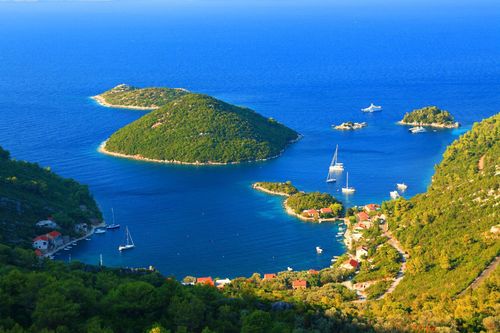
Your best bet for bathing opportunities in the Šibenik area is to head for the nearby islands of Zlarin and Prvić, where you stand a good chance of finding a secluded bit of rocky shoreline and crystal-clear water. There’s no mass tourism on the islands, and no cars – merely a succession of orderly and neat little villages kept alive by a trickle of independent tourists and weekending Croatians.
Zlarin
Thirty minutes out by boat from Šibenik, the village of Zlarin is an attractive huddle of houses at the apex of a broad bay. Coral fishing and processing used to be the island’s main employer, until overharvesting led to a shutdown of all but one of the coral workshops in the 1950s. Nowadays the island has a winter population of around 25 souls, although the figure increases hundredfold in July and August.
Largely lacking in modern buildings, the village is an almost perfect example of what a typical Dalmatian settlement looked like in the early twentieth century. There’s a brace of coral souvenir shops in the alleyways behind the harbour, and a seasonally open coral museum that allows a glimpse of how the coral is polished and processed. Zlarin’s rarely open parish church is famous for housing the body of fourth-century Roman martyr St Fortunatus, a relic obtained for the island by a resourceful local priest in 1781. Every fifty years the remains are paraded through the village on April 23 – the next celebration is due in 2050, so there’s no need to pack your bags just yet.
Paths on the western side of the bay will take you to an abundance of rocky bathing areas backed by pines.
Prvić Luka and around
A fifteen-minute ferry journey from Zlarin, the main settlement of Prvić, Prvić Luka, is another unassuming, bay-hugging village with a charmingly soporific atmosphere. The parish church, just up from the harbour, boasts an extrovert collection of Baroque altarpieces as well as the tomb of Šibenik-born humanist and all-round brainbox Faust Vrančić.
Faust Vrančić (1551–1617)
Renaissance Šibenik produced many learned minds, most famously Faust Vrančić (Faustus Verantius), the author of Machinae Novae (1615) – a book of machines and contraptions whose inventiveness rivalled the mechanical fantasies of Leonardo da Vinci. The album of 49 copper engravings included suspension bridges, wind-powered mills with rotating roofs and, most famously, Homo volans – a picture of a man jumping from a tower with a primitive parachute. Equipped with a square of sail-canvas, Vrančić opined in the accompanying text, “a man can easily descend securely and without any kind of danger from a tower or any other high place”. According to seventeenth-century British scientist Bishop John Wilkins, Vrančić successfully tested his parachute by jumping out of a window in Venice, although Wilkins’ account was written thirty years after the event and remains tantalizingly unconfirmed by other sources.
Vrančić compiled Machinae Novae towards the end of a busy intellectual life. As the nephew of imperial diplomat and Archbishop of Hungary, Antun Vrančić, the young Faust served as secretary to the court of Emperor Rudolf II in Prague – a renowned meeting place for humanists from all over Europe. He subsequently retired to become a monk in Rome, where he probably became acquainted with Leonardo’s drawings, and was moved to compile his Machinae. Vrančić’s other major work was his Dictionarium quinque nobilissimarum Europae linguarum (“Dictionary of the Five Most Noble Languages of Europe”; 1595), a lexicon including Latin, Italian, German, Hungarian and “Dalmatian” (Croatian). It was the first real dictionary in either Croatian or Hungarian, and had a profound influence on the subsequent development of both languages.
Knin
Set dramatically amid the stark, arid scenery typical of inland Dalmatia, the fortress town of Knin occupies an indelible place in the Croatian national psyche, both as an important centre of the medieval kingdom and as a bone of bitter contention in the Homeland War of 1991–95. It was during the latter conflict that Knin became notorious as the capital of the so-called Republic of the Serbian Krajina (RSK).
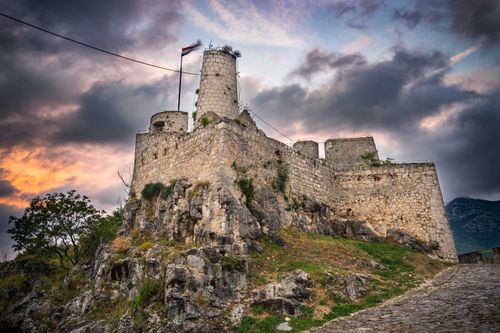
Despite being surrounded by a patchwork of both Serbian and Croatian villages, Knin itself had a Serbian majority in 1990 and became the epicentre of the Serbian armed rebellion. Many of the key players in the Serb–Croat conflict started out in Knin, only to end up in the International War Crimes Tribunal in The Hague a decade or two later: Milan Babić, the RSK’s first leader; Milan Martić, the Knin police chief who built up the Krajina’s armed forces; and Colonel Ratko Mladić, commander of the Knin military garrison, who practised ethnic cleansing here, forcibly ejecting Croats from nearby villages, before becoming head of the Bosnian Serb army in 1992. In the end, Serbian forces melted away when the Croatian army launched the Oluja (Storm) offensive in August 1995, and Knin’s recapture on the morning of August 5 brought the war in Croatia to a rapid conclusion. Fearing Croatian reprisals, most Serb civilians fled in the wake of their defeated army, and only a handful have since returned. Otherwise Knin has largely reverted to what it was in the pre-1990 period: a provincial railway-junction town that accommodates a trickle of day-trippers drawn to its spectacular hilltop castle.
Primošten
Heaped up on an island that’s joined to the mainland by a short causeway, Primošten, 20km south of Šibenik, is enchanting when seen from a distance, although the place comes over as blandly packagey once you get up close. Its main attribute is the ultra-clear water that laps the pebble and rock beaches of the wooded promontory north of town, where there are also a number of hotels. The Primošten area is famous for its dry-stone walls, vineyard plots and olive groves – a landscape that has changed little for centuries. Much of the Šibenik region’s best Babić wine is produced around here, and you should definitely make the effort to down a glass or few of the stuff if you are sticking around.
Top image: Zadar, Croatia © xbrchx/Shutterstock
.jpg)