Slunj
Perched on a hilltop on the old Zagreb–Split road, the small town of Slunj hovers above the confluence of the Korana and Slunjčica rivers, with the rushing waters of the latter dropping into the Korana gorge through a series of burbling rapids. In times past this natural power source led to the development of a riverside watermilling settlement known as Rastoke, where several traditional buildings still survive – solid structures with stone lower floors and timber upper storeys. It’s a delightful area for a stroll, with wooden bridges crossing gurgling torrents of channelled water, although many of Rastoke’s most picturesque spots are on privately owned land. Otherwise, there are excellent views of the gorge from the path above the north bank of the Korana, visible when entering the town by road from the north.
The Lonjsko polje
Just over an hour’s drive southeast of Zagreb lies a particularly beautiful stretch of seasonally flooded wetland known as the Lonjsko polje, an enchanting area of ancient timber houses, rustic lifestyles and – most famously of all – nesting storks. Marking the Lonjsko polje’s southern end, the town of Jasenovac was the site of a notorious concentration camp in World War II and is now home to a dignified memorial park.
Lonjsko polje can be treated as a day-trip from Zagreb if you have your own transport, although the area's bucolic B&Bs provide sufficient inducement to linger. However you approach the region, you’ll find yourself on a badly surfaced road which winds its way along the banks of the River Sava, passing through a sequence of single-street villages characterized by their chicken-choked yards and the kind of tumbledown, timber-built houses that seem to have jumped straight out of an illustrated book of fairy stories. The polje’s dyke-top roads are perfect for cyclists, and many of the B&Bs rent out bikes.
The polje (which means “field”) is at its wettest in spring and autumn, when the tributaries of the River Sava habitually break their banks and the area is colonized by spoonbills, herons and storks. The area’s oak forests and pastures are also home to the Posavlje horse (Posavski konj), a stocky, semi-wild breed, and the spotty-hided Turopolje pig (Turopoljska svinja), which lives off acorns. The villages of the polje contain more in the way of nineteenth-century wooden architecture than any other region of Croatia, and are protected – alongside the flora and fauna – by the Lonjsko polje Nature Park (Park prirode Lonjsko polje).
Čigoć
The village of Čigoć is a world-renowned migrating stop for white storks, which head here every spring (usually arriving late March or early April) ready to feast on the polje’s abundant supply of insects, fish and frogs, and nest on chimneys and telegraph poles throughout the village. You stand a good chance of seeing baby storks during the hatching season, which falls in late April or May. According to tradition, the storks leave Čigoć for the wintering grounds of southern Africa (an eight- to twelve-week journey) on St Bartholomew’s Day (August 24), although a handful of creatures stay in the village all year, their migratory instincts weakened by food handouts by soft-hearted locals.
Most of the houses in Čigoć are traditional two-storey structures with shingle roofs, overhanging eaves and a main entrance on the first floor, reached by a covered outside staircase known as a ganjak; many also have elaborately carved porches or balconies.
Slavonia
Stretching from the Lonjsko polje to the Danube, which forms Croatia’s border with Serbia, the rich agricultural plain of Slavonia has an unjust reputation as the most scenically tedious region of the country. All that most visitors ever see of it is the view from the Autocesta – the highway originally built to link Zagreb with Belgrade, and still the main route into the eastern corner of the country – as it forges across unbroken flatlands. However, the region does have its attractions, not least a distinctive and often captivating rural landscape, characterized in summer by a seemingly endless carpet of corn and sunflowers, with vineyards on the low hills to the north.
Slavonia’s main urban centre is Osijek, a former Austrian fortress town which retains a dash of Habsburg-era elegance. It’s around Osijek that the best of Slavonia’s scenery lies, a patchwork of greens and yellows dotted with dusty, half-forgotten villages, where latticed wooden sheds groan under the weight of corncobs and, in the autumn, strings of red paprikas hang outside to dry. Just north of Osijek, the Kopački rit Nature Park, with its abundant birdlife, is Croatia’s most intriguing wetland area, while in the far southeast the siege-scarred town of Vukovar is slowly regaining its provincial Baroque charm. Elsewhere in Slavonia there’s plenty in the way of history and heritage, notably in the pleasant provincial towns of Ilok, Vinkovci and Đakovo.
Osijek
Tucked into the far northeastern corner of Slavonia, 30km from the Hungarian border and just 20km west of the Serbian province of Vojvodina, Osijek is the undisputed capital of the region. A park-filled city hugging the banks of the River Drava, Osijek has an easy-going spaciousness – owing in large part to its being spread out across three quite separate town centres. The oldest of these, Tvrđa, retains the air of a living museum; originally a Roman strongpoint, it was subsequently fortified by the Ottomans and then finally rebuilt in Baroque style by the Austrians, who kicked the Turks out in 1687. The Austrians were also responsible for the construction of Gornji grad (Upper Town – so called because it’s upriver from Tvrđa), the nineteenth-century area which still exudes a degree of fin-de-siècle refinement and now serves as the administrative heart of the modern city. At the eastern end of town, Donji grad (Lower Town) is a relatively quiet residential district, developed at around the same time as Gornji grad in order to accommodate economic migrants from the surrounding plains.
After the fall of Vukovar in November 1991, the Yugoslav People’s Army and Serb irregulars laid siege to Osijek and subjected the city to a nine-month bombardment. Osijek survived, but memories of life on the front line are still fresh.
Osijek has enough in the way of sightseeing and nightlife to detain you for a day or two, and the city’s proximity to the Kopački rit Nature Park provides the perfect excuse to lengthen your stay.
Tvrđa
Two kilometres east from Gornji grad lies the fantastically well-preserved Baroque quarter known as Trvđa (literally “citadel”), a collection of military and administrative buildings thrown up by the Austrians after the destruction of the earlier Ottoman castle. Tvrđa’s grid of cobbled streets zeros in on Trg svetog Trojstva, a broad expanse bearing a plague column, built in 1729 with funds donated by the local fortress commander’s wife to give thanks for deliverance from a devastating outbreak of plague which is thought to have killed a third of Osijek’s population. The square is surrounded by former Habsburg military buildings, many of which are now occupied by high schools or university faculties – coffee-swilling students fill the local cafés on weekdays.
Đakovo
The neat and tidy plains town of Đakovo, 60km south of Osijek, is dominated by the skyline-hogging, 84m-high twin towers of its neo-Gothic, red-brick cathedral. The town’s other main claim to fame is the Lippizaner stud farm, home to a sizeable community of the famously handsome white horses. Đakovo is worth a day-trip from Osijek but probably doesn’t merit a longer stay.
Đakovački vezovi folk festival
Đakovo is the scene of one of Croatia’s most important festivals of authentic folk culture, Đakovački vezovi (literally “Đakovo embroidery”; early July), which features a weekend-long series of song and dance performances by folkloric societies from all over Croatia. Performances take over the town park from mid-morning till mid-evening, after which there’s usually some sort of live music and revelry in the town centre.
The Baranja
North of Osijek, the main road to Hungary forges through the pastel-coloured villages and corn-rich fields of the Baranja, a fertile extension of the Slavonian plain which fills the triangle formed by the Drava to the west, the Danube to the east and the low hills of southern Hungary to the north. The main attraction here is the Kopački rit Nature Park, although the region possesses enough in the way of picturesque villages, paprika-cuisine restaurants and wine cellars to justify a more extensive trip. With a largely flat terrain and well-signed cycling routes, the region is perfect for touring by bike, though sights are of a disparate nature and to explore further afield you really need a car.
Kopački rit Nature Park
Stretching east of Bilje, the Kopački rit Nature Park (Park prirode Kopački rit) covers an area of marsh and partly sunken forest just north of the point where the fast-flowing River Drava pours into the Danube, forcing the slower Danube waters to back up and flood the plain. The resulting wetland is inundated from spring through to early autumn, when fish come here to spawn and wading birds congregate to feed off them. At this time you’ll also see cormorants, grey herons and, if you’re lucky, black storks, which nest in the oak forests north of Bilje. In autumn the area fills up with migrating ducks and geese, while the surrounding woodland provides a year-round home for deer and wild boar. Watch out for mosquitoes in summer, when it’s a good idea to anoint yourself with insect repellent.
The main route into the park is along the dyke-top road that heads north from the visitor centre and runs past commercial fish ponds before eventually arriving at the magisterial sunken forest of Lake Sakadaš, where wading birds stalk their prey among a tangle of white willows. North of here, tracks continue through Tikveš, an area of oak forest where you stand a good chance of spotting wild pigs and deer. Josip Broz Tito used the fine villa of Dvorac Tikveš as a hunting lodge; it was neglected during the Serb occupation (when most of the furnishings disappeared), but you can still see the balcony where Tito and guests waited, rifle in hand, while servants drove forest beasts out onto the lawn in front of them.
Vukovar
Set amid wheat and cornfields on the west bank of the Danube, Vukovar was until 1991 the most prosperous town in Croatia, with a quaint Baroque centre, a successful manufacturing industry, and an urban culture that was lively, open and tolerant. However, the town’s proximity to the Serbian border and ethnically mixed population (of whom 44 percent were Croat and 37 percent Serb) conspired to place Vukovar at the sharp end of the Croat–Serb conflict. The resulting siege and capture of the town by the Yugoslav People’s Army and Serbian irregulars killed hundreds of civilians, left the centre of town in ruins, and did untold emotional damage to those lucky enough to escape. In January 1998 Vukovar was returned to Croatia as part of the Erdut Accord, though Croats driven away seven years earlier were initially slow to return, either because their homes were still in ruins or because the local economy wasn’t yet strong enough to provide sufficient jobs. There are currently about 18,000 Croats and 9000 Serbs living in Vukovar – about two-thirds of the original population – although social contact between the two communities is virtually nonexistent. Today, the town is limited and mutual suspicions remain.
For the visitor, however, the signs are increasingly positive. The town’s cute historic centre has been almost fully restored, while the opening of both a much-restored town museum and a new archeological museum at nearby Vučedol, have propelled the city into the tourist limelight. These, along with a brace of memorial sites commemorating the 1991 siege, mean there is plenty to see in Vukovar.
The siege of Vukovar
Inter-ethnic tension flared in Vukovar at the dawn of the Croat–Serb conflict in April 1991, when barricades went up between the Croatian-controlled town centre and the Serb-dominated suburbs. The firing of a rocket at the Serb district of Borovo Selo by Croat extremists was a calculated attempt to raise the stakes. Croatian policemen patrolling Borovo Selo were shot at by Serbian snipers on May 1, and when a busload of their colleagues entered the suburb the following day, they were met by an ambush in which twelve of them lost their lives. The JNA (Yugoslav People’s Army) moved in, ostensibly to keep the two sides apart, digging into positions that were to serve them well with the breakout of all-out war in the autumn.
On September 14, 1991, the Croatian National Guard surrounded the JNA barracks in town. Serb irregulars in the outlying areas, supported by the JNA, responded by launching an attack. Croatian refugees fled the suburbs, crowding into the centre. Aided by the fact that many of the outlying villages were ethnically Serb, the JNA swiftly encircled the town, making it all but impossible to leave (the only route out was through sniper-prone cornfields), and subjecting the population to increasingly heavy shelling. By the beginning of October the people of Vukovar were living in bomb shelters and subsisting on meagre rations of food and water, their plight worsened by the seeming inactivity of the government in Zagreb. Some of the town’s defenders suspected that Vukovar was being deliberately sacrificed in order to win international sympathy for the Croatian cause. Vukovar finally fell on November 18, with most of the inhabitants fleeing back to the town hospital or making a run for it across the fields to the west. Of those who fell into Yugoslav hands, the women and children were usually separated from the men – many of the latter simply disappeared.
The worst atrocities took place after Yugoslav forces reached the hospital, which they proceeded to evacuate before the agreed arrival of Red Cross supervisors. Those captured here were bundled into trucks and driven away to be murdered, finishing up in a mass grave near the village of Ovčara, 6km southeast. About two thousand Croatian soldiers and civilians died in the defence of Vukovar, and those listed as missing still run into the hundreds. The fact that Vukovar held out for so long turned the town into an emotionally powerful symbol of Croatian resistance, and also put paid to the JNA as an effective army of conquest.
Ilok
Long considered the kind of provincial town you race through en route to the Serbian border, Danube-hugging Ilok is fast emerging as one of eastern Croatia’s most compelling destinations. With wine cellars galore grouped around an imposing hilltop castle, it certainly promises enough to keep you occupied for a day or two. The town can also boast a great choice of affordable accommodation, making it a far better base for exploring the region than either Vukovar or Vinkovci. With the bridge to the Serbian side of the Danube only 2km downstream, it is also a good jumping-off point for Novi Sad and Belgrade.
Ilok Fortress
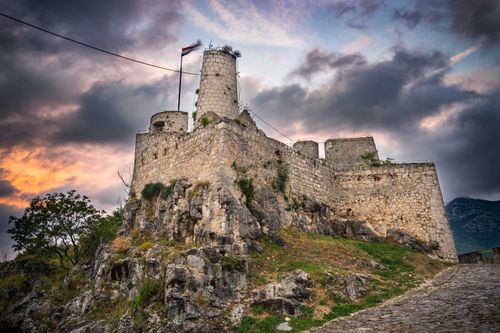
Much of modern Ilok huddles around the fortress (tvrđava), its ruddy walls dominating a ridge overlooking the Danube. It owes its shape to Nikola Iločki (1415–77), the local power baron who turned the town into a major strategic point in Europe’s defences against the Ottoman Turks. Occupied by the Ottomans in 1526, Ilok became a Habsburg possession in 1688 when it was presented to the Pope’s nephew Livio Odescalchi, who built a fine Baroque palace (now the Ilok Museum) inside the walls.
The fortress walls and towers are in a good state of preservation and can be admired by walking through the park that runs around its western and southern side.
Ilok wine cellars
Although Iločki podrumi is the most famous of Ilok’s wine producers, it is the large number of independent wineries that give the town its flavour. These are by and large family businesses, selling wines directly to visitors to their cellars. Visitors are welcome (you can taste wines by the glass and might also be offered cheese-and-ham nibbles).
- Buhač Hercegovačka
One of the most enterprising and innovative boutique producers in Ilok, producing good Graševinas and Chardonnays, as well as a highly regarded Merlot.
- Knezović Matije Gupca
Friendly family house with cellar and tasting room, offering Chardonnay and red Frankovka (Blaufränkisch) alongside the usual Graševina.
- Stipetić Radićeva
A family winery with a two hundred-year tradition right in the centre of Ilok, with cellars built into the hillside. Known for good-quality Graševina and Rhine Riesling.
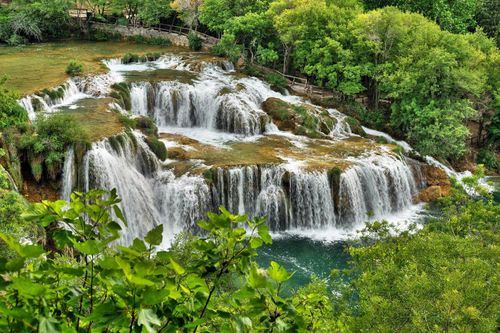
Top image: Waterfalls in Plitvice National Park © Fesus Robert/Shutterstock
.jpg)