Phong Nha-Ke Bang National Park
There are plenty of opportunities to visit caves in Vietnam – especially around Ha Long Bay – but for sheer scale nothing can compare with those at Phong Nha-Ke Bang National Park. Designated a World Heritage Site in 2003, Phong Nha’s 885 square kilometres of jungle is littered with caves and underground rivers; every year more are being discovered, surveyed and opened to the public. But don’t be fooled into thinking it’s all about the landscape: the park also offers opportunities for kayaking, ziplining, swimming and biking, plus it has an interesting war history and the rugged terrain provides an ideal habitat for many animals. Phong Nha is home to over one hundred species of mammal, including bears, elephants and muntjacs, as well as over eighty species of reptiles and amphibians, three hundred birds and seventy types of fish.
Located on Highway 20, which leads into the national park, little Phong Nha town (also known as Son Trach) has seen big changes recently, with a visitors’ centre, several recently opened hotels and hostels as well as foreigner-friendly eateries to cater for the growing numbers of visitors, mostly backpackers, who are eager for adventure. Increasing numbers of travellers are spending a few days here, but keep in mind that flooding frequently occurs in October and November, when most caves become inaccessible; the best months to visit are from March to May.
The world’s largest cave
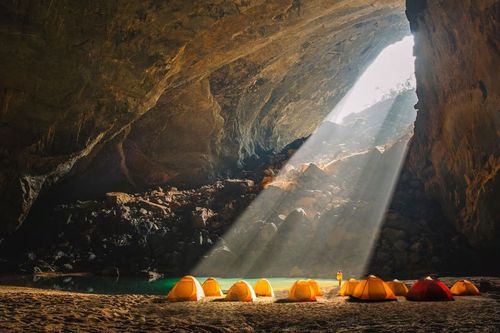
Rarely can the word “cavernous” have been used with such justification. In 2009, a group of British cavers attempted the first-ever detailed survey of the Son Doong (Mountain River) Cave in Phong Nha-Ke Bang National Park, finally giving up 4.5km in; they returned a year later to charter the final 2km. Their records and photographs revealed chambers large enough to swallow up whole city blocks – the largest is over 250m high, and 150m wide – plus 70m-long stalactites, gigantic shards of crystal and grapefruit-sized calcite pearls.
Phong Nha Cave
The only way to Phong Nha Cave is by boat. These seat up to fourteen people, and though it’s theoretically possible to join other groups, you’ll likely be told to charter one of your own. The boats wend their way 5km (30min) upstream to the cave entrance, after which the pilot cuts the engine and starts to paddle through. You’ll drift awhile between rippling walls of limestone, and see immense stalactites and stalagmites, all lit by multicoloured spotlights. The boat eventually draws into a small subterranean beach, from which you follow an easy, 500m-long trail around the cave (flip-flops will be fine) – note that visitors must stick to the path to avoid any risk of rock damage. Your driver will be waiting for you at the end of the path.
Tien Son Cave
You can follow up your visit to Phong Nha by taking a steep, 330-step climb up to Tien Son Cave. From here you’ll have a grand view of the valley, while inside there are Cham inscriptions dating as far back as the ninth century. Unfortunately, their magnificence is diluted somewhat by lurid lighting, presumably placed here to make for a more visually vivid experience – unless you’re a true cave fanatic, you’ll likely be happy with visiting Phong Nha alone.
Thien Duong Cave
Before the discovery of Son Doong, Thien Duong, or "Paradise Cave", held a brief period in the limelight as the longest cavern in Vietnam. Under the same management as the Sun Spa Resort in Dong Hoi, the first kilometre or so has now been fully opened up to tourism – a truly baffling staff-to-visitors ratio shows that there are high hopes of making this one of Vietnam’s major drawcards. This partially explains the high ticket price, though this also affords you a golf-buggy ride to the trailhead, and a (largely unnecessary) guide for the cave itself. It’s a sweaty climb up, but the jaw-dropping beauty of the cavern makes such exertion worthwhile – there’s nothing in particular to see, but it’s simply a joy to be walking in a cavern of such unworldly size – in places, over 100m in both height and width.
Nuoc Mooc Eco-trail
Sprawling along picturesque riverside territory and lassoed together with bamboo bridges, this 1km-long eco-trail shows the reassuring direction in which local tourism is heading. You’re highly unlikely to see any animals, but there are a couple of opportunities to swim – the entry price will see your bags taken care of, though you’ll have to pay extra for drinks.
Vinh
If you want to see whole swathes of bleak, Soviet-style architecture, you could do worse than heading to Vinh. Although a place of pilgrimage for Vietnamese tourists – Ho Chi Minh was born in the nearby village of Kim Lien – it receives very few foreign guests, most of whom use the city as a stop on the long journey between Hué and Hanoi, or a jumping-off point for the Lao border. Still, the place has its merits – plenty of cheap accommodation around the train and bus stations, and the chance to discover a real Vietnamese city, almost entirely unaffected by international tourism.
Brief history of Vinh
Vinh fared particularly badly in the twentieth century. As an industrial port-city dominating major land routes, whose population was known for rebellious tendencies, the town became a natural target during both French and American wars. In the 1950s French bombs destroyed large swathes of Vinh, after which the Viet Minh burnt down what remained rather than let it fall into enemy hands; the rebuilt town was flattened once again during the American air raids. Reconstruction proceeded slowly after 1975, mostly financed by East Germany; the decrepit hulks of barrack-like apartment blocks, totally unsuited to the Vietnamese climate, still dominate the city centre. Things are beginning to improve, however, as trade with Laos brings more money into the region.
Kim Lien
Ho Chi Minh was born in 1890 in Hoang Tru Village, Kim Lien commune, 14km west of Vinh. The two simple houses made of bamboo wattle and palm-leaf thatch are 1959 reconstructions, now surrounded by fields of sweet potatoes. Ho’s birthplace is said to be the hut by itself on the left as you approach, while behind stands the brick-built family altar. At the age of 6 Ho moved 2km west, to what is now called Lang Sen (Lotus Village), to live with his father in very similar surroundings. The two Sen houses are also replicas, built in 1955, with nothing much to see inside, but the complex is peaceful and alive with dancing butterflies. The museum nearby illustrates Ho’s world travels with memorabilia and photos.
The Ho Chi Minh Trail
The Ho Chi Minh Trail is a network of trails, footpaths and roadways once used as a military supply route that led from North to South Vietnam through Laos and Cambodia. The communist-led group, The Viet Cong, also known as the National Liberation Front, used the route to send weapons, ammunition and manpower to their allies in the South. The mass political organization, who fought against the USA and South Vietnam, were eventually on the winning side of the Vietnam war.
History of the Ho Chi Minh Trail
At the end of its "working" life, the Ho Chi Minh Trail had grown from a rough assemblage of animal tracks and jungle paths to become a highly effective logistical network stretching from near Vinh, north of the Seventeenth Parallel, to Tay Ninh Province on the edge of the Mekong Delta. Initially it took up to six months to walk the trail from north to south, most of the time travelling at night while carrying rations of rice and salt, medicines and equipment; in four years one man, Nguyen Viet Sinh, is reputed to have carried more than fifty tonnes and covered 40,000km, equivalent to walking round the world. By 1975, however, the trail – comprising at least three main arteries plus several feeder roads leading to various battlefronts and totalling over 15,000km – was wide enough to take tanks and heavy trucks, and could be driven in just one week. It was protected by sophisticated anti-aircraft emplacements and supported by regular service stations (fuel and maintenance depots, ammunition dumps, food stores and hospitals), often located underground or in caves and all connected by field telephone. Eventually there was even an oil pipeline constructed alongside the trail to take fuel south from Vinh to a depot at Loc Ninh. All this absorbed thousands of men and women in maintenance work, as engineers, gunners and medical staff, while as many as fifty thousand Youth Volunteers repaired bridges and filled in bomb craters under cover of darkness.
The founding of the trail
The trail was conceived in early 1959 when General Giap ordered the newly created Logistical Group 559 to reconnoitre a safe route by which to direct men and equipment down the length of Vietnam in support of Communist groups in the south. Political cadres blazed the trail, followed in 1964 by the first deployment of ten thousand regular troops, and culminating in the trek south of 150,000 men in preparation for the 1968 Tet Offensive. It was a logistical feat that rivalled Dien Bien Phu in both scale and determination: this time it was sustained over fifteen years and became a symbol to the Vietnamese of both their victory and their sacrifice. For much of its southerly route the trail ran through Laos and Cambodia, sometimes on paths forged during the war against the French, sometimes along riverbeds and always through the most difficult, mountainous terrain plagued with leeches, snakes, malaria and dysentery.
On top of all this, people on the trail had to contend with almost constant bombing. By early 1965, aerial bombardment had begun in earnest, using napalm and defoliants as well as conventional bombs, to be joined later by carpet-bombing B-52s. Every day in the spring of 1965 the US Air Force flew an estimated three hundred bombing raids over the trail and in eight years dropped over two million tonnes of bombs, mostly over Laos, in an effort to cut the flow. Later they experimented with seismic and acoustic sensors to eavesdrop on troop movements and pinpoint targets, but the trail was never completely severed and supplies continued to roll south in sufficient quantities to sustain the war.
The Ho Chi Minh Trail Today
Today, parts of the Ho Chi Minh Trail have vanished beneath time, nature and tarmac but this does not stop eager tourists hoping for a taste of history amongst the green scenic jungle. The route, when followed in full, sees travellers through the isolated beauty of Cambodia and Laos. With increasing popularity, the trail has provided big business for tour companies and bike hire companies alike. With many choosing to opt for guided tours on bikes or choosing to travel solo, the business in Vietnam for hiring motorcycles is booming. Many small local villages have also jumped on the bandwagon, and opened up their homes for a small price to provide tourists with local food and an authentic, rural place to stay whilst passing through on the route. Families share their stories not through language, but through photographs of their loved ones who would have also provided shelter for guerrilla fighters passing the trail themselves.
Unfortunately, the trail cannot be followed lightly and caution is recommended at all times. During the war, around 15 million tonnes of bombs were dropped on Vietnam alone. In Cambodia and Laos there was a total of around 5 million tonnes dropped, many of which still remain killing and injuring hundreds of local people each year. It is highly advised to stay clear of wandering of the track as waiting bombs may be lurking beneath the undergrowth, especially in the remote regions of Laos.
The life of Ho Chi Minh
So inextricably is the life of Ho Chi Minh intertwined with Vietnam’s emergence from colonial rule that his biography is largely an account of the country’s struggle for independence in the twentieth century. As Ho adopted dozens of pseudonyms and never kept diaries, uncertainty clouds his public life and almost nothing is known about the private man beneath the cultivated persona of a celibate and aesthete, totally dedicated to his family – a concept that embraced all the Vietnamese people.
Ho Chi Minh's origins
Ho’s origins were humble enough – he was born Nguyen Sinh Cung in 1890, the youngest child of a minor mandarin who was dismissed from the Imperial court in Hué for anti-colonialist sympathies. Ho attended high school in Hué but was expelled for taking part in a student protest; he left Vietnam for France in 1911, then spent several years wandering the world. He worked in the dockyards of Brooklyn and as a pastry chef in London’s Carlton Hotel, before returning to France in the aftermath of World War I, to earn his living retouching photographs. In Paris, Ho became an increasingly active nationalist, and caused quite a stir during the Versailles Peace Conference when he published a petition demanding democratic constitutional government for Indochina. For a while Ho joined the French Socialists, but when they split in 1920 he defected to become one of the founder members of the French Communist Party, inspired by Lenin’s total opposition to imperialism.
Ho’s energetic role in French Communism was rewarded when he was called to Moscow in 1923 to begin a career in international revolution, and a year later he found himself posted to southern China as a Comintern agent. Within a few months he had set up Vietnam’s first Marxist-Leninist organization, the Revolutionary Youth League, which attracted a band of impassioned young Vietnamese eager to hear about the new ideology. But in 1927, Chiang Kai-shek, leader of the Chinese nationalists, turned against the Communists and Ho was forced to flee. For a while he lived in Thailand, disguised as a Buddhist monk, before turning up in Hong Kong in 1930 where he was instrumental in founding the Vietnamese Communist Party. By now the French authorities had placed a death sentence on Ho’s head, for insurrection; he was arrested in Hong Kong but escaped with the help of prison hospital staff, who managed to persuade everyone, including the French police, that Ho had died of tuberculosis.
Return to Vietnam
Ho disappeared again for a few years while the fuss died down, before reappearing on China’s southern border in the late 1930s. In 1941, aged 51, he re-entered Vietnam for the first time in thirty years, wearing a Chinese-style tunic and rubber-tyre sandals, and carrying just a small rattan trunk and his precious typewriter. In the mountains of northern Vietnam, Ho, now finally known as Ho Chi Minh (meaning "He Who Enlightens"), was joined by Vo Nguyen Giap, Pham Van Dong and other young militants. Together they laid the groundwork for the anticipated national uprising, establishing a united patriotic front, the League for the Independence of Vietnam – better known by its abbreviated name, the Viet Minh – and training the guerrilla units that would eventually evolve into the Vietnamese People’s Army. But events conspired against Ho: in 1942 he was arrested as a Franco-Japanese spy when he crossed back into China to raise support for the nationalist cause, and he languished for more than a year in various prisons, writing a collection of poetry later published as the "Prison Diary".
Ho Chi Minh's death
Meanwhile, however, events were hotting up, and when the Japanese occupation of Vietnam ended in August 1945, the Viet Minh were ready to seize control. Ho Chi Minh, by this time seriously ill, led them to a brief period in power following the August Revolution, and then ultimately to Independence in 1954. For the next fifteen years, as President of the Democratic Republic of Vietnam, Uncle Ho took his country along a sometimes rocky socialist path, continually seeking reunification through negotiation and then war. But he didn’t live to see a united Vietnam: early in 1969 his heart began to fail and on September 2, Vietnam’s National Day, he died. Since then, myth and fact have converged in a cult placing Ho Chi Minh at the top of Vietnam’s pantheon of heroes, true to Confucian tradition – though against Ho’s express wishes.
Ninh Binh
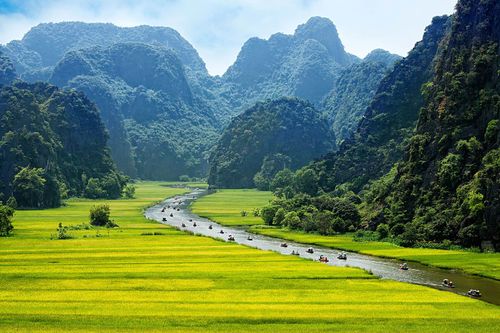
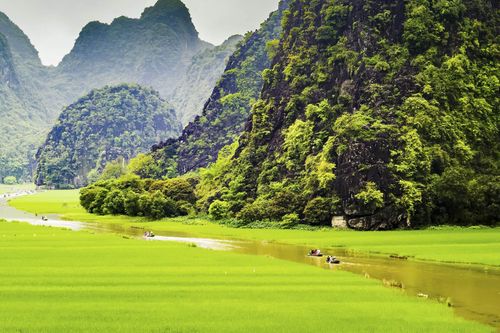
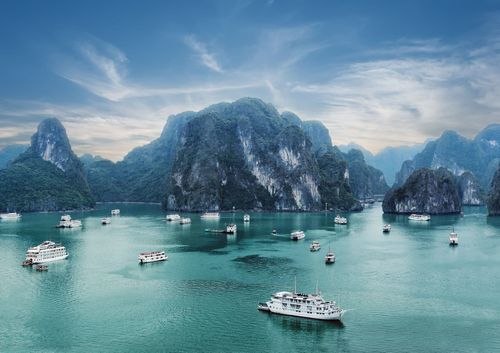
At first glance, the provincial capital of Ninh Binh appears to be yet another dusty, traffic-heavy northern town. However, glance to the west and you’ll be beckoned to stay by a thousand fingers of limestone – a land-lubbing Ha Long Bay, with a clutch of historic and architectural sights to add to its geological beauty.
Despite the wealth of sights surrounding it, Ninh Binh itself claims just one sight of its own: a kilometre to the north a picturesque little pagoda nestles at the base of Non Nuoc Mountain. This knobbly outcrop – no more than 60m high – is noted for an eminently missable collection of ancient poetic inscriptions and views east over a power station to the graphically named “Sleeping Lady Mountain”.
Hoa Lu
Twelve kilometres northwest of Ninh Binh, Hoa Lu makes another rewarding excursion. In the 10th century, this site was the capital of an early, independent Vietnamese Kingdom called Dai Co Viet. The fortified royal palaces of the Dinh and Le kings are now reduced to archaeological remains, but their dynastic temples (seventeenth-century copies of eleventh-century originals) still rest quietly in a narrow valley surrounded by wooded, limestone hills. Though the temple buildings and attractive walled courtyards are unspectacular, the inner sanctuaries are compelling – mysterious, dark caverns where statues of the kings, wrapped in veils of pungent incense, are worshipped by the light of candles.
Making the most of Ninh Binh
While the town itself has little to detain you, the surrounding hills shelter Tam Coc, where sampans slither through the limestone tunnels of “Ha Long Bay on land”, and one of Vietnam’s ancient capitals, Hoa Lu, represented by two darkly atmospheric dynastic temples. On the way to Hoa Lu is Trang Anh, a less-touristed version of Tam Coc, while further on is is Bai Dinh Pagoda – though decidedly non-ancient, this ranks as the largest Buddhist complex in Vietnam, and quite possibly the whole world, and is worth a look for its sheer scale alone. All of these places can be tackled in one day by car or motorbike, or by bicycle via the back lanes.
To the east, the stone mass of Phat Diem Cathedral wallows in the rice fields, an extraordinary amalgam of Western and Oriental architecture that still shepherds an active Catholic community. Heading west instead, Cuc Phuong is one of Vietnam’s more accessible national parks and contains some magnificent, centuries-old trees.
More boat trips are in store at Kenh Ga, to visit a limestone cave, and at Van Long nature reserve, both on the Cuc Phuong road. These last sights are more distant: the cathedral requires a half-day outing, while Cuc Phuong and either Kenh Ga or Van Long can be combined in a long day-trip. Hanoi is only a couple of hours away, and the Hoa Lu/Tam Coc–Bich Dong circuit makes a popular and inexpensive day tour out of the capital. However, with more time, it’s far better to take advantage of Ninh Binh’s hotels and services to explore the area at a more leisurely pace.
Cuc Phuong National Park
In 1962 Vietnam’s first national park was established around a narrow valley between forested limestone hills on the borders of Ninh Binh, Thanh Hoa and Hoa Binh provinces, containing over two hundred square kilometres of tropical evergreen rainforest. Cuc Phuong is well set up for tourism and sees a steady stream of visitors, attracted principally by the excellent primate rescue centre, but also by the easy access to impressively ancient trees. With more time, you can walk into the park interior, overnight in a Muong village and experience the multi-layered forest. The most enjoyable time for walking in these hills is October to January, when mosquitoes and leeches take a break and temperatures are relatively cool – but this is also peak season. Flowers are at their best February and March, while April and May are the months when lepidopterists can enjoy the “butterfly festival” as thousands of butterflies colour the forest.
Cuc Phuong’s flora and fauna
Even now the park has not been fully surveyed but is estimated to contain approximately three hundred bird species and ninety mammal species, some of which were first discovered in Cuc Phuong, such as red-bellied squirrels and a fish that lives in underground rivers. Several species of bat and monkey, including the critically endangered Delacour’s langur, inhabit the park, while bears and leopards roam its upper reaches. Hunting has taken its toll, though, and you’re really only likely to see butterflies, birds and perhaps a civet cat or a tree squirrel, rather than the more exotic fauna. What you can’t miss, though, is the luxuriant vegetation including 1000-year-old trees (living fossils up to 70m high), tree ferns and kilometre-long corkscrewing lianas, as well as a treasure-trove of medicinal plants.
Walking in Cuc Phuong
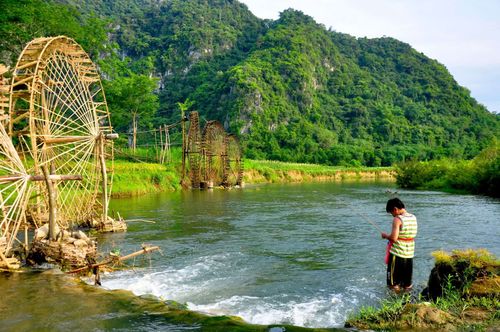
Of several walks in the park, one of the most popular starts at Car Park A, 18km from the park gate. For a steamy 7km (roughly 2hr), a well-trodden path winds through typical rainforest to reach the magnificent cho xanh tree, a 45m-high, 1000-year-old specimen of Terminalia myriocarpa – its dignity only slightly marred by a viewing platform. Dropping back down to the flat, take a left turn at the unmarked T-junction to bring you back to the road higher up at Car Park B. This second car park is also the start of the "Adventurous Trail", an 18-km hike through the park to Muong villages, noted for their gigantic wooden waterwheels, for which you’ll need a guide and a night’s accommodation.

 (1).jpg)