Explore The Mekong Delta
Since the opening of the border to Cambodia a few kilometres north of town, CHAU DOC has boomed in popularity, and is the only place apart from Can Tho where you are likely to see foreigners in any numbers. Snuggled against the west bank of the Hau Giang River, the town came under Cambodian rule until it was awarded to the Nguyen lords in the mid-eighteenth century for their help in putting down a localized rebellion. The area sustains a large Khmer community, which combines with local Cham and Chinese to form a diverse social melting pot. Just as diverse is Chau Doc’s religious make-up: as well as Buddhists, Catholics and Muslims, the region supports an estimated 1.5 million devotees of the indigenous Hoa Hao religion. Forays by Pol Pot’s genocidal Khmer Rouge into this corner of the delta led to the Vietnamese invasion of Cambodia in 1978.
On Doc Phu Thu and a few other streets in town, colonial relics are still evident, but their grand shophouse terraces, flaunting arched upper-floor windows and awnings propped up by decorous wrought-iron struts, are interspersed with characterless new edifices.
Read More-
Around Chau Doc
Around Chau Doc
There are several places of interest to visit in the area around Chau Doc, including a Cham community and the brooding Sam Mountain with its kitsch pagodas. Further afield are a bird sanctuary, a battlefield from the American War and the scene of a Khmer Rouge massacre. If you’re making the journey up to Chau Doc from Long Xuyen on Highway 91, look out for the incense factories, where the sticks are spread out to dry along the roadside, often arranged in photogenic circles.
Chau Doc Floating Market
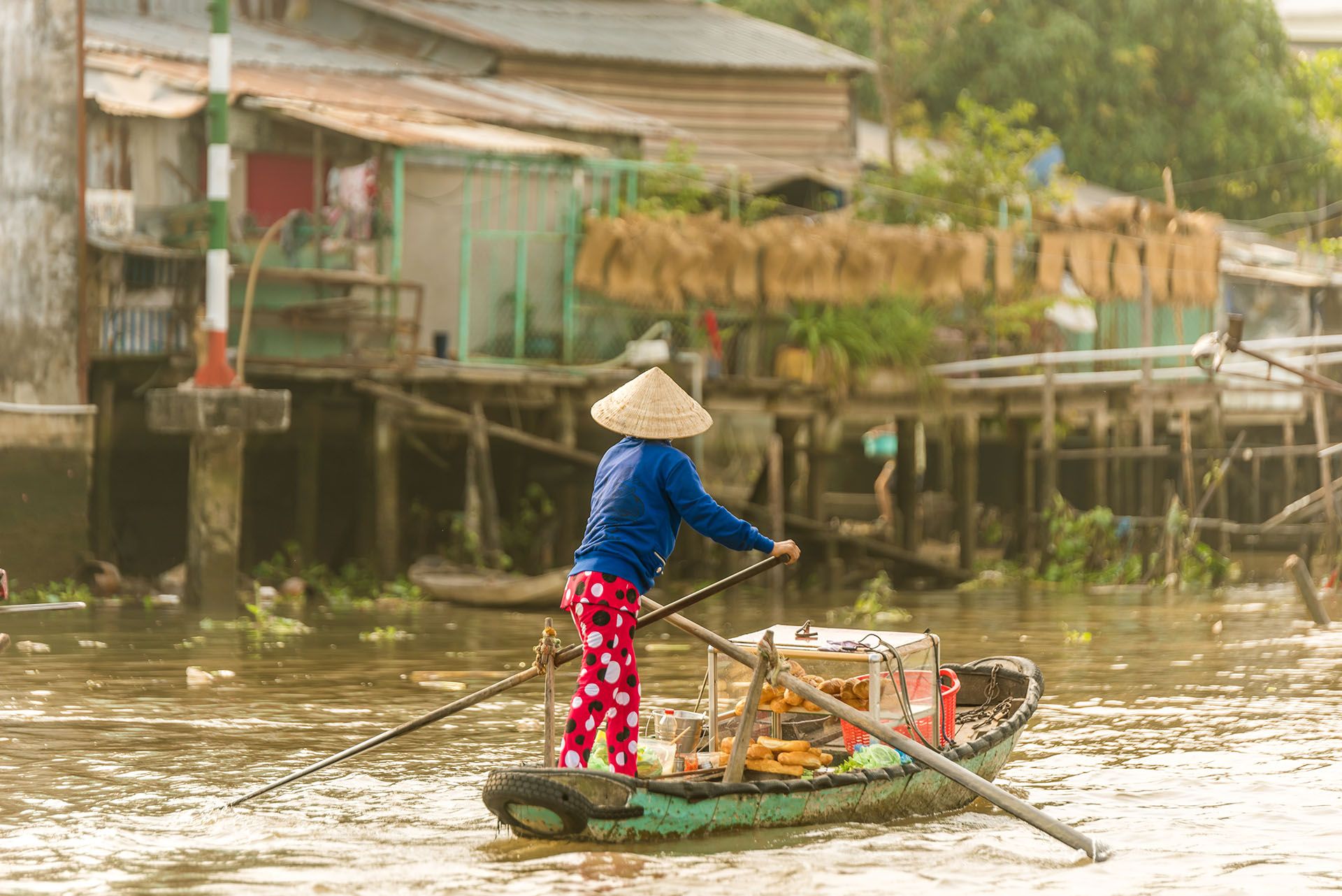
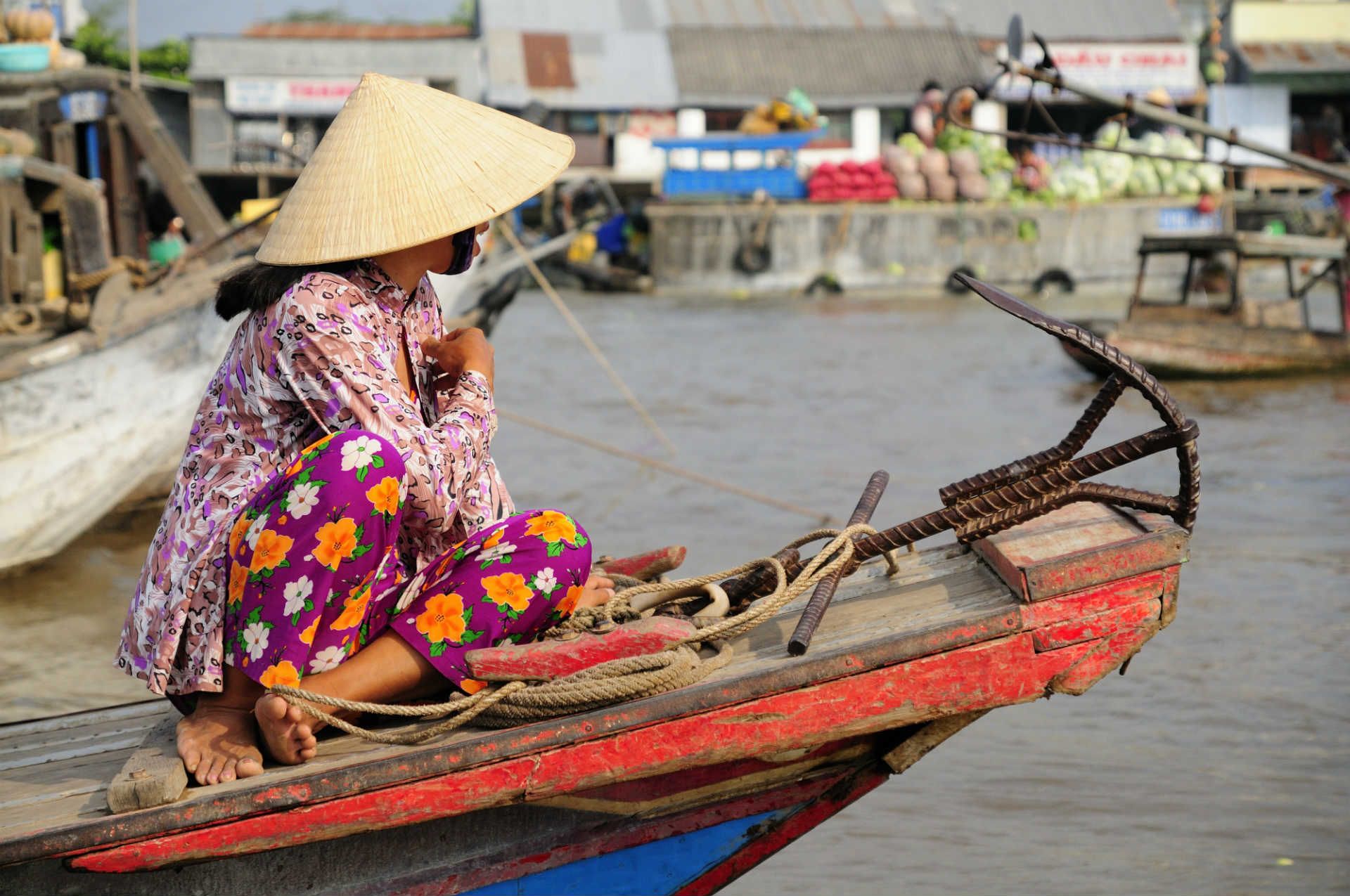
Since this floating market was only established recently, you have to wonder whether it’s more for the benefit of tourists than locals. Nevertheless, if you’ve managed to get this far through the delta without visiting any of the other floating markets along the way, it’s certainly worth a look. As usual, boats advertise their products by hanging a sample from a stick on the deck.
Con Tien Island and Chau Giang District
Two settlements a stone’s throw away from Chau Doc across the Hau Giang River are worth venturing out to, and most people visit both on a half-day tour. One is the cluster of fish-farm houses floating on the river next to Con Tien Island, above cages of catfish that are fed through a hatch in the floor. Fish farming is big business in the delta, and some of these cages can be over 1000 cubic metres in size.
The other settlement is a Cham community in Chau Giang District, which you can visit independently via a ferry from a jetty south of the tourist jetty on Le Loi. Here you’ll discover kampung-style wooden houses, sarongs and white prayer caps that betray the influence of Islam, as do the twin domes and pretty white minaret of the Mubarak Mosque.
Sam Mountain
Arid, brooding Sam Mountain rises dramatically from an ocean of paddy fields. It’s known as Nui Sam to Vietnamese tourists, who flock here in their thousands to worship at its clutch of pagodas and shrines. Even if the temples don’t appeal, the journey up the hill is good fun. As you climb, you’ll pass massive boulders that seem embedded in the hillside, as well as some plaster statues of rhinos, elephants, zebras and a Tyrannosaurus rex near the top. From the top, the view of the surrounding, pancake-flat terrain is breathtaking, though the hill is, in fact, only 230m high. In the rainy season, the view is particularly spectacular, with lush paddy fields scored by hundreds of waterways, though in the dry season the barren landscape is hazy and less inspiring. There’s a tiny military outpost at the summit, from which you can gaze into Cambodia on one side, Chau Doc on the other.
Tay An Pagoda
At the foot of Sam Mountain the first pagoda you’ll see is kitsch, 1847-built Tay An Pagoda, the pick of the bunch, its frontage awash with portrait photographers, beggars, incense-stick vendors and bird-sellers (releasing one from captivity accrues merit, though some clever vendors train the birds to fly back later). Guarding the pagoda are two elephants, one black, one white, and a shaven-headed Quan Am Thi Kinh. The number of gaudy statues inside exceeds two hundred: most are of deities and Buddhas, but an alarmingly lifelike rendering of an honoured monk sits at one of the highly varnished tables in the rear chamber. To the right of this room an annexe houses a goddess with a thousand eyes and a thousand hands, on whose mound of heads teeters a tiny Quan Am.Chua Xu Temple
Fifty metres west of Tay An, Chua Xu Temple honours Her Holiness Lady of the Country, a stone statue said to have been found on Sam’s slopes in the early nineteenth century, though the present building, with its four-tiered, glazed green-tile roof, dates only from 1972. Inside, the Lady sits in state in a marbled chamber, resplendent in colourful gown and headdress. Glass cases in corridors either side of her are crammed to bursting with splendid garb and other offerings from worshippers, who flood here between the 23rd and 25th of the fourth lunar month, to see her ceremonially bathed and dressed. Shops in front of the temple sell colourful baskets of fruit that locals buy to offer to Her Holiness.Chua Hang
A few hundred metres west and then south around the base of Sam Mountain, the multi-storey Chua Hang (Cave Pagoda), is a popular stopping-off point for local tourists, although the tiny grotto after which the pagoda is named is rather a let-down after the sweaty ascent.Tra Su Bird Sanctuary
Beyond Sam Mountain, the varied attractions at Tra Su, Tup Duc and Ba Chuc could all be covered in a busy day’s travelling, though this remote area is not a place for hurrying. This bird sanctuary is located about 23km from Chau Doc and consists of a protected forest of cajuput trees and wetlands that attract a great variety of birds including storks, egrets, cormorants, peafowl and water cocks. A boat ride around the sanctuary combined with a walk to a viewing tower takes a couple of hours and costs around $7 per person depending on how many in the group. Even if you’re not a dedicated birder, you’d probably enjoy floating around this watery wonderland with its huge lily pads and moss-shrouded trees.
Tup Duc
During the American war, Tup Duc gained the rather ignominious moniker “Two Million Dollar Hill”, a reference to the amount the US military is said to have spent trying to dislodge the Viet Cong from its slopes.
Now the Vietnamese government has ploughed in money of its own in an attempt to turn it into a tourist resort, by installing pedal boats on a lake, an ostrich-breeding farm, a flower garden, a shooting range, a restaurant and refreshment kiosks at the foot of the hill. There is also a small museum here, an electronic mock-up of the battle and dummies in a cave on the hill, re-creating a Viet Cong briefing scene. Kids will probably latch onto you and lead you up a stairway past the huge boulders that provided such effective cover to the Viet Cong. Squeezing through the narrow passageways formed by the jumble of boulders, it is easy to see how it made such a perfect hide-out.
Ba Chuc
Both Tup Duc and Ba Chuc are located in a sweep of staggeringly beautiful countryside southwest of Chau Doc, though their significance is far from peaceful. Refugees fleeing Pol Pot’s Cambodia boosted the Khmer population here in the late 1970s, and pursuit by the Khmer Rouge ended in numerous indiscriminate massacres; a grisly memorial to the worst of these, at the village of Ba Chuc, stands as testament to that horrific era.
Ba Chuc Memorial and Phi Lai Pagoda
The memorial in the centre of the village pays homage to to the 3157 villagers massacred, most of them clubbed to death, in two weeks in April 1978. Only two villagers survived the tragedy. An unattractive concrete canopy fails to lessen the impact of the eight-sided memorial: behind its glass enclosure, the bleached skulls of the dead of Vietnam’s own “killing fields” are piled in ghoulish heaps, grouped according to age to highlight the youth and innocence of many of the dead.Many of the victims were killed in the adjacent Phi Lai Pagoda, where bloodstains on the walls and floor can still be easily seen. A signboard in Vietnamese beside a tiny door below the altar notes that forty villagers perished here when a grenade was thrown into the cramped space.
Between the memorial and the pagoda is a small room, where a horrific set of black-and-white photos taken just after the massacre shows buckled, abused corpses scattered around the countryside. Some of the images on display are extremely disturbing and you should not enter if you are a sensitive type. There are also a few cafés and food stalls set up to cater to visitors to the site.
-
The Hoa Hao religion
Sited 20km east of Chau Doc, the diminutive village of Hoa Hao lent its name to a unique religious movement at the end of the 1930s. The Hoa Hao Buddhist sect was founded by the village’s most famous son, Huynh Phu So. A sickly child, Huynh was placed in the care of a hermitic monk under whom he explored both conventional Buddhism and more arcane spiritual disciplines. In 1939, at the age of 20, a new brand of Buddhism was revealed to him in a trance. Upon waking, Huynh found he was cured of his congenital illness, and began publicly to expound his breakaway theories, which advocated purging worship of all the clutter of votives, priests and pagodas, and paring it down to simple unmediated communication between the individual and the Supreme Being. The faith has a fairly strong ascetic element, with alcohol, drugs and gambling all discouraged. Peasants were drawn to the simplicity of the sect, and by rumours that Huynh was a faith healer in possession of prophetic powers.
Almost immediately, the Hoa Hao developed a political agenda, and established a militia to uphold its fervently nationalist, anti-French and anti-Communist beliefs. The Japanese army of occupation, happy to keep the puppet French administration it had allowed to remain nominally in charge of Vietnam on its toes, provided the sect with arms. For themselves, the French regarded the Hoa Hao with suspicion: Huynh they labelled the “Mad Monk”, imprisoning him in 1941 and subsequently confining him to a psychiatric hospital – where he promptly converted his doctor. By the time of his eventual release in 1945, the sect’s uneasy alliance with the Viet Minh, which had been forged during World War II in recognition of their common anti-colonial objectives, was souring, and two years later Viet Minh agents assassinated him. The sect battled on until the mid-Fifties when Diem’s purge of dissident groups took hold; its guerrilla commander, Ba Cut, was captured and beheaded in 1956, and by the end of the decade most members had been driven underground. Though in the early Sixties some of these resurfaced in the Viet Cong, the Hoa Hao never regained its early dynamism, and any lingering military or political presence was erased by the Communists after 1975.
Today there are thought to be somewhere around two million Hoa Hao worshippers in Vietnam, concentrated mostly around Chau Doc and Long Xuyen. Some male devotees still sport the distinctive long beards and hair tied in a bun that traditionally distinguished a Hoa Hao adherent.