Explore The Mekong Delta
Touring the orchards, paddy fields and swamplands of the Mekong Delta, you could be forgiven for thinking you’ve stepped into the pages of a geography textbook. A comma-shaped flatland stretching from Ho Chi Minh’s city limits southwest to the Gulf of Thailand, the delta is Vietnam’s rice bowl, an agricultural miracle that pumps out more than a third of the country’s annual food crop from just ten percent of its total land mass. Rice may be the delta’s staple crop, but coconut palms, fruit orchards and sugar-cane groves also thrive in its nutrient-rich soil, and the sight of conical-hatted farmers tending their land is one of Vietnam’s most enduring images. To the Vietnamese, the region is known as Cuu Long, “Nine Dragons”, a reference to the nine tributaries of the Mekong River, which dovetail across plains fashioned by millennia of flood-borne alluvial sediment.
Surprisingly, agriculture gripped the delta only relatively recently. Under Cambodian sway until the close of the seventeenth century, the region was sparsely inhabited by the Khmer krom, or “downstream Khmer”, whose settlements were framed by swathes of marshland. The eighteenth century saw the Viet Nguyen lords steadily broaden their sphere of influence to encompass the delta, though by the 1860s France had taken over the reins of government. Sensing the huge profits to be gleaned from such fertile land, French colons spurred Vietnamese peasants to tame and till tracts of the boggy delta; the peasants, realizing their colonial governors would pay well for rice harvests, were quick to comply. Ironically, the same landscape that had served the French so well also provided valuable cover for the Viet Minh resistance fighters who sought to overthrow them; later it did the same for the Viet Cong, who had well-hidden cells here – inciting the Americans to strafe the area with bombs and defoliants.
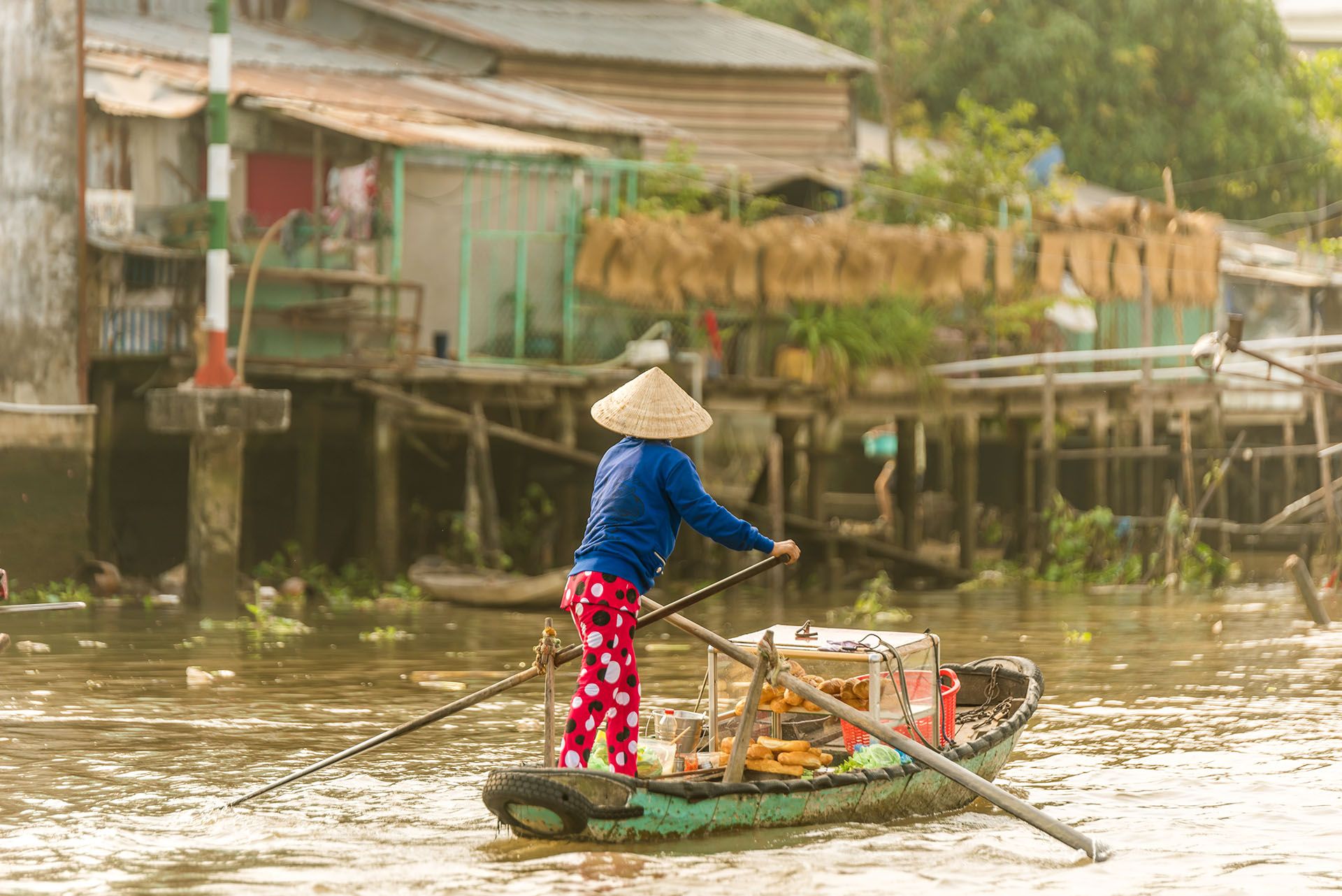
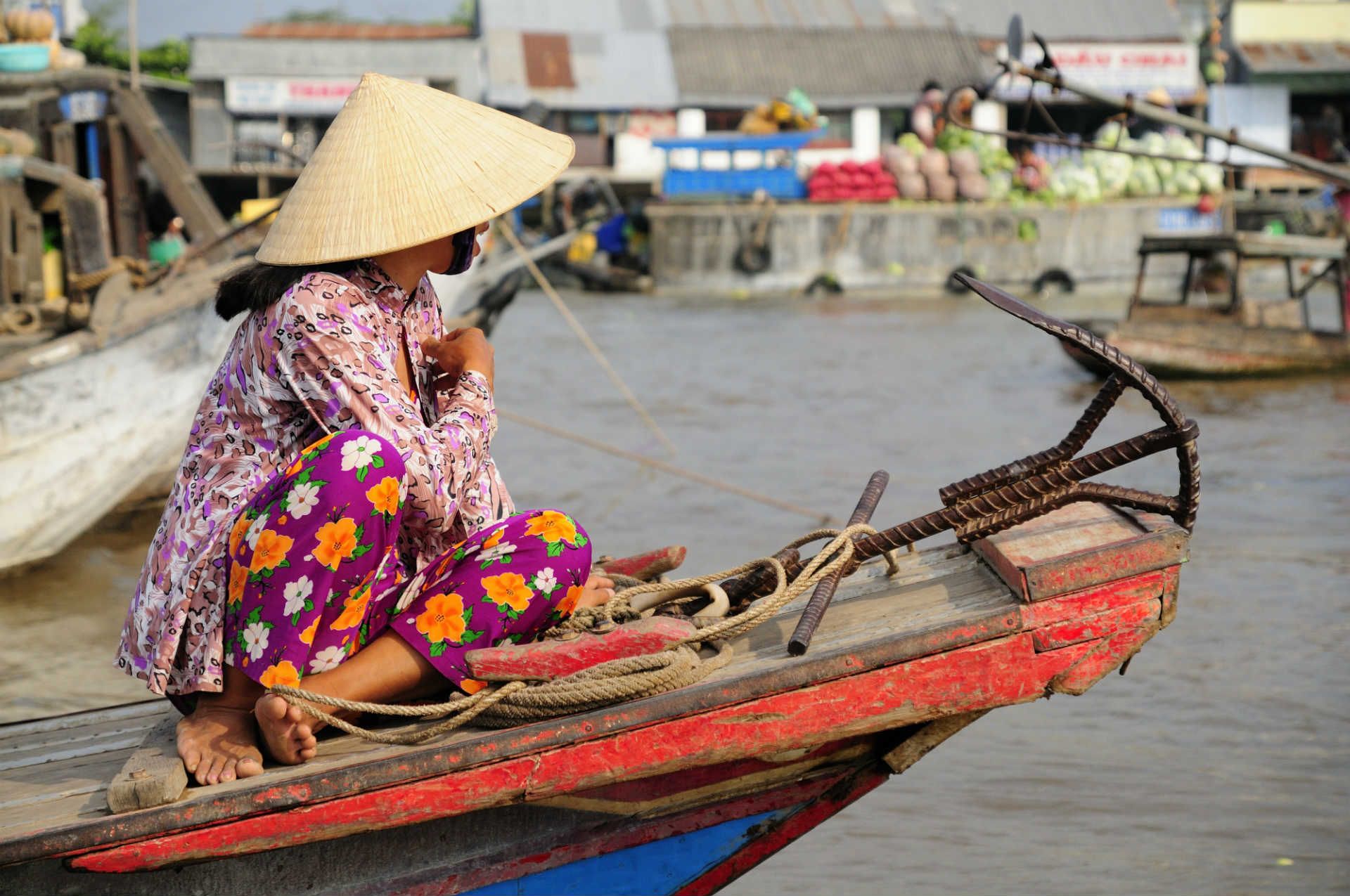
A visit to the Mekong Delta is so memorable because of the region’s diversity. Everyday scenes include children riding on the backs of water buffalo or cycling to school through country lanes clad in white ao dai; rice workers stooping in a sea of emerald; market vendors grinning behind stacks of fruit; bright yellow incense sticks drying at the roadside; flocks of storks circling over a sanctuary at dusk; Khmer monks walking mindfully in the shadow of pastel pagodas; locals scampering over monkey bridges or rowing boats on the delta’s maze of channels.
There are over a dozen towns in the delta with facilities for tourists, though some are rarely visited as they are not on the way to anywhere. My Tho is well geared up for boat trips, and near enough to Ho Chi Minh City to be seen on a day-trip: it affords an appetizing glimpse of the delta’s northernmost tributary, the Tien Giang. From My Tho, laidback Ben Tre and the bounteous fruit orchards besieging it are only a hop and a skip away. Cao Lanh is strictly for bird enthusiasts, but Sa Dec, with its timeless river scenes and riotously colourful flower nurseries, has a more universal appeal, while just down the road, Vinh Long is another jumping-off point for boat trips.
Many visitors spend a day or two in Can Tho, the delta’s biggest settlement, to take advantage of its decent hotels and restaurants and to recharge batteries before venturing out to the floating markets nearby. From Can Tho, there’s something to be said for dropping down to the foot of the delta, where the swampland that surrounds Ca Mau can be explored by boat, and Mui Ca Mau signals journey’s end in Vietnam. Pulling up, en route, at the Khmer stronghold of Soc Trang is especially rewarding if your trip coincides with the colourful Oc Om Bok festival (Nov or Dec), during which the local Khmer community takes to the river to stage spectacular longboat races. Northwest of Can Tho meanwhile, and a stone’s throw from the Cambodian border, is the ebullient town of Chau Doc, south of which Sam Mountain provides a welcome undulation in the surrounding plains. The opening of the border here has brought a steady stream of travellers going on to Phnom Penh by boat, and several of them rest up a few days here before leaving the country.
Ha Tien, a remote border town surrounded by Khmer villages, is the best place to hop on a boat to Phu Quoc. The town has also become popular for its international border crossing, which allows beach bums to slide along the coast from Phu Quoc Island to Sihanoukville in Cambodia or vice versa.
Given its seasonal flooding, the best time to visit the delta is, predictably enough, in the dry season, which runs from December to May.
Read More-
The Mekong River
The Mekong River
By the time it reaches Vietnam, the Mekong River has already covered more than four thousand kilometres from its source high on the Tibetan Plateau; en route it traverses southern China, skirts Burma (Myanmar), then hugs the Laos–Thailand border before cutting down through Cambodia and into Vietnam – a journey that ranks it as Asia’s third-longest river, after the Yangtse and Yellow rivers. Flooding has always blighted the delta; ever since Indian traders imported their advanced methods of irrigation more than eighteen centuries ago, networks of canals have been used to channel the excess water, but the rainy season still claims lives from time to time.
It’s difficult to overstate the influence of the river: the lifeblood of the rice and fruit crops grown in the delta, it also teems with craft that range in size from delicate rowing boats to hulking sampans, all painted with distinctive eyes on the prow. These continue an ancient tradition and were originally intended to scare off “river monsters”, probably crocodiles.
-
Boat trips
Boat trips
Several companies offer boat trips from the tourist boat centre (6–8, 30 Thang 4) to the islands in the Mekong; most tours head for Thoi Son, Phung and Qui islands. Tien Giang Tourist Company (t 073 387 3184, w tiengiangtourist.com), and Ben Tre Tourist Company (t 073 387 9103, w bentretourist.vn) are the most reliable. Both charge $18–35 per person for a tour of about three hours, depending how many people are in the group. Local boats, which you can find at the small jetty on Trung Trac, are much cheaper, and $20 should get you an entire boat for a two- to three-hour trip. However, bear in mind that the owners of these boats are not licensed or insured to carry tourists, so it’s a bit of a risky business.
-
Ong Dao Dua, the Coconut Monk
Ong Dao Dua, the Coconut Monk, was born Nguyen Thanh Nam in the Mekong Delta, in 1909. Aged 19, he travelled to France where he studied chemistry until 1935, when he returned home, married and fathered a child. During a lengthy period of meditation at Chau Doc’s Sam Mountain he devised a new religion, a fusion of Buddhism and Christianity known as Tinh Do Cu Si. By the 1960s, this new sect had established a community on Phung Island, where the monk lorded it over his followers from a throne set into a man-made grotto modelled on Sam Mountain. The monk became as famous for his idiosyncrasies as for his doctrine: his name, for instance, was coined after it was alleged he spent three years meditating and eating nothing but coconuts.
Unfortunately, the Coconut Monk never got to enjoy his “kingdom” for long: his belief in a peaceful reunification of North and South Vietnam (symbolized by the map of the country behind his grotto, on which pillars representing Hanoi and Saigon are joined by a bridge) landed him in the jails of successive South Vietnamese governments, and the Communists were no more sympathetic to his beliefs after 1975. Ong Dao Dua died in 1990.
-
Home-stays in the delta
While the Vietnamese are generally gregarious people, it’s unusual for foreigners to be invited into their homes. However, most visitors are curious about local culture, so it’s not surprising that home-stays are becoming ever more popular and widely available. Though there are home-stays all around the country, those located on tranquil islands of the delta, surrounded by acres of orchards, are particularly attractive.
For around $25 a head, you are transported by boat to your host’s (usually isolated) abode, shown around the gardens, given a tasty dinner (most likely including the delicious elephant-ear fish – a delta speciality) and lodgings for the night, either in a bed or hammock in a spare room. Bathroom facilities are basic, sometimes with squat toilets and bucket baths, but generally clean. If you book your home-stay with a tour operator like Sinhbalo Adventures, you can also spend the day kayaking between water palms along narrow canals, or cycling along narrow lanes between coconut, mango and papaya trees.