Unravelling the architectural features of Hoi An
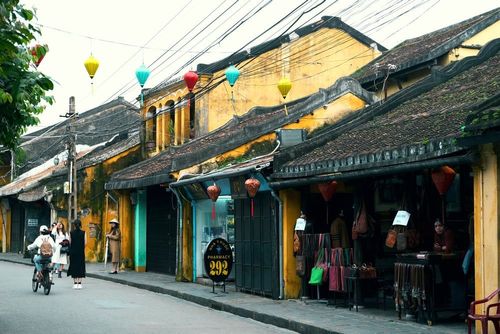
You can’t walk far in Hoi An without confronting a mythical beast with a fish’s body and dragon’s head; though they’re found all over northern Vietnam they seem to have struck a particular chord with Hoi An’s architects. One of the most prominent examples tops a weather vane in the Phuoc Kien Assembly Hall, but there are plenty of more traditional representations about, carved into lantern brackets and beam ends, or forming the beams themselves. The carp symbolizes prosperity, success and, here, metamorphosing into a dragon, serves a reminder that nothing in life comes easily. To become a dragon, and thereby attain immortality, a fish must pass through three gates – just as a scholar has to pass three exams to become a mandarin, requiring much patience and hard work.
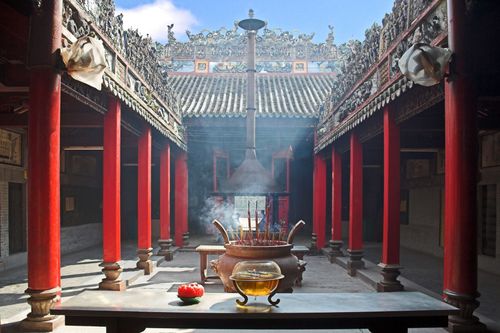
Another typical feature of Hoi An’s architecture are "eyes" watching over the entrance to a house or religious building. Two thick wooden nails about 20cm in diameter are driven into the lintel as protection against evil forces, following a practice that originated in the pagodas of northern Vietnam. Assembly halls offer the most highly ornamented examples: that of Phuoc Kien consists of a yin and yang with two dragons in obeisance to the sun, while the Cantonese version is a fearsome tiger. The yin and yang symbol became fashionable in the nineteenth century and is the most commonly used image on houses, sometimes set in a chrysanthemum flower, such as at the Tan Ky House, or as the octagonal talisman representing eight charms.
Around Hoi An
Hoi An is easy to explore beyond its old streets, with quiet routes leading out toward the coast and the Thu Bon River.
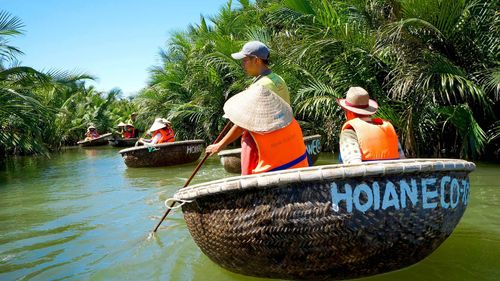
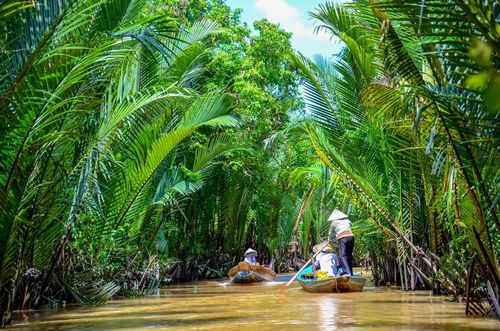
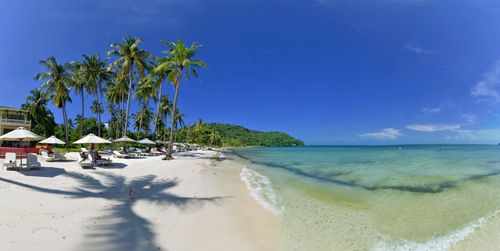
You can cycle along meandering paths to the white sands of Cua Dai Beach, or take a sampan to low-lying islands and craft villages along the riverbanks.
On 11-day Vietnam trips that include Hoi An, these short excursions help slow the pace between bigger city and heritage stops.
Longer boat trips can also reach the Cham Islands, known for their sea swallows’ nests and a more remote coastal feel.
My Son
Vietnam’s most evocative Cham site, My Son, lies 40 kilometres southwest of Hoi An and makes a compelling highlight of a Vietnam romantic trip. Set in a bowl of lush, forested hills beneath Cat’s Tooth Mountain, this UNESCO listed complex exudes a sense of faded majesty.
Though no Vietnamese Angkor Wat, the ruins retain a powerful atmosphere, enhanced by scattered lingam carvings, Sanskrit stelae, and the peaceful rural setting. The temple groups known as B, C, and D are especially striking, inviting visitors to imagine the grandeur of My Son in its heyday.
Brief history of My Son
Excavations at My Son have revealed that Cham kings were buried here as early as the fourth century, indicating that the site was established by the rulers of the early Champa capital of Simhapura, sited some 30km back towards the highway, at present-day Tra Kieu. The stone towers and sanctuaries whose remnants you see today were erected between the seventh and thirteenth centuries, with successive dynasties adding more temples to this holy place, until in its prime it comprised some seventy buildings. The area was considered the domain of gods and god-kings, and living on site would have been an attendant population of priests, dancers and servants.
French archaeologists discovered the ruins in the late nineteenth century, when the Chams’ fine masonry skills were still evident – instead of mortar, they used a resin mixed with ground brick and mollusc shells, which left only hairline cracks between brick courses. After the Viet Cong based themselves here in the 1960s, many unique buildings were pounded to oblivion by American B52s, most notably the once magnificent A1 tower. Craters around the site and masonry pocked with shell and bullet holes testify to this tragic period in My Son’s history.
Group B
Archeologists regard Group B as the spiritual epicentre of My Son. Of the central kalan (sanctuary), marked on maps as B1, only the base remains, along with a lingam discovered under the foundations a few years ago; but stone epitaphs found nearby reveal that it was dedicated to the god-king Bhadresvara, a hybrid of Shiva and fourth-century King Bhadravarman, and erected in the eleventh century, under King Harivarman IV, on the site of an earlier, wooden temple.
The repository room and around B1
Fortunately, other elements of Group B have fared rather better, particularly B5, the impressive repository room. Votive offerings and other ritual paraphernalia would have been stored in B5’s chimney-shaped interior, while its outer walls support ornate columns and statues of deities. The carving on the southern facade is particularly well preserved; on the west look out for a fine bas-relief depicting two elephants with their trunks entwined around a coconut tree.
The carving of Vishnu sitting below the thirteen heads of the snake-god Naga that adorned the roof of B6 was an early casualty of war, but the oval receptacle for the holy water used in purification rituals and statue-washing ceremonies is still intact inside. The two smaller temples flanking B1’s south side, B3 and B4, would have been dedicated to Skanda and Ganesha, the children of Shiva, while posted around the complex are the remains of seven tiny shrines honouring the gods of the elements and of the points of the compass.
Groups C
Originally separated from Group B by a wall, the Group C complex is quite distinct from it. This time the central kalan, C1, is standing and fairly well preserved, though the statue of Shiva that it was built to house long since went to Da Nang’s museum, leaving only its base in place. The statues of standing gods around the walls have been allowed to stay, though, as has the carved lintel that runs across the entrance.
Group D
East of B and C, the two long, windowed mandapa (meditation halls) that comprise Group D have now both been converted into modest galleries. Precisely aligned with the foundations of B1 is D1, the mandapa, where the priests would meditate prior to proceeding through the (now ruined) gate B2 to worship. It also contains a lingam, the remains of a carving of Shiva, and a statue of Nandi, Shiva’s bull, while in D2 you’ll see a fine rendition of many-armed Shiva dancing, and, beside the steps up to its eastern entrance, an impressive statue of Vishnu’s vehicle, Garuda. The ground between these two galleries was named the Court of Stelae by early archeologists, a reference to the stone tablets, etched with Sanskrit script, that litter it. As well as these stelae, altars and statues of deities would have stood in the court, though all that remain of these are their plinths, on whose sides are sculpted images of dancing women, arms raised to carry their gods.
Groups A and G
East of Group D, signs direct you to Groups A and G. Bomb damage was particularly cruel in the vicinity of Group A, reducing the once spectacular kalan, A1, to a heap of toppled columns and lintels that closely resembles a collapsed hall of cards. Unusually, A1 was constructed with both an eastern and a western entrance. Within, a huge lingam base is ringed by a number of detailed, fifteen-centimetre-high figures at prayer. You’ll pass A9, the mandapa, and A8, the gate, en route from B, C and D; A11 would have been the repository room.
The remains of hilltop Group G, 60m north of Group A, are equally poorly preserved. However, you can still pick out horned gargoyles, sporting fangs and bulbous eyes, carved into the corners of the main kalan. The base of a lingam stands at the kalan’s southwestern corner, with breasts around its base.
Mines
While we’ve outlined a handful of the site’s particularly noteworthy edifices above, you’ll get most out of My Son simply by wandering at your leisure – but don’t stray far from the towers and marked paths, as unexploded mines may still be in the ground.
Hoi An to Da Nang
Heading between Hoi An and Da Nang is a piece of cake, either by bus or rented vehicle. While most buses take the busy main road between the two cities, travelling by taxi or xe om – or under your own steam – gives you the chance to utilize the newer coastal road, take in the Marble Mountains on the way, and enjoy a brief Vietnam nature escape between two urban stops.
Since 2008, the long stretch of beach running parallel to the road, once unspoilt, has been the subject of huge development. Five-star resorts are springing up like mushrooms, and there are now a couple of golf courses in the area, as advertised by Greg Norman and Colin Montgomerie, whose faces adorn billboards along the coastal road.
Want to learn more useful information before your upcoming trip to Vietnam? Read our tips for traveling in Vietnam.
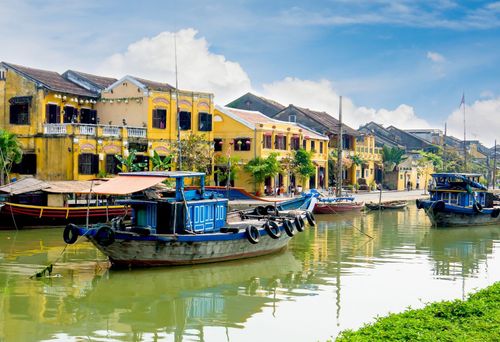
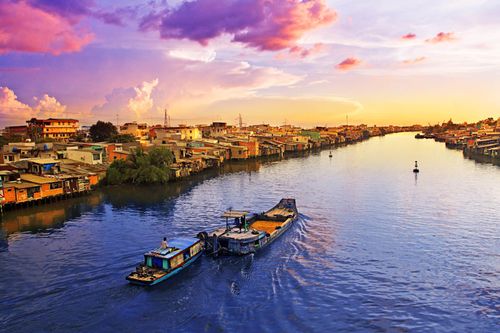
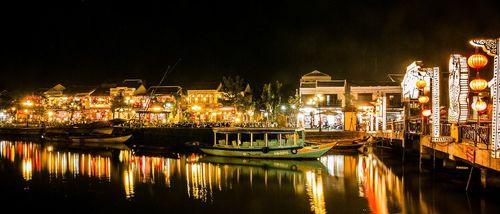
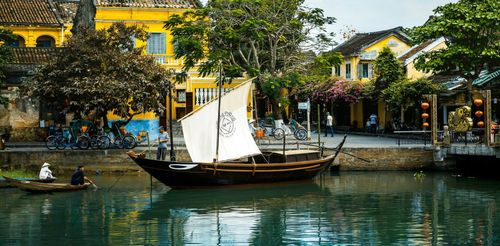
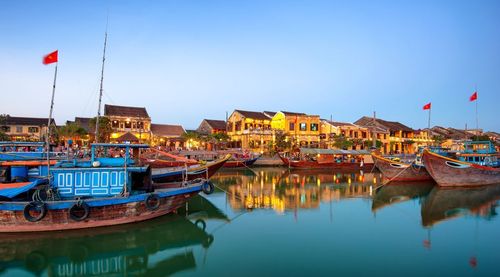
Top image: Traditional boats in front of ancient architecture in Hoi An, Vietnam © Romas_Photo/Shutterstock

 (1).jpg)