What to see near Hanoi
Hanoi, somewhat unjustly, remains less popular than Ho Chi Minh City as a jumping-off point for touring Vietnam, with many making the journey from south to north. Nevertheless, there are still plenty of things to see around Hanoi and it provides a convenient base for excursions to Ha Long Bay, and to Sa Pa and the northern mountains, where you’ll be able to get away from the tourist hordes and sample life in rural Vietnam.
Around Hanoi
When you’ve taken in Hanoi’s main sights, there are plenty more places waiting to be explored in the surrounding area, including the cave-shrine of the Perfume Pagoda, which is one of the country’s most sacred locations. There are dozens of other historic buildings, of which the most strongly atmospheric are the Thay Pagoda and Tay Phuong Pagoda, both buried deep in the delta and fine examples of traditional Vietnamese architecture. You could also spend months exploring the delta’s villages – in particular, the craft villages, which retain their traditions despite a constant stream of tourists passing through. The Ho Chi Minh Trail Museum, southwest of the centre, is also well worth a visit, especially if you’re heading out of town on Highway 6, for example to Mai Chau. Finally, the ancient citadel of Co Loa, just north of the Red River, merits a stop in passing, mostly on account of its historical significance since there’s little to recall its former grandeur.
Perfume Pagoda Hanoi
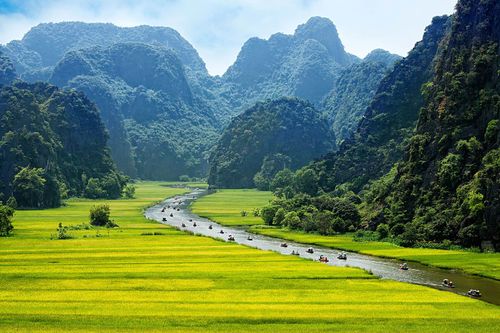
The cave-shrine of the Perfume Pagoda complex is one of the country’s most sacred locations. To the southwest of Hanoi, steep-sided limestone hills rise from the paddy fields. The most easterly of these forested spurs – known as Nui Huong Tich (the “Mountain of the Perfumed Traces”) – shelters north Vietnam’s most famous pilgrimage site, the Perfume Pagoda (Chua Huong), which is named after the spring blossoms that scent the air. You can get to perfume pagoda by boat which makes for a great day trip.
The Perfume Pagoda
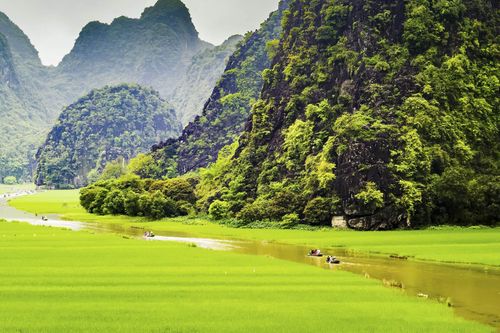
Sixty kilometres southwest of Hanoi, the Red River Delta ends abruptly where steep-sided limestone hills rise from the paddy fields. The most easterly of these forested spurs shelters north Vietnam’s most famous pilgrimage site, the Perfume Pagoda, Chua Huong, hidden in the folds of Ha Tay Province’s Mountain of the Perfumed Traces, and said to be named after spring blossoms that scent the air.
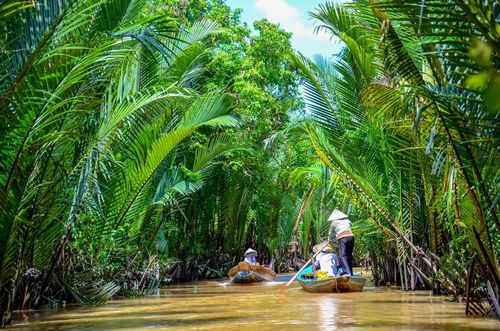
The Perfume Pagoda, one of more than thirty peppering these hills, occupies a spectacular grotto over 50m high. The start of the journey is an hour’s ride by row-boat up a silent, flooded valley among karst hills where fishermen and farmers work their inundated fields. From where the boat drops you (memorize your boat’s number as there are hundreds of identical craft here), a stone-flagged path shaded by gnarled frangipani trees brings you to the seventeenth-century Chua Thien Chu.
Each year, thousands of pilgrims across Vietnam travel to the Perfume Pagoda to partake in the religious festival known as Huong Pagoda Festival. It is believed that the sacred site enriches spirituality and empowers people to stay balanced and relaxed. The festival, which sees the pathway lined with colourful garlands, candles and gold, last for 3 months in accordance to the Lunar calendar and is one of the biggest religious festivals in Vietnam.
How to get to the Perfume Pagoda from Hanoi
To get to The Perfume Pagoda is quite a task, although a pleasant one. First, you must travel from Hanoi to My Duc, where you will then take a boat ride through scenic waterways lead by local people from the village. There are many tours that will assist you to the Perfume Pagoda that cover everything from transport from getting there to being guided through the temple.
Note that respectful attire – meaning long trousers, skirts below the knee and no sleeveless tops – should be worn for this trip; nobody will berate you for not doing so, but you might be the subject of unflattering comments. A hat or umbrella is also a help, as the boats have no shelter.
Path to the Perfume Pagoda
To the right of the Chua Thien Chu as you face it, a path leads steeply uphill for two kilometres (about 1hr) to the Perfume Pagoda, also dedicated to Quan Am. It is a hot and not particularly interesting walk up the mountain or a quick but expensive ride on the cable car.
Note that the hike is hard going and can be highly treacherous on the descent during wet weather; you’ll need good walking shoes and remember to drink plenty of water, especially in the hot summer months. It’s a good idea to bring your own, or be prepared to pay above the odds at drinks stalls along the route. During festival time, the path is lined all the way with stalls selling tacky souvenirs and refreshments, giving the place more of a commercial than a spiritual atmosphere.
Chua Thien Chu
A magnificent, triple-roofed bell pavilion stands in front of the Chua Thien Chu, (“Pagoda Leading to Heaven”). Quan Am, Goddess of Mercy, takes pride of place on the pagoda’s main altar; the original bronze effigy was stolen by Tay Son rebels in the 1770s and some say they melted it down for cannonballs.
The Grotto
The grotto reveals itself as a gaping cavern on the side of a deep depression filled with vines and trees reaching for light beneath the inscription “supreme cave under the southern sky”. A flight of 120 steps descends into the dragon’s-mouth-like entrance where gilded Buddhas emerge from dark recesses wreathed in clouds of incense that are lit as an offering by Vietnamese visitors.
Tay Phuong Pagoda
The small “Pagoda of the West”, Tay Phuong Pagoda, perches atop a 50m-high limestone hillock supposedly shaped like a buffalo. Among the first pagodas built in Vietnam, Tay Phuong’s overriding attraction is its invaluable collection of jackfruit wood statues, some of which are on view at Hanoi’s Fine Arts Museum. As Tay Phuong is also an important Confucian sanctuary, disciples of the sage are included on the altar, each carrying a gift to their master, some precious object, a book or a symbol of longevity, alongside the expected Buddha effigies.
Tram Gian Pagoda
With time to spare, you could combine a day’s outing to the Thay and Tay Phuong pagodas with a quick detour to the Tram Gian Pagoda. Again, the large, peaceful temple sitting on a wooded hill is best known for its rich array of statues. Though not as fine as those of Tay Phuong, they are numerous, including more arhats in the side corridors, alongside some toe-curling depictions of the underworld, and an impressive group on the main altar.
Ho Chi Minh Trail Museum
While this museum is not really worth making a special trip to see, with a bit of forethought it can be combined with visits to the Perfume Pagoda, the Tram Gian or Tay Phuong Pagodas, or on the way to Mai Chau. Once you’re here, there’s much to learn, including the fact that the Ho Chi Minh Trail was never a single trail but a complex network of muddy tracks that crisscrossed the border with Laos and Cambodia.
Co Loa Citadel Hanoi
The earliest independent Vietnamese states grew up on the Red River flood plain, atop low hills or crouched behind sturdy embankments. First to emerge from the mists of legend was Van Lang, presided over by the Hung kings from a knob of high ground marked today by a few dynastic temples north of Viet Tri (Vinh Phu province), known as the Hung Kings Temple. Then the action moved closer to Hanoi when King An Duong Vuong defeated the last of the Hung kings and ruled Au Lac (258–207 BC) from an immense citadel at Co Loa (Old Snail City). At the time it was the first fortified Vietnamese capital, but these days the once massive earthworks are barely visible and all that remains are a couple of quiet temples with interesting histories set amid the streets of modern Co Loa.
Co Loa Temple Complex
The Co Loa Temple Complex forms part of the Citadel of the same name. The principal temple, Den An Duong Vuong, faces a refurbished lake, with a graceful stele-house to one side. Inside the rebuilt temple, a sixteenth-century black-bronze statue of the king resides on the main altar, resplendent in his double crown, while a subsidiary altar is dedicated to Kim Quy, the Golden Turtle.
More interesting, however, is the second group of buildings, 100m north of the archer, where a large, walled courtyard contains a beautifully simple open-sided hall, furnished with huge, ironwood pillars, and containing some of the archaeological finds. Next door is the princess’s small temple, Den My Chau. Sadly, it’s all new concrete, but inside she is still honoured in the surprising form of a dumpy, armchair-shaped stone clothed in embroidered finery and covered in jewels but lacking a head.
History of the Co Loa Citadel
The earliest independent Vietnamese states grew up in the Red River flood plain, atop low hills or crouched behind sturdy embankments. First, to emerge from the mists of legend was Van Lang, presided over by the Hung kings from a knob of high ground marked today by a few dynastic temples north of Viet Tri (Vinh Phu Province). Then the action moved closer to Hanoi when King An Duong ruled Au Lac (258–207 BC) from an immense citadel at Co Loa (Old Snail City). These days the once-massive earthworks are barely visible and it’s really only worth stopping off here in passing, to take a look at a couple of quiet temples with an interesting history.
King An Duong built his citadel inside three concentric ramparts, spiralling like a snail shell, separated by moats large enough for ships to navigate; the outer wall was 8km long, 6–8m wide and at least 4m high, topped off with bamboo fencing. After the Chinese invaded in the late second century BC, Co Loa was abandoned until 939 AD, when Ngo Quyen established the next period of independent rule from the same heavily symbolic site.
Archaeologists have found rich pickings at Co Loa, including thousands of iron arrowheads, displayed here and in Hanoi’s History Museum, which lend credence to at least one of the Au Lac legends. The story goes that the sacred Golden Turtle gave King An Duong a magic crossbow made from a claw that fired thousands of arrows at a time. A deceitful Chinese prince married An Duong’s daughter, Princess My Chau, persuaded her to show him the crossbow and then stole the claw before mounting an invasion. King An Duong and his daughter were forced to flee, whereupon My Chau understood her act of betrayal and nobly told her father to kill her. When the king beheaded his daughter and threw her body in a well, she turned into lustrous, pink pearls.
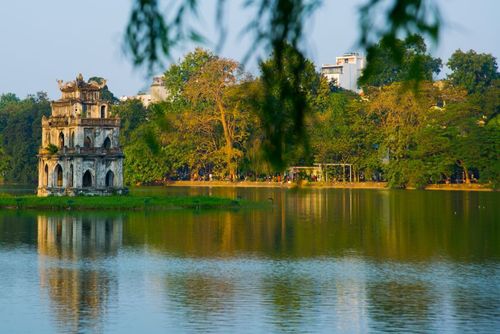
Top image: Red Bridge- The Huc Bridge in Hoan Kiem Lake, Hanoi © Tony Duy/Shutterstock

 Travel Expert



 (1).jpg)