Phuket town
Though it has plenty of hotels and restaurants, PHUKET TOWN (Muang Phuket) stands distinct from the tailor-made tourist settlements along the beaches as a place of tangible history and culture. Most visitors hang about just long enough to jump on a beach-bound songthaew, but you may find yourself returning for a welcome dose of real life; there’s plenty to engage you in a stroll through the small but atmospherically restored heart of the Old Town, along with many idiosyncratic cafés and art shops, several notable restaurants and some good handicraft shops. The town works well as an overnight transit point between the islands and the bus station or airport, but is also worth considering as a base for exploring the island, with more interesting and affordable accommodation, eating and drinking options than the beaches, but linked to them by regular songthaews.
Thinking of travelling to Phuket? Start planning by learning about how to get to Thailand.
Phuket Town Sino-Portuguese architecture
As Chinese immigrant merchants got rich on tin-mining profits so they started building homes. Though the very richest commissioned enormous mansions, a number of which survive in Phuket town today, the vast majority bought themselves eminently practical terraced shophouses at the heart of the merchant district. Phuket’s Old Town retains south Thailand’s finest examples, some of which are open to the public, but there are also intact, if less well-conserved, shophouse neighbourhoods in many other southern cities, including Ranong and Takua Pa.
Shophouse design followed a standard prototype favoured by the mixed-race Chinese–Malay (“Baba”, or “Straits Chinese”) immigrants from Melaka and other parts of the Malay Peninsula. It’s a style now widely dubbed Sino-Portuguese because Melakan architecture of the time was itself strongly influenced by the territory’s Portuguese former colonists, though it also incorporates traits from Dutch and Anglo-Indian colonial architecture. Although some features have evolved with changing fashions the basic look is still recognizably mid-nineteenth century.
Because streetside space was at a premium, shophouses were always long and thin, with narrow frontages, recessed entrances and connecting porches that linked up all the way down the block to make shady, arched colonnades known as five-foot walkways, ideal for pedestrians and shoppers. The front room was (and often still is) the business premises, leaving the rest of the two- or three-storey building for living. A light well behind the front room encouraged natural ventilation and sometimes fed a small courtyard garden at its base, and the household shrine would always occupy a prominent and auspicious position. Outside, the hallmark features that make the neighbourhoods so striking today include pastel-painted louvred windows that might be arched or rectangular and perhaps topped by a pretty glass fantail, lacquered and inlaid wooden doors, fancy gold-leaf fretwork, detailed stucco mouldings and perhaps Neoclassical pilasters.
Ngan Kin Jeh: the Vegetarian Festival
For nine days, usually in October or November, at the start of the ninth lunar month, the celebrations for Ngan Kin Jeh – the Vegetarian Festival – set the streets of Phuket buzzing with processions, theatre shows and food stalls, culminating in the unnerving spectacle of men and women parading about with steel rods through their cheeks and tongues. The festival marks the beginning of Taoist Lent, a month-long period of purification observed by devout Chinese all over the world, but celebrated most ostentatiously in Phuket, by devotees of the island’s five Chinese temples. After six days’ abstention from meat (hence the festival’s name), alcohol and sex, the white-clad worshippers flock to their local temple, where drum rhythms help induce a trance state in which they become possessed by spirits. As proof of their new-found transcendence of the physical world they skewer themselves with any available sharp instrument – fishing rods and car wing-mirrors have done service in the past – before walking over red-hot coals or up ladders of swords as further testament to their otherworldliness. In the meantime there’s singing and dancing and almost continuous firework displays, with the grandest festivities held at Wat Jui Tui on Thanon Ranong in Phuket town.
The ceremony dates back to the mid-nineteenth century, when a travelling Chinese opera company turned up on the island to entertain emigrant Chinese working in the tin mines. They had been there almost a year when suddenly the whole troupe – together with a number of the miners – came down with a life-endangering fever. Realizing that they’d neglected their gods, the actors performed elaborate rites and kept to a vegetarian diet, and most were soon cured. The festival has been held ever since, though the self-mortification rites are a later modification, possibly of Hindu origin.
Diving and snorkelling off Phuket
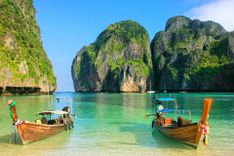
The reefs and islands within sailing distance of Phuket rate among the most spectacular in the world, and diving and snorkelling trips are both good value and hugely popular.
For couples planning a Thailand honeymoon trip, these boat excursions can be one of the most memorable ways to experience the Andaman Sea.
Many trips operate year-round, though some of the more remote islands and reefs become too dangerous to reach during part or all of the monsoon season, roughly June to October.
Andaman coast dive and snorkel sites
Anemone Reef
About 22km east of Phuket. Submerged reef of soft coral and sea anemones starting about 5m deep. Lots of fish, including leopard sharks, tuna and barracuda. Usually combined with a dive at nearby Shark Point. Unsuitable for snorkellers.
Burma Banks
About 250km northwest of Phuket; only accessible on live-aboards. A series of submerged “banks”, well away from any landmass and very close to the Burmese border. Only worth the trip for its sharks. Visibility up to 25m.
Hin Daeng and Hin Muang
56km southwest of Ko Lanta. Hin Daeng is an exceptional reef wall, named after the red soft corals that cover the rocks, with visibility up to 30m. One hundred metres away, Hin Muang also drops to 50m and is good for stingrays, manta rays, whale sharks and silvertip sharks. Visibility up to 50m. Because of the depth and the current, both places are considered too risky for novice divers who have logged fewer than twenty dives. Unsuitable for snorkellers.
King Cruiser
Near Shark Point, between Phuket and Ko Phi Phi. Dubbed the Thai Tanic, this became a wreck dive in May 1997, when a tourist ferry sank on its way to Ko Phi Phi. Visibility up to 20m, but hopeless for snorkellers because of the depth, and collapsed sections make it dangerous for any but the most experienced divers.
Ko Phi Phi
48km east of Phuket’s Ao Chalong. Visibility up to 30m. The most popular destination for Phuket divers and snorkellers. Spectacular drop-offs; good chance of seeing whale sharks.
Ko Racha Noi and Ko Racha Yai
About 33km and 28km south of Phuket’s Ao Chalong respectively. Visibility up to 40m. Racha Yai (aka Raya Yai) is good for beginners and for snorkellers; at the more challenging Racha Noi there’s a good chance of seeing manta rays, eagle rays and whale sharks.
Ko Rok Nok and Ko Rok Nai
100km southeast of Phuket, south of Ko Lanta. Visibility up to 18m. Shallow reefs that are excellent for snorkelling.
Ko Similan
96km northwest of Phuket; easiest access from Khao Lak. One of the world’s top diving spots. Visibility up to 30m. Leopard sharks, whale sharks and manta rays, plus caves and gorges.
Ko Surin
174km northwest of Phuket; easiest access from Khuraburi. Shallow reefs of soft and hard corals that are good for snorkelling.
Richelieu Rock
Just east of Ko Surin, close to Burmese waters. A sunken pinnacle that’s famous for its whale sharks. Considered by many to be Thailand‘s top dive spot.
Shark Point (Hin Mu Sang)
24km east of Phuket’s Laem Panwa. Protected as a marine sanctuary. Visibility up to 10m. Notable for soft corals, sea fans and leopard sharks. Often combined with the King Cruiser dive and/or Anemone Reef; unrewarding for snorkellers.
Phuket day-trips and other activities
Bookings for most of the following Phuket day-trips and activities can be made through any tour agent and should include return transport from your hotel (though not for the cooking classes). In addition to the trips listed below, diving is also available (see Diving and snorkelling off Phuket). Other sights worth checking out, especially for kids, include the Phuket Butterfly Garden and Insect World in Phuket town, the Aquarium on Laem Panwa, the Shell Museum in Rawai, the Big Buddha near Chalong and the Gibbon Rehabilitation Project near Thalang. Avoid any tour that features Ko Siray (Ko Sireh), the island across the narrow channel from Phuket town, which merely encourages tour-bus passengers to gawp at Phuket’s largest and longest-established indigenous chao ley community.
Bicycle touring
Full- and half-day guided mountain-bike rides into Phuket’s rural hinterlands and to Ko Yao Noi, as well as multi-day rides around Phang Nga Bay, with Action Holidays Phuket.
Elephant trekking
Award-winning, conservation-conscious Siam Safari runs Four-in-One tours featuring their hillside elephant camp plus rubber tapping, buffalo-cart riding and a sail on a Burmese junk; tours to Khao Sok National Park are also on offer.
Kiteboarding
One- and three-day courses at Hat Nai Yang and Ao Chalong (depending on the season) are offered by Kiteboarding Asia.
Mini-golf
If you just need a little time off from the beach, head for the eighteen-hole Dino Park mini-golf, next to Marina Phuket Resort on the headland between Ao Karon and Ao Kata, which is part of a pseudo-prehistoric theme park comprising a dinosaur restaurant and an erupting “volcano” (evenings only).
Sea-canoeing
There are dozens of companies offering canoeing and kayaking in Phuket, but the two with the best reputations are John Gray’s Sea Canoe, who offer “Starlight” afternoon and evening trips around the spectacular limestone karsts of Ao Phang Nga, as well as multi-day and self-paddle trips; and Paddle Asia, who run day-trips to Ao Phang Nga and multi-day trips, which can include Khao Sok National Park and other adventure activities.
Surfing
The rainy season (roughly May–Oct) is the best time for surfing off Phuket’s west coast; courses and board rental are available from Phuket Surf on Ao Kata Yai.
Thai cookery courses
Most famously, every Sat and Sun morning at The Boathouse hotel on Ao Kata Yai; but also at the Holiday Inn Phuket, 86/11 Thanon Thavee Wong, Patong; and the Blue Elephant Restaurant, 96 Thanon Krabi, Phuket town.
Thai culture and wildlife tours
Plan to Phuket run a number of tours, including full-day “Culture Tours” that include market and temple visits, batik-making and rubber production; and “Jungle Tours” to Ton Sai waterfall and the Gibbon Rehabilitation project; or a combination of both.