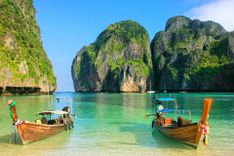
Ao Phang Nga
Protected from the ravages of the Andaman Sea by Phuket, AO PHANG NGA has a seascape both bizarre and beautiful. Covering some four hundred square kilometres of coast between Phuket and Krabi, the mangrove-edged bay is spiked with limestone karst formations up to 300m in height, jungle-clad and craggily profiled. This is Thailand’s own version of Vietnam’s world-famous Ha Long Bay, reminiscent too of Guilin’s scenery in China, and much of it is now preserved as national park. The bay is thought to have been formed about twelve thousand years ago when a dramatic rise in sea level flooded the summits of mountain ranges, which over millions of years had been eroded by an acidic mixture of atmospheric carbon dioxide and rainwater. Some of these karst islands have been further eroded in such a way that they are now hollow, hiding secret lagoons or hongs that can only be accessed at certain tides and only by kayak. The main hong islands are in the western and eastern bay areas – to the west or east of Ko Yao Noi, which sits roughly midway between Phuket and Krabi. But the most famous scenery is in the central bay area, which boasts the biggest concentration of karst islands, and the weirdest rock formations.
The hongs
Hongs are the pièce de résistance of Ao Phang Nga: invisible to any passing vessel, these secret tidal lagoons are enclosed within the core of seemingly impenetrable limestone outcrops, accessible via murky tunnels that can only be navigated at certain tides in kayaks small enough to slip beneath and between low-lying rocky overhangs. Like the karsts themselves, the hongs have taken millions of years to form, with the softer limestone hollowed out from above by the wind and the rain, and from the side by the pounding waves. Eventually, when the two hollows met, the heart of the karst was able to fill with water via the wave-eroded passageway at sea level, creating a lagoon. The world inside these roofless hollows is an extraordinary one, protected from the open bay by a ring of cliff faces hung with vertiginous prehistoric-looking gardens of upside-down cycads, twisted bonsai palms and tangled ferns. And as the tide withdraws, the hong’s resident creatures emerge to forage on the muddy floor, among them fiddler crabs, mudskippers, dusky langurs and crab-eating macaques, with white-bellied sea eagles often hovering overhead.
Phang Nga town
Friendly if unexciting little PHANG NGA TOWN, beautifully located under looming limestone cliffs edged with palm groves midway between Phuket and Krabi, serves mainly as a point from which to organize budget longtail trips around the spectacular karst islands of Ao Phang Nga. But there are also several caves and waterfalls nearby, accessible on cheap tours run by Phang Nga tour operators.
Tours from Phang Nga town
Ao Phang Nga
The most popular budget tours of Ao Phang Nga are the longtail-boat trips run by tour operators based inside Phang Nga bus station. Competition between these outfits is fierce and the itineraries they offer are almost identical, so it’s best to get recommendations from other tourists fresh from a bay trip, especially as reputations fluctuate with every change of staff. To date the one that’s remained most constant is Mr Kean Tour; next door but one is Sayan Tour. Both offer half-day tours of the bay costing B500 per person (including national park fee; minimum four people), as well as full-day trips, which cost B800, including lunch and national park fee; take the 8.30am tour to avoid seeing the bay at its most crowded. All tours include a chance to swim in the bay, and most offer the option of an hour’s canoeing around Ko Thalu as well, for an extra B350.
All tour operators also offer the chance to stay overnight at their own guesthouse on Ko Panyi. Mr Kean can also sometimes offer (dependent on the tides) an interesting alternative overnight programme on his home island of Ban Mai Phai, a much less commercial version of Ko Panyi, with the chance to trek, cycle and kayak.
Local sights around Phang Nga town
Mr Kean can arrange trips to Tham Phung Chang, or Elephant Belly Cave, a natural 1200m-long tunnel through the massive 800m-high wooded cliff that towers over the Provincial Hall, about 4km west of the town centre. With a bit of imagination, the cliff’s outline resembles a kneeling elephant, and the hollow interior is, of course, its belly. You can travel through the elephant’s belly to the other side of the cliff and back on a two-hour excursion that involves wading, rafting and canoeing along the freshwater stream, Khlong Tham, that has eroded the channel.
Mr Kean also offers tours that take in several other local caves, plus Sa Nang Manora Forest Park, which has hiking trails through thick, impressive rainforest and several waterfalls with swimmable pools, 9km north of the town centre.
Laem Phra Nang: Railay and Ton Sai
Seen from the close quarters of a longtail boat, the combination of sheer limestone cliffs, pure white sand and emerald waters around the LAEM PHRA NANG peninsula is spectacular – and would be even more so without the hundreds of other admirers gathered on its four beaches. The peninsula (often known simply as Railay) is effectively a tiny island, embraced by impenetrable limestone massifs that make road access impossible – but do offer excellent, world-famous rock-climbing; transport is by boat only, from Krabi town or, most commonly, from nearby Ao Nang. It has four beaches within ten minutes’ walk of each other: Ao Phra Nang graces the southwestern edge, and is flanked by East and West Railay, just 500m apart; Ao Ton Sai is beyond West Railay, on the other side of a rocky promontory. Almost every patch of buildable land fronting East and West Railay has been taken over by bungalow resorts, and development is creeping up the cliffsides and into the forest behind. But at least high-rises don’t feature, and much of the construction is hidden among trees or set amid prettily landscaped gardens. Accommodation is at a premium and not cheap, so the scene on West and East Railay, and Ao Phra Nang, is predominantly holidaymakers on short breaks rather than backpackers. The opposite is true on adjacent Ao Ton Sai, Krabi’s main travellers’ hub and the heart of the rock-climbing scene.
West Railay
The loveliest and most popular beach on the cape is WEST RAILAY, with its gorgeous white sand, crystal-clear water and impressive karst scenery at every turn. The best of the peninsula’s bungalow hotels front this shoreline, and longtail boats from Ao Nang pull in here too, so it gets crowded.
East Railay
Follow any of the tracks inland, through the resort developments, and within a few minutes you reach EAST RAILAY on the other coast, lined with mangrove swamps and a muddy shore that make it unsuitable for swimming; boats from Krabi town dock here. Accommodation on this side is a bit cheaper, and there’s more variety in price too, though – aside from a couple of gems – it’s mostly an uncomfortable mix of uninspired, low-grade developments and unsubtle bars with names like Skunk and Stone. Depressingly, much of East Railay’s hinterland is despoiled by trash and building rubble, but inland it’s another story, with a majestic amphitheatre of forested karst turrets just ten minutes’ walk away, on the back route to Ao Ton Sai.
Rock-climbing and kayaking on Laem Phra Nang
Ton Sai and Railay are Thailand’s biggest rock-climbing centres, attracting thousands of experienced and novice climbers every year to the peninsula’s seven hundred bolted routes, which range in difficulty from 5a to 8c (see wrailay.com for a full rundown). Of the many climbing schools that rent out equipment and lead guided climbs, the most established include King Climbers at Ya Ya Resort on East Railay and Basecamp Tonsai on Ton Sai. A typical half-day introduction costs B1000, a full day B1800, while B6000 will get you a three-day course, learning all rope skills; equipment can be rented for about B1300 per day for two people. If you don’t need instruction, the locally published and regularly updated guidebooks, Basecamp Tonsai’s Rock Climbing in Thailand and Laos and King Climbers’ Thailand Route Guide Book, will give you all the route information you need. Unaided over-water climbing on cliffs and outcrops out at sea, known as deep-water soloing, with no ropes, bolts or partner, is also becoming a big thing around here and can be arranged through most climbing schools for about B1000.
Kayaking around this area is also very rewarding – you can get to Ao Nang in less than an hour; kayaks cost B200 per hour to rent, for example on the beach in front of Flame Tree restaurant on West Railay. There are plenty of other activities in the Krabi area that you could hook up with from Laem Phra Nang.
Ko Jum
Situated halfway between Krabi and Ko Lanta Yai, KO JUM (whose northern half is known as Ko Pu) is the sort of laidback spot that people come to for a couple of days, then can’t bring themselves to leave. Though there’s plenty of accommodation on the island, there’s nothing more than a handful of beach bars for evening entertainment, and little to do during the day except try out the half-dozen west-coast beaches. The beaches may not be pristine, and are in some places unswimmably rocky at low tide, but they’re mostly long and wild, and all but empty of people. Nights are also low-key: it’s paraffin lamps and starlight after about 11pm (or earlier) at those places that are off the main grid, and many don’t even provide fans as island breezes are sufficiently cooling.
The island is home to around three thousand people, the majority of them Muslim, though there are also communities of chao ley sea gypsies on Ko Jum, as well as Buddhists. The main village is Ban Ko Jum, on the island’s southeastern tip, comprising a few local shops and small restaurants, one of the island’s three piers for boats to and from Laem Kruat on the mainland, and a beachfront school. It’s about 1km from the village to the southern end of the island’s most popular beach, the appropriately named Long Beach. Long Beach is connected to Golden Pearl Beach, which sits just south of Ban Ting Rai, the middle-island village that’s about halfway down the west coast. North of Ban Ting Rai, a trio of smaller, increasingly remote beaches at Ao Si, Ao Ting Rai, and Ao Luboa complete the picture. The island’s third village, Ban Ko Pu, occupies the northeastern tip, about 5km beyond Ban Ting Rai, and has another Laem Kruat ferry pier. Many islanders refer to the north of the island, from Ban Ting Rai upwards, as Ko Pu, and define only the south as Ko Jum. Much of the north is made inaccessible by the breastbone of forested hills, whose highest peak (422m) is Khao Ko Pu.
Very high winds and heavy seas mean that Ko Jum becomes an acquired taste from May through October, so nearly all accommodation and restaurants close for that period: the few exceptions are highlighted in the text.
Activities on Ko Jum
Most bungalows can organize day-trips, as will tour agencies in Ban Ko Jum, for example to Ko Phi Phi, Bamboo Island and Mosquito Island (about B3500–4000 per boat), or around Ko Jum (B2500 per boat). Many offer guided hikes up Khao Ko Pu (about B1000, including lunch). Ko Jum Divers, at Ko Jum Beach Villas at the north end of Long Beach, run daily dive trips to Ko Phi Phi (B4200), with snorkellers welcome (B2100), and diving courses on offer (Discover Scuba B4900; Openwater B14,900).