Things To Do At Trincomalee
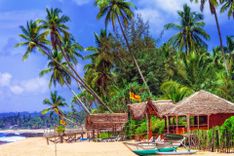
There are not just white sands, wildlife and rock formations to enjoy at Trincomalee but a range of activities and places to see. In the evening laid-back bars line the beach oozing with chill vibes, relax in a hammock and enjoy the sunset after an afternoon snorkelling at Pigeon Island. The beauty of Trincomalee island is that it is full of local life. The people have not changed their way to accommodate tourists making it an ideal location to see the rare and untouched parts of Sri Lanka.
Want to learn even more useful information for your upcoming trip to Sri Lanka? Read our travel tips for travelling to Sri Lanka.
Whale-Watching
Whale-watching is somewhat a hot spot at Trincomalee, with the best times to go being between March and August. Expect to see Blue Whales and Sperm Whales, it is also likely that you will see Dolphins and a range of fish species.
Sri Pathrakali Amman Kovil
This Hindu temple is full of colourful garlands and aromatic incense. Something not to be missed if you love your doses of culture.
Fort Frederik
Fort Frederik was built by the Portuguese back in the day and is now used by the Sri Lankan military. Luckily for you, the old fort is open to visitors and can make an interesting trip. The area is covered by trees providing a shaded haven to escape the midday heat.
Koneswaram Temple
Koneswaram Temple is not just any regular temple as its location makes it special. The views of Trincomalee Bay can be seen here in all its glory. Drink from a coconut and admire the temple and views.
History at Trincomalee
Eastern Sri Lanka’s major town, TRINCOMALEE (or “Trinco”) has been celebrated since antiquity for its superlative deep-water harbour, one of the finest in Asia – the legendary Panduvasudeva is said to have sailed into Trincomalee (or Gokana, as it was originally known) with his followers, while the town served as the major conduit for the island’s seaborne trade during the Anuradhapuran and Polonnaruwan periods. The harbour was later fought over repeatedly during the colonial period and even attracted the hostile attentions of the Japanese air force during World War II.
Trincomalee suffered massively following the onset of the civil war in 1983. Although Trinco avoided the massive bomb damage inflicted on Jaffna, the town’s position close to the front line made it the island’s major collecting point for war-displaced refugees, while tensions between the town’s Tamil, Muslim and Sinhalese communities regularly erupted into communal rioting. Things have been a lot quieter following the expulsion of the LTTE from the east in 2007, and Trinco is now once again looking to the future with renewed, if cautious, optimism.
North of Trincomalee
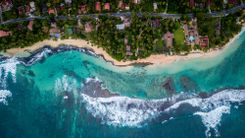
North of Trincomalee the coast is lined with a fine strand of wide golden beach, beginning at the village of Uppuveli and continuing through to Nilaveli and beyond: a superb stretch of coast whose enormous tourist potential has as yet barely even been scratched – which is a large part of its appeal. Both Uppuveli and Nilaveli were saved from development during the civil war by their position close to the front line, and have little changed since – although a handful of courageous local entrepreneurs continue to plug away against the odds, sustained by a steady stream of NGOs on weekend jollies. Both places remain extremely low-key even during the season from May to September, and at other times of the year are usually more or less comatose.
Nilaveli
Some 10km north of Uppuveli, the straggling settlement of NILAVELI is home to another fine stretch of largely deserted beach, though the village has yet to recover from the twin effects of war and tsunami and the whole place still feels moribund, at least apart from the attractive Nilaveli Beach Hotel, the area’s major – indeed only – landmark, and one of the east coast’s most attractive boltholes.
Uppuveli
Just a few kilometres north of Trinco, the low-key village of UPPUVELI is little more than a modest cluster of guesthouses, a couple of hotels, a few fishing boats, and a great many palm trees. Uppuveli’s guesthouses managed to eke out a tenuous existence during the war years, while the village was lucky enough to escape the widespread destruction wrought by the tsunami on nearby Nilaveli thanks to its sheltered position behind Trincomalee’s Swami Rock. The long-anticipated postwar resurgence has yet to be felt here, however, and although the village has a little more life than Nilaveli further down the coast, the atmosphere remains deeply somnolent.
Whale-watching around Trincomalee
Following the recent development of whale-watching tours in Mirissa, Trincomalee is rapidly emerging as another internationally important whale-watching destination. Blue whales in particular (plus smaller numbers of sperm whales) can regularly be seen around six to eight nautical miles east of Trincomalee (about 30min by boat), and can even occasionally be spotted from the land – with Swami Rock offering the best vantage point. Dolphins (mainly Spinner) are also regularly seen. Most sightings occur between March/April and August/September, as whales continue their migrations around the island from the south coast (where they mainly congregate from December to April) – this means that Sri Lanka offers around ten months of continuous whale-watching annually at different points around the coast.
South of Trincomalee
The stretch of coastline between Trincomalee and Batticaloa remains one of the poorest and least-developed in Sri Lanka – until 2007 much of this area was controlled by the LTTE – although things are once again looking up, at least if the burgeoning development at Passekudah is anything to go by. The A15 highway runs the length of the coast, though it’s in poor condition between Trinco and Mutur and is punctuated by several river crossings where vehicles are carried over by ferry – buses from Trincomalee to Batticaloa make the long detour inland via Habarana.
Passekudah and Kalkudah
Way back in the 1970s and early 1980s, the twin beaches of Passekudah and Kalkudah were the east coast’s most developed tourist destinations, home to a modest cluster of resort hotels and drawing a steady string of European tourists to this far-flung corner of the island. All that ended following the outbreak of war. The hotels were first abandoned, and subsequently blown up by the LTTE to prevent them being used by the Sri Lankan Army – their ghostly skeletons remained, until quite recently, standing sentry over the deserted beaches.
Now the area is on the cusp of a second, and even more dramatic coming, earmarked as a special tourist development zone and already in the throes of enormous development. The formerly deserted arc of PASSEKUDAH BAY is now ringed with the concrete skeletons of no fewer than thirteen new hotels under construction (along with the already completed Maalu Maalu resort) which are likely to transform this sleepy village into the east coast’s answer to Beruwala within just a couple of years. By contrast, neighbouring KALKUDAH BAY remains mercifully unchanged, so far at least, with a superb sweep of powder-fine golden sand – blissfully deserted and unspoilt, although a couple of plots of land have already been fenced off for future development, suggesting that Kalkudah’s days as a sleepy backwater are also numbered. See it while you can.
Batticaloa
The principal east-coast settlement south of Trincomalee, BATTICALOA (often shortened to “Batti”) is one of Sri Lanka’s most appealing but least-known larger towns, mainly thanks to its long years of isolation and turbulence during the civil war. Throughout the conflict, the town and surrounding area was a major flashpoint between LTTE and Sri Lankan Army forces, with the army controlling the town and the LTTE running their own parallel administration – complete with courts, police force and tax collectors – from the village of Kokkadicholai, a short drive south. As Indian journalist Nirupama Subramanian put it in Sri Lanka: Voices from a War Zone: “Technically, Batticaloa town came under the government … That was by day. By night, the town took orders from the Tigers.”
The LTTE are now gone, although intriguing reminders of Batti’s long colonial history can still be seen, while the mercantile hustle and bustle of the main commercial areas suggests a town now increasingly on the mend. The town’s setting is also magical, perched on a narrow sliver of land backed by the serpentine Batticaloa Lagoon and surrounded by water on three sides, with the constantly shifting views of land, lagoon and ocean lending Batticaloa an interesting – if disorienting – character.
Brief history
Historically, Batticaloa is best known as the site of the first landing (in 1602) by the Dutch in Sri Lanka, and as the place where they established their first lasting foothold on the island by seizing the local fort from the resident Portuguese in 1638 (colonial influence lives on in the town’s name, which appears to be a Portuguese corruption of the Sinhalese Mudda Kalapuwa, meaning “muddy lagoon”). Many Muslims also settled in the area under the protection of the kings of Kandy during the same period to escape Portuguese persecution elsewhere, mixing with the region’s largely Tamil population.
Batticaloa and the surrounding area was a major LTTE stronghold throughout the civil war, and perhaps one of the most dangerous places in the island, for civilians at least, over a thousand of whom were killed in or around Batti in the late 1980s and early 1990s. Two of the war’s most gruesome events occurred close to the city. The first, in August 1990, when almost 150 Muslims were massacred by the LTTE in a mosque at Kattankudi (just south of town); the second, just a month later, when more than 180 Tamil civilians (including 47 children under the age of 10) were slaughtered by the Sri Lankan Army in three nearby villages. Towards the end of the war, the region was also wracked by clashes between rival factions of the LTTE, as Colonel Karuna launched his breakaway movement. Widespread disappearances of civilians by the Sri Lankan security services continued to be reported even after the end of fighting in the east in 2007.
The singing fish of Batticaloa
Batti is famous in Sri Lankan folklore for its singing fish. According to tradition, between April and September a strange noise – described variously as resembling a plucked guitar or violin string, or the sound produced by rubbing a wet finger around the rim of a glass – can be heard issuing from the depths of the lagoon. The “singing” is allegedly strongest on full moon nights, though no one knows exactly what causes it. The most popular explanation is that it’s produced by some form of marine life – anything from catfish to mussels – while another theory states that it’s made by water flowing between boulders on the lagoon floor. The best way to listen to the singing is apparently to dip one end of an oar in the water and hold the other end to your ear. Kallady Bridge is traditionally held to be a good place to tune in.
If you're planning a trip to Sri Lanka, don't miss our Sri Lanka itineraries and information on how to get there.
Featured Image, Shiva Statue, Koneshwaram Hindu Temple © erandalx / iStock