Explore Seoul
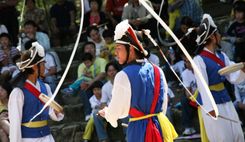
The Korean capital of SEOUL (서울) is an assault on the senses. Even small streets find themselves quite alive with frenzied activity by day and searing neon after sunset, while eardrums are set pounding by clamouring shop assistants and the nighttime thump of a thousand karaoke rooms. Restaurants serving Korea’s delectably spicy national dishes lure you in with their amazing aromas and tastes while doing minimal damage to your figure (or wallet), and for tactile bliss, the hot pools and ice rooms of the ubiquitous jjimjilbang bathhouses have no equal. With over twenty million souls packed sardine-like into a metropolitan area smaller than Luxembourg, this is one of the most densely populated places on the planet, but for all its nonstop consumption, Seoul is also a place of considerable tradition and history. Joseon-dynasty palaces, displayed like medals in the centre of the city, proclaim its status as a seat of regal power from as far back as 1392; the tiled roofs of wooden hanok houses gently fish-scale their way towards the ash-coloured granite crags of Bukhansan, the world’s most-visited national park; the ancient songs and dances of farmhands and court performers are still clashed out in a whirligig of sound and colour along the street of Insadonggil. A city with a hyper-efficient transport system, a negligible crime rate, locals eager to please foreign guests and an almost astonishing wealth of locally produced modern art: it’s little wonder that so many visitors come away so impressed.
Top of most tourists’ agendas are the half-a-dozen sumptuous palaces dating from the late fourteenth century that surround the city centre; these include Gyeongbokgung and Changdeokgung, together with the nearby ancestral shrine of Jongmyo. Situated in the middle is Insadong; by far the most popular part of the city with tourists, its warren of tight streets is littered with traditional restaurants, quaint tearooms, art galleries and trinket shops, and makes for a great wander. Samcheongdong and Bukchon Hanok Village are two areas offering similar delights, though with fewer tourists. The amount of art on display in all three areas can come as quite a surprise – contemporary Korean work receives a fraction of the international press devoted to art from Japan or China, but is just as creative. Also offering a modern-day fusion of Korea old and new are the colossal markets of Dongdaemun and Namdaemun, in whose sprawling reaches you’ll find anything from pig intestines to clip-on ties. The more modern facets of the city can be seen in the shoppers’ paradise of Myeongdong or achingly fashionable Apgujeong, while the number of American soldiers hanging out in cosmopolitan Itaewon hint at Seoul’s proximity to North Korea – it’s even possible to take a day-trip to the border.
To get a sense of what makes Seoul so unique, however, you’ll need to do more than tick off the sights. To truly appreciate the subtle facets of this distinctive society, take a leap of faith into the local cuisine, follow the Korean lead on a wild night (and early morning) out, and spend a decent amount of time simply walking the streets.
Brief history
Contrary to the expectations of many a visitor, Seoul possesses a long and interesting past; after first rising to prominence at the beginning of the Three Kingdoms period, it was then ruled over by almost every major power in Korean history. In 18 AD, then named Wiryeseong, it became the first capital of the Baekje kingdom; the exact location is believed to be a site just east of present-day Seoul, but this was to change several times. The kings and clans were forced far south to Gongju in 475, having been squeezed out by the rival Goguryeo kingdom; less than a century later, the city completed a Three Kingdoms clean-sweep when King Jinheung expanded the domain of his Silla kingdom far to the north, absorbing Seoul – then known as Hanseong – on the way. By 668, Silla forces held control of the whole peninsula, but having chosen Gyeongju as their capital, Seoul faded into the background. In the tenth century, Silla was usurped by the nascent Goryeo kingdom – they chose Kaesong, in modern-day North Korea, as the seat of their power, though Seoul was close enough to become an important trading hub, and soon earned yet another name, Namgyeong, meaning “Southern Capital”.
It was not until the end of the Goryeo dynasty that Seoul really came into its own. In 1392, the “Hermit Kingdom” of Joseon kicked off over five centuries of power; after running the rule over a few prospective candidates, King Taejo – the inaugurator of the dynasty – chose Seoul as his new capital, impressed by its auspicious location. He immediately set about reorganizing the city with a series of major projects. Exactly two hundred years after its birth, Joseon was invaded by Japanese forces from 1592 to 1598 under the control of warlord Hideyoshi; Seoul was pillaged in the course of the battles, and many of its most beautiful buildings lay in ruins. Though the country survived this particular struggle, mainly thanks to the heroic Admiral Yi, the Japanese proved more obdurate on their return in the late nineteenth century. After making tame inroads with a series of trade treaties, an escalating series of events – including the assassination of Queen Min in Gyeongbokgung – culminated in outright annexation of the peninsula in 1910, which lasted until the end of World War II, and closed the long chapters of Korean regal rule. During this time, Japan tried its best to erase any sense of Korean nationality; part of this was a drive to wipe out the Korean language, and earned Seoul yet another name – Keijo, which roughly translates as “Walled-off Capital”. The city was to suffer greater indignity when its beloved palaces were modified in an attempt to make them “more Japanese”; a few of these alterations are still visible today. After the war, peninsular infighting and global shifts in power and ideology resulted in the Korean War (1950–53). Seoul’s position in the centre of the peninsula, as well as its obvious importance as the long-time Korean capital, meant that it changed hands four times, coming under North Korean control twice before being wrested back. Seoul finally ended up under South Korean control, though most of the city lay in ruins, but despite – or perhaps, because of – all these setbacks, there has been no stopping it since then. The economic reforms inaugurated by president Park Chung-hee in the 1970s brought it global attention as a financial dynamo, and Seoul’s population has ballooned to over ten million, more than double this if the whole metropolitan area is taken into account.
Read More-
Building a capital
Building a capital
Rarely can a capital have been built so quickly. On the inauguration of his Joseon kingdom in 1392, the ambitious King Taejo immediately set his minions to work on a truly incredible number of gigantic projects. Even more astonishing is the fact that many of them can still be seen today, albeit in reproduction form, since few original structures survived the Japanese occupation and Korean War.
Gyeongbokgung
Seoul’s first palace completed in 1394.
Jongmyo
the ancestral shrines, built in 1394.
Changdeokgung
Seoul’s second palace, built in 1395.
Namdaemun
the city’s south gate; construction started in 1395.
City walls
built in stages from 1396.
Dongdaemun
the east gate, built in 1396.
-
A banging good time
A banging good time
University areas are a good place to get a grip on the “bang” culture that pervades modern Korean life. The term is a suffix meaning “room”, and is attached to all sorts of places where locals – and occasional foreigners – like to have fun. Below are a few of the most popular:
DVD-bang
Imagine a small room with wipe-clean sofas, tissue paper on hand and a large television for movies – if it sounds a little sleazy, you’d be absolutely right. Though people do occasionally come to appreciate plot, cinematography or Oscar-winning performances, these places are more often used by couples looking for a cheap bit of privacy – going in by yourself, or with a person of the same sex, would draw some baffled looks. Figure on around W11,000 per movie.
Jjimjilbang
Popular with families, teenagers and the occasional budget-minded traveller, these steam rooms have sauna rooms, a range of hot and cold pools, and often services from massage treatments to internet booths. Though they might sound dodgy, the reality is somewhat tamer; most are open all night, making them an incredibly cheap way to get a night’s sleep – prices tend to be around W6000. for more information see Staying at a jjimjilbang.
Noraebang
These “singing rooms”, found all over the country, even outside national park entrances, are wildly popular with people of all ages; if you have Korean friends, they’re bound to invite you, as noraebang are usually sam-cha in a Korean night out – the “third step” after a meal and drinks. You don’t sing in front of a crowd, but in a small room with your friends, where you’ll find sofas, a TV, books full of songs to choose from and a couple of maracas or tambourines to play. Foreigners are usually intimidated at first, but after a few drinks it can be tough to get the microphone out of people’s hands. Figure on around W15,000 per hour between the group.
PC-bang
Even more ubiquitous in Korea are places to get online, which cost an almost uniform W1000 per hour. Despite the prevalence of such places, they’re often packed full of gamers, and incredibly noisy – you’re likely to be the only one sending emails.
-
A real Korean night out
The “proper” Korean night out has long followed the same format, one that entwines food, drink and entertainment. The venue for stage one (il-cha) is the restaurant, where a meal is chased down with copious shots of soju. This is followed by stage two (i-cha), a visit to a bar; here beers are followed with snacks (usually large dishes intended for groups). Those still able to walk then continue to stage three (sam-cha), the entertainment component of the night, which usually involves a trip to a noraebang room for a sing-along, and yet more drinks. Stages four, five and beyond certainly exist, but few participants have ever remembered them clearly.
-
Gay and lesbian Seoul
Seoul’s burgeoning queer nightlife scene has come on in leaps and bounds since 2000, when star actor Hong Seok-cheon came out of the closet – the first Korean celebrity to do so. He has since opened up a whole raft of gay-friendly bars and restaurants in Itaewon, which remains the best gay area for foreigners.
Seoul does have other gay zones; the area around Jongno 3-ga station has long been home to underground gay bars, and recent years have seen the scene becoming more and more open. Unfortunately, few venues are foreigner-friendly, though the Starmoon café attracts all sorts – it’s in the ground floor of the tall Fraser Suites building. Additionally, the university district of Sinchon is popular with the local lesbian community, many of whom congregate of an evening in “Triangle Park”, a patch of concrete near exit 1 of Sinchon subway station (take the first right).
-
Seoul festivals
Seoul festivals
APRIL International Women’s Film Festival wwffis.or.kr
A week-long succession of films that “see the world through women’s eyes” (even if they were created by men).
MAY Hi Seoul Festival whiseoulfest.org
With everything from choreographed firework displays and tea ceremonies to men walking across the Han River by tightrope, this ten-day-long celebration of the coming of summer also incorporates the Seoul World DJ festival.
Late MAY Seoul International Cartoon & Animation Festival wwww.sicaf.org
Koreans are cartoon addicts. While most of the national fix is sated by Japanese fare, there’s still a lot of local talent – The Simpsons, Family Guy and Spongebob Squarepants are among the shows inked and lined here.
JUNE Korean Queer Culture Festival wwww.kqcf.org
Not exactly an event trumpeted by the local tourist authorities – in fact, not so long ago the police were still trying to ban it – this is a great way to see Korea crawling out of its Confucian shell.
JULY Jisan Valley www.valleyrockfestival.com & Pentaport Rock Festivals wpentaportrock.com
Two alcohol-fuelled European-style music festivals (think tents, mud and portaloos) which manage to rope in major international acts, though admittedly ones usually on the wane in their homelands.
AUGUST Seoul Fringe Festival wwww.seoulfringefestival.net
This fortnight-long platform for all things alternative is very popular with local students, and its semi-international nature means it appeals to overseas visitors too. Hongdae is usually the best place to be.
SEPTEMBER/OCTOBER Seoul Performing Arts Festival wwww.spaf.or.kr
This increasingly acclaimed event has seen performances from as far afield as Latvia and Israel, though its main aim is to showcase Korean talent. It takes place in various locations around Seoul over a three-week period.
OCTOBER Drum Festival wwww.seouldrum.go.kr & Fashion Week www.seoulfashionweek.org
The crashes and bangs of all things percussive ring out at the annual drum event, while Fashion Week has become Asia’s largest fashion event since starting in 2000.
-
Accommodation
Accommodation
Seoul has by far the best range of accommodation in the country, with everything from five-star hotels to cheap hostels. Those seeking high-quality accommodation have a wealth of places to choose from, particularly around Myeongdong and City Hall on the north of the river, and Gangnam to the south. At the lower end of the price spectrum are Seoul’s ballooning number of backpacker guesthouses. One interesting option, popular with foreign travellers, is to stay in traditional wooden guesthouses north of Anguk station in the palace district.
At around the same price, though different in character, motels form a cheap alternative to official tourist hotels, sometimes having rooms of comparable size and quality; note that two of the most popular nightlife areas – Itaewon and Hongdae – have a shockingly poor range of motel accommodation. It’s hard to book motels in advance, except for those listed on the excellent Innostel website (winnostel.visitseoul.net), which also features an ever-growing number of cheap hotels.
Seoul is the only city in Korea to have a good range of backpacker accommodation. There are a couple of places in and around Insadong, and Daehangno has long had a few good cheapies, but these days most backpackers stay close to the hectic nightlife of the Hongdae area. All have private rooms available for around W35,000; motel rooms are larger and better value, but for some the chance to meet fellow travellers is adequate compensation.
-
Eating
Eating
Food in Seoul is cheap by international standards and invariably excellent, while the number of restaurants is nothing short of astonishing – there’s almost one on every corner, and many more in between. Korean food has a well-deserved reputation as one of the spiciest around; if you’re looking for something a little blander you can stick to the ever-growing choice of restaurants serving global cuisine, or breakfast at one of the many bakeries strewn around the city (note, however, that Korean bread is rather sweet for many foreigners’ tastes). Restaurants are usually open whenever you’re likely to require food, and some are 24hr; if you do get stuck, head for one of Seoul’s seemingly infinite number of convenience stores – large chains include 7-Eleven, Mini Stop and Buy the Way – which sell drinks and fast food. All have hot water for instant noodles and small tables outside for eating; partaking in this highly Korean activity will endear you to any passing locals. For something even more authentic, head to one of Seoul’s many markets, those at Dongdaemun and Namdaemun being the most popular. Also note that the consumption of food and drink have long been entwined in Korea; many bars, including some of those listed from, serve meals every bit as good as you’d find in a restaurant.
Restaurants
Seoul’s excellent choice of restaurants is growing more cosmopolitan with each passing year. They run the full gamut from super-polished establishments in five-star hotels to local snack bars where stomachs can be filled for just W1000; even in the cheapest places, you may be surprised by the quality of the food. With much of the national cuisine alien to most foreign guests, it may be easier to head for the food courts in department stores and shopping malls, where you can see plastic versions of the available dishes. Also popular are snack chains serving basic Korean staples.
Many parts of Seoul have their own particular culinary flavour. Most popular with tourists are the streets around Insadonggil, where restaurants almost exclusively serve traditional Korean food in an equally fitting atmosphere. Then there’s cosmopolitan Itaewon, where local restaurants are outnumbered by those serving Indian, Japanese, Thai or Italian food, among others. Student areas such as Hongdae and Daehangno are filled with cheap places, while Gangnam is also popular with local youth, and trendy Apgujeong with the fashionistas.
Cafés and tearooms
There are a number of major café chains knocking around, including Pascucci, Starbucks and The Coffee Bean & Tea Leaf. In theory, all have wi-fi access, but you may need a Korean ID number to get online; with no such identity restrictions and power sockets aplenty, branches of Tom & Toms are best for the internet-hungry and open 24hr, though the coffee itself is poor. Far more interesting for the visitor are the thousands of privately run ventures, which reach heights of quirky individuality around Hongdae and Samcheongdong. Prices tend to be W3000–5000 per cup, though you can usually double this south of the river.
-
Nightlife and entertainment
Koreans love going out, whether it’s with family, colleagues, social acquaintances or old study friends, making Seoul a truly 24-hour city – day and night, it simply hums with life. Those wanting to drink or dance can choose from myriad bars and clubs, with each area of Seoul having its own particular flavour. The city also has a thriving theatre scene that’s surprisingly accessible to foreign visitors.
Bars and clubs
Clubs pumping out techno, trance and hip-hop to wiggling masses; loungey subterranean lairs filled with hookah smoke and philosophical conversation; noisy joints serving up live jazz and rock; neon-tinged cocktail bars in the bowels of five-star hotels. After a lengthy gestation, Seoul’s nightlife scene is finally wide open, and the drinkers themselves are becoming ever more liberal. It wasn’t so long ago that drinking in Seoul was pretty much a male-only affair, taking place in restaurants or at a “hof”, the ubiquitous faux-Western bars that are still winning the battle for street-space, but are increasingly being looked over in favour of more genuinely Western ideas imported from overseas. That said, there are some more local elements that can be factored into a night out: Korean friends are likely to drag you before long into a noraebang singing room to belt out your favourite songs amid a cacophony of castanets.
Most of the action is concentrated into just a few areas. Of these, Hongdae is by far the busiest, its streets lined with bars, clubs and restaurants, and full every day of the week from early evening on. Almost as busy at the weekend is Itaewon, which has some of the best bars, clubs and restaurants in the capital. Its traditional popularity with American soldiers from the nearby base has resulted in a mass of “sexy bars” (expensive venues where the bar-girls wear bikinis, hot-pants and the like, and the customers pay for their company) and brothels, many lining “Hooker Hill”. The side street leading from this (“Homo Hill”) has become the most popular gay area in the whole country, with some excellent bars.
Cinema
Korean cinema has become the subject of growing worldwide attention and acclaim, but because almost no films are screened with English-language subtitles, it’s probably best to hunt them down in your home country.
Wherever you find yourself in Seoul, you won’t be too far from the nearest cinema. CVG and Megabox are the two major cinema chains; foreign films are shown in their original language with Korean subtitles. There are also a few arthouse establishments catering to foreigners.
Theatre and live music
Seoul’s wide array of traditional performances and musicals are particularly popular with foreign travellers. Seoul has a few venues where you can hear more highbrow offerings such as jazz or classical music.
-
Sports and activities
Seoul has a small but pleasing range of ways to keep sport nuts entertained, as well as simple exercise equipment on almost every mountainside, as well as in parks, and dotting the banks of the Hangang and other waterways.
Baseball
Seoul has two main professional teams: LG Twins and the Doosan Bears, long-time rivals who both play in Jamsil Baseball Stadium. Games take place most days from April to October, and tickets can cost as little as W3000. Avid players can get some practice at a number of batting cages dotted around the city, particularly in student areas.
Football
If you want to watch some K-League action, catch FC Seoul at the World Cup Stadium (wwww.fcseoul.com; weekends March–Oct); every now and then foreigners can buy special tickets that include a free beer. Seongnam and Suwon, the two most dominant Korean teams, also play near Seoul; the atmosphere at all grounds is fun but they can be on the empty side, unless you’re lucky enough to be around for a major international game (wwww.fifa.com). Those who prefer to play rather than watch can try their luck with the highly competitive foreigners’ football league (wwww.leaguelineup.com/kffl).
Ice-skating
In winter you can skate outdoors at various points in the city: Seoul Plaza and Gwanghwamun Plaza turn into a gigantic ice-rinks for the season (usually mid-Dec to Feb; 10am–10pm). There’s also a year-round rink in Lotte World (10am–9.30pm). The cheapest option is the Olympic-size rink at Korea National University (2–6pm); it’s within walking distance of Korea University subway station.
Swimming
Unless you’re staying at a higher-end hotel or serviced apartment, you may find it tricky to get a swim in Seoul. There are municipal pools in most parts of the city; enquire at a tourist office for your nearest option. In summer, a number of outdoor pools open up around the Hangang; most convenient are those on Yeouido.
Taekwondo
There are a number of ways in which foreign visitors can have a go at the Korean martial art of taekwondo. Training sessions have in the past taken place at Gyeonghuigung palace, but had been shelved at the time of writing. Tourist information offices are the best places to ask about taekwondo action, including longer programmes. There are also occasional performances and tournaments at the home of Korea’s national sport, Kukkiwon (Mon–Fri 9am–5pm; free), a hall near Gangnam station.
-
Shopping
Shopping
Shopaholics will be quite at home in Seoul: the city has everything from trendy to traditional, markets to malls. High on the itinerary of many tourists are the colossal markets of Dongdaemun and Namdaemun.
Clothing
There are department stores all over the city; the bustling streets of Myeongdong host department stores from the biggest nationwide chains – Migliore, Shinsaegae, Lotte and Galleria – and there are also luxury examples in Apgujeong. Perhaps more interesting are the city’s boutiques; these are most numerous (and expensive) around Apgujeong, though there are cheaper versions of the same in Hongdae and Samcheongdong. Itaewon is also worth a mention for its excellent tailored suits, and last, but not least, are the colossal markets of Dongdaemun and Namdaemun, which feature an almost bewildering array of cheap and knock-off brand-name clothing.
Arts, crafts and antiques
The best place to head for anything vaguely arty is Insadonggil and its side streets, which have numerous craft shops selling paints, brushes, calligraphy ink and handmade paper. There are also a few shops selling antiques here, though there are more of the same in Itaewon; these sell cases, cupboards, medicinal racks and the like, many in a distinctively oriental style. Proprietors often speak English, and can arrange international shipping.
Books and music
Most of Seoul’s larger bookstores have dedicated English-language sections stocked with novels, history books and language study guides for those studying Korean or teaching English. Three of these are directly accessible from subway stations – Youngpoong and Bandi & Luni from Jonggak, and Kyobo Bookstore from Gwanghwamun. These are also the best places in which to find mainstream music; fans of anything edgier should head to Purple Record in Hongdae.
Cameras and electronic equipment
Technophiles have two main choices – one is Yongsan Electronics Mart, a multilevel giant rising up alongside the train and subway station of the same name, and the other Techno Mart, near Gangbyeon subway station on line 2. At both, many staff speak a little English (particularly Yongsan, thanks to its proximity to Itaewon). Prices are generally about twenty percent less than elsewhere in the land; this can rise to fifty percent for imported goods.