Discover more places in Philippines
Planning your own trip? Prepare for your trip
Use Rough Guides' trusted partners for great rates
- Manila
- Philippines

written by
Rough Guides Editors
If you like big cities you’ll love Manila: it’s a high-speed, frenetic place, where you can eat, drink and shop 24 hours a day and where the Filipino heritage of native, Spanish, Chinese, and American cultures is at its most mixed up. Like many capital cities, Manila bears little resemblance to the rest of the country – something to remember if this is your first taste of the Philippines.
Technically sixteen cities and one municipality make up what is officially known as Metro Manila, covering a vast 636 square kilometres.
Travelling around the city takes some effort; its reputation as an intimidating place stems from its size, apparent disorder, and dispiriting levels of pollution, exacerbated by the equally fierce heat and humidity.
To see the sights you will have to sweat it out in traffic and be prepared for delays, but the main attractions are essentially confined to Manila proper: the old walled city of Intramuros. For a full list of things to do in Manila, focus your efforts here.
Don’t miss Binondo – Manila’s Chinatown – north of the Pasig River; and the museums and parks grouped along the crescent sweep of Manila Bay and Roxas Boulevard. Makati and Ortigas to the east are glossy business districts best known for their malls and restaurants.
Quezon City on the city’s northern edge is a little out of the way but boasts some lively nightlife, most of it fuelled by students from the nearby University of the Philippines.
Indeed, Manila prides itself on the quality of its restaurant, bar, and clubs and the ability of its residents to whip up a good time – for many tourists, this will be their enduring memory of the place.
Need a hand planning your trip? Our local experts can help you out!

© Jon Bilous / Shutterstock
Manila is not the reason you visit the Philippines, but there is more to see and do, than most people think. Especially the old part of the city is worth a visit. We have selected the best things to do in Manila.
The old Spanish heart of Manila, Intramuros is the one part of the metropolis where you get a real sense of history. It was established in the 1570s and remains a monumental, if partially ruined, colonial relic – a city within a city, separated from the rest of Manila by its overgrown walls.
It’s not a museum; plenty of government offices are still located here, and many of Manila’s poorest call the backstreets home.
The main drag is General Luna Street, also known as Calle Real del Palacio. A good way to see the area is by arranging a walking tour with Old Manila Walks (Woldmanilawalks.com).
Dominating the southern section of Intramuros, San Agustin Church boasts a magnificent Baroque interior, trompe l’oeil murals and a vaulted ceiling and dome.
Built between 1586 and 1606, it’s the oldest stone church in the Philippines, and contains the modest tomb of Miguel López de Legazpi (1502–72), the founder of Manila, to the left of the altar.
The church was the only structure in Intramuros to survive the devastation of World War II, an indication of just how badly the city suffered.
Access to the church is via the adjacent San Agustin Museum, a former Augustinian monastery that houses a surprisingly extensive collection of icons and artefacts, including rare porcelain, church vestments and a special exhibition on Fray Andrés Urdaneta (who led the second voyage to circumnavigate the world in 1528, and pioneered the Manila–Acapulco sea route).

San Agustin church, Manila © Shutterstock
The remains of Fort Santiago stand at the northwestern end of Intramuros. The first log fortress was built by Spanish conquistador Miguel López de Legazpi in 1571 on the ruins of Rajah Sulaiman’s base but was rebuilt in stone twenty years later.
The seat of the colonial power of both Spain and the US, Fort Santiago was also a prison and torture chamber under the Spanish regime and the scene of countless military police atrocities during the Japanese occupation (1942–45). Most of what you see today has been rebuilt in stages since the 1950s, after being virtually destroyed in 1945.
The real highlight is the Rizal Shrine, occupying a reconstruction of the old Spanish barracks (the brick ruins of the original are next door). It is edicated to José Rizal, the writer and national hero who was imprisoned here before being executed in what became Rizal Park in 1896.
Just to the north of Rizal Park is the National Museum of Fine Arts, the foremost art museum in the Philippines, housed in the grand old Legislative Building (completed in 1926 and home of the Senate till 1996) on the northern edge of Rizal Park.
Galleries are laid out thematically in a rather desultory fashion over two floors, but each one is relatively small and easy to digest.
The highlights are paintings by Filipino masters including Juan Luna (1859–99), Félix Hidalgo (1855–1913), José Joya (1931–95) and Fernando Amorsolo (1892–1972), with the most famous works displayed in the Hall of the Masters near the entrance.
Other galleries are dedicated to National Artist award winners (Amorsolo was the first in 1972), showcasing Joya’s Origins and Amorsolo’s Portrait of President Manuel Roxas.

National Museum Fine Arts Building, Manila, Philippines © Shutterstock
The absorbing National Museum of Anthropology occupies what used to be the Department of Finance Building, a stately Greek Revival edifice completed in 1940. Much of the priceless collection of artefacts on display have been retrieved from shipwrecks, most notably the San Diego, a Spanish galleon that sank off Fortune Island in Batangas after a battle with the Dutch in 1600.
Recovered in 1992, the ship yielded over five thousand objects, not all intrinsically valuable: you’ll see chicken bones and hazelnuts from the ship’s store, as well as tons of Chinese porcelain, storage jars, rosaries and silver goblets.

National Museum of Anthropology in Rizal Park - Manila © Shutterstock
The Manila Hotel, just northwest of Rizal Park, is the most historic of the city’s luxury hotels, though now a little careworn.
It’s still the best place to get a sense of early twentieth-century Manila, those halcyon days when the city was at its cultural and social zenith; you can even stay in the General Douglas MacArthur Suite, residence from 1936 to 1941 of the man Filipinos called the Caesar of America.
If staying the night is beyond your means, you can at least sip a martini in the lobby while listening to a string quartet and watching the capital’s elite strut by. When the hotel opened in 1912 it represented the epitome of colonial class and luxury.
Lavish dances known as rigodon balls were held every month in the Grand Ballroom, with high-society guests dancing the quadrille in traditional ternos (formal evening dresses) and dinner jackets.
Makati’s one must-see attraction is the Ayala Museum, by far the best place in the Philippines to get to grips with the nation’s complex history. The mighty Ayala family donated much of the initial collection in 1967, and this modern building was completed in 2004.
There are no dreary exhibits here, or ponderous chronological approach – the permanent exhibitions just highlight the key aspects of Philippine history beginning on the fourth floor with an extraordinary collection of pre-Hispanic goldware, created by the islands’ often overlooked Indigenous cultures between the tenth and thirteenth centuries.
Over one thousand gold objects are on display, much of it from the Butuan area in Mindanao, including the “Surigao Treasure”. Don’t miss the astonishing Gold Regalia, a huge 4kg chain of pure gold thought to have been worn by a datu (chief).
Aristocrat, Manila’s most famous restaurant, still knocks out the best barbecue, along with a full roster of Filipino favourites.
Established out of an old van in 1936, Aristocrat is an institution among Filipinos for its justly lauded barbecued chicken and pork, as well as the whole spread of Filipino comfort food. The special halo-halo here is an extravagant concoction of taro ice cream, sliced banana, beans, nata de coco, ice and evaporated milk.
From megaclubs to pubs, there’s a good night out to suit everyone in Makati. The nightlife here used to revolve around office workers spilling out of the nearby banks and skyscrapers, but these days much of middle-class Manila parties in the bars and clubs here, with plenty of expats and travellers thrown in – it’s generally smarter, safer, and more fashionable than Malate where the LGBTQI+ nightlife scene is centred.
The area around P. Burgos St is a bit seedier, though the go-go bar scene here is being driven more by Korean and Japanese KTV-style joints these days, and there are several genuine pubs in between offering cheap beers and snacks.

Roof top dining in Makati, Philippines © Shutterstock
Manila’s vibrant and chaotic street markets offer the best bargains. Taking a taxi from one of Manila’s opulent malls to a more traditional market district such as Quiapo or Divisoria is like going from New York to Guatemala in thirty minutes – the difference between the two worlds is shocking.
Prices in Manila’s markets are a lot cheaper than in the malls. Try labyrinthine Baclaran, a street market that spreads tentacle-like around the Baclaran LRT station. The focus throughout is cheap clothes and shoes of every hue, size and style, though you’ll also come across fake designer watches and pirated CDs and DVDs.
Or sprawling Greenhills Tiangge, north of Makati, which is notorious for its illegal bargains: fake designer goods as well as pirated software and DVDs. There’s also attractive costume jewellery on sale, and an area full of stalls selling jewellery made with pearls from China and Mindanao.
The splendid Casa Manila, a sympathetic replica of an 1850s colonial mansion, offers a window into the lives of rich Filipinos in the nineteenth century.
Redolent of a grander age, the house contains an impressive sala (living room) where tertulias (soirees) and bailes (dances) were held.
The upstairs family latrine is a two-seater, which allowed husband and wife to gossip out of earshot of the servants while simultaneously going about their business.
Although it’s a faithful reproduction of period Spanish styles, Imelda Marcos commissioned the house in the early 1980s, during her “edifice complex”
Originally just a nipa and bamboo structure, Manila Cathedral was officially raised in 1581 but destroyed numerous times down the centuries by a combination of fire, typhoon, earthquake and war.
The seventh version was comprehensively flattened during World War II but the Vatican contributed funds to have it rebuilt.
The present Byzantine-Romanesque inspired structure was completed in 1958 from a design by Fernando Ocampo, one of the nation’s finest architects, and is similar in style to the cathedral that stood here in the nineteenth century.
The cathedral lacks the rich historical ambience of San Agustin, but the interior is impressive in its simplicity, with a long aisle flanked by marble pillars, stained-glass rose windows and a soaring central dome.

Facade of Manila Cathedral, Manila, Philippines © Shutterstock
At the far western end of Rizal Park, along the bayfront, lies Manila Ocean Park, one of the city’s most popular attractions. The undoubted highlight is the Oceanarium, a huge saltwater tank viewed via a 25m-long walkway, packed with some twenty thousand sea creatures. Depending on what entry package you choose, it may include spectacular light shows, musical fountains, sea lion shows, a bird of prey exhibit, a trippy jellyfish installation and a penguin park.
The Metropolitan Museum is best known for the Central Bank’s astounding collection of pre-colonial gold and pottery, which lies in the basement.
Most of this stunning ensemble of magnificent jewellery, amulets, necklaces and intricate gold-work dates from between 200 BC and 900 AD, long before the Spanish Conquest.
Look out for the extraordinary Kamagi necklaces (long threads of gold), Islamic art from Lake Maranao, ancestral death masks and items from the Surigao Treasure.
The museum also houses a fine permanent collection of contemporary and historic artworks from Asia, America, Europe and Africa (including Egypt), plus temporary displays from high-profile contemporary Filipino artists.
The shopping thoroughfare Escolta Street, which leads southwest off Plaza Santa Cruz, was named after the horse-mounted military escorts of the British commander-in-chief during the British occupation of 1762.
In the nineteenth century this was where Manila’s elite promenaded and shopped, but its dizzy days as a Champs-Élysées of the Orient are long gone.
Only a few examples of the street’s former glory remain; just across the river on the right is the First United Building, a pink and white Art Deco gem designed in 1928 by Andres Luna de San Pedro, the son of painter Juan Luna.
Opposite is another of his buildings, the all-white Regina Building of 1934, at 400–402 Escolta, with its Art Nouveau cupolas. Both buildings are occupied by eclectic shops and small businesses today.
Home of the governor-generals and presidents of the Philippines since the 1860s, the Malacañang Palace (also “Malacañan” Palace) is a fittingly grand and intriguing edifice, well worth the minor hassle involved in arranging a visit (you can also join a tour).
Much of the palace is permanently off-limits to the public, but you can visit the wing that houses the Malacañang Museum.
Housed in the beautifully restored Kalayaan Hall, completed in 1921, the museum traces the history of the palace and of the presidency from Emilio Aguinaldo to the present day.
The origins of the Malacañang go back to a smaller stone house dating from 1750, which was bought in 1825 by the Spanish government and, in 1849, made into the summer residence of the governor-general of the Philippines.

Malacanang Palace, Manila © Shutterstock
As the capital, Manila has the best and biggest range of accommodation in the whole of the Philippines. From swish boutique hotels in the historic heart of the city to stylish historical stays, plus plenty of hostels and budget spots too. Here's where to stay in Manila:
Most of Manila’s budget accommodation is in the Manila Bay area, specifically in Ermita and Malate, which also have a high density of cheap restaurants, bars and tourist services. In recent years a number of reasonably priced mid-range hotels have sprung up, as well as several five-star places along Manila Bay, joining the historic Manila Hotel.
In the business district of Makati, there’s some midrange accommodation in and around P. Burgos St at the northern end of Makati Ave, beyond the Mandarin Oriental Manila. This is close to the red-light district, so if you want somewhere else in Makati try the somewhat anaemic but comfortable chain hotels in Arnaiz Ave (formerly Pasay Rd), behind the Greenbelt mall.
The hotels in Quezon City are almost all around Timog Ave and Tomas Morato Ave, close to the nightlife; if you’re planning to catch an early bus from Cubao, it might be worth staying here. If you have an early flight and a bit more cash to spend, try one of the convenient upmarket options close to the airport.

Jellyfish aquarium in Manila Ocean Park Philippines © Shutterstock
Eating in Manila is a real treat; there’s a full range of international and Filipino cuisine on offer, and budget eats are available on every street corner and in every mall in the form of vast food courts.
Everywhere you go, you’ll see evidence of the Filipino love of fast-food franchises, with national chains such as Jollibee, Chowking, Mang Inasal (with unlimited rice) and Max’s (for fried chicken) dotted all over the city.
Manila also offers a full range of fun, from the offbeat watering holes of Malate to the chic wine bars of Makati. Here are the best restaurants and bars in Manila:
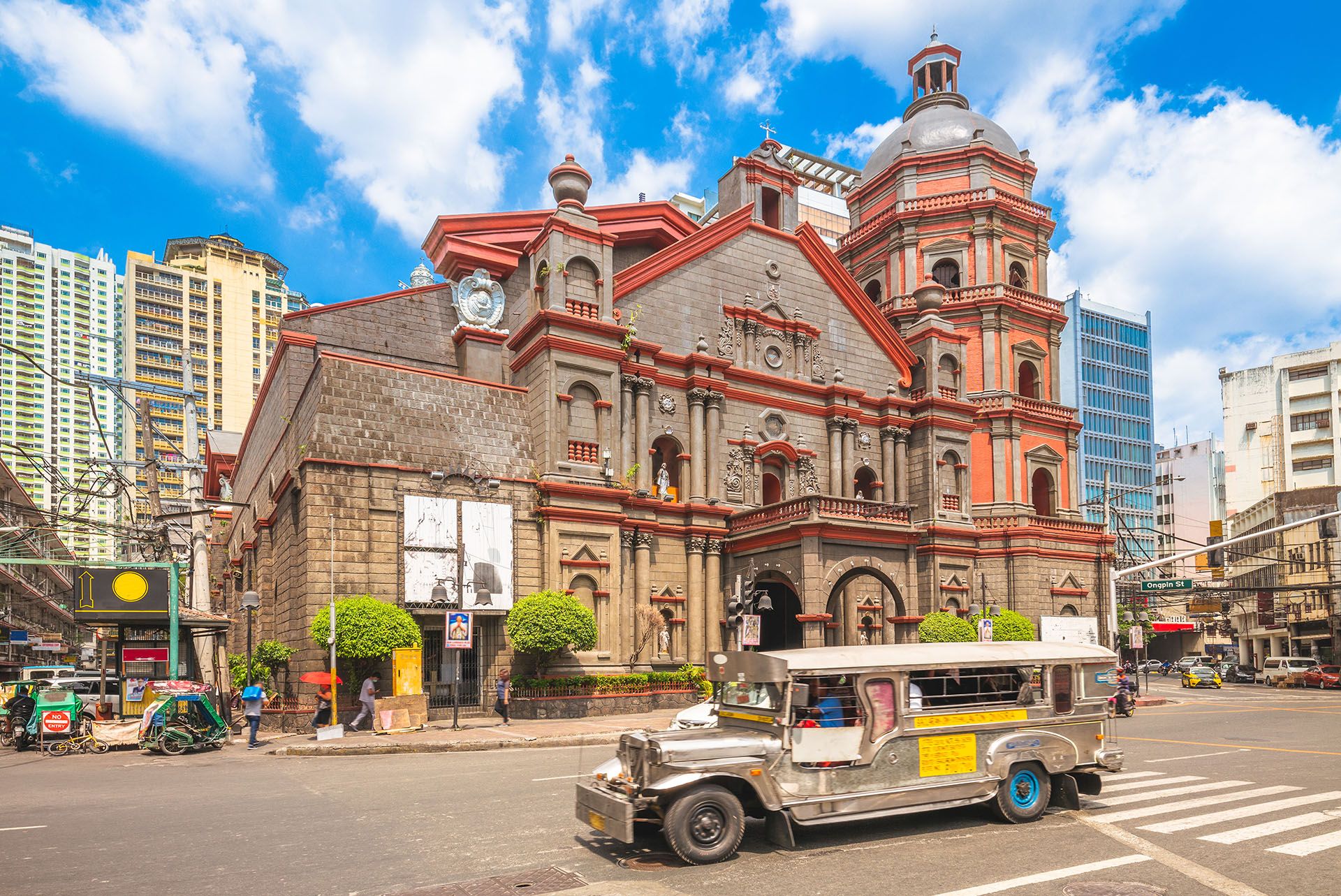
© Richie Chan / Shutterstock
There are so many vehicles fighting for every inch of road space in Manila that at peak times it can be a sweaty battle of nerves just to move a few hundred metres, let alone get around easily. There are buses and jeepneys but visitors usually use Manila’s inexpensive, mostly airconditioned taxis.
Manila’s two light railway lines, the Manila Light Rail Transit (LRT) and the MetroStar Express (MRT) are cheap and reliable but badly integrated.
Trains are best avoided during rush hour (Mon–Fri 7–9.30am & 5–8pm) when you may have to line up just to get into the stations, and carriages will be jam-packed. Here’s how to get around Manila:
The MetroStar Express (daily 5.30am–11pm, every 3–6min) is also known as MRT-3 (or yellow line). It runs for 17km along EDSA from Taft Ave in Pasay City in the south to North Ave, Quezon City in the north, connecting with LRT lines at the southern end and in the middle, and in the future at the northern end too.
You can buy a single journey ticket, or purchase a stored-value “beep card” (Wbeeptopay.com): these are available from station ticket offices, and from machines at the main entrances of stations.
The LRT has two elevated rail lines: the 17.2km Green Line (LRT-1); and the 13.8km Purple Line, which, confusingly, is known as MRT-2.
The Green Line runs from Baclaran in the south to Roosevelt in the north, connecting with MRT-1 at Taft Ave/EDSA, and is due to connect at North Ave when the line on from Roosevelt is completed.
The Purple Line runs from Santolan in Pasig City to Recto in Quiapo, close to the Green Line’s Doroteo Jose station.
Tickets can be bought at most station offices, or “beep cards” are valid on both the LRT and MRT.

Food stall at Quiapo market in Manila, Philippines © Shutterstock
The vintage 1892 Philippines National Railway line is gradually being brought back into service and should eventually have trains from Tutuban station north to Malolos.
At present all it has are a few infrequent and not tremendously useful services down the South Luzon Expressway as far as Calamba.
While sometimes useful (linking SM Mall of Asia and Baclaran station, for example), jeepneys can be incredibly cramped, and traffic congestion can make even short journeys last hours. Jeepneys are the cheapest way to get around, and they run back and forth all over the city.
You’ll also see tiny minivans or “FX taxis”, usually labelled UV Express, that zip between fixed points, usually without stopping.
Buses go along all major thoroughfares, such as Taft, EDSA and Gil Puyat (Buendia) Avenue, but are not allowed on most side streets. The destination is written on a sign in the front window. Most vehicles are ageing contraptions bought secondhand from Japan or Taiwan, and feature no particular colour scheme; it’s a matter of luck whether a bus has air conditioning.
Most Manila taxi drivers are honest these days and use the meter, though some may still try to set prices in advance or “forget” to switch it on (insist on the meter).
Taxis come in a confusing mix of models, colours and shapes; most metered taxis are white (and often called “white taxis” to differentiate them from the yellow airport taxis that have higher fares). Fares are good value and you’ll save time using white taxis over other road transport.
It is worth spending at least 3-4 days in Manila to get a good feel for the city and its attractions. You'll need at 2-3 days to see the historic Intramuros walled city, the National Museum of the Philippines, and the Rizal Park, but Manila could drag you in for weeks with its malls and markets, vibrant nightlife and incredible food scene. If you want to explore a number of neighbourhoods too, stay for 7-10 days.
Not sure how to plan your trip to the Philippines? Let our local experts help you out.

© PH Tourism Promotions Board
Manila has a hot and humid tropical climate with a wet season from May to October and a dry season from November to April. The best time to visit is during the dry season, although the city can get quite a lot of rain till February, and even the wet season sees many sunny days with short, intense downpours at dusk.
January and February are the coolest months and good for travelling, while March, April and May are very hot: expect sunshine all day and temperatures to peak at a broiling 36°C. As well as higher humidity, the wet season also brings typhoons, with flights sometimes cancelled and roads impassable.
The first typhoon can hit as early as May, although typically it is June or July before the rains really start, with July to September the wettest (and stormiest) months.
Find out more about the best time to visit the Philippines.

Fort Santiago, Manila © Shutterstock
Almost everyone visiting the Philippines arrives at Ninoy Aquino International Airport, on the southern fringes of Manila, named after the anti-Marcos politician who was assassinated here in 1983. But you can get to Manila by ferry and bus as well.
Ninoy Aquino International Airport has four separate and unconnected terminals, making it seem, confusingly, as if there are several different airports (you may hear locals refer to them this way).
Most international flights arrive at Terminals 1 and 3; Terminal 2, relatively nearby, serves only Philippine Airlines (international and domestic); the tiny Domestic Passenger Airport Terminal (aka Terminal 4) is 3km away on the other side of the airport.
An “airport loop” shuttle bus connects all the terminals, running frequently throughout the day, but traffic congestion means transfers can take over an hour in some cases – leave plenty of time.
2GO Travel ferries (incorporating Negros Navigation, SuperFerry, Cebu Ferries and SuperCat) use the passenger terminal at Pier 4, North Harbor (along Marcos Rd, a few kilometres north of Intramuros), from where you can catch a taxi to Ermita.
Departures include: Bacolod (4 weekly; 20hr); Butuan (1 weekly; 23hr); Cagayan de Oro (4 weekly; 34hr); Cebu City (5 weekly; 23hr); Coron (2 weekly; 15hr); Dipolog (1 weekly; 32hr); Dumaguete (1 weekly; 26hr); Iligan (1 weekly; 42hr); Iloilo (4 weekly; 28hr); Ozamiz (1 weekly; 35hr); Puerto Princesa (2 weekly; 32hr); Zamboanga (1 weekly; 42hr).
Dozens of buses link Manila with the provinces. As a general rule (and to avoid extra time negotiating Manila’s gridlock), for points south, you’re best off going to or from Pasay, in the south of the city around the junction of Taft Ave with EDSA, while for the north you’re better off using terminals in Cubao (Quezon City), towards the northern end of EDSA.
From Pasay, you can take the LRT or a taxi north to the Malate area or the MRT northeast to Makati and beyond. It’s a short walk to the Cubao MRT station from most bus stations in Cubao; taxis from Cubao to Makati are easy to flag down.
Leaving Manila by bus can be confusing as there’s no central bus terminal – each company has its own station, albeit clumped together in Cubao and Pasay (a third cluster lies on Rizal Ave, known as “Avenida”, in Quiapo). Usually, if you tell your taxi driver your destination, they will bring you to the right station.
Plan your trip to Manila with our guide to the Philippines.
Use Rough Guides' trusted partners for great rates
written by
Rough Guides Editors

