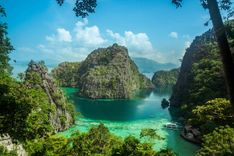
Outdoor activities in the Philippines
There are some superb wilderness areas in the Philippines and dozens of volcanoes and mountains to be climbed, from the tallest in the country, Mount Apo (2954m), to more manageable peaks close to Manila in Batangas and Rizal provinces, some of which can be tackled in a day-trip. The country also offers opportunities for caving, whitewater rafting, surfing and sailing. When it comes to sport, basketball and boxing are among the biggest passions in the Philippines.
But for a sizeable proportion of the tourists who visit the Philippines every year, the main attraction is the scuba diving. The abundance of exceptional dive sites and the high standard of diving instruction available have made the archipelago one of the world’s foremost diving destinations.
Scuba diving
Diving is one of the most popular activities in the Philippines and one of the best dive sites in the world. It’s possible year-round here, with surface water temperatures in the 25–28°C range, the warmest conditions being from February to June. On deeper dives temperatures can drop to 22°C due to the upwelling of deeper, cooler water, so a wet suit is essential. During the typhoon season from June to November, be prepared for your plans to be disrupted if a major storm hits and dive boats are unable to venture out. Visibility depends on water temperature, the strength of the current and wind direction, but generally lies in 10–30m range, as good as anywhere in the world. Popular locations include the coast around Palawan, the wrecks around Coron Town, Puerto Galera, Padre Burgos, Anilao and the more remote but scintillating reefs at Tubbataha and Apo.
Most dives cost around P1800 to P2000, including rental of the boat and equipment such as mask, booties, wet suit, fins, weight belt and air tanks. For night dives and more demanding technical dives, expect to pay around P500 extra. If you’ve booked a package, two dives a day will normally be included in the cost.
Courses
All PADI-accredited resorts offer a range of courses run by qualified professional instructors. If you haven’t been diving before and aren’t sure if you’ll take to it, try a gentle twenty-minute “discovery dive”, guided by an instructor for around P1500, or the longer PADI Discover Scuba Diving course for around P3000. The main course for beginners is the PADI Open Water Diver Course (from P18,000) which will allow you to dive at depths up to 18m. You might want to consider doing the pool sessions and written tests before you travel, then doing the checkout dives at a PADI resort in the Philippines. It saves time and means you don’t have to slave over homework in the tropical heat. If you choose this option, make sure you bring your PADI referral documents with you.
Once you’ve passed the course and been given your certification card, you are free to dive not just anywhere in the Philippines, but anywhere in the world. You might also want to take another step up the diving ladder by enrolling in a more advanced course. There are many to choose from, including Advanced Open Water Diver (from P14,000), Emergency First Response (from P6000), which is also suitable for non-divers and Rescue Diver (from P18,000).
Liveaboards
There are two great advantages to diving from a liveaboard (a boat that acts as a mobile hotel) – you can get to places that are inaccessible by bangka and once you’re there you can linger for a night or two. Liveaboards allow you to explore terrific destinations such as Apo Reef off the coast of Mindoro and Tubbataha in the Sulu Sea, arguably the best dive spot in the country. Packages include all meals and dives, but vary significantly according to destination; Tubbataha costs at least US$1200–1600 per week, while trips around Coron start at around US$130 per day. Most of the boats used have air-conditioned en-suite cabins for two. Packages often include unlimited diving and are always full board.
Diving dos and don’ts
Divers can cause damage to reefs, sometimes inadvertently. Be aware of your fins because they can break off coral heads that take years to re-grow. Don’t grab coral to steady yourself and always maintain good buoyancy control – colliding with a reef can be destructive. Don’t kick up sediment, which can choke and kill corals. For more information about reef conservation efforts in the Philippines, check out wwww.oceanheritage.com.ph, the website of the Ocean Heritage Foundation, a local environmentalist group. Below is a list of additional dos and don’ts:
- Collecting aquatic life - Resist the temptation to take home corals or shells, and never take souvenirs from wreck dives or remove anything dead or alive – except rubbish – from the ocean.
- Riding aquatic life - Hard to credit, but some divers still think it’s a great lark to hang onto the back of a turtle or manta ray. Simply put, there are no circumstances in which this is right.
- Spear-fishing - This has been outlawed in the Philippines, and environmental groups are increasingly reporting spear-fishers to the authorities for prosecution.
- Touching and handling aquatic life - For many organisms this is a terrifying and injurious experience. Handling marine life is best left to people who have experience with the creatures concerned.
Trekking and climbing
The Philippines offer plenty of opportunities to explore pristine wilderness areas. Luzon, for example, has the Sierra Madre and the Balbalasang-Balbalan National Park in Kalinga, both rarely visited by tourists and offering exhilarating trekking through dense rainforest and across dizzying peaks. In Bicol there are some terrific volcano climbs (Mount Mayon and Mount Isarog, for instance), while Mindoro, Palawan and the Visayas between them have dozens of national parks, heritage areas, wildlife sanctuaries and volcanoes. Mount Kanlaon, an active volcano in Negros, is one of the country’s more risky climbs, while the nearby Northern Negros Forest Reserve is a raw, mesmerizing landscape of peaks, waterfalls and fumaroles, typical of wilderness areas throughout the archipelago.
The country actually has more than sixty national parks and protected areas, but because funds for their management are scarce, you won’t find the kind of infrastructure that exists in national parks in the West. While the most popular climbs – Mount Apo in Mindanao and Mount Pulag in Mountain province, for example – have trails that are relatively easy to find and follow, it’s important to realize that trails are generally poorly maintained and hardly marked, if they’re marked at all. There are seldom more than a few badly paid wardens or rangers responsible for huge tracts of land. Where accommodation exists, it will be extremely basic. Some national parks have administrative buildings where you might be able to get a bed in a dorm for the night, or where you can roll out a mattress or sleeping bag on the floor. They may also have basic cooking facilities, but the closest you’ll get to a shower is filling a bucket and washing outside. Deep within park territory, the best you can hope for is a wooden shack to shelter in for the night.
This lack of facilities means you’ll need to hire a reliable guide. Often, the place to make contact with guides is the municipal hall in the barangay or town closest to the trailhead. Fees range from P800–1500 per day depending where you are, plus food and water, which you’ll have to bring with you as it’s unlikely you’ll come across anywhere to buy anything once you’re on the trail.
There are some outdoor shops in big cities – mainly Manila – where you can buy a basic frame-tent for P3000 and a sleeping bag for P1500. Other essentials such as cooking equipment, lanterns and backpacks are also available, and you may be able to rent some items, though the range of gear on offer is limited even in the best shops.
Caving
It’s hardly surprising that caving – spelunking – is a growth industry, as there are huge caves to explore throughout the country. The largest cave systems are in northern Luzon – in Sagada and in Cagayan province near Tuguegarao, where the Peñablanca Protected Area has three hundred caves, many deep, dangerous and not yet fully explored. The other exciting caving area is the Sohoton Natural Bridge National Park in Samar.
Whitewater rafting
Whitewater rafting is becoming more popular in the Philippines, notably along the Cagayan River and Chico River in northern Luzon and Cagayan de Oro River in Mindanao. Zip lines have mushroomed all over the islands, but some are much tamer than others – some of the best are near Cagayan de Oro and Davao. You can also take a thrilling ride in a microlight near Cagayan de Oro.
Surfing
Surfing is also becoming popular, with good waves in eastern Bicol, Catanduanes, eastern Mindanao (especially Siargao Island and Tandag), and around San Fernando in La Union. There are also any number of hard-to-reach areas in the archipelago that are visited only by a handful of die-hard surfers, such as Baler in northern Luzon, or around Borongan in eastern Samar.
Basketball
The Filipinos embraced basketball as they did everything else American, from pizza to popcorn. Every barrio and town has a basketball court, even if all it consists of are a couple of makeshift baskets nailed to wooden poles in the church plaza. The major league – the equivalent of the NBA – is the Philippine Basketball Association (PBA; wwww.pba.com.ph), founded in 1975. Ten teams compete for honours, all of them sponsored by a major corporation and taking their sponsors’ name. You might find yourself watching Meralco Bolts play Powerade Tigers, or San Miguel Beermen take on Talk ’N Text Tropang Texters. PBA games are all played in Manila for details.
The San Miguel Beermen is the most successful team, while the Barangay Ginebra Kings is the most popular. The players are household names to most Filipinos; James Yap (with the Derby Ace Llamados), Jayjay Helterbrand (Barangay Ginebra Kings), Kelly Williams (Talk ’N Text), Willie Miller (Barangay Ginebra Kings) and Dondon Hontiveros (San Miguel Beermen) command huge attention.
Boxing
Boxing has been big business in the Philippines since the Americans introduced the sport in the early twentieth century. In recent years, one name stands out in particular: Manny “the Pacman” Pacquiao, the poor boy from Mindanao who became world champion. Though you are unlikely to see the great man himself, fights are held almost every week, with major venues in Caloocan (Manila), Cebu City, Mandaluyong (Manila), Tagaytay City, Victoria (Negros) and Taytay in the Luzon province of Rizal. Tickets are cheap and often sell out; whenever there’s a bout of any significance Filipinos gather around every available television set. You can check schedules for fights at wwww.philboxing.com.
In addition to Manny Pacquiao, at the time of writing the Philippines could boast another four world champions: Nonito “The Filipino Flash” Donaire, Gerry Peñalosa, Donnie “Ahas” Nietes and Brian “Hawaiian Punch” Viloria.
Pool
Every town and city in the country has some sort of billiards hall, even if it’s just a few old tables on the pavement, where games are played by kerosene lamps, between locals, for the price of a few San Miguels. The sport has always been popular – it’s cheap and reasonably accessible – but has boomed over the past decade because of the success of Efren Reyes and Francisco Bustamante. Reyes, sometimes called “The Magician”, is one of the pool world’s great characters; a diminutive fellow with a toothy grin, he picked up the nickname “Bata” (“The Kid”) while helping out in his uncle’s pool halls in Manila as a child. He was born in Pampanga province, to the north of Manila, and can still occasionally be found on a Friday or Saturday night shooting pool in his hometown bars around Clark, good-naturedly scalping unsuspecting tourists’ drinks. In 2006, Reyes and Francisco “Django” Bustamante represented their country as Team Philippines and won the inaugural World Cup of Pool by defeating Team USA – a victory of major significance for a country with few global sporting heroes. They repeated the feat in 2009.
Cockfighting
Cockfighting is the Filipino passion few Westerners get to see or understand, for obvious reasons. It’s a brutal blood sport where fighting cocks literally peck and jab each other to death as onlookers make bets on the outcome. The fight begins when the two roosters are presented to each other in the pit. Both have a razor-sharp curved blade three inches long strapped to their leg. The fight is over in a burst of feathers in no more than a few minutes, when one rooster is too bloodied and wounded, or simply too dead, to peck back at its opponent when provoked. To make the evening last, most major cockfights feature seven contests. Anyone who likes animals should definitely stay well away.
If you do attend a cockfight (sabong in Tagalog), you’ll be experiencing Filipino culture at its rawest – at the very least it might make you think again about how much “American influence” dominates the culture. It’s best to start at one of the major cockpits in Manila, or ask your hotel for the nearest place to see one. Entrance fees are minimal, but you’ll rarely see women attending – the cockpit is the exclusive preserve of men, who see it as an egalitarian refuge from the world’s woes, a place where class differences are temporarily put to one side and everyone wears flip-flops and vests. In Manila foreign females should be OK at the main venues, but in the provinces you’ll probably feel more comfortable with a male companion.
Cockfighting and the Filipino
Cockfighting has a long history in the Philippines. National hero José Rizal, martyred by the Spanish in 1896, once pointed out that the average Filipino loves his rooster more than he does his children.
Contrary to received wisdom, cockfighting was not introduced to the country by the Spanish. When conquistadors landed in Palawan shortly after the death of Magellan, they discovered native men already breeding domestic roosters to fight, putting them in shared cages and letting them scrap over small amounts of food.
Social scientists say cockfighting is popular in the Philippines because it reflects the national passion for brevity or a quick payoff, the trait of ningas cogon (cogon being a wild grass that burns ferociously and quickly). Part of the appeal is the prize money. For a P200 entrance fee, a struggling farmer from the backwoods could finish the day with P300,000 in his pocket, all thanks to a trusty rooster he has groomed and trained assiduously for months.
Catholic nation
Catholicism was introduced to the Philippines in 1521 with the arrival of Magellan, and today around 80 percent of the population is Roman Catholic; just 10 percent is Protestant, 5 to 10 percent Muslim and the remainder Buddhist, animist and other religions. Every barangay, town and city has its patron saint, for whom grand fiestas are held annually, and churches, many beautifully weathered colonial relics, are well attended. Daily life, too, is shot through with Catholic imagery, whether it’s government announcements in the press urging people to pray the rosary, or television footage of god-fearing presidential candidates appealing to the heavens for guidance.
Jeepneys
Millions of Filipinos depend on jeepneys – a kind of informal minibus service – to get to school and the office, or to transport livestock to market. Jeepneys are able to operate where roads are too narrow for regular buses, and as a result most travellers end up using them at least once – despite the discomfort, for many it’s one of the highlights of their trip, a genuine slice of Filipino life.
The original jeepneys, cannibalized from vehicles left behind by departing Americans at the end of World War II, have evolved over the past five decades into the mass-produced versions that you see on the streets today, decorated with chrome trinkets, blinking fairy lights and images of celebrities. Others sport religious mottos, crucifixes and images of saints, perhaps understandable given the high accident rates they rack up.