From Kota Bharu to Kuala Terengganu
Few travellers linger long on the coast south of Kota Bharu; most are simply waiting for a boat from Kuala Besut (for Pulau Perhentian) or Merang (to Pulau Redang or Pulau Lang Tengah; not to be confused with Marang further south). Get money before you set out; there are no ATMs on any of the mentioned islands (or in Kuala Besut), though some accommodation may accept cards, and you may be able to get cash advances at punitive rates. If you do have time to stop, then there are a few good resorts on the coast plus some interesting villages and wildlife in the Setiu Wetlands.
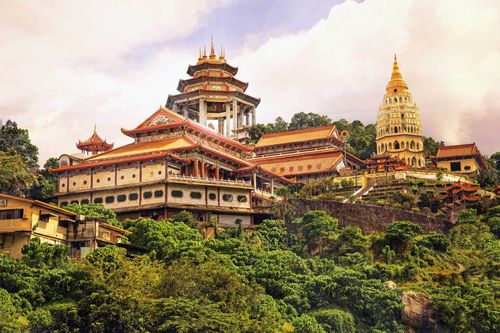
Buddhist temples
The area north of Kota Bharu is dotted with Buddhist temples, which can be visited using buses bound for the stretch of beach called Pantai Seri Tujuh. Getting from one to the next can take a while by public transport, though, so it’s quicker and easier to take a tour, arranged through the state tourist office or individual guesthouses. It’s often possible to combine the temples with visits to handicraft workshops. They’re especially worth visiting during Wesak, the festival (usually in May) celebrating the Buddha’s birthday.
Craft workshops
Most of Kota Bharu’s craft workshops lie on the road to PCB, the uninspiring beach 11km north of the city. As they are quite spread out, the best way to see a variety of workshops (including kite-making, batik and more) is on a tour, arranged either via a guesthouse or through the state tourist office. Half-day tours cost around RM90 per person, with a minimum of two people. The workshops listed here are not on the way to PCB, and are relatively easy to visit independently.
Kelantanese silverware is well known throughout the Peninsula. At the workshop of K.B. Permai, you can watch artisans shaping silver wire into fine filigree, as well as producing items such as embossed gongs and jewellery. You can buy pieces here, or at their retail outlet in the Kampung Kraftangan, at much keener prices than in Kuala Lumpur.
A wayang kulit puppeteer who also makes the tools of his trade, Pak Yusoff can be visited in Kampung Laut. His workshop, to the right of the pier as you get off the boat, holds examples of his distinctively translucent puppets. Call ahead as he is not always around.
Cultural Centre
A high point of any visit to Kota Bharu, the excellent Cultural Centre (Gelanggang Seni) puts on demonstrations of Kelantan’s cultural and recreational activities. Each day’s session is different, so check with the state tourist office if you have a particular interest. Together they include gasing (spinning tops), pencak silat (martial arts), rebana ubi (giant drums), kertok (smaller drums formed from coconuts) and congkak (a game involving the strategic movement of seeds around the holes on a wooden board). Best of all, Wednesday evenings see wayang kulit (shadow puppetry) performances from 9–11pm.
Islam in Kelantan
Unlike elsewhere in the country, Kelantan’s legal system traditionally operated according to Islamic law – an important factor in the maintenance of national pride under Thai overlordship. This wholehearted embrace of Islam was encouraged by trading contacts with the Arab world, enabling a free flow of new ideas from as early as the 1600s. One of Kota Bharu’s most famous sons is To’ Kenali, a religious teacher who, after years of study in Cairo, returned at the start of the twentieth century to establish sekolah pondok – huts functioning as religious schools.
Kelantan retains its distinctive identity today, to the extent that it’s even difficult for anyone from outside the state to buy property here. It’s also the scene for an intense, ongoing political rivalry that has, for example, seen the national government blocking the state government’s attempts to introduce hudud (punishments including flogging, amputation, stoning and execution, meted out for specific types of crime).
This rivalry is producing dramatic changes in Kota Bharu. After years of stagnation under PAS and a refusal by UMNO to release funds from federal coffers, both parties have decided that development is the avenue to political glory. As a result, the city now boasts a major shopping mall and a sprinkling of fancy riverside apartments – all of which would have been unthinkable until relatively recently. While some foreign visitors find Kelantan’s conservatism apparent, especially if they’ve arrived from Thailand, by and large Kota Bharu comes across as a bustling, pragmatic sort of place.
The markets of Kota Bharu
Kota Bharu has a fine array of markets, reflecting its role both as the state capital and as a centre for Malay culture and handicrafts. In addition to those listed here, see shopping for details of the night food market.
Central market
Just east of the historical centre. Kota Bharu’s humming central market (aka Pasar Besar Siti Khadijah) is a focal point of the city. The main building, an octagonal hall, has a perspex roof casting a soft light over the multicoloured patchwork of the main trading floor – a mass of fruit, vegetables and textiles. The whole scene is worth contemplating at length from the upper floors. Trading continues east of here in an extension to the original market, with yet more stalls spilling out onto the surrounding pavements. Daily 8am–6pm.
Bazaar Buluh Kubu
A couple of minutes’ walk west of the central market. Though lacking in atmosphere, this market does have a good range of batik, songket and other crafts on sale. Daily 8am–6pm.
Friday market
Jalan Ismail south of Jalan Hulu Pasar. A visit to the informal, morning-only Friday market is recommended as a way to witness the rustic heart of Kelantan laid bare, as traders and shoppers pour in from the surrounding kampungs on their weekend day out in the city. Fri 8am–noon.
The performing arts in Kelantan
Kelantan has a rich artistic tradition, boasting two costumed dance/drama forms, mak yong and the Thai-influenced menora. Even more striking is wayang kulit, shadow puppetry, traditionally staged on a dais screened from the audience by a large cloth sheet and illuminated from behind. The cast consists of a set of stencils made of hide and formed into the shapes of the various characters, which are manipulated against the screen by a sole puppeteer, who also improvises all the dialogue. Reflecting the long history of Indian influence in the region, the tales are taken from the Hindu epic, the Ramayana; in the past, wayang kulit functioned as a sort of kampung soap opera, serializing Ramayana instalments nightly during the months after the rice harvest. Performances are gripping affairs, with a hypnotic soundtrack provided by an ensemble of drums, gongs and the oboe-like serunai, whose players are seated behind the puppeteer.
Sadly, all three of the above traditional art forms have been banned in Kelantan by the PAS-led state government since the 1990s. PAS has cited issues of public morality – which could mean they object to the fact that both mak yong and menora can involve an element of cross-dressing. PAS also objects to the non-Islamic nature of these performances, since they involve folk tales or Hindu mythology. Finally, the party also has a problem with the spiritualism permeating these arts. A wayang kulit performance always begins with a buka panggung ceremony, in which the puppeteer readies the stage by reciting mantras and making offerings of food to the spirits, while mak yong can be staged for an individual as part of a folk-healing tradition called main puteri, in which the performers enter a trance to remove a spirit believed to be affecting that person.
Whatever the reasons for the ban, the effect has been akin to cultural hara-kiri, depriving a generation of Kelantanese of their own traditions. Dozens of wayang kulit troupes have been reduced to a mere handful, performing largely outside Kelantan or, thanks to one concession from PAS, for the benefit of the mainly tourist audience at Kota Bharu’s Cultural Centre. On a brighter note, all three forms mentioned here are being passed on to a new generation, and sometimes staged, at the National Academy of Arts, Culture and Heritage in KL (waswara.edu.my).
From Kota Bharu to Kuala Terengganu
Few travellers linger long on the coast south of Kota Bharu; most are simply waiting for a boat from Kuala Besut (for Pulau Perhentian) or Merang (to Pulau Redang or Pulau Lang Tengah; not to be confused with Marang further south). Get money before you set out; there are no ATMs on any of the mentioned islands (or in Kuala Besut), though some accommodation may accept cards, and you may be able to get cash advances at punitive rates. If you do have time to stop, then there are a few good resorts on the coast plus some interesting villages and wildlife in the Setiu Wetlands.
Kuala Besut
The only reason to visit the mainland village of KUALA BESUT is to catch a boat to the Perhentian Islands. It’s practically a one-street affair, the street in question running past the boat terminal and terminating just beyond the bus and taxi station. You’ll find agents selling boat tickets and Perhentians packages in the lanes along this street or in the boat terminal; all offer similar services at similar prices.
Merang
Most travellers who make it to MERANG, along the coastal road just south of the Sungai Merang creek, only glimpse the back of the village on their way to the jetty. The beach, accessible along a couple of side roads, is not exceptional, but if you have time to kill there’s reasonable swimming and memorable views of the islands offshore – from left to right, the Perhentians, Lang Tengah, Redang and finally Bidung Laut, now uninhabited but once the site of a refugee camp for Vietnamese boat people.
The Setiu wetlands
As a breeding ground for the painted terrapin and green turtle, the Setiu wetlands, between Kuala Besut and Merang, have been a focus for WWF projects since the early 1990s, but even now they attract only a trickle of tourists.
Both the main settlements hereabouts, namely Penarik, on the main coastal road, and Mangkok, 6km inland, are small villages, so the easiest way to explore is on a tour organized by an operator in Kuala Terengganu.
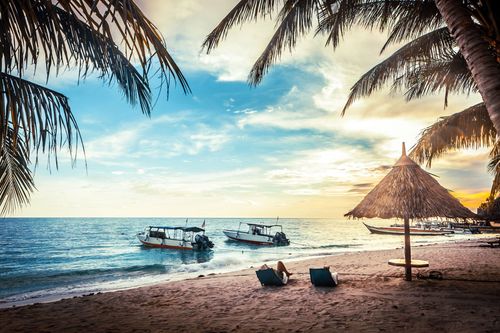
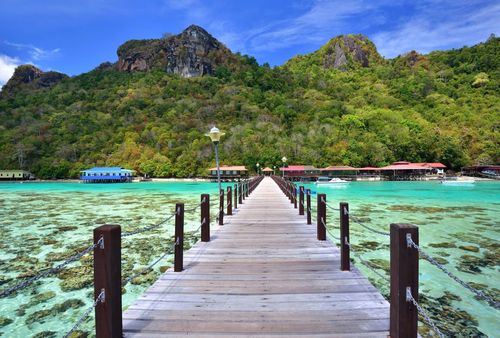
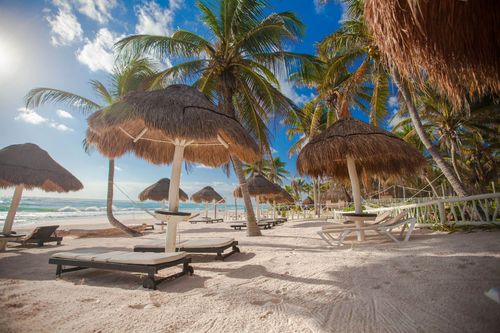
Top image: Perhentian Kecil Island, Terengganu, Malaysia © Ruzaini Haron/Shutterstock
 (1).jpg)