Don Khong
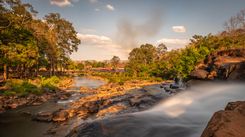
The largest of the Four Thousand Islands group, DON KHONG draws a steady stream of visitors, most of whom use it as a base to explore other attractions in Si Phan Don. That said, it’s nowhere near as popular as Don Det and Don Khon, further south, which means it’s far easier to find a peaceful place to watch the sunset.
Don Khong is surprisingly wide for a river island, and is known locally for its venerable collection of Buddhist temples, some with visible signs of a history stretching back to the sixth or seventh century. These, together with the island’s good-value accommodation and interesting cuisine, based on fresh fish from the Mekong, make Don Khong the perfect place for indulging both adventurous and lazy moods.
Don Khong has only three settlements of any size, the port town of Muang Sen on the island’s west coast, the east-coast town of MUANG KHONG, where most of the accommodation and cafés are situated (see the map), and the smaller town of Ban Houa Khong, where slow boats from Pakse moor. Like all Si Phan Don settlements, both Muang Sen’s and Muang Khong’s homes and shops cling to the bank of the Mekong for kilometres, but barely penetrate the interior, which is primarily reserved for rice fields. The best way to explore Don Khong and experience the traditional sights and sounds of riverside living is to rent a bicycle from one of the guesthouses and set off along the road that circles the island. Don Khong’s flat terrain and almost complete absence of motor vehicles make for ideal cycling conditions. For touring, the island can be neatly divided into two loops, southern and northern, each beginning at Muang Khong, or done all in one big loop that takes about three hours without stops.
Getting to Don Khong
A total of six public buses to Don Khong (30,000K) leave from Pakse’s Southern Bus Station daily, stopping at Ban Hat Xai Khoun to cross the Mekong by boat. Much faster are the minibuses operated by tour companies in Pakse (60,000K) and Champasak (50,000K), but look out for the pirogue drivers who meet buses at the riverbank; plenty of travellers have handed them all-inclusive bus and boat tickets, only to be told they have to pay an extra 10,000K for the crossing once they reach Muang Khong.
In Muang Khong you’ll find the island’s only post office, just south of the bridge across the creek, and further south, near the colonial mansion, a small Agricultural Promotion Bank where you can exchange money. Internet and telephone services are offered by a handful of guesthouses along the main drag. Several of the guesthouses and shops here offer bicycles for rent; Pon’s River Guesthouse also rents out motorbikes.
Accommodation in Don Khong
Most of the island’s accommodation is concentrated in Muang Khong. Over in Muang Sen there are only a few guesthouses, including Say Khong (40,500–80,000K), directly above the ferry landing, with spacious doubles and triples with fans and a balcony; and Muong Sene Guest House (40,000K and under), situated a little further east, on the road to Muang Khong – but Muang Khong has much better eating options. All the below are in Muang Khong.
Eating in Don Khong
All of Don Khong’s guesthouses serve food, and, as you might expect, fish is the island’s staple. The islanders have dozens of recipes, all worthy of a place on your plate – from the traditional làp pa (a Lao-style salad of minced fish mixed with garlic, chillies, shallots and fish sauce) to fish steamed in coconut milk – but whatever you do, be sure to try the island speciality, mók pa. Steamed in banana leaves, this sublime fish dish has the consistency of custard and takes an hour to prepare.
For this and just about anything else, Pon’s River Guesthouse stands out as having the best restaurant in Muang Khong. If it’s Chinese food and a perfect river view you’re after, head for the restaurant at the Souksan, which stands on stilts above the Mekong. Done Khong Guesthouse, once the only place to eat in town, remains popular and its banana crepes are divine. Most restaurants and guesthouses rustle up tasty Western breakfasts.
The people of Si Phan Don are very proud of their lào-láo, which has gained a reputation nationally as one of the best rice whiskies in Laos. For those who haven’t taken a liking to Lao white lightning, you’re in luck: Muang Khong has devised a gentler blend known as the “Lao cocktail”, a mix of wild honey and lào-láo served over ice with a dash of lime.
Departing from Don Khong
The chances of getting on a public bus to Pakse are pretty slim, but if you want to chance your arm, cross the river by pirogue and wait for one to pass by on Route 13. An easier and more reliable option is to arrange a ride through Mr Pon’s Restaurant (2hr 30min; 70,000K) – boats leave the ferry landing near the restaurant at 11.30am each morning and the subsequent bus ride includes a drop-off at your hotel.