Explore The far north
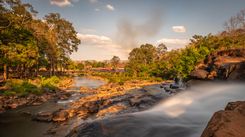
Starting on the China border, the Nam Ou drains all of Phongsali province and flows down through western Luang Prabang province to meet the Mekong above Luang Prabang. Much of the Phongsali province watershed is devoid of roads and still well covered with old-growth forests, and the river and its many tributaries remain in many ways as they were when nineteenth-century French explorers passed through. That said, the advent of improved roads has meant that river traffic has somewhat diminished; while this can mean that you may have to wait a few days (or charter a boat) to travel up (or down) it, it does retain an unhurried, very local charm, without the uncomfortable crowds of the more famous Mekong journey.
An important Mekong tributary, the Nam Ou holds a cherished place in Lao lore as the original route followed by Luang Prabang’s founding father, Khun Lo, and later by Fa Ngum, the warrior-king, as he headed towards Luang Prabang to claim the throne and found the Kingdom of a Million Elephants. The river begins its journey in the southern flanks of the mountains separating Laos and Yunnan in China. This northernmost part of Laos, Phongsali province, is hemmed in by high mountains on three sides, and the Nam Ou is joined by no less than eight major tributaries before entering Luang Prabang province and beginning its final run down to the Mekong. Two of these tributaries, the Nam Khang and the Nam Houn, pass within the huge Phou Den Din NBCA, along the border with Vietnam.
The main city of the upper Nam Ou is Phongsali, the provincial capital. To the east, Hat Sa effectively acts as Phongsali’s river port on the Nam Ou. The other two important towns on the Nam Ou are Muang Khoua and Nong Khiaw: Muang Khoua sits astride the river where Route 4 continues from Oudomxai to Dien Bien Phu, Vietnam, while Nong Khiaw is located where Route 1 crosses the river on its way from Oudomxai to Hua Phan province in the extreme northeast. Aside from tiny Muang Ngoi, all of the towns listed in this section can be reached by both road and river, though undoubtedly the latter is the more enjoyable option.
Read More-
Nong Khiaw
Nong Khiaw
Resting at the foot of a striking red-faced cliff, amid towering blue-green limestone escarpments, the dusty town of NONG KHIAW on the banks of the Nam Ou River lies smack in the middle of some of the most dramatic scenery in Indochina. The relatively slow advent of tourism here has allowed it to retain its village-like charm; it’s a great place to lose a few days, preferably watching the river from your own private balcony.
Though there’s not a great deal to the town itself, Nong Khiaw makes a good base for day-trips in the scenic surrounding countryside, though it’s also a lovely place to just do nothing for a few days. The old town is worth a wander – heading left at the T-junction immediately after the bridge will take you along the rather dusty road to the morning market, which is worth a look; the town temple is situated on the street behind.
One day-trip that can be done independently is to the Pathok Caves, 2.5km north of town, where villagers hid during the Second Indochina War. The easy walk takes you along quiet Route 1 past wooden village houses as the scenery becomes gradually more dramatic, with limestone karsts rising around you. The caves are indicated by a small blue sign on the right; buy your ticket from the little wooden hut before the bamboo bridge and you’re then free to explore the caves by yourself. They are surprisingly extensive and very dark, so bring a torch or hire one from the hut. Mountain bikes can be hired from the northern side of the bridge, next to Vongmany Restaurant, and are well recommended for exploring the area further.
There’s an excellent herbal sauna and massage place in town, just north of the turning to Sunset Guesthouse. Sabai Sabai, run by the family of Hom at Tiger Trail is the ideal place to unwind, with the fragrant steam bath (using cinnamon, lemongrass, eucalyptus and basil, among other things) leaving you utterly relaxed.
-
Muang Ngoi
Muang Ngoi
Tiny MUANG NGOI, idyllically set among beautiful scenery on the banks of the Nam Ou, has long been an attractive spot for tourists, many of whom end up whiling their days away here. Just an hour’s boat ride north of Nong Khiaw, the fact that the village can only be reached by river gives it an edge-of-the-world feel. Although it’s easy enough to just hang out here sipping coffee and swinging in a hammock (as, indeed, most people do), there are a lot of activities on offer, including trekking to nearby hill-tribe villages, canoeing on the river, organized fishing trips, and outings to the caves and waterfall. However, wandering the main street, especially during high season, you can’t help but feel this sleepy little place has been somewhat ambushed by tourism, with every second property seeming to be a guesthouse or a travellers’ café.
Muang Ngoi is pretty much a one street village, with dusty pathways striking off it in both directions. One excursion that you can take without a tour guide is to the nearby caves, where villagers’ hid during the war; to get there, turn left near Kaikeo and follow the path for a few kilometres. Take a torch.
Most guesthouses now offer trips and activities around Muang Ngoi, as do a few cafés along the main street. Situated on the path up from the boat landing, just beyond Lattanavongsa, Lao Youth Travel offer perhaps the most extensive range of options, from a half-day kayaking trip that includes a stop at a beach and time for a swim to a one-day trek that visits three local villages.
-
Phongsali
Phongsali
Perched just below the peak of Phou Fa (“Sky Mountain”), PHONGSALI looks and feels every bit the capital of Laos’s northernmost province. The altitude gained becomes apparent once the sun drops below the horizon and the chill sets in; on clear nights, as soon as the lights go out, the view of the heavens is unparalleled. The crisp air seems to amplify the stellar glow and the Milky Way is splashed across the sky like a giant, luminescent cloud. Despite being a large town, it lacks any real tourist infrastructure, and wandering around you will most likely find yourself the object of curious (but not bad-natured) stares. Though at first you may wonder where you’ve ended up, soon enough the lack of other tourists, cool mountain air and stunning surrounding countryside will work their charm on you. With the trekking scene still fairly low-key here, the town is a great place to do an overnight trip to the province’s fascinating hill-tribe villages.
A wide slice of terrain wedged between China’s Yunnan and Vietnam’s Lai Chau provinces, Phongsali province would surely be a part of China today were it not for the covetous nineteenth-century French. During the Second Indochina War, Phongsali came under heavy Chinese influence, a fact evident in the fortress-like former Chinese consulate, now the Phou Fa Hotel. It was during this time also that much of the province was stripped of its hardwood forests, compensation for China’s support for the Pathet Lao. The town’s inhabitants are made up of the Theravada Buddhist, Tibeto-Burman-speaking Phu Noi people and the Chinese Haw, descendants of Yunnanese traders who annually drove caravans of pack-ponies south into old Siam.
On a slope directly behind the Phongsaly Hotel is the town’s old quarter. A wander through these friendly but medieval-looking lanes is like stepping back in time. Interspersed among the squat houses of mud bricks and rough-hewn planks are a few architectural standouts, including one distinctly Chinese building with a beautifully carved wooden facade that looks like it belongs on the backstreets of old Kunming. The quarter’s three main streets run parallel for a stretch and then converge at a large basketball court, from which leads Phongsali’s main commercial thoroughfare, a tidy street of low shophouses, some with roofs constructed of oil drums hammered flat and laid out like shingles. Situated on the opposite bank of the town’s green bathing pond is Wat Kaeo, the local monastery.
Anyone interested in seeing what Phongsali’s ethnic groups dressed like before the influx of cheap Western-style clothing from China should pay a visit to the Museum of Tribes on the main road. Unfortunately, the rather small display of costumes and traditional wooden utensils isn’t done any favours by its lack of English explanations.
The nearby market is fairly small, considering this is a provincial capital, but as usual is a good bet for a cheap bowl of noodles. It’s worth making the stiff but not unpleasant walk up the forested hillside of Phou Fa hill, the top of which offers excellent views over the town and surrounding countryside on a clear day.
The main attraction of a visit to Phongsali is the opportunity to trek in this beautiful region. At the time of writing, the only treks available were offered by the tourist office, which clearly outlines where your money will go. Tours range from one- to multi-day treks, taking in local hill-tribe villages, with prices ranging according to the size of the group.
-
Slow boats on the Nam Ou
The southern leg of the journey up the Nam Ou is the six-hour ride between Luang Prabang and Nong Khiaw which is wildly scenic, especially the karst forests around Nong Khiaw and Muang Ngoi. Closer to Luang Prabang, where the river follows Route 13, extensive logging and slash-and-burn agriculture have stripped the surrounding mountains: only where the slopes are too rocky or too steep for cultivation have stands of forest been left intact. In an effort at reforestation, however, rows of young teak trees, recognizable by their enormous leaves, have been planted. After the road leaves the river, the scenery takes a turn for the spectacular, with vertical limestone peaks and pristine little white-sand beaches.
Upriver from Nong Khiaw the scenery continues to impress, possibly even surpassing that of the stretch below Nong Khiaw, the river snaking through impenetrable jungle. Because many of the surrounding mountains are simply too steep for slash-and-burn agriculture, the forests have been left virtually untouched. When the river is not too high and fast, this leg is also blessed with shelves of squeaky-clean beach, perfect for taking a lazy swim and admiring the dramatic scenery. However, this primeval landscape lasts only a third of the distance to Muang Khoua and is then replaced by arable hills with a beaten, domesticated air about them. The journey between Nong Khiaw and Muang Khoua takes approximately five hours.
Beyond Muang Khoua, it’s another 100km to Hat Sa, the last town of any size on the Nam Ou until U Thai, far to the northeast. The mountainous scenery on the Muang Khoua–Hat Sa leg may be a little less dramatic than around Nong Khiaw, but the journey is nonetheless impressive and peaceful.
Passenger boats continuing up the Nam Ou River beyond Hat Sa are few and far between, but it is possible to charter a boat to explore Laos’s northernmost corner. Anticipate paying upwards of $60 for a day-trip. North of Hat Sa there’s no formal accommodation but it should be possible to find lodging in villages.