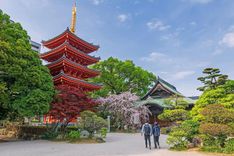
Afuel-injected adrenaline rush into a neon-bright future, TOKYO (東京) is a mercurial metropolis flashing by in a blur of conflicting images. Obsessed with the latest trends and fashions, the world’s largest city – the heart of which is home to at least eight million people – is also fiercely proud of its heritage. Lively neighbourhood festivals are held virtually every day of the year, and people regularly visit their local shrine or temple and scrupulously observe the passing seasons in manicured gardens.
Caught up in an untidy web of overhead cables, plagued by seemingly incessant noise, its freeways often clogged with bumper-to-bumper traffic, this concrete-and-steel conurbation may seem the stereotypical urban nightmare. Yet back from the frenetic main roads are tranquil backstreets, where dinky wooden houses are fronted by neatly clipped bonsai trees; wander beyond the hi-tech emporia, and you’ll discover charming fragments of the old city such as temples and shrines wreathed in wisps of smoking incense.
The fact is that centuries-long experience of organizing itself to cope with the daily demands of millions of inhabitants has made Tokyo something of a model metropolitan environment. Trains run on time and to practically every corner of the city, crime is hardly worth worrying about, and shops and vending machines provide everything you could need (and many things you never thought you did), 24 hours a day.
With so much going on, first-time visitors should be prepared for a massive assault on the senses – just walking the streets of this hyperactive city can be an energizing experience. It need not be an expensive one, either. You’ll be pleasantly surprised by how affordable many things are. Cheap-and-cheerful izakaya – bars that serve food – and casual cafés serving noodles and rice dishes are plentiful, the metro is a bargain, and tickets for a sumo tournament or a kabuki play can be bought for the price of a few drinks.
Browsing the shops and marvelling at the passing parade is mesmerising – the next best thing to having a ringside seat at the hippest of fashion shows. The city’s great wealth and relative lack of planning restrictions have given architects almost unparalleled freedom to realize their wildest dreams. Likewise, in Tokyo’s uber-chic bars, restaurants and clubs you’ll see today what the rest of the world will get tomorrow. You may not figure out exactly what makes it tick – and you’re sure to get a little lost while trying – but the conclusion is inescapable: Tokyo is a fun, seductive and addictive experience.
Brief history
The city’s founding date is usually given as 1457, when minor lord Ōta Dōkan built his castle on a bluff overlooking the Sumida-gawa and the bay. However, a far more significant event occurred in 1590, when the feudal lord Tokugawa Ieyasu chose the obscure castle-town for his power base.
By 1640 Edo Castle was the most imposing in all Japan, complete with a five-storey central keep, a double moat and a spiralling network of canals. A bewildering warren of narrow, tortuous lanes, sudden dead ends and unbridged canals was created to snare unwelcome intruders. Drainage work began on the surrounding marshes, and embankments were raised to guard the nascent city against floods.
The daimyō (lords) who were required by the shogun to spend part of each year in Edo were granted large plots for their estates on the higher ground to the west of the castle, an area that became known as Yamanote. Artisans, merchants and other lower classes were confined to Shitamachi, a low-lying, overcrowded region to the east. Though growing less distinct, this division between the “high” and “low” city is still apparent today.
During two centuries of peace, during which time Edo grew to be the most populous city in the world, life down in the Shitamachi buzzed with a wealthy merchant class and a vigorous, often bawdy, subculture of geisha and kabuki, of summer days on the Sumida-gawa, moon-viewing parties and picnics under the spring blossom. Inevitably, there was also squalor, poverty and violence, as well as frequent fires; in January 1657, the Fire of the Long Sleeves laid waste to three-quarters of the city’s buildings and killed an estimated 100,000 people.
A year after the Meiji Restoration, in 1868, the emperor took up permanent residence in the city, now renamed Tokyo (Eastern Capital) in recognition of its proper status. As Japan quickly embraced Western technologies, the face of Tokyo gradually changed: the castle lost much of its grounds, canals were filled in or built over, and Shitamachi’s wealthier merchants decamped to more desirable Yamanote. However, the city was still disaster-prone: in 1923 the Great Kantō Earthquake devastated half of Tokyo and another 100,000 people perished.
More trauma was to come during World War II. In just three days of sustained incendiary bombing in March 1945, hundreds of thousands were killed and great swathes of the city burnt down, including Meiji-jingō, Sensō-ji, Edo Castle and most of Shitamachi. From a prewar population of nearly seven million, Tokyo was reduced to around three million people in a state of near-starvation. This time, regeneration was fuelled by an influx of American dollars and food aid under the Allied Occupation, plus a manufacturing boom sparked by the Korean War in 1950.
By the time Emperor Hirohito opened the Tokyo Olympic Games in October 1964, Tokyo was truly back on its feet and visitors were wowed by the stunning new Shinkansen trains running west to Ōsaka. The economy boomed well into the late 1980s, when Tokyo land prices reached dizzying heights, matched by excesses of every conceivable sort, from gold-wrapped sushi and mink toilet-seat covers to huge building projects such as the Odaiba reclamation in Tokyo Bay.
In 1991, the financial bubble burst. This, along with revelations of political corruption, financial mismanagement and the release of deadly Sarin gas on Tokyo commuter trains by the AUM cult in 1995 – a particularly shocking event in what is one of the world’s safest cities – led to a more sober Tokyo in the late 1990s.
In the new millennium, as the economy recovered, so did the city’s vitality. Events such as the 2002 World Cup, plus growing interest in Japanese pop culture and the delicious food scene have contributed to more curious overseas visitors heading to Tokyo, with some staying on – making the capital feel more cosmopolitan than it has ever been. District after district has undergone structural makeovers, starting with Roppongi and Shiodome back in 2003. The latest megadevelopment is at Oshiage east of the Sumida-gawa where the Tokyo Sky Tree, set to be completed in 2012, is already Japan’s tallest structure.
Read More-
Ueno
Ueno
Most people visit UENO (上野) for its park, Ueno Kōen, which is home to a host of good museums, including the prestigious Tokyo National Museum, plus a few relics from Kan’ei-ji, a vast temple complex that once occupied this hilltop. But Ueno also has proletarian, Shitamachi roots, and much of its eastern district has a rough-and-ready feel, which is best experienced in the market area of Ameyokochō.
-
Rikugi-en
Rikugi-en
Five minutes’ walk south of Komagome Station on the Yamanote line, Rikugi-en (六義園; daily 9am–5pm; ¥300) is Tokyo’s best surviving example of a classical, Edo-period stroll-garden, designed in the early 18th century by high-ranking feudal lord Yanagisawa Yoshiyasu. Both a perfectionist and a literary scholar, Yanagisawa took seven years to create this celebrated garden – with its 88 allusions to famous scenes, real or imaginary, from ancient Japanese poetry – and then named it Rikugi-en, “garden of the six principles of poetry”, in reference to the rules for composing waka (poems of 31 syllables).
Few of the 88 landscapes have survived – the guide map issued at the entrance identifies a mere eighteen. Nevertheless, Rikugi-en still retains its rhythm and beauty, beginning as you enter with an ancient, spreading cherry tree, then slowly unfolding along paths that meander past secluded arbours and around the indented shoreline of an islet-speckled lake. In contrast, there are also areas of more natural woodland and a hillock from which to admire the whole scene.
-
Ikebukuro
Ikebukuro
Northern Tokyo’s main commercial hub is IKEBUKURO (池袋). Cheap accommodation and good transport links have attracted an increasing number of expatriates, typically Chinese and Taiwanese, but including a broad sweep of other nationalities, to settle around here, which lends Ikebukuro a faintly cosmopolitan air. Either side of the hectic station (around one million passengers pass through each day), the massive department stores Tōbu and Seibu square off against each other.
-
The 47 ronin
The 47 ronin
Celebrated in kabuki and bunraku plays, as well as on film, Chūshingura is a true story of honour, revenge and loyalty. In 1701, a young daimyō, Asano Takumi, became embroiled in a fatal argument in the shogun’s court with his teacher and fellow lord Kira Yoshinaka. Asano had lost face in his performance of court rituals and, blaming his mentor for his lax tuition, drew his sword within the castle walls and attacked Kira. Although Kira survived, the shogun, on hearing of this breach of etiquette, ordered Asano to commit seppuku, the traditional form of suicide, which he did.
Their lord having been disgraced, Asano’s loyal retainers, the rōnin – or masterless samurai – vowed revenge. On December 14, 1702, the 47 rōnin, lead by Oishi Kuranosuke, stormed Kira’s villa, cut off his head and paraded it through Edo in triumph before placing it on Asano’s grave in Sengaku-ji. The shogun ordered the rōnin’s deaths, but instead all 47 committed seppuku on February 14, 1703, including Oishi’s 15-year-old son. They were buried with Asano in Sengaku-ji, and today their graves are still wreathed in the smoke from the bundles of incense placed by their gravestones.
-
Tokyo’s last tramline
Tokyo once had an extensive tram network, of which only the 12km Toden Arakawa line (都電荒川線) remains, running north from Waseda to Minowa-bashi. The most interesting section is the short stretch from Kōshinzuka Station, a fifteen-minute walk northwest of Sugamo Station, from where the line heads southwest towards Higashi-Ikebukuro, rocking and rolling along narrow streets and through Tokyo back yards. Most of the original tramlines were private enterprises – the Arakawa line was built purely to take people to the spring blossoms in Asukayama Park – and have gradually been replaced with subways. Now the last of the chin chin densha (“ding ding trains”), as they’re known from the sound of their bells, the Arakawa line, will probably survive for its nostalgia value if nothing else. Tickets cost ¥160, however far you travel; you pay as you enter. Station signs and announcements are in English.
-
Tokyo for kids
Tokyo for kids
Tokyo is a fantastic city for kids. For starters, there’s a whole swathe of museums, the best ones being Miraikan, the National Science Museum and Edo-Tokyo Museum. For animal lovers, there’s the fabulous aquarium at Kasai Rinkai-kōen and Ueno zoo.
The city also boasts Tokyo Disneyland, of course, and the thrill of the rides at Tokyo Dome as well as the wonderful Ghibli Museum, based on the popular anime films produced by the Ghibli studio. If your children are six or under, the National Children’s Castle will keep them occupied for many an hour. For older, tech-savvy kids, the electronic emporia of Akihabara will be a must.
-
Purr-fect cafés
Purr-fect cafés
The latest hit in Tokyo’s polymorphous kissaten culture is cat cafés, offering quality time with well-groomed pedigree felines. Particularly popular among young women and dating couples, they are relaxing places, offering the pleasures of pet ownership without the commitment. A great example is Calico where ¥600 gets you thirty minutes of quality cat time. There are English instructions on the house rules, and inexpensive drinks and food. Another option is Nekorobi where you have to spend at least ¥1000 per visit, including drinks.
-
Karaoke bars and boxes
Legend has it that karaoke, literally translated as “empty orchestra”, was invented by an Ōsaka record store manager in the early 1970s. Today the mainstay of this ¥1 trillion business is the karaoke box, a building packed with comfy booths kitted out with a karaoke system. Rental of these boxes is by the hour and they have proved particularly popular with youngsters, women and families.
If you fancy flexing your vocal cords, branches of the major karaoke box operator Karaoke-kan (カラオケ館) are liberally peppered across the capital. An hour of karaoke here costs from ¥1000 with drinks and snacks extra. Catering to foreigners are Fiesta and the long-running Smash Hits, both of which offer thousands of songs in English as well as several other languages.
-
Major Tokyo festivals
Whenever you visit Tokyo, the chances are there’ll be a festival (matsuri) taking place somewhere in the city. The tourist information centres can provide comprehensive lists of events in and around Tokyo, or check in the English press for what’s on. Below is a review of the city’s biggest festivals ( for more about nationwide celebrations). Note that dates may change, so be sure to double-check before setting out.
January 1: Ganjitsu (or Gantan)
The first shrine visit of the year (hatsu-mōde) draws the crowds to Meiji-jingū, Hie-jinja, Kanda Myōjin and other city shrines. Performances of traditional dance and music take place at Yasukuni-jinja. National holiday.
January 6: Dezomeshiki
At Tokyo Big Sight in Odaiba, firemen in Edo-period costume pull off dazzling stunts atop long bamboo ladders.
Second Monday in January: Momoteshiki
Archery contest and other ancient rituals at Meiji-jingū to celebrate “Coming-of-Age Day”. A good time to spot colourful kimono, here and at other shrines.
Febuary 3 or 4: Setsubun
The last day of winter is celebrated with a bean-scattering ceremony to drive away evil. The liveliest festivities take place at Sensō-ji, Kanda Myōjin, Zōjō-ji and Hie-jinja.
Early April: Hanami
Cherry-blossom-viewing parties get into their stride. The best displays are at Chidorigafuchi Park and nearby Yasukuni-jinja, Aoyoma Cemetery, Ueno-kōen and Sumida-kōen.
Mid-May: Kanda Matsuri
One of Tokyo’s top three festivals, taking place in odd-numbered years at Kanda Myōjin, during which people in Heian-period costume escort eighty gilded mikoshi through the streets.
Third weekend in May: Sanja Matsuri
Tokyo’s most rumbustious annual bash, when over one hundred mikoshi are jostled through the streets of Asakusa, accompanied by lion dancers, geisha and musicians.
Mid-June: Sannō Matsuri
In even-numbered years the last of the big three festivals (after Kanda and Sanja) takes place, focusing on colourful processions of mikoshi through Akasaka.
Early July: Yasukuni Matsuri
The four-night summer festival at Tokyo’s most controversial shrine is well worth attending for its jovial parades, Obon dances and festoons of lanterns.
Late July and August: Hanabi Taikai
The summer skies explode with thousands of fireworks, harking back to traditional “river-opening” ceremonies. The Sumida-gawa display is the most spectacular (view it from riverboats or Asakusa’s Sumida-kōen on the last Sat in July), but those in Edogawa, Tamagawa, Arakawa and Harumi come close.
Mid-August: Fukagawa Matsuri
Every three years Tomioka Hachiman-gū, a shrine in Fukugawa, east across the Sumida-gawa from central Tokyo, hosts the city’s wettest festival, when spectators throw buckets of water over a hundred mikoshi being carried through the streets. The next will take place in 2011.
Mid-November: Tori-no-ichi
Fairs selling kumade, bamboo rakes decorated with lucky charms, are held at shrines on “rooster days”, according to the zodiacal calendar. The main fair is at Ōtori-jinja (Iriya Station).
November 15: Shichi-go-san
Children aged 3, 5 and 7 don traditional garb to visit the shrines, particularly Meiji-jingū, Hie-jinja and Yasukuni-jinja.
Late November: Tokyo International Film Festival
(wwww.tiff-jp.net) One of the world’s top competitive film festivals, with a focus on Japanese and Asian releases. The main venues for the week-long festival are the cinemas in Roppongi Hills and Shibuya’s Bunkamura, though screenings take place at halls and cinemas throughout the city.
December 17–19: Hagoita-ichi
The build-up to New Year begins with a battledore fair outside Asakusa’s Sensō-ji temple.
-
Au revoir Kabuki-za
Au revoir Kabuki-za
In May 2010 Kabuki-za, Tokyo’s oldest and largest theatre devoted to kabuki, was destroyed to make way for a new tower block and a more modern stage and performance hall. A kabuki theatre has stood on this Ginza site since 1889; its last guise was a 1950s restoration of the florid 1924 version of the building (the original burned down in 1921). Until the new theatre reopens in 2013, regular performances of kabuki will take place at Shinbashi Enbujō.
-
Tokyo’s wholesale districts
Tokyo’s wholesale districts can be fun to poke around. Best known to visitors are the fish and fresh produce market Tsukiji and the “Kitchenware Town” Kappabashi. Other ones to search out include the area around Edo-dōri, north of Asakusabashi Station, which specializes in traditional Japanese dolls. Further north along Edo-dōri, the area called Kuramae is “Toy Town”, where shops sell fireworks, fancy goods and decorations, as well as cheap plastic toys. Bakurochō and Yokoyamachō are the textile districts where you’ll also find shops selling cheap clothes.
-
Accommodation
Accommodation
The choice of accommodation in Tokyo ranges from no-expense-spared luxury hotels to atmospheric ryokan and budget hostels charging around ¥2000 a night. Central Tokyo (comprising Ginza, Nihombashi, Akasaka and Roppongi) is largely the domain of expensive, world-class establishments and upmarket business hotels. For cheaper rooms, there’s a greater choice in Shinagawa, Shibuya and Shinjuku to the south and east, and Asakusa, Ueno and Ikebukuro in the north. Wherever you stay, remember that trains stop running around midnight; if you’re a night animal, opt for somewhere near one of the entertainment districts to avoid costly taxi journeys.
Tokyo’s capsule hotels can come in handy if you miss your last train home. However, the marjority are for men with a few exceptions. An alternative crash pad is a manga café.
Whatever your budget, it’s wise to reserve your first few nights’ accommodation before arrival. For more extensive accommodation listings and information about long-term accommodation in the city, see the Rough Guide to Tokyo.
-
Eating
Eating
When it comes to gastronomic experiences, few places can compare to Tokyo. The number, range and quality of restaurants are breathtaking, with practically any world cuisine you can think of available alongside all the usual (and many unusual) Japanese dishes.
There’s no need to panic about prices. Even Michelin-starred restaurants offer good-value set-meal specials, particularly for lunch. There’s an abundance of fast-food options and cafés offering light meals. Many of the pubs (izakaya) and live music venues listed serve fine food, too.
One of the easiest options is to head to the restaurant floors of department stores and shopping malls. They harbour a wide choice of cuisines under one roof, often with plastic food displays in the windows and lots of daily specials.
-
Nightlife and entertainment
Tokyo’s nightlife and entertainment options run the gamut from grand theatres and multiplex cinemas to broom-cupboard bars and live music venues (known as “live houses”). The distinction between restaurants, bars and clubs in the city’s sakariba (“lively places”), such as Ginza, Shibuya or Shinjuku, is hazy, with many places offering a range of entertainment depending on the evening or customers’ spirits.
On the cultural side, you can sample all of Japan’s major performing arts, from stately nō, the oldest in its theatrical repertoire, to Butō, the country’s unique contribution to contemporary dance. If you only have the energy, or budget, for one cultural experience, save it for kabuki. Information about these and other performances is available in the English-language press and from the TICs. Tickets are available from theatres and ticket agencies.