Explore Goa
Development in North Goa is concentrated mainly behind the seven-kilometre strip of white sand that stretches from the foot of Fort Aguada, crowning the peninsula east of Panjim, to Baga creek in the north. Encompassing the resorts of Candolim, Calangute and Baga, this is Goa’s prime charter belt and an area most independent travellers steer clear of.
Since the advent of mass tourism in the 1980s, the alternative “scene” has drifted progressively north away from the sunbed strip to Anjuna and Vagator – site of some of the region’s loveliest beaches – and scruffier Chapora, a workaday fishing village. Further north still, Arambol has thus far escaped any large-scale development, despite the completion of the new road bridge across the Chapora River. What little extra traffic there is since the new road link tends to focus on the low-key resorts just south of Arambol, namely Aswem and Mandrem.
North Goa’s market town, Mapusa, is this area’s main jumping-off place, with bus connections to most resorts on the coast. If you’re travelling here by train via the Konkan Railway, get off the train at Tivim (Thivim), 12k east of Mapusa, from where you’ll have to jump in a bus or taxi for the remaining leg.
Read More-
Candolim and Fort Aguada
CANDOLIM is prime package tourist country, and not a resort that sees many backpackers but, with lots of pleasant places to stay tucked away down quiet back lanes, it can make a good first landfall if you’ve just arrived in Goa. The busy strip running through the middle of town holds a string of banks and handy shops where you can stock up with essentials before moving further afield, and there are some great places to eat and drink, frequented mostly by boozy, middle-aged Brits and young Russians.
The one sight worth seeking out in the area is Fort Aguada, crowning the rocky flattened headland to the south, at the end of the beach. Built in 1612 to protect the northern shores of the Mandovi estuary from Dutch and Maratha raiders, the bastion encloses several natural springs, the first source of drinking water available to ships arriving in Goa after the long sea voyage from Lisbon. The ruins of the fort can be reached by following the main drag south from Candolim as it bears left, past the turning for the Fort Aguada Beach Resort; keep going for 1km until you see a right turn, which runs uphill to a small car park. Nowadays, much of the site serves as a prison, and is therefore closed to visitors. It’s worth a visit, though, for the panoramic views from the top of the hill where a four-storey Portuguese lighthouse, erected in 1864 and the oldest of its kind in Asia, looks down over the vast expanse of sea, sand and palm trees.
From the base of Fort Aguada on the northern flank of the headland, a rampart of red-brown laterite juts into the bay at the bottom of what’s left of Sinquerim Beach, which was virtually wiped out by a series of particularly heavy monsoon storms in 2009. This was among the first places in Goa to be singled out for upmarket tourism. The Taj Group’s Fort Aguada resort, among the most expensive hotels in India, lords it over the sands from the slopes below the battlements. Off-shore, the hulk of the MV River Princess lurches in the shallows, more than a decade after it ran aground in a monsoon gale. Several attempts have been made to refloat and tow the wreck away in one piece, but to no avail: the River Princess sinks deeper into the sand each year – a surreal spectacle so close to India’s flagship tourist beach.
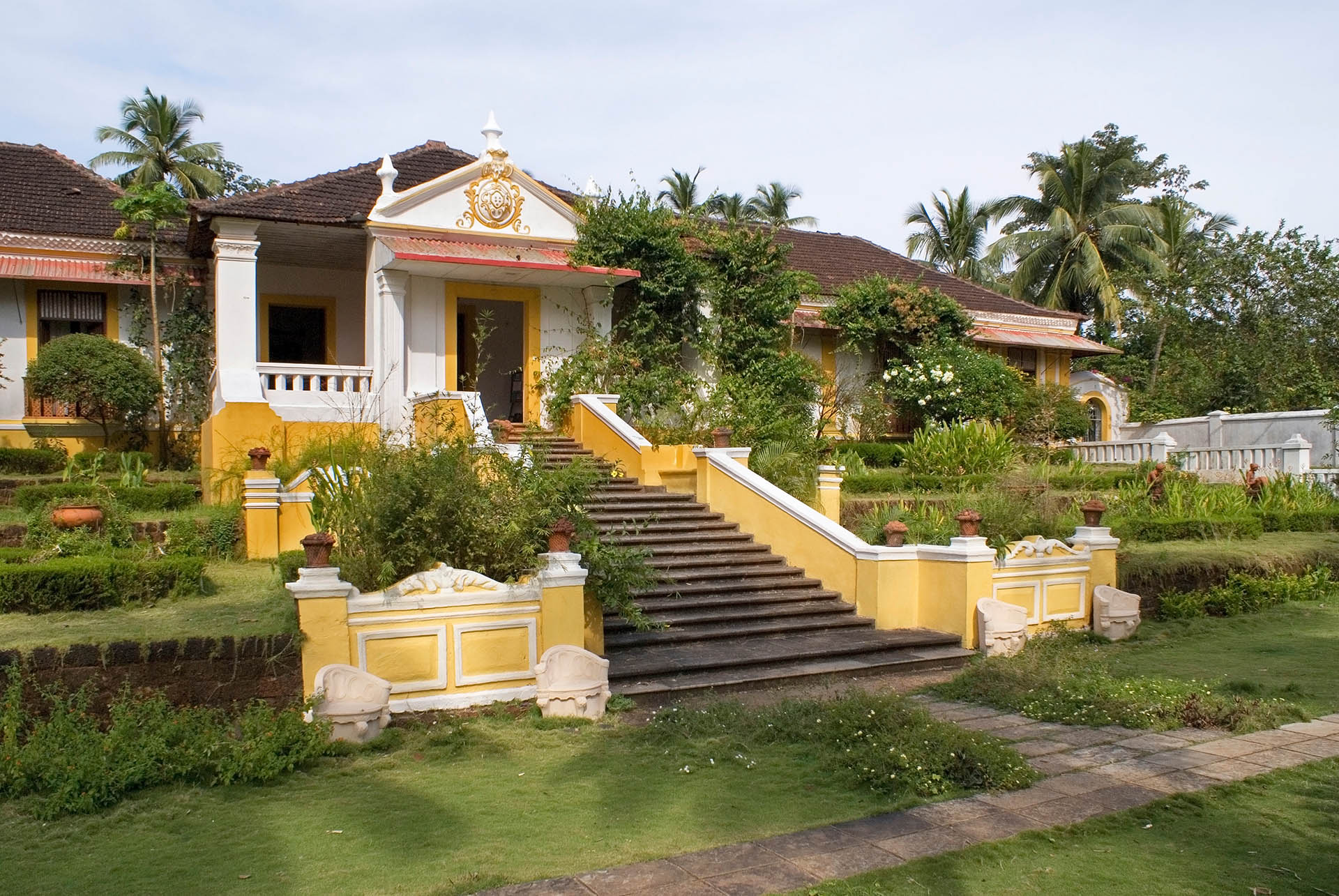
Lots of wonderful old mansions and typically Goan houses nestle in the palm trees around Candolim, some of the best of them in the folk and architectural museum, Calizz, on the south side of the resort. Comprising five beautifully restored period buildings spread over a site of several acres, the complex showcases various styles of traditional Goan homes – both Christian and Hindu – from humble mud structures dating from pre-colonial times to a sumptuous Portuguese palacio with chapel attached. On display inside is an engaging array of antiques, furniture, religious icons and daily artefacts.
-
Calangute
Calangute
A 45-minute bus ride up the coast from Panjim, CALANGUTE was, in Portuguese times, where well-to-do Goans would come for their annual mudança, or change of air, in May and June, when the pre-monsoonal heat made life in the towns insufferable. It remains the state’s busiest resort, but has changed beyond recognition since the days when straw-hatted musicians in the beachfront bandstand would regale smartly dressed strollers with Lisbon fados and Konkani dulpods. Mass package tourism, combined with a huge increase in the number of Indian visitors (for whom this is Goa’s number-one beach resort), has placed an impossible burden on the town’s rudimentary infrastructure. Hemmed in by four-storey buildings and swarming with traffic, the market area, in particular, has taken on the aspect of a typical makeshift Indian town of precisely the kind that most travellers used to come to Goa to get away from. In short, this is somewhere to avoid, although most people pass through here at some stage, to change money or shop for supplies. The only other reason to endure the chaos is to eat: Calangute boasts some of the best restaurants in the whole state.
- Baga
- Anjuna
-
Vagator
Vagator
Barely a couple of kilometres of clifftops and parched grassland separate Anjuna from the southern fringes of VAGATOR. Spread around a tangle of winding back lanes, this is a more chilled, undeveloped resort that appeals, in the main, to Israeli and southern European beach bums who come back year after year.
With the red ramparts of Chapora fort looming above it, Vagator’s broad sandy beach – known as “Big Vagator” – is undeniably beautiful. However, a peaceful swim or lie on the sand is out of the question here as it’s a prime stop for bus parties of domestic tourists. A much better option, though one that still sees more than its fair share of day-trippers, is the next beach south. Backed by a steep wall of crumbling palm-fringed laterite, Ozran (or “Little”) Vagator beach is actually a string of three contiguous coves. To reach them you have to walk from where the buses park above Big Vagator, or drive to the end of the lane running off the main Chapora–Anjuna road (towards the Nine Bar), from where footpaths drop sharply down to a wide stretch of level white sand (look for the mopeds and bikes parked at the top of the cliff). Long dominated by Italian tourists, the southernmost – dubbed “Spaghetti Beach” – is the prettiest, with a string of well established shacks, at the end of which a face carved out of the rocks, staring serenely skywards, is the most prominent landmark. Relentless racquetball, trance sound systems and a particularly sizeable herd of stray cows are the other defining features.
-
Chapora
Chapora
Huddled in the shadow of a Portuguese fort on the opposite, northern side of the headland from Vagator is CHAPORA, north Goa’s main fishing port. The anchorage and boatyard below its brown-walled citadel forms the backbone of the village’s economy, but there’s always been a hard-drinking, heavy-smoking hippy tourist scene alongside it, revolving around the coffee shops and bars on the main street. Come here at sunset time and you’ll see the “boom shankar brigade” out in full force, sipping banana lassis and toking on chillums under the banyan tree – a spectacle little changed in decades. For a brief period a few years back, Russian mafia types took over and squeezed the freaks out, but like migrating turtles they’ve returned to their old hangout in numbers undiminished by the recent changes in Goa. If this doesn’t sound much like your bag, you’ll probably be best off sticking to neighbouring Vagator.
Chapora’s chief landmark is its venerable old fort, most easily reached from the Vagator side of the hill. At low tide, you can also walk around the bottom of the headland, via the anchorage and the secluded coves beyond it to Big Vagator, then head up the hill from there. The red-laterite bastion, crowning the rocky bluff, was built by the Portuguese in 1617 on the site of an earlier Muslim structure (thus the village’s name – from Shahpura, “town of the Shah”). Deserted in the nineteenth century, it lies in ruins today, although the views up and down the coast from the weed-infested ramparts are still superb. Also worth a visit is the village’s busy little fishing anchorage, where you can buy delicious calamari fresh off the boats most evenings.
- Aswem
-
Arambol
Arambol
ARAMBOL, 32km northwest of Mapusa, is by far the most populous village in the far north, and the area’s main tourist hub. Traditionally a refuge for a hard-core hippy fringe, the village nowadays attracts a lively and eclectic mix of travellers, the majority of whom stick around for the season, living in rented rooms, hut camps and small houses scattered behind the magnificent white-sand beach. Hedonistic, well-heeled young Russians way outnumber the older, more alternative, spiritually-inclined types from northern Europe who have long formed Arambol’s mainstay. But the two groups rub along harmoniously enough, and the overall vibe here is inclusive and positive, with plenty of live music to enjoy in the evenings, lots of relaxed places to eat and drink, and more opportunities to learn new yoga poses and reshuffle your chakras than you could get through in several lifetimes, let alone a winter. Moreover, beach life is generally laidback too – except on weekends, when day-tripping drinkers descend en masse in SUVs from nearby Maharashtra.