Best things to do in Delhi
From the imposing spendour of the Red Fort to the country’s finest museum, exhibiting more than five thousand years of Indian culture, here are the best things to do in Delhi.
#1 Visit the Red Fort
The largest of Old Delhi’s monuments is Lal Qila, known in English as the Red Fort because of the red sandstone from which it was built. It is a key stop on any Golden Triangle India trip and was commissioned by Shah Jahan to be his residence, modelled on the fort at Agra.
Work started in 1638, and the emperor moved in ten years later. The fort contains all the trappings you’d expect at the centre of Mughal government: halls of public and private audience, domed and arched marble palaces, plush private apartments, a mosque and elaborately designed gardens.
The ramparts, which stretch for more than 2km, are interrupted by two gates – Lahori Gate to the west, through which you enter, and Delhi Gate to the south. Shah Jahan’s son, Aurangzeb, added barbicans to both gates.
In those days, the Yamuna River ran along the eastern wall, feeding both the moat and a “stream of paradise” which ran through every pavilion. As the Mughal Empire declined, the fort fell into disrepair. It was attacked and plundered by the Persian emperor Nadir Shah in 1739, and by the British in 1857.
Nevertheless, it remains an impressive testimony to Mughal grandeur. Keep your ticket stub, as you may have to show it several times.
#2 Wander Rajpath, the centrepiece of Lutyens’ imperial New Delhi
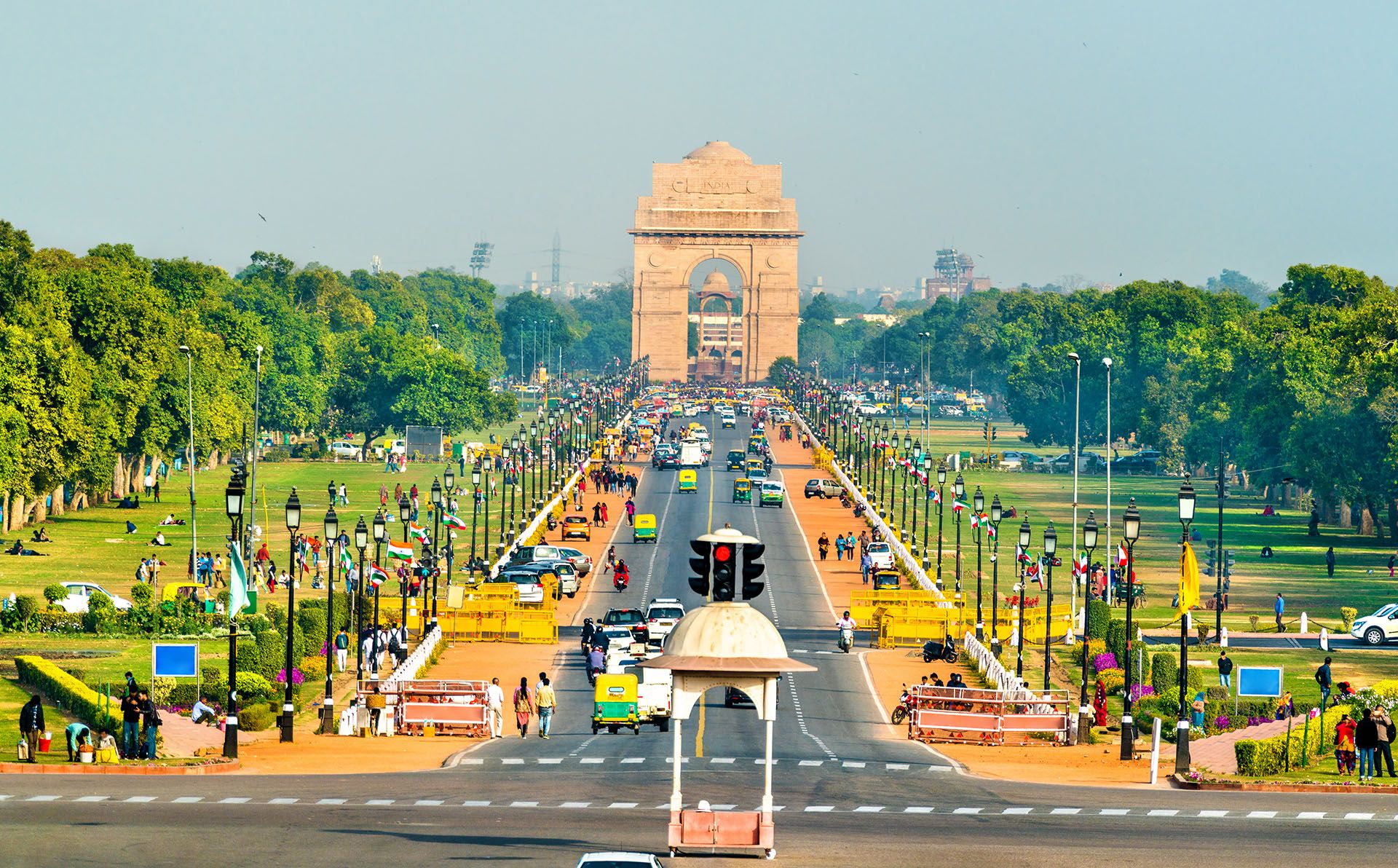
Vijay Chowk, immediately in front of Rashtrapati Bhavan, leads into the wide, straight Rajpath, flanked with gardens and fountains that are floodlit at night, and the scene of annual Republic Day celebrations (Jan 26).
The Rajpath runs east to India Gate; designed by Lutyens in 1921, the high arch – reminiscent of the Arc de Triomphe in Paris – commemorates ninety thousand Indian soldiers killed fighting for the British in World War I, and bears the names of more than three thousand British and Indian soldiers who died on the North-West Frontier and in the Afghan War of 1919.
The extra memorial beneath the arch honours the lives lost in the Indo-Pakistan War of 1971.
#3 Explore more than five thousand years of Indian culture at the National Museum
The National Museum provides a good overview of Indian culture and history. At a trot you can see the museum in a couple of hours, but to get the best out of your visit you should set aside at least half a day.
Guided tours are available, though they cover a rather random selection of exhibits. The most important displays are on the ground floor, kicking off in room 4 with the Harappan civilization.
The Gandhara sculptures in room 6 betray some very obvious Greco-Roman influence, while room 9 around the corner has some very fine bronzes, most especially those of the Chola period (from south India, between the ninth and the thirteenth centuries), and a fifteenth-century statue of Devi from Vijayanagar in south India.
Among the late mediaeval sculptures in room 10 is a fearsome, vampirelike, late Chola dvarapala, also from south India, and a couple of performing musicians from Mysore. Room 12 is devoted to the Mughals, and in particular their miniature paintings – look out for two depicting the nativity of Jesus, a subject you might not expect.
#4 Escape the heat at Humayun’s Tomb
Close to the centre of Nizamuddin stands Humayun’s Tomb, best photographed in late afternoon. Delhi’s first Mughal mausoleum, it was constructed to house the remains of the second Mughal emperor, Humayun, and was built under the watchful eye of Haji Begum, his senior widow (and mother of Akbar), who camped here for the duration, and is now buried alongside her husband.
The grounds were later used to inter several prominent Mughals, and served as a refuge for the last emperor, Bahadur Shah II, before his capture by the British in 1857. The tomb’s sombre, Persian-style elegance marks this as one of Delhi’s finest historic sites.
Constructed of red sandstone, inlaid with black and white marble, and set on a commanding podium looking towards the Yamuna River, it stands in the centre of the formal charbagh, or quartered garden. The octagonal structure is crowned with a double dome that soars to a height of 38m.
Though it was the very first Mughal garden tomb – to be followed by Akbar’s at Sikandra and, of course, the Taj Mahal at Agra, for which it can be seen as a prototype – Humayun’s mausoleum has antecedents in Delhi in the form of Ghiyas-ud-din Tughluq’s tomb at Tughluqabad, and that of Sikandar Lodi in Lodi Gardens.