Explore Delhi
Delhi is the symbol of old India and new…even the stones here whisper to our ears of the ages of long ago and the air we breathe is full of the dust and fragrances of the past, as also of the fresh and piercing winds of the present.
India’s capital, DELHI is the hub of the country, a buzzing international metropolis which draws people from across India and the globe. Home to fifteen million people, it’s big, sprawling and still growing. Yet tucked away inside Delhi’s modern suburbs and developments are tombs, temples and ruins dating back centuries; in some places, the remains of whole cities from the dim and distant past nestle among homes and highways built in just the last decade or two. The result is a city full of fascinating nooks and crannies that you could happily spend weeks or even months exploring.
From a tourist’s perspective, Delhi is divided into two main parts. Old Delhi is the city of the Mughals and dates back to the seventeenth century. It’s the capital’s most frenetic quarter, and its most Islamic, a reminder that for over seven hundred years Delhi was a Muslim-ruled city. While many of the buildings enclosing Old Delhi’s teeming bazaars have a tale to tell, its greatest monuments are undoubtedly the magnificent constructions of the Mughals, most notably the mighty Red Fort, and the Jama Masjid, India’s largest and most impressive mosque.
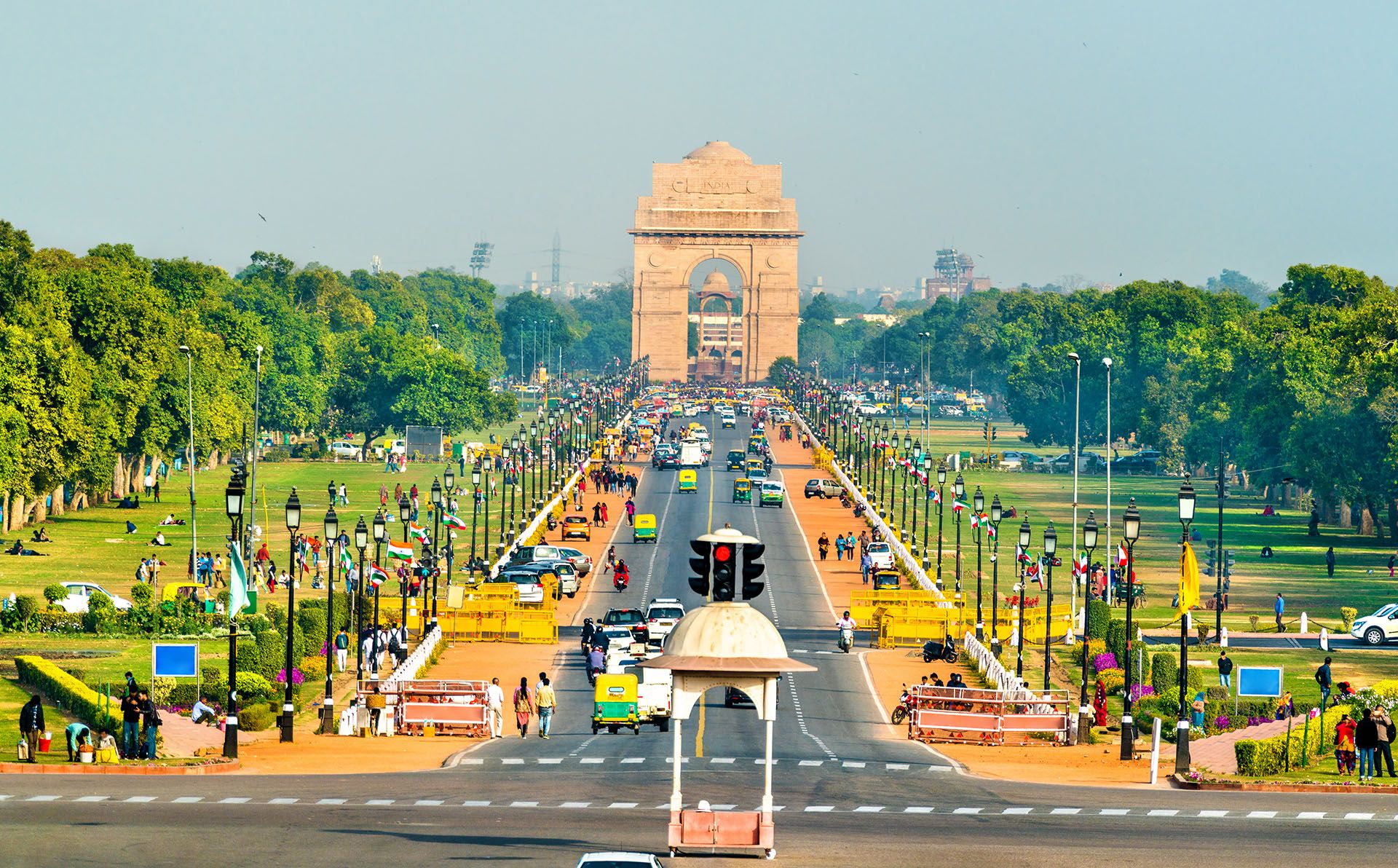
To the south, encompassing the modern city centre, is New Delhi, built by the British to be the capital of their empire’s key possession. A spacious city of tree-lined boulevards, New Delhi is impressive in its own way. The Rajpath, stretching from India Gate to the Presidential Palace, is at least as mighty a statement of imperial power as the Red Fort, and it’s among the broad avenues of New Delhi that you’ll find most of the city’s museums, not to mention its prime shopping area, centred around the colonnaded facades of Connaught Place, the heart of downtown Delhi.
As the city expands, however – which it is doing at quite a pace – the centre of New Delhi is becoming too small to house the shops, clubs, bars and restaurants needed to cater to the affluent and growing middle class. Many businesses are moving into South Delhi, the vast area beyond the colonial city. Here, among the modern developments, and new business and shopping areas, is where you’ll find some of Delhi’s most ancient and fascinating attractions. Facing each other at either end of Lodi Road, for example, lie the constructions marking two ends of the great tradition of Mughal garden tombs: Humayun’s Tomb, its genesis, and Safdarjang’s Tomb, its last gasp. Here too, you’ll find the remains of six cities which preceded Old Delhi, most notably the Qutb Minar and the rambling ruins of Tughluqabad.
As a place to hit India for the first time, Delhi isn’t a bad choice. The city is used to foreigners: hotels in all price ranges cater specifically for foreign tourists, and you’ll meet plenty of experienced fellow travellers who can give you tips and pointers. And there’s certainly no shortage of things to see and do while you acclimatize yourself to the Subcontinent. Quite apart from its historical treasures, Delhi has a host of museums and art treasures, cultural performances and crafts that provide a showcase of the country’s diverse heritage. The city’s growing nightlife scene boasts designer bars, chic cafés and decent clubs. Its auditoriums host a wide range of national music and dance events, drawing on the richness of India’s great classical traditions. Smart new cinemas screen the latest offerings from both Hollywood and Bollywood, while its theatres hold performances in Hindi and in English. And if it’s from Delhi that you’re flying home, you’ll find that you can buy goods here from pretty much anywhere else in India, so it’s a good place to stock up with souvenirs and presents.
Delhi is both daunting and alluring, a sprawling metropolis with a stunning backdrop of ancient architecture. Once you’ve found your feet and got over the initial impact of the commotion, noise, pollution and sheer scale of the place, the city’s geography slowly slips into focus. Monuments in assorted states of repair are dotted around the city, especially in Old Delhi and in southern enclaves such as Hauz Khas. The British-built modern city centres on Connaught Place, the heart of New Delhi (though actually on its northern edge), from which it’s easy – by taxi, bus, auto-rickshaw or metro – to visit pretty much anywhere else in town.
Read More-
Delhi history
Delhi history
Delhi is said to consist of seven successive cities, with British-built New Delhi making an eighth. In truth, Delhi has centred historically on three main areas: Lal Kot and extensions to its northeast, where the city was located for most of the Middle Ages; Old Delhi, the city of the Mughals, founded by Shah Jahan in the seventeenth century; and New Delhi, built by the British just in time to be the capital of independent India.
Timeline
c.1450 BC
Pandavas (heroes of the Mahabharata) have their capital at Indraprastha, near Purana Qila
1060 AD
Tomars (Rajput clan) found Lal Kot, considered the first city of Delhi
1180
Chauhans (rival Rajput clan) oust Tomars and rename the city Qila Lal Pithora
1191
Qila Lal Pithora falls to the Afghan Muslim armies of Muhammad of Ghor
1206
Muhammad of Ghor’s general, Qutb-ud-din Aibak, sets up as an independent ruler, founding the Delhi Sultanate
1211–36
Sultan Iltutmish makes Delhi the capital of lands stretching from Punjab to Bengal
1290
Khaljis, from Central Asia, overthrow Qutb-ud-din’s “Slave Dynasty” and take over as Delhi sultans
1303
Sultan Ala-ud-Din Khalji commissions Siri, the second city of Delhi
1321
Ghiyas-ud-Din Tughluq ousts Khaljis, founds the Tughluq dynasty, and also Tughluqabad, the third city of Delhi
1326
Sultan Muhammad Tughluq founds Delhi’s fourth city, Jahanpanah, as an extension of Lal Kot, joining it to Siri
1354
As the sultanate gradually disintegrates, Sultan Firoz Shah founds the fifth city of Delhi at Firozabad
1398
Timur the Lame (Tamerlaine) invades and sacks Delhi, founding Sayyid dynasty
1444
Sayyids ousted by Buhul Lodi, whose family take over as Delhi sultans
1526
First Battle of Panipat: Mughal emperor Babur defeats Sultan Ibrahim Lodi, ending the Delhi Sultanate
1541
Sher Shah Suri ousts Babur’s son Humayun and founds the sixth city of Delhi at Purana Qila
1544
Humayun retakes Delhi but dies the following year
1565
Humayun’s son Akbar shifts the Mughal capital from Delhi to Agra
1638
Akbar’s grandson Shah Jahan shifts the capital back to Delhi, creating its seventh city at Shahjahanabad (Old Delhi)
1739
Persian emperor Nadir Shah sacks Delhi, slaughtering 15,000 of its inhabitants as Mughal power crumbles
1784
The Marathas subdue Delhi, making the emperor their vassal
1803
In the Battle of Delhi, Britain’s East India Company defeat the Marathas and take over as effective rulers
1857
In the great uprising (First War of Independence), Delhi supports the insurgents, but the British retake the city with bloody reprisals, deposing the Mughals and expelling Muslim Delhiites for two years
1911
The British decide on a new Indian capital at Delhi as opposition to colonial rule mounts in Calcutta
1931
New Delhi officially inaugurated as capital of the Raj
1947
British hand over power in Delhi to India’s first elected government, but Hindu mobs drive many Muslims from the city, while Hindu and Sikh refugees flood in from Punjab and Bengal
1957
Delhi Development Authority (DDA) founded to plan the city’s development
1975–77
Indira Gandhi’s Emergency: forced evictions of Muslim slum-dwellers in Old Delhi
1984
Indira Gandhi’s assassination, followed by sectarian riots targetting Delhi’s Sikh population
1992
Delhi gains status of Capital Territory (CT), with its own government, but not full statehood; BJP take power in CT elections
1998
Congress Party wrests the CT from the BJP, holding power ever since
-
Delhi scams
Delhi scams
Delhi can be a headache for the first-time visitor because of scams to entrap the unwary – one dodge is to dump dung onto visitors’ shoes, then charge to clean it off. The most common wheeze, though, is for taxi drivers or touts to convince you that the hotel you’ve chosen is full, closed or has just burned to the ground so as to take you to one that pays them commission. More sophisticated scammers will pretend to phone your hotel to check for yourself, or will take you to a travel agent (often claiming to be a “tourist office”) who will do it, dialling for you (a different number); the “receptionist” on the line will corroborate the story, or deny all knowledge of your reservation. The driver or tout will then take you to a “very good hotel” – usually in Karol Bagh – where you’ll be charged well over the odds for a night’s accommodation. To reduce the risk of being caught out, write down your taxi’s registration number (make sure the driver sees you doing it), and insist on going to your hotel with no stops en route. Heading for Paharganj, your driver may try to take you to a hotel of his choice rather than yours. To avoid this, you could ask to be dropped at New Delhi railway station and walk from there. You may even encounter fake “doormen” outside hotels who’ll tell you the place is full; check at reception first, and even if the claim is true, never follow the tout to anywhere he recommends. These problems can be avoided by reserving in advance; many hotels will arrange for a car and driver to meet you at your point of arrival.
New Delhi railway station is the worst place for touts; assume that anyone who approaches you here – even in uniform – with offers of help, or to direct you to the foreigners’ booking hall, is up to no good. Most are trying to lure travellers to the fake “official” tourist offices opposite the Paharganj entrance, where you’ll end up paying way over the odds, often for unconfirmed tickets. And don’t believe stories that the foreigners’ booking hall has closed. On Connaught Place and along Janpath, steer clear of phoney “tourist information offices” (which touts may try to divert you to), and never do business with any travel agency which tries to disguise itself as a tourist information office. For the record, India Tourism is at 88 Janpath and the DTTDC is at N-36, Middle Circle (in a street swarming with touts and look-alike agencies).
Finally, be aware that taxi, auto and rental-car drivers get a hefty commission for taking you to certain shops, and that commission will be added to your bill should you buy anything. You can assume that auto-wallahs who accost you on the street do so with the intention of overcharging you, or of taking you to shops which pay them commission rather than straight to where you want to go. Always hail a taxi or auto-rickshaw yourself, rather than taking one whose driver approaches you, and don’t let them take you to places where you haven’t asked to go.
-
Accommodation
Accommodation
Delhi has a vast range of accommodation, from dirt-cheap lodges to extravagant international hotels. Bookings for upmarket hotels can be made at airport and railway station tourist desks; budget travellers will have to hunt around independently. Don’t believe touts, taxi drivers or auto-wallahs telling you there are no rooms at your hotel, and avoid the places they recommend in Karol Bagh.
-
Eating
Eating
Most restaurants close around 11pm, but those with bars usually stay open until midnight. If you’re looking for a late-night meal, you have a number of choices: eat in one of the restaurants in a top hotel, or the 24-hour coffee shops in Le Meridien, the Park or The Claridges; try a snack in Paharganj’s round-the-clock rooftop cafés; or head to Pandara Road market (open till 1.30am). Old Delhi railway station also has a couple of 24-hour places, and the refreshment hall just down the corridor from the foreigners’ booking office in New Delhi station is also open round the clock.
-
Nightlife and entertainment
With an ever-increasing number of pubs and clubs, Delhi’s nightlife scene is in full swing. During the week, lounge and dance bars are your best bet, but come the weekend the clubs really take off. Most, if not all, of the ones popular with Delhi’s young jet-set are in the luxury hotels, and many don’t allow “stag entry” (men unaccompanied by women), which makes them a whole lot more comfortable for women, but is tough luck if you’re male and alone; the big exception is Elevate – the spot in Delhi for serious clubbers. Cover charges are Rs500–2000 per couple depending on the club and the night. India Gate and Rajpath attract nightly people’s parties where large crowds mill about, snacking and eating ice cream; these are not advisable for women on their own, as you’re likely to get hassled.
For drinking, the five-star hotels all have plush and expensive bars, and many of the better ones have dance floors. Lounge bars with laid-back music have become very popular of late, and there are some good ones scattered about the southern suburbs. The drinking age in Delhi is 25.
-
Sports and outdoor activities
The recreational activity most likely to appeal to visitors in the pre-monsoon months has to be a dip in one of Delhi’s swimming pools. Unfortunately most public pools require you to take out membership; aside from Siri Sports Complex, try the Talkatora Pool. Luxury hotels usually restrict their pools to residents, but may allow outsiders to join their health clubs.
-
Shopping
Shopping
Although the traditional places to shop in Delhi are around Connaught Place (particularly the underground Palika Bazaar) and Chandni Chowk, a number of suburbs created by the rapid growth of the city are emerging as fashionable shopping districts. To check prices and quality for crafts, you can’t do better than the state emporiums on Baba Kharak Singh Marg.
Unlike the markets of Old Delhi, most shops in New Delhi take credit cards; beware of touts trying to sweet-talk you into visiting supposed “government shops” which pay them a commission. In all bazaars and street markets, the rule is to haggle.