The Escarpment
Four hours’ drive east of Johannesburg International Airport is one of the city’s favoured mountain retreats: the waving grasslands and luxury guesthouses of the Mpumalanga Drakensberg, generally known as the Escarpment. While most travellers visit the region purely because of its proximity to the Kruger National Park, it provides some of the most dramatic views in the country, making it a scenic highlight of a South Africa safari and city trip. These highlands, known as the Panorama Route, can also be explored as an organized day-trip by numerous tour operators in Nelspruit. The main draw of the Escarpment is the Blyde River Canyon, whose dizzying views into one of the world’s great gorges appear in countless South African tourist brochures. In addition to a number of viewpoints along the Escarpment lip, the canyon has hiking trails which give access to the flora and, if you’re quiet and lucky, fauna of the reserve, including zebra, hippo, kudu and numerous primates – baboons, vervet and samango monkeys and bushbabies.
The lowveld
South Africa’s lowveld, wedged between the Mpumalanga section of the Drakensberg and Mozambique, is part of a vast subtropical region of savanna that stretches north through Zimbabwe and Zambia as far as Central Africa. Closely associated at the turn of the last century with fortune-seekers, hunters, gold-diggers and adventurers, these days the South African lowveld’s claim to fame is its proximity to the Kruger National Park and the adjacent private game reserves. Although several of the towns on the game park fringes are pleasant enough, most people come here to get into big-game country.
Largest of the lowveld towns, and the capital of Mpumalanga, is Nelspruit, accessible by air and bus (including buses from Maputo in Mozambique). East of Nelspruit, the N4 runs close to the southern border of the Kruger, providing easy access to its Malelane and Crocodile Bridge gates; the latter is just 12km north of Komatipoort, a humid frontier town on the border with Mozambique. From Nelspruit, you can also head 32km south to Barberton, an attractive settlement in the hills with strong mining connections, or continue another 41km to Swaziland.
The R40 north of the provincial capital passes through White River, Hazyview, Klaserie, Hoedspruit and Phalaborwa, a series of small towns that act as bases for exploring Kruger. Each town is well supplied with accommodation, and has a Kruger entrance gate nearby; tours are available from some. The closest to Nelspruit and an entry point into the Park, Hazyview is now leader of the pack. Hoedspruit and Phalaborwa actually fall within Limpopo Province, but for the sake of continuity have been included in this chapter.
Barberton
Barberton, 36km south of Nelspruit, began its urban existence after gold was discovered in 1883, and its frontier history makes it an atmospheric stop on a South Africa trip. An influx of shopkeepers, hoteliers, barmen, prostitutes, even ministers of religion, soon joined the diggers in the growing frontier town, which consisted of tents, tin, thatch and mud, with nearly every second building functioning as a boozing joint. During the fabulous boom of the 1880s the mines slipped out of the grasp of the small-time prospectors and came under the control of the large corporations that still own them today. There are seven working mines around Barberton, each with its own entertainment venue for miners only, which means you won’t find miners packing out public bars as in the wild days of old.
This is the best place in the country to take an underground gold-mining tour, in a working mine, or learn to do gold panning. This attraction aside, Barberton also has a colonial backwater charm, reasonably priced accommodation, a handful of historical sights, tropical vegetation and an attractive setting in a basin surrounded by mountains.
Kruger’s western flank
The R40 heads north from Nelspruit along the western border of the Kruger National Park, passing through prosperous tropical-fruit-growing farmlands and crowded, poverty-stricken African areas. The only reason you’re likely to find yourself heading north along this road from Hazyview is to access the private game reserves – Sabi Sands, Manyeleti or Timbavati – that join up with the western flank of Kruger, or to reach the Orpen Gate, for the rewarding central section of Kruger National Park. Though marked prominently on maps, Klaserie, which lies on the border of Mpumalanga and Limpopo Province, is little more than an easily missed petrol station and shop, surrounded by a number of private game farms – poor cousins to the pricier lodges inside the game reserves to the east.
North of the Mpumalanga border, in Limpopo, you’ll pass little towns en route to the central section of Kruger National Park and the Manyeleti and Timbavati private game reserves. Coming down the Escarpment along the R36/R527 from the Blyde River viewpoints, you’ll encounter a fork in the road after about 75km. The more northerly road leads to the towns of Hoedspruit, which is not a desirable destination or place to base yourself, particularly in the area at the foot of the Escarpment, and Klaserie. Much further north and generally reached from Polokwane on the N1, the mining town of Phalaborwa is conveniently 2km from the Phalaborwa Gate into central Kruger and the rewarding camps of Letaba and Olifants.
Elephant Sanctuary
At the Elephant Sanctuary, 5km from Hazyview on the R536 road to Sabie, close encounters with rescued elephants can add a hands-on element to a safari tour in South Africa. You can touch and feed the two orphaned elephants rescued from a culling programme, and a variety of programmes offer close encounters with the elephants – the “Brush Down” Programme, where you groom the animals and feel the texture of their skin and ears, combined with “Trunk in Hand”, where you walk alongside them, lightly holding their trunks, is recommended. Rides are also available.
Blyde River Canyon
There are few places in South Africa where dramatic scenery is as easily accessible as Blyde River Canyon, a colossal gorge weathered out of red rock and dropping sharply from the escarpment into the lowveld. The Blyde River Canyon Nature Reserve, also known as Blyderivierspoort Nature Reserve, stretches from a narrow southern tail near Graskop before broadening about 60km to the north into a great amphitheatre partly flooded by the Blydepoort Dam. For 16-day South Africa trips that combine Kruger, the Panorama Route, and wider northern highlights, Blyde River Canyon adds a spectacular scenic counterpoint to safari days, with vast viewpoints, layered rock formations, and lush escarpment landscapes.
The drive along the canyon lip
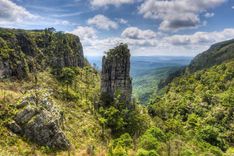
The views of the canyon are wonderful from both above and below, but the nicest way to take in the vistas is on an easy half-day’s drive along the canyon lip. Some 3km north of Graskop, the R534 does a 15km loop past a series of superb viewpoints. The road winds through pine plantations until it comes to the turn-off to the Pinnacle, a gigantic quartzite column topped with trees, rising out of a ferny gorge. After another 4km the road reaches the sheer drop and lowveld views of God’s Window, one of the most famous of the viewpoints; it’s also one of the most developed, with toilets and curio stalls. The looping road returns to rejoin the R532, which continues north for 28km beyond the turn-off to reach Bourke’s Luck Potholes at the confluence of the Treur and Blyde rivers – a collection of strange, smoothly scooped formations carved into the rocks by water-driven pebbles. The best view of all lies 14km beyond, at the Three Rondavels. The name describes only one small feature of this cinemascope vista: three cylinders in the shape of huts with the meandering Blyde River twisting its way hundreds of metres below. No photograph does justice to the sheer enormity of the view, punctuated by one series of cliffs after another buttressing into the valley.
Three Rondavels to Blydepoort Dam
The 90km drive from the Three Rondavels viewpoint to the base of the canyon provides spectacular views of the Escarpment cliffs rising out of the lowveld and is easily incorporated into your itinerary if you’re heading to or from Kruger. The drive winds west to join with the R36 and heads north to begin its descent through the Abel Erasmus Pass and then the J.G. Strijdom Tunnel through the mountain, with the wide lowveld plains opening out on the other side. The road takes a wide arching trajectory to circumnavigate the canyon.
Kruger National Park
KRUGER NATIONAL PARK is arguably the emblem of South African tourism, the place that delivers best what most visitors to Africa want to see – scores of elephants, lions and a cast of thousands of other game roaming the savanna. A narrow strip of land hugging the Mozambique border, Kruger stretches across Limpopo Province and Mpumalanga, an astonishing 414km drive from Pafuri Gate in the north to Malelane Gate in the south, all of it along tar, with many well-kept gravel roads looping off to provide routes for game drives.
Kruger is designed for self-driving and self-catering. Self-driving offers complete flexibility, though the temptation is to drive too much and too fast, leading to fewer sightings. Furthermore, rental cars tend to be low off the ground and aren’t as good for game viewing as those used by lodges or tour operators. However, you can hop in a car knowing you’ll find supplies at most of the restcamps – indeed self-driving is often the only way of seeing Kruger’s animals if you’re travelling with young children and want to manage time and food your own way. The park’s popularity means that not only are you likely to share animal sightings with other motorists, but that accommodation is at a premium, particularly during South African school holidays, when you may not be able to find anything. Book as far in advance as possible.
Outside the public section, big-game country continues in several exclusive and expensive private wildlife reserves, clustering on huge tracts of land to the west, often referred to as Greater Kruger. As far as animals are concerned, the private and public areas are joined in an enormous, seamless whole. The three major private reserves are Sabi Sands to the south, and Timbavati and Manyeleti, adjoining the central section of the national park. The private reserves are not places you drive around yourself, and they offer a greater sense of being in the wilderness as there are no tarred roads or buildings away from the lodges, and you will not be sharing your sightings with a bunch of other cars. The safari lodges are luxuriously romantic and beautifully set, and dedicated to finding you wildlife.
But whatever you choose, be sure to relax and don’t get too obsessed with seeing the Big Five. Remember that wildlife doesn’t imitate TV documentaries: you’re most unlikely to see lion-kills (you may not see a lion at all), or huge herds of wildebeest migrating across dusty savanna. The element of luck involved is exactly what makes game spotting so addictive.