Best things to do at the Pyramids of Giza
You will need at least half a day to visit the Pyramids of Giza as there are lots of things to do. If you have plenty of time to spare, it is worth spending a whole day in Memphis and Saqqara. You could follow local tradition and take a picnic to enjoy in the ruins of the monastery of St Jeremiah.
Here are the best things to do in Giza.
#1 Visit the Pyramids of Giza themselves
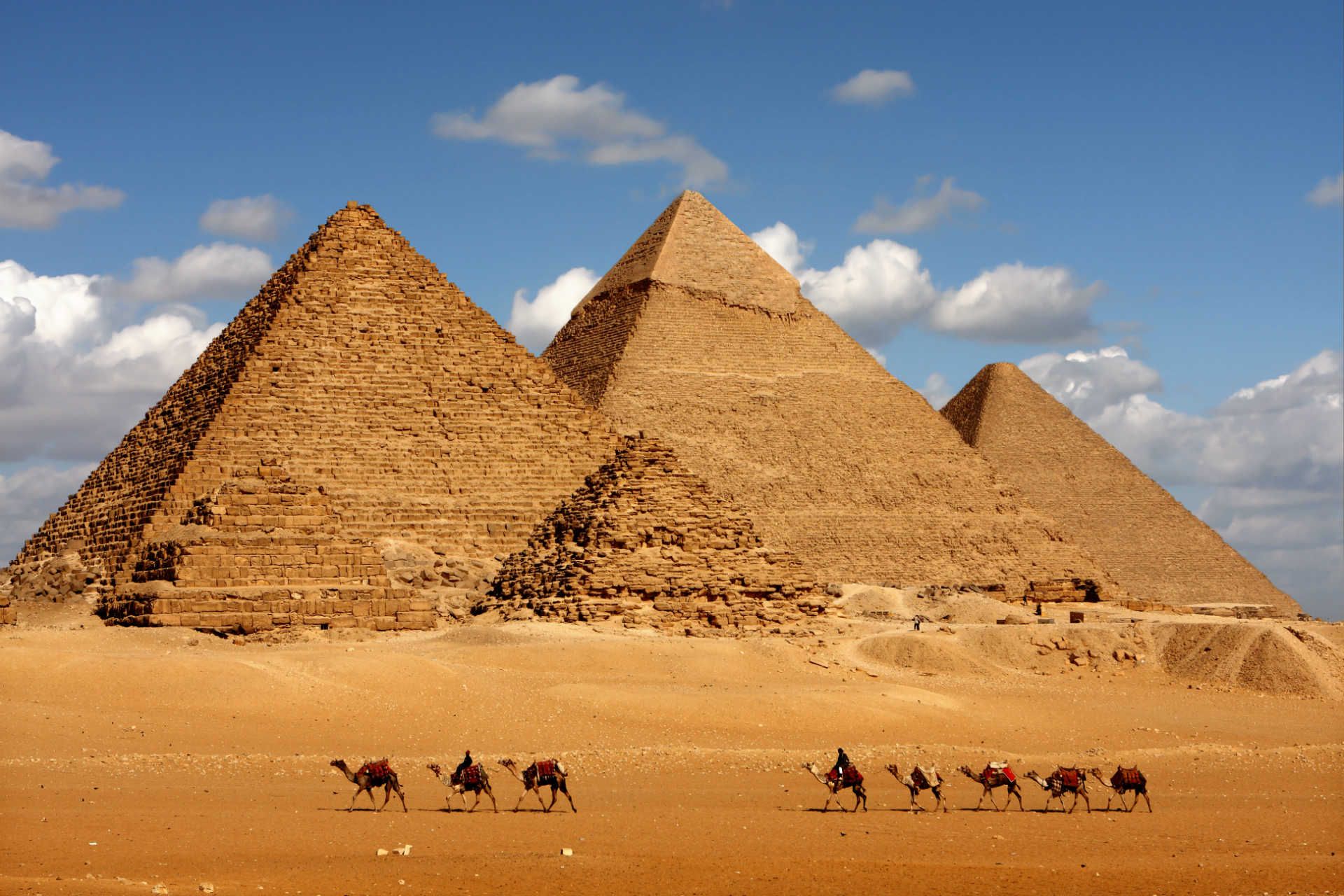
The only survivors among the Seven Wonders of the Ancient World, the Pyramids of Giza (called al-Ahram in Arabic) are not hard to find.
Standing at the end of a boulevard (Shari’ al-Ahram) on the desert plateau above the western edge of Giza, across the river from Cairo, they can frequently be glimpsed from the city centre.
The most striking aspect of the Pyramids of Giza is their size. But even with all the facts and figures, it is still hard to believe that these ancient structures remain in such a good state of preservation.
The vision and workmanship of people 4,500 years ago in creating structures that would be the world’s tallest until the 14th century is staggering.
There are several pyramids to see including The Great Pyramid of Khufu, The Pyramid of Khafre, which includes the Sphinx, and The Pyramid of Menkaure, which is the smallest.
#2 See Egypt 's the first capital Memphis
The most important of Cairo’s predecessors was the city of Memphis, founded by Narmer, also known as Menes, who is traditionally regarded as the first king of the 1st Dynasty and said to have been the first to unite Upper and Lower Egypt. Its proximity to Cairo makes Memphis an easy addition to 7-day Egypt trips that focus on the capital and nearby ancient sites.
The city was built on land reclaimed from the Nile in about 3100 BC and lies 24km, or 15 miles, south of Cairo on the western side of the river.
The ruins of Memphis surround Mit Rahinah village, which derives its name from a temple of Mithras built here under the Romans, long after the days of the city’s greatest glory, when the cult of Ptah was worshipped at a temple adorned with huge statues. Even after power was transferred to Thebes, Memphis remained an important city.
There is little to see at Memphis except for the Alabaster Sphinx and one of Ramesses’ two colossi.
#3 See the vast cemetery of Saqqara
The site of Saqqara lies on the desert plateau about 3km (1.75 miles) west of Memphis. This vast cemetery, which spans a period from the 27th century BC to the 10th century AD, is possibly named after Sokar, god of the burial sites.
A welcome addition to the site is the modern Imhotep Museum (admission is included in that of the Saqqara site), opened in 2006 in an attempt to redistribute many of the treasures in the Egyptian Museum to more relevant locations.
Of the many highlights are objects found inside Saqqara’s pyramids and tombs, including a delightful wooden model of a rowing boat with human figures from the tomb of Khennu, a royal scribe of the Middle Kingdom.
The mummy of King Merenre I, who ruled for five years from 2297 BC, is the oldest complete mummy yet found.
#4 Gawp at The Black Pyramid of Dahshur
The peace and quiet beauty of the palm groves around Dahshur have attracted many of Cairo’s professional class, who have built rural retreats here. The most pleasant time of year to visit the site is mid-winter, when a lake forms within an artificial embankment below the Black Pyramid.
The Black Pyramid was built of brick but unused by Amenemhet III (1842–1797 BC), one of Egypt’s most colourful kings. The dark colour that gives it its name arises from the fact that it has been systematically stripped of its original white limestone covering. The view of the pyramid across the lake is one of the most charming in Egypt.