Cementerio Municipal
The city’s magnificent Cementerio Municipal covers four city blocks. Crisscrossed by a network of footpaths lined with immaculately clipped cypresses, this eclectic necropolis reflects the turbulent history of Patagonia. The monumental tombs of the city’s ruling families – some made of the same Italian marble as Michelangelo’s David and elaborately engraved with the English and Spanish names – mingle with the Croatian and Scandinavian names of immigrant labourers, etched on more modest gravestones.
A monument depicting a Selk’nam Indian is surrounded with plaques conveying the gratitude of those whose wishes it granted. See if you can spot the onion-domed crypt of the Braun family – one of the city’s founding dynasties – and the simple gravestone of Charles Milward.
Parque Nacional Pali Aike
From the small town of Punta Delgada, a good gravel road heads 28km north to Chilean Patagonia’s seldom-visited Parque Nacional Pali Aike, a stark and unusual stop on a Chile hiking trip.
The park’s entrance looms up out of the barren rolling plains, green roof first. The sight explains its Tehuelche Indian name, meaning “desolate place of bad spirits”.
There’s a strange magic to the otherworldly volcanic formations that dot the heath and the small lagoons ringed by white tidemarks. This seemingly barren place is home to a surprising amount of smaller wildlife, from well-camouflaged lizards and owls, which may be mistaken for rocks, to guanacos feeding on the hardy coirón.
From the guardería, the main gravel road runs north to the remote, picturesque Laguna Ana, where you can occasionally spot flamingos, and the start of the park’s longest hike: a 9km (2hr 45min) walk across flat, windy, exposed terrain to Cueva Pali Aike, a 17m-deep cave in a tall ridge of congealed lava. It was excavated by the famous archaeologist Junius Bird in 1937, and was found to contain evidence of prehistoric inhabitation, including bones of a milodón and the Onohippidium, an extinct American horse, dating from nine thousand years ago.
An 8km gravel road branches off from the main one, heading east to the cave via the starting point for the park’s other two hikes: a 1700m (30min) wander through the largely flat old lava beds to the volcano rim of the Crater Morada del Diablo (“Dwelling of the devil”), followed by a 2000m (45min) ascent through the fields of jagged volcanic rock to the Pozos del Diablo (“The devil’s wells”) – dozens and dozens of somewhat sinister craters; sturdy footwear is a must.
Monumento Natural Isla Magdalena
One of the largest penguin colonies in southern Chile, Monumento Natural Isla Magdalena is home to more than 120,000 Magellanic penguins. The small island, just one square kilometre in size and topped by a pretty red lighthouse, lies 35km northeast of Arenas, two hours away by boat. The penguins dig their burrows under the tufts of grass covering the 15m-high cliffs.
In October each year, the birds migrate back here and find their mate – they’re monogamous and remain faithful to one partner all their lives. The female lays two eggs in the nest and when the chicks hatch, in November, both parents nurture the young, one adult remaining with the chick, the other going fishing. In late January, the chicks shed their baby feathers and get ready for their first trips into the ocean. By the end of March the penguins have returned to sea again.
You can get very close to the birds as they half hide in the waving grass, and lounge by the sea. If they start to cock their heads from side to side, it’s a sign that you’re disturbing them. The five-hour round-trip, which includes one hour on the island, is worth it for the scenic ride alone, as you may well spot black-and-white Commerson’s dolphins and other marine mammals.
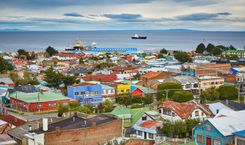
Top image: Scenic view of Punta Arenas with Magellan Strait in Patagonia, Chile © Ekaterina Pokrovsky/Shutterstock