Coquimbo
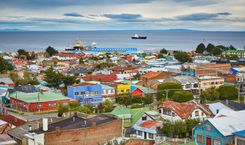
West of Ovalle, the Panamericana turns towards the ocean and skirts a string of small resorts that provide a calmer and more attractive beach setting than the built-up coast at La Serena. Spread over a rocky peninsula studded with colourful houses, the busy port of Coquimbo was established during colonial times to serve neighbouring La Serena and became Chile’s main copper exporter during the nineteenth century. Despite its impressive setting, the town has a slightly rough-edged, down-at-heel air, but is useful as an inexpensive base from which to enjoy La Serena’s beaches, or for taking public transport to the nearby resorts of Guanaqueros – a fishing village 37km south with a sweeping beach – and Tongoy, 13km further south. A couple of blocks north of Coquimbo’s main street, Avenida Costanera runs along the shore, past the large port, the terminal pesquero, and along to the lively fish market. This area makes for a pleasant stroll along the ocean, provided you don’t mind the strong whiff of fish.
Elqui Valley
Quiet, rural and extremely beautiful, the Elqui Valley unfolds east from La Serena and into the Andes. Irrigated by canals fed by the Puclara and La Laguna dams, the valley floor is given over entirely to cultivation – of papayas, custard apples (chirimoyas), oranges, avocados and, most famously, the vast expanses of grape vines grown to produce pisco. It’s the fluorescent green of these vines that makes the valley so stunning, forming a spectacular contrast with the charred, brown hills that rise on either side.
Some 60km east of La Serena, appealing little Vicuña is the main town and transport hub of the Elqui Valley. Moving east from here, the valley gets higher and narrower and is dotted with tiny villages like Montegrande and the odd pisco distillery. Pisco Elqui, 105km east of La Serena, is a very pretty village that makes a great place to unwind for a couple of days. If you really want to get away from it all, head for one of the rustic cabañas dotted along the banks of the Río Cochiguaz, which forks east of the main valley at Montegrande, or delve beyond Pisco Elqui into the farthest reaches of the Elqui Valley itself. Buses and a paved road will get you all the way to Horcón but not to the farthest village of all, Alcohuaz.
Vicuña
An hour by bus inland from La Serena, Vicuña is a neat and tidy agricultural town ringed by mountains and laid out around a large, luxuriantly landscaped square. It’s a pleasant, easy-going place with a few low-key attractions, a good choice of places to stay and eat, a couple of pisco distilleries just out of town and two visitor-friendly observatories on its doorstep. If you’re looking to stretch your legs, there are panoramic views of the town and entire Elqui Valley from the top of Cerro de la Virgen, north-east of the centre.
Life revolves firmly around the central Plaza de Armas, which has at its centre a huge stone replica of the death mask of Nobel Prize-winning poet Gabriela Mistral, the Elqui Valley’s most famous daughter. On the square’s northwest corner stands the Iglesia de la Inmaculada Concepción, topped by an impressive wooden tower built in 1909 – take a look inside at its vaulted polychrome ceiling, painted with delicate religious images and supported by immense wooden columns. Right next door, the eccentric Torre Bauer is a bright-red, mock-medieval tower prefabricated in Germany in 1905 and brought to Vicuña on the instructions of the town’s German-born mayor, Adolfo Bauer; the adobe building supporting it houses the Municipalidad.
Gabriela Mistral
Possibly even more than its pisco, the Elqui Valley’s greatest source of pride is Gabriela Mistral, born in Vicuña in 1889 and, in 1945, the first Latin American to be awarded the Nobel Prize for Literature. A schoolmistress, a confirmed spinster and a deeply religious woman, Mistral’s poetry reveals an aching sensitivity and passion, and her much romanticized life was punctuated with tragedy and grief.
Pisco
Pisco has been enjoyed by Chileans for more than four centuries, but it wasn’t until the 1930s that it was organized into an effective commercial industry, starting with the official creation of a pisco denominación de origen. Shortly afterwards, a large number of growers, who’d always been at the mercy of the private distilleries for the price they got for their grapes, joined together to form cooperatives to produce their own pisco. The largest were the tongue-twisting Sociedad Cooperativa Control Pisquero de Elqui y Vitivinículo de Norte Ltda (known as “Pisco Control”) and the Cooperativa Agrícola y Pisquera del Elqui Ltda (known as “Pisco Capel”), today the two most important producers in Chile, accounting for over ninety percent of all pisco to hit the shops.
Planta Capel distillery
Just out of Vicuña, across the bridge by the filling station, you’ll find the Planta Capel, the largest pisco distillery in the Elqui Valley. It has a small museum outlining the history of pisco and also offers slick guided tours in English and Spanish every half-hour, with tastings and the chance to buy bottles and souvenirs at the end.
Cerro Mamalluca observatory
Nine kilometres northeast of Vicuña, the Cerro Mamalluca observatory, built specifically for public use, is run by the Municipalidad de Vicuña and features a 30cm Smith-Cassegrain telescope donated by the Cerro Tololo team. The two-hour evening tours start with a high-tech audiovisual talk on the history of the universe, and end with the chance to look through the telescope. If you’re lucky, you might see a dazzling display of stars, planets, galaxies, nebulas and clusters, including Jupiter, Saturn’s rings, the Orion nebula, the Andromeda galaxy and Sirius. These tours are aimed at complete beginners, but serious astronomers can arrange in-depth, small-group sessions with at least a few weeks’ notice.
Vallenar
North of La Serena, the Panamericana turns inland and heads via a couple of winding passes (Cuesta Buenos Aires and Cuesta Pajonales) towards the busy but somewhat run-down little town of Vallenar, 190km up the road. The town, which acts as a service centre for local mining and agricultural industries, was founded in 1789 by Governor Ambrosio O’Higgins, who named the city after his native Ballinagh in Ireland. It makes a convenient base for an excursion east into the fertile upper Huasco Valley, laced with green vines and small pisco plants, or northwest towards the coast and, in the spring, the wild flowers of the Parque Nacional Llanos de Challe.
The self-appointed “capital del desierto florido” (and vigorously promoted as such by the tourist authorities), Vallenar is indeed the best base for forays into the flowering desert, if you’re here at the right time. The Museo del Huasco at Ramírez 1001 has some moderately diverting displays on indigenous cultures and photos of the nearby flowering desert.
The Flowering Desert
For most of the year, as you travel up the Panamericana between Vallenar and Copiapó you’ll cross a seemingly endless, semi-desert plain, stretching for nearly 100km, sparsely covered with low shrubs and copao cacti. But take the same journey in spring, and in place of the parched, brown earth, you’ll find green grass dotted with beautiful flowers. If you’re really lucky and you know where to go after a particularly wet winter, you’ll happen upon fluorescent carpets of multicoloured flowers, stretching into the horizon.
This extraordinarily dramatic transformation is known as the desierto florido, or “flowering desert”; it occurs when unusually heavy rainfall (normally very light in this region) causes dormant bulbs and seeds, hidden beneath the earth, to sprout into sudden bloom, mostly from early September to late October.
There’s no predicting the desierto florido, which is relatively rare – the frequency and intensity varies enormously, but the general phenomenon seems to occur every four to five years, although this has been more frequent in recent years. The best guide in Vallenar, and a veritable gold-mine of information about the dozens of flower varieties, is Roberto Alegría (desiertoflorido2010@hotmail.cl).
Copiapó
Overlooked by arid, rippling mountains, the prosperous city of Copiapó sits in the flat basin of the Río Copiapó, some 60km from the coast and 145km north of Vallenar. To the east is the most northerly of Chile’s “transverse valleys” and beyond it the transformation from semi-desert to serious desert is complete, and the bare, barren Atacama stretches a staggering 1000km north towards the Peruvian border. Just to the north of the city, Arabian-style dunes await exploration. There isn’t a great deal to do here, however, and Copiapó’s main use to travellers is as a springboard for excursions into the surrounding region.
Brief history of Copiapó
When Diego de Almagro made his long trek south from Cuzco in 1536, following the Inca Royal Road down the spine of the Andes, it was into this valley that he descended, recuperating from the gruelling journey at the tambo, or resting place, where Copiapó now stands. The valley had been occupied and cultivated by the Diaguita people starting around 1000 AD and was then inhabited, beginning around 1470, by the Inca, who mined gold and copper here. Although Spanish encomenderos occupied the valley from the beginning of the conquest, it wasn’t until 1744 that the city of Copiapó was founded, initially as “San Francisco de la Selva”. A series of random silver strikes in the nineteenth century, most notably at Chañarcillo, threw the region into a frenzied boom.
Following a period of decline at the beginning of the twentieth century, Copiapó is once more at the centre of a rich mining industry, revolving around copper, iron and gold. The city shot to international notoriety in October 2010, when 33 workers from the nearby San José mine were rescued after 69 days trapped underground.
The rescue of Los 33
On August 5, 2010, a boulder collapsed inside the San José copper and gold mine, 32km north-east of Copiapó, trapping 33 workers some 700m below the desert. That may well have been the end of the story – the miners consigned to statistics in Chile’s notoriously dangerous mining industry – but for a fortuitous combination of determined families, a captivated media and a president in dire need of a ratings boost. In the aftermath of the accident, relatives of the trapped miners set up camp outside the pithead and refused to budge, urging the company to continue their search effort.
Limelight in the darkness
The families kept up the pressure via the national media, compelling the then new right-wing president Sebastián Piñera – perceived to be out of touch with the working class and reeling from a ratings blow following his handling of February’s earthquake and tsunami – to get involved. On day 17 of the search operation, just as hope was fading, rescue workers struck media gold – a handwritten note attached to their drillhead which read: “We are fine in the shelter – the 33.” The miners’ relatives were euphoric, the president triumphant and the international media dispatched to “Camp Hope” to cover the miracle (and soap opera) unfolding in the Chilean desert.
Food, medicine, pornography and video cameras were sent down a narrow communications shaft to the desperate men. What happened next was beamed around the world: one miner proposed a church marriage to his partner; a two-timer was exposed when his wife and mistress turned up at Camp Hope to lend support; a musical miner kept his colleagues entertained with Elvis impersonations; and another lay in the hot, dark tunnel while above ground his wife give birth to his daughter, named, appropriately, “Esperanza” (hope).
Saved
Just after midnight on October 13, 69 days after the miners were buried alive (the longest underground entrapment in history), state-of-the-art rescue capsules hauled the first of “Los 33” to freedom, to an estimated global TV audience of 1.5 billion people. In the aftermath of the rescue, the miners enjoyed a flurry of media attention and were flown around the world and paraded as heroes. Most, however, chose to remain tight-lipped about what really went on in that subterranean hell, and as well as struggling with post-traumatic stress, the majority now live quiet, unassuming lives in Copiapó.