What to see in Chiloé
Chiloé was originally populated by the native Chonos and Huilliche (southern Mapuche), who eked out a living from fishing and farming before the Spanish took possession of the island in 1567. For over three hundred years, Chiloé was isolated from mainland Chile owing to the fierce resistance of the mainland Mapuche to European colonists. As a result, the slow pace of island life saw little change. Ancud, in fact, was the last stronghold of the Spanish empire during the wars of Independence, before the final defeat by pro-independence forces in 1826. In spite of being used as a stopover during the California Gold Rush, Chiloé remained relatively isolated until the end of the twentieth century, though now it draws scores of visitors with its unique blend of architecture, cuisine and famous myths and legends.
More than 150 eighteenth- and nineteenth-century wooden churches and chapels dot the land. Chiloé is also one of the few places in the country where you can still see palafitos, precarious but picturesque timber houses on stilts, which were once the traditional dwellings of most of the fishermen of southern Chile. Much of the old culture has been preserved, assimilated into Hispanic tradition by a profound mixing of the Spanish and indigenous cultures that occurred here more than in other parts of South America, making today’s Chiloé more “pagan Catholic” than Roman Catholic.
Ancud
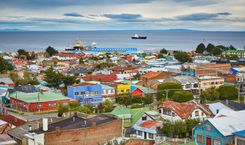
Ancud is a pretty little seaside town and a lively fishing port; numerous visitors find themselves preferring the relaxed pace of life here to the hustle and bustle of grittier Castro. Built on a small, square promontory jutting into the Canal de Chacao and the Golfo de Quetalmahue, the town centres on the pretty Plaza de Armas (undergoing complete renovation at the time of writing), which fills with craft stalls and street musicians in the summer. The colourful Mercado Municipal, one block to the north, is the place to grab a cheap meal or pick up fresh produce and some local crafts, though there’s a more attractive temporary produce and crafts market a few blocks east of the centre along Arturo Prat.
The town also makes a good base for exploration of the northern half of the island. Among the attractions are a day-trip to the penguin colony at Puñihuil, a drive to the nearby Península Lacuy (itself the start of the Chiloé section of the Sendero de Chile) or a rattle along the gravel roads that link the tiny villages along the east coast.
Brief history of Ancud
Ancud was founded in 1769 as a Spanish stronghold and, after Peruvian independence in 1824, became the crown’s last desperate foothold in South America. Its forts resisted one attempt at capture, but finally fell in January 1826 when the lonely and demoralized Spanish garrison fled into the forest in the face of a small criollo attack. The remains of these Spanish forts – Fuerte San Antonio in the town and Fuerte Agüi on a peninsula to the northwest – can still be visited today.
Maquí: The Wonder Berry
Stronger than a blueberry. More powerful than the açai berry. Able to battle ageing and neurodegenerative diseases. Look! In the evergreen tree! It’s Maquí the Wonder Berry! The maquí berry (Aristotelia chilensis), also known as the Chilean wineberry, is native to Chile’s Valdivian rainforests and has been used by the Mapuche for centuries, both as a foodstuff and as a means of preparing chicha (an alcoholic drink made from fermented berries). In recent years, scientific studies have discovered that the maquí berry has far higher antioxidizing properties than its nearest competing “superfoods” – blackberries, açai berries and blueberries. While studies are still limited, it is believed that the consumption of antioxidants helps to prevent degenerative diseases such as cancer and Alzheimer’s. Maquí berry products can be found at islanatura.com.
Around Ancud
West of Ancud lies Península Lacuy, its clifftop Fuerte Agüi famous as Spain’s last stronghold in Chile, while south of the town you find Islotes de Puñihuil, a thriving penguin colony that’s home to both Magellanic and Humboldt penguins. Further south still, Chepu Valley, formed by the powerful tsunami after the earthquake of 1960, is a top destination for birders, its wetlands home to an abundant wealth of bird life. East of Ancud, a turn-off leads to Caulín, one of the best spots in Chile for oysters.
The Chepu Valley
From the seaside village of Pumillahue, it’s a good six to eight-hour walk to the mouth of Río Chepu, one that can be rather muddy in parts, though you are rewarded with splendid views of the unspoiled coast. Alternatively, a new dirt road runs through some farmland straight to the Chepu Valley. You’ll see plenty of gently undulating pastureland and, making up the scattered settlement of Chepu, a few farmhouses spread out along the gravel roads.
The main attraction here is a large stretch of wetlands, created in 1960 when the tsunami caused by the most powerful earthquake ever recorded flooded a large section of coastal forest. Today, the sunken forest provides a thriving habitat for over a hundred different bird species, as well as ample ground for kayaking and fishing. Chepu is also the entry point for the Sector Chepu of Parque Nacional Chiloé and is part of the Sendero de Chile.
Hot rocks: the culinary secrets of curanto
Chiloé’s signature dish, curanto, has been prepared for several centuries using cooking methods very similar to those used in Polynesia. First, extremely hot rocks are placed at the bottom of an earthen pit; then, a layer of shellfish is added, followed by chunks of smoked meat, chicken, longanisa (sausage), potatoes, chapaleles and milcaos (potato dumplings). The pit is then covered with nalca (Chilean wild rhubarb) leaves; as the shellfish cooks, the shells spring open, releasing their juices onto the hot rocks, steaming the rest of the ingredients.
Traditional curanto (curanto en hoyo) is slow-cooked in the ground for a day or two, but since traditional cooking methods are only used in the countryside, you will probably end up sampling curanto en olla, also known as pulmay, oven-baked in cast-iron pots. The dish comes with hot shellfish broth, known to the locals as “liquid Viagra”, to be drunk during the meal. Other Chilote specialities include cancato, salmon steamed in tinfoil and stuffed with cheese, sausage and tomatoes, and carapacho, a filling crab stew with a crispy crust.
Quemchi
East from the Panamericana, 41km south of Ancud, a pictureque coastal road leads along the coast to Quemchi, an attractive little fishing town with narrow, irregular streets sloping down to the water’s edge. On a sunny day, the sight of snow-tipped volcanoes beyond the village makes for an impressive sight. A couple of kilometres south, there’s a tiny wooded island, Isla Aucar, only accessible by a 500m-long footbridge. Nestled on the island is a small wooden church with a duck-egg-blue roof and white walls.
Dalcahue
The bustling, historical town of Dalcahue lies 20km northeast of Castro via the turn-off at Llau-Llao. It is famous for its thriving traditional boat-building industry and the Sunday Feria Artesanal, when artisans come from nearby islands to sell woollen crafts, wood carvings and hand-woven baskets. Dalcahue also provides the only link with nearby Isla Quinchao, the second largest in the Chiloé archipelago.
Most of the action is centred around the attractive Plaza de Armas and the open-sided market building on the waterfront. On the plaza rises the imposing, UNESCO-listed Iglesia de Nuestra Señora De Los Dolores, which dates to 1893 and boasts a unique nine-arched portico.
Around Dalcahue
For those who wish to witness traditional Chilote life in settlements where time seems to stand still, there are few better places to do so than Chiloé’s east coast. If you have your own vehicle, take the gravel roads to tiny, sleepy coastal villages, where on a grey and misty day you can almost imagine the characters from Chiloé’s mythology coming to life. Those without their own wheels can cross over to the island of Quinchao, characterized by its rolling farmland, small towns with striking traditional churches and the busy market in Achao, attended by sellers from neighbouring islands.
Isla Quinchao
For some, Isla Quinchao is the cultural heart of the whole of Chiloé. Rich in traditional wooden architecture, this island is a mere ten-minute ferry ride from Dalcahue. A paved road runs across Isla Quinchao through the only two towns of any size, Curaco de Vélez and Achao, both of which offer a taste of traditional Chilote life.
Twelve kilometres from the ferry terminal, Curaco de Vélez comprises a couple of streets of weather-beaten shingled houses set around a beautiful bay and bordered by gently rolling hills. The Plaza de Armas features an unusual sight – a decapitated church steeple, docked from the top of an old church, and a bust of locally born hero Almirante Riveros, who commanded the fleet that captured the Peruvian, ironclad Huáscar during the War of the Pacific.
Achao
Fifteen kilometres southeast of Curaco lies the fishing village of Achao with its scattering of houses clad in colourful tejuelas (shingles), set against a backdrop of snowcapped volcano peaks across the gulf. It is famous both for the oldest church in the archipelago and a couple of simultaneous festivals in early February: Encuentro Folklórico de las Islas del Archipiélago, a folk festival that draws musical groups from all over Chiloé, and Muestra Gastronómica y Artesanal, which gives you a chance to both sample traditional Chilote cuisine and pick up the handiwork of the archipelago’s artisans.
Achao is a living museum of Chiloé’s cultura de madera (woodworking culture). Dominating the Plaza de Armas and dating back to 1764, Iglesia Santa Maria de Loreto is a prime example of a typical Chilote church and is thought to be the oldest one in the archipelago. The main framework is made from ciprés de las Guaitecas and mañío, a tree still common in southern Chile. The original alerce shingles which covered the exterior have mostly been replaced with ciprés boarding. Restoration work is a constant and expensive necessity – if you look around the luma wood floorboards, you can see the church’s foundations, a rare glimpse into the way these old buildings were constructed. All the joints have been laboriously fixed into place with wooden plugs and dowels made from canelo, another type of Chilean wood.
Chilote mythology
The Chiloé islands have long been rife with myths and legends, especially in the remote rural regions, where tradition and superstition hold sway, with colourful supernatural creatures cropping up in stories throughout the archipelago.
Chilote churches
It is impossible to visit Chiloé and not be struck by the sight of the archipelago’s incredible wooden churches. In the early nineteenth century these impressively large buildings would have been the heart of a Chilote village. Several of the churches have been declared national monuments, an honour crowned in 2001 when UNESCO accepted sixteen of them on its prestigious World Heritage list.
The churches generally face the sea and are built near a beach with an open area, plaza or explanada in front of them. The outside of the churches is almost always bare, and the only thing that expresses anything but functionality is the three-tiered, hexagonal bell tower that rises up directly above an open-fronted portico. The facades, doors and windows are often brightly painted, and the walls clad with tejuelas (wooden tiles or shingles). All the churches have three naves separated by columns, which in the larger buildings are highly decorated, supporting barrel-vaulted ceilings. The ceilings are often painted, too, with allegorical panels or sometimes with golden constellations of stars painted on an electric blue background.